2Slides Team
18 min read

Quick answer: The right AI art style depends mostly on what is in your photo. Daylight landscapes and travel shots work with almost every style. Single objects and animals suit calligrams, stamps and embroidery. People need one of the few styles built for them: marker portrait, couple diorama or palette knife. Across 205 test runs of the 34 styles on 2Slides Photo Effect Tools, 169 (82%) came out clean. A 2K image costs 100 credits, about $0.25.
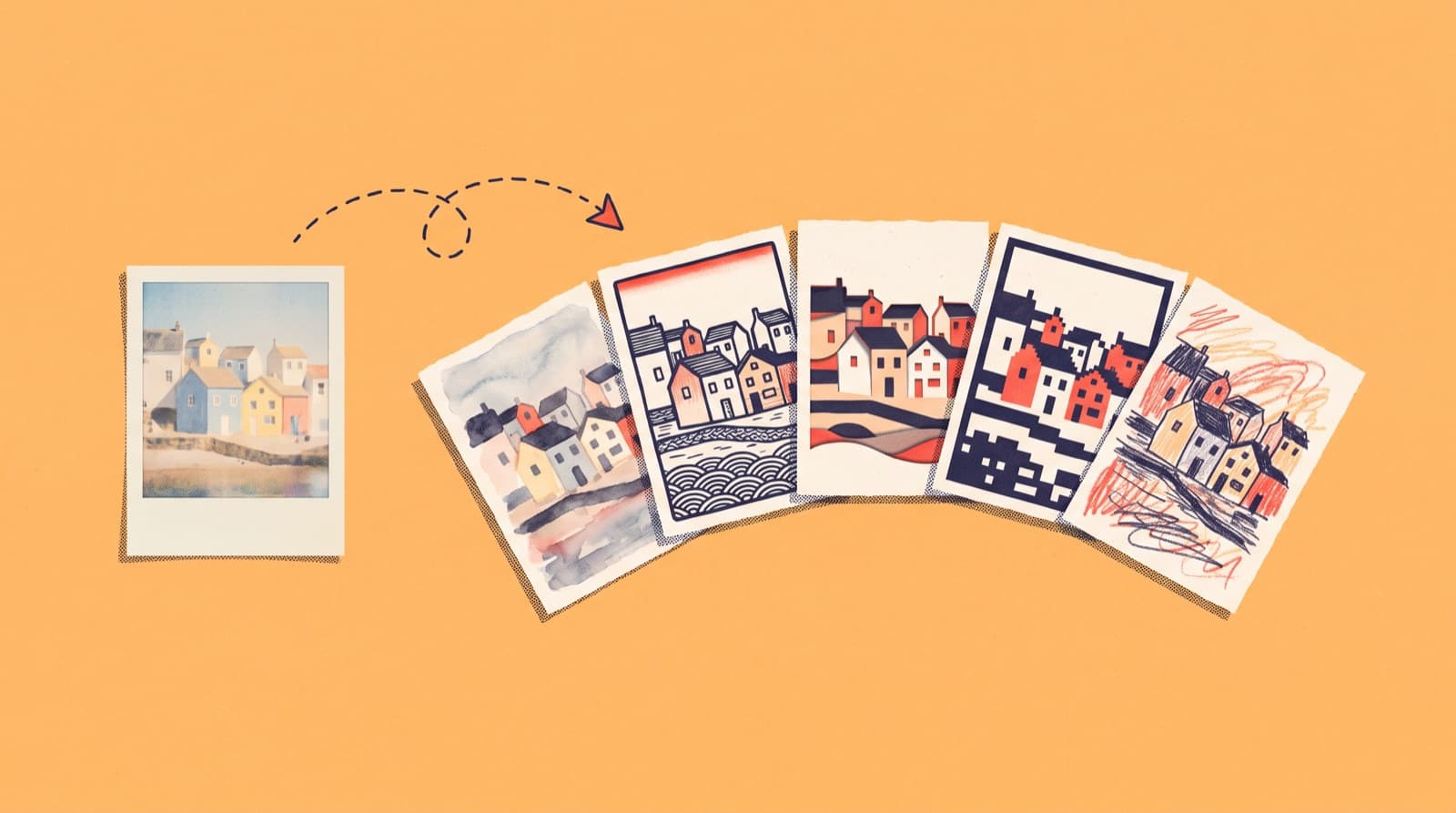
Most "turn your photo into art" tools give you one filter and a slider. We took a different approach. Each of our 34 effects is a separate, fully written image prompt for one medium: a Japanese woodblock print, a hand-torn paper collage, a children's crayon drawing, a calligram built out of words. Every effect makes the same kind of image, a poster with your original photo on one half and the same scene redrawn in that medium on the other, so the result works as a keepsake you can print, not just a filtered copy.
Before an effect goes live, we run its prompt several times on fixed test photos and score every output against written rules. This guide uses those results. It shows which style suits which photo, how often each one worked in testing, and what it costs.
Every effect went through a regression run before publishing:
The rates are small samples from one or two test photos each, so treat them as a guide to which styles are forgiving and which need a few attempts. They are not precise success probabilities. We publish them on each effect page so you know before you spend credits.
The photo matters more than the style. Here is the short version of what testing showed:
| Your photo | Styles that handle it well | Styles to avoid |
|---|---|---|
| Daylight landscape or coast | Watercolor Painting, Fabric Collage, Hand-Drawn Travel Postcard, Line Art | Calligram, Food Illustration |
| Temple, old town or city architecture | Ukiyo-e Woodblock, Chinese Ink Wash, Architectural Sketch, Torn Paper Collage | Marker Portrait |
| Busy street with people | Crayon Travel Poster, Doodle Icon Grid, Colored Pencil | Calligram, Embroidery Patch, Pixel Mosaic |
| One object, pet or animal on a plain background | Calligram Word Art, Embroidery Patch, Vintage Stamp, Needle Felt | Doodle Icon Grid |
| A couple, full length | Couple Diorama, Palette Knife Painting | Almost every travel style |
| Someone doing something (back view, posture) | Marker Portrait, Palette Knife Painting | Ukiyo-e, Line Art |
| Food on a table, shot from above | Food Illustration Card | Most of the rest |
| Portrait-orientation photo of a moment | Photo Memory Stamp | Fabric Collage (wide only) |
Close-up face portraits are the weak spot of almost every style. A painting or print that reduces a scene to shapes cannot hold a likeness. If the face is the point of the photo, keep the photo as it is.
"Clean runs" is how many test generations passed every rule. "Shape" is the poster's aspect ratio.
| Style | Medium | Best photos | Avoid | Shape | Clean runs |
|---|---|---|---|---|---|
| Watercolor Painting Poster | Painting | Landscape-shaped travel photos with a clear scene and daylight | Close-up portraits, and dusk or night shots — the prompt asks for daylight, and in testing it once relit a dusk photo into day | 3:4 | 7/8 |
| Watercolor Travel Print | Painting | Coastal and architectural scenes — whitewashed buildings, a cove, steps down to water, a harbour, a terrace with umbrellas | Portraits, interiors, food and anything without architecture or a horizon | 4:5 | 5/6 |
| Japanese Minimal Watercolor Print | Painting | Scenes that survive being reduced to a few shapes | Photos that depend on detail or on many competing subjects | 4:5 | 0/6* |
| Watercolor Journal Poster | Painting | Scenic travel photos with a clear view and readable structure | Close-up portraits, crowds, busy interiors and very dark shots | 3:4 | 5/5 |
| Oil Painting Diorama Poster | Painting | A clear scene with a strong subject and a sense of place | Close-up portraits and flat, frontal subjects | 3:4 | 5/6 |
| Palette Knife Painting Poster | Painting | Photos where a person, a pair or an animal is doing something readable | Crowds, group shots and photos where the subject is small against a busy background | 3:4 | 4/5 |
| Couple Diorama Poster | Painting | Full-length or knee-up photos of two people with a clear shared pose — leaning on a sign, sitting on a bench, waving, holding hands — in bright daylight with some colour in the clothes or setting | Tight face close-ups, groups of three or more, and dim or night photos | 3:4 | 5/6 |
| Chinese Ink Wash Poster | Painting | Architecture and landscape with a clear silhouette and layered depth | Portraits, close-ups and anything whose interest is colour or fine texture | 3:4 | 6/6 |
| Ukiyo-e Woodblock Poster | Print and graphic design | Landscapes and travel architecture | Portraits and close-ups — this is a landscape tradition, and a face reduced to flat fields loses the likeness | 3:4 | 5/6 |
| Risograph Print Poster | Print and graphic design | Landscapes and travel photos with one clear subject and one clear colour | Portraits, crowds, food and anything that depends on detail | 3:4 | 5/6 |
| Mid-Century Illustration Poster | Print and graphic design | Landscape-shaped photos where something is happening or where one subject has a strong outline | Close-up portraits and faces — the drawing turns people into simple figures, not likenesses | 3:4 | 6/7 |
| Editorial Magazine Poster | Print and graphic design | Works best on photos with strong, readable shapes | Struggles with low-contrast or cluttered scenes, close-up portraits where the likeness lives in fine facial detail, and photos that are mostly texture with no clear edges | 3:4 | 5/6 |
| Geometric Collage Poster | Print and graphic design | Unusually broad for this set | Scenes whose interest is fine detail or density: crowds, dense foliage, intricate patterns, busy interiors | 3:4 | 5/6 |
| Particle Dispersion Poster | Print and graphic design | City and travel photos with one strong subject and one strong colour | Close portraits and group photos, because the print reduces people to small halftone figures and recognisable faces are lost or distorted | 3:4 | 9/12 |
| Pixel Mosaic Poster | Print and graphic design | Works best on photos with one clear silhouette against open space | Struggles with crowds, busy street scenes, close-up portraits, and anything whose subject reads only through fine detail | 3:4 | 5/6 |
| Torn Paper Collage Poster | Paper, fabric and relief | Scenes with depth and structure | Portraits and close-ups: torn paper flattens a face into a shape | 3:4 | 6/6 |
| Torn Paper Reveal Poster | Paper, fabric and relief | Travel photos with one recognisable subject and a clear silhouette | Portraits, crowds and busy street scenes | 3:4 | 4/6 |
| Paper Cut Travel Poster | Paper, fabric and relief | Daylight travel photos with a clear subject and readable shapes | Night shots, dense crowds, close-up portraits and very busy scenes | 2:3 | 4/5 |
| Fabric Collage Poster | Paper, fabric and relief | Wide landscape photos with a clear horizon and a few large shapes | Close-up portraits and anything that depends on fine detail | 3:2 | 6/6 |
| Embroidery Patch Poster | Paper, fabric and relief | One clear object in soft light | Crowded scenes, wide landscapes, interiors and portraits | 3:4 | 6/6 |
| Needle Felt Travel Poster | Paper, fabric and relief | Travel scenes with one clear subject | Portraits and close-ups of faces — felting flattens features and the result reads as a doll | 2:3 | 6/6 |
| Plaster Relief Travel Poster | Paper, fabric and relief | Daylight travel photos with strong built or natural structure | Close-up portraits, dense crowds, interiors and night shots | 3:4 | 3/5 |
| Crayon Travel Poster | Drawing and illustration | Street scenes with people | Wide landscapes, interiors and close-up portraits | 3:4 | 6/6 |
| Colored Pencil Travel Poster | Drawing and illustration | Detailed travel scenes that reward a drawn treatment | Close-up portraits, and photos that are already soft or low in detail | 2:3 | 5/5 |
| Line Art Travel Poster | Drawing and illustration | Landscape-shaped travel photos with one strong line heading towards the bottom edge | Portraits and close-ups of people — the drawn figure is a tiny generic character, not a likeness, and a face-filling photo has no line to extend | 2:3 | 5/6 |
| Architectural Sketch Poster | Drawing and illustration | Buildings above all | Portraits and close-ups | 3:4 | 5/6 |
| Marker Portrait Poster | Drawing and illustration | One clear subject with a readable expression or posture, filling a decent part of the frame | Crowds and scenes where the setting carries the meaning | 3:4 | 6/6 |
| Storybook Illustration Poster | Drawing and illustration | Travel scenes with one clear visual centre and a story you can read at a glance | Cluttered scenes and close-up portraits | 3:4 | 4/6 |
| Doodle Icon Grid Poster | Drawing and illustration | Travel photos with several distinct things in them | Photos with a single thing and nothing else — a close-up face, one dish, a plain sky — because the grid needs nine different pieces and will pad them with generic suns and hearts | 3:4 | 4/4 |
| Food Illustration Card | Drawing and illustration | Everyday tabletop shots taken slightly from above | Rooms, people, landscapes and anything without a clear set of objects on one surface | 3:4 | 5/5 |
| Hand-Drawn Travel Postcard | Drawing and illustration | Wide scenes with a clear foreground, middle and distance | Close-up portraits and faces | 3:2 | 5/6 |
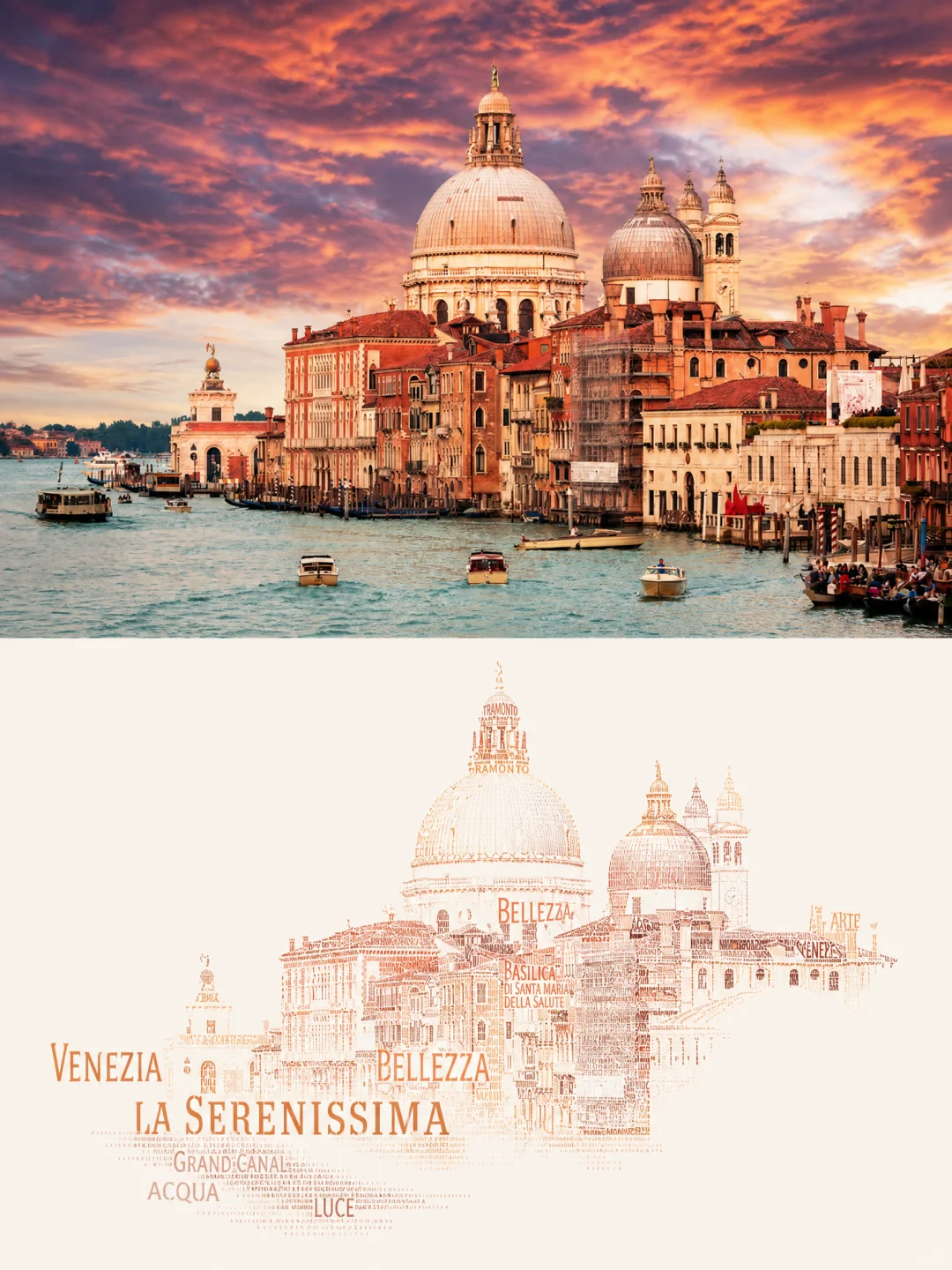
| Calligram Word Art Poster | Type and stamps | Subjects with a strong, readable silhouette against a simple background | Busy scenes, portraits of people, and anything whose interest lies in fine texture | 3:4 | 2/6 |
| Vintage Stamp Postcard | Type and stamps | Works best on photos with a clear subject and a readable background | Struggles with very dark photos, heavy motion blur, dense crowds where no single subject dominates, and screenshots or images that are mostly text | 3:4 | 6/6 |
| Photo Memory Stamp | Type and stamps | Built for portrait photos, unlike the other effects here — the photograph occupies a tall column, so anything shot vertically fits without losing its subject | Struggles with wide landscape shots, which lose their edges to the narrow column, and with busy scenes that have no dominant form | 4:5 | 4/6 |
* Japanese Minimal Watercolor was scored against the strictest version of the "keep the photo unchanged" rule using a small 1080×720 test photo, and the model re-rendered fine texture in every run. The scene, composition and lighting were preserved, so it was published after manual review. We will re-measure it with a full-resolution photo.
Eight styles redraw your photo in paint. The four watercolor effects differ more than their names suggest. Watercolor Painting Poster is a full, soft painting of the whole view. Watercolor Travel Print is built for whitewashed coastal architecture. Watercolor Journal is a pen-and-wash sketchbook page. Japanese Minimal Watercolor reduces the scene to a few quiet shapes on a lot of white paper.
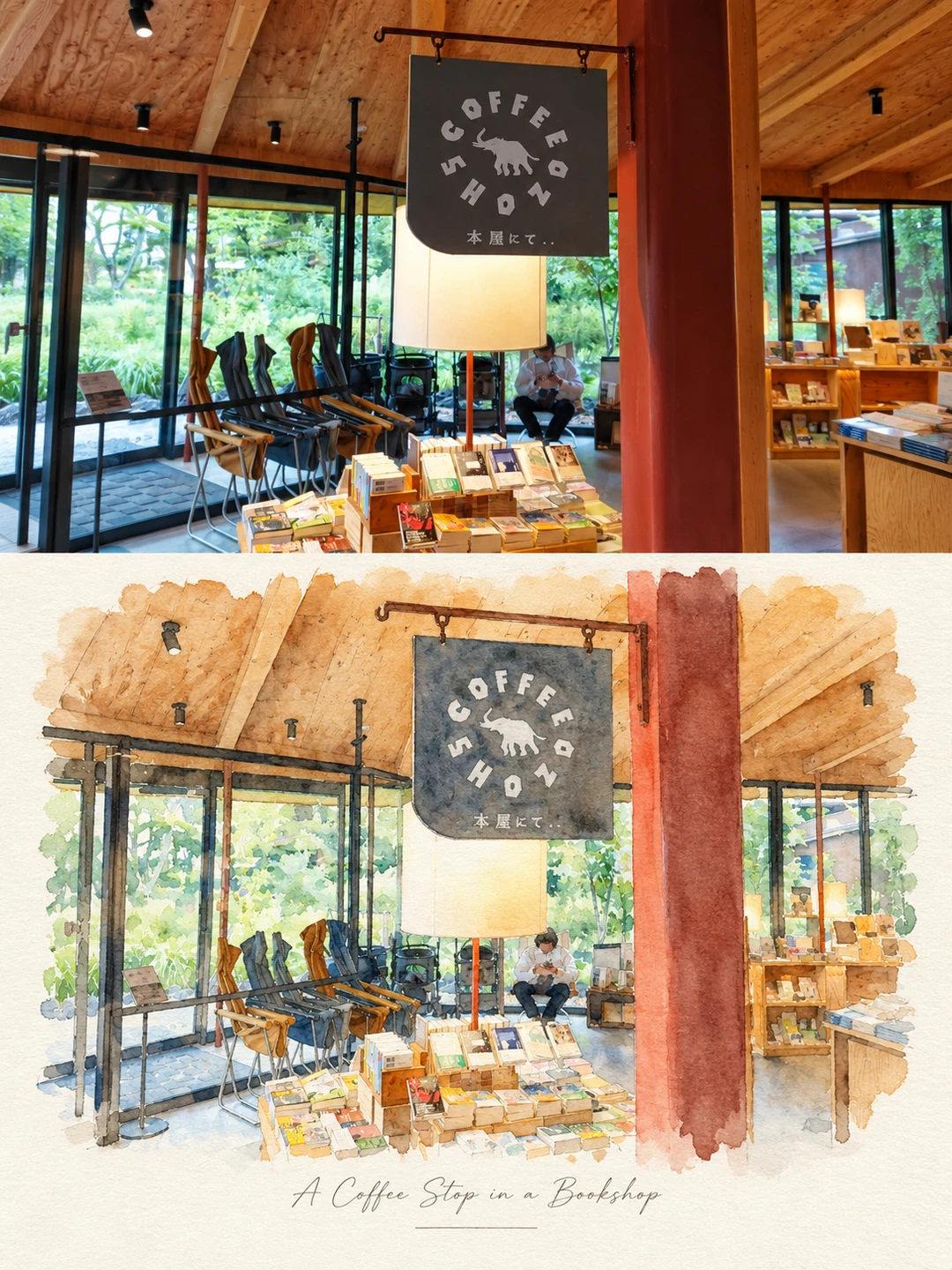
Watercolor Painting Poster: the timber roof, the sign, the lounge chairs and the reader all keep their places.
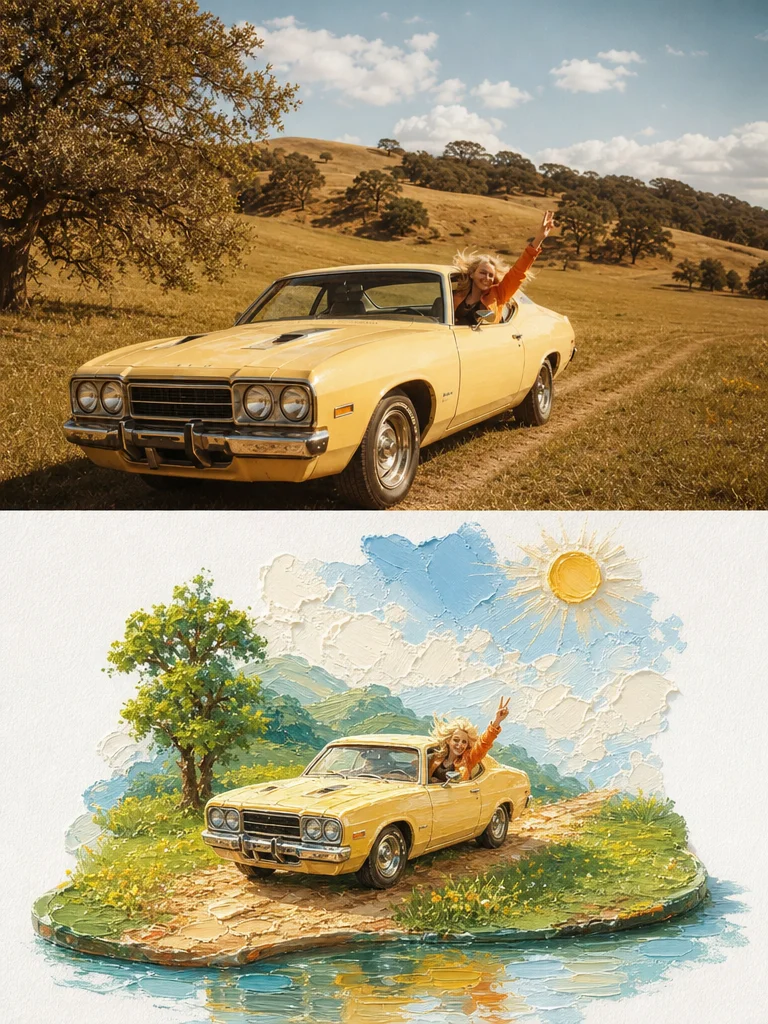
The oil styles go the other way, toward thick, sculpted paint. Oil Painting Diorama turns the scene into a small floating island of impasto. Palette Knife Painting is the one to use when a person or animal is doing something. Couple Diorama turns two people into tiny oil-paint figures. Chinese Ink Wash distills architecture and mountains into ink on xuan paper.
Seven styles borrow from printmaking and graphic design. Ukiyo-e Woodblock cuts the scene as an Edo-period print, and it works best on temples, mountains and water. Risograph Print pares the photo down to one subject in two or three inks. Mid-Century Illustration, Editorial Magazine and Geometric Collage are flat, poster-like redraws. Particle Dispersion and Pixel Mosaic break the subject into dots or tiles.
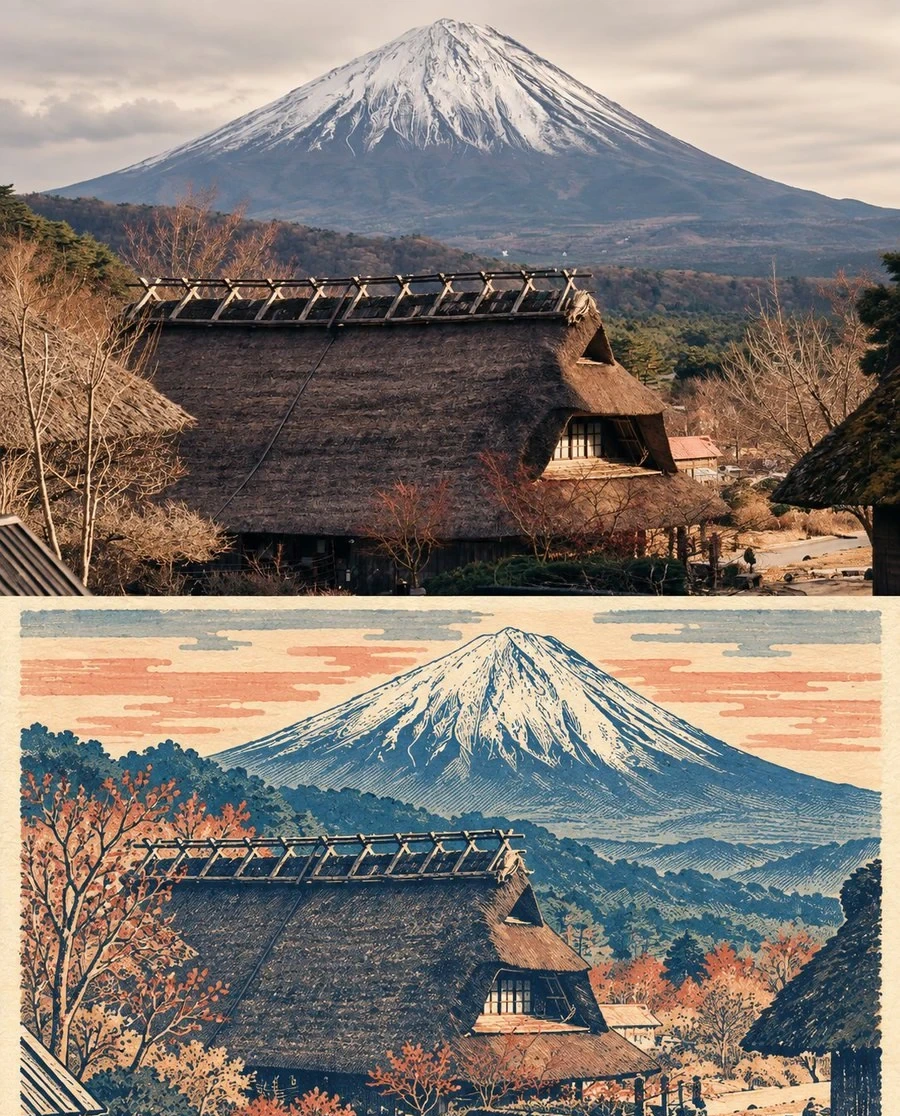
Ukiyo-e Woodblock: the mountain is carved in indigo hatching, the maples in vermilion.
Seven styles rebuild the scene from a physical material. Four of them passed every test run: torn paper collage, fabric collage, embroidery and needle felt. Torn Paper Collage and Paper Cut suit scenes with depth. Fabric Collage needs a wide photo with a clear horizon. Embroidery Patch and Needle Felt want one clear subject. Plaster Relief carves the scene into a rough wall, and Torn Paper Reveal opens a tear in the page onto the same place.
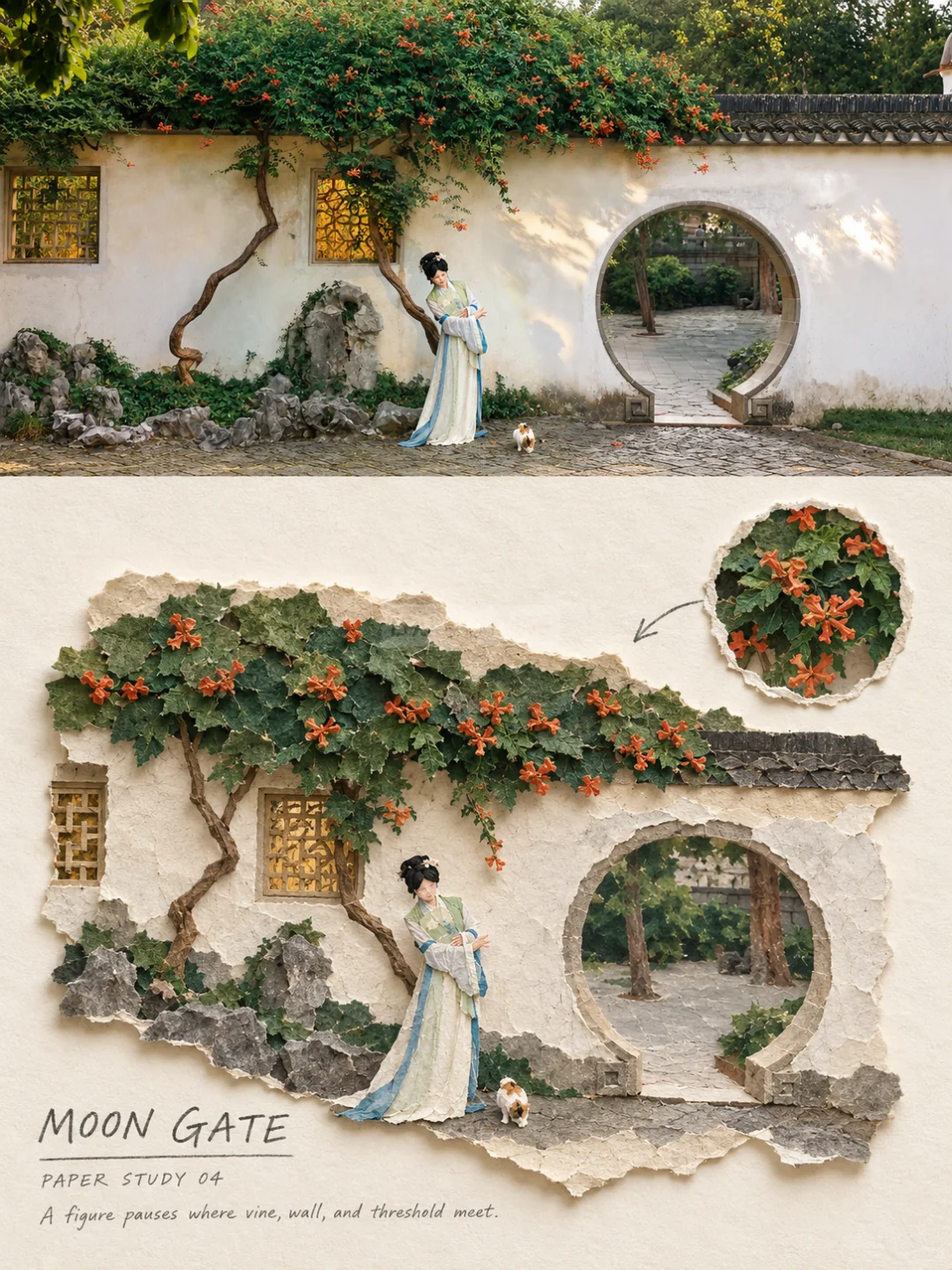
Torn Paper Collage: the trumpet vine keeps its orange, and everything else drops to greyed paper.
Nine styles redraw the photo by hand. As a group they were the most reliable in our tests, with 45 of 50 runs clean. Crayon Travel Poster is the best choice for street scenes with people in them. Colored Pencil rewards detailed scenes. Line Art continues one line from your photo as a pen drawing. Architectural Sketch is for buildings, and Marker Portrait is for a single subject with readable posture. Storybook Illustration, Doodle Icon Grid and Hand-Drawn Travel Postcard are made for travel memories, and Food Illustration Card is for a table shot from above.
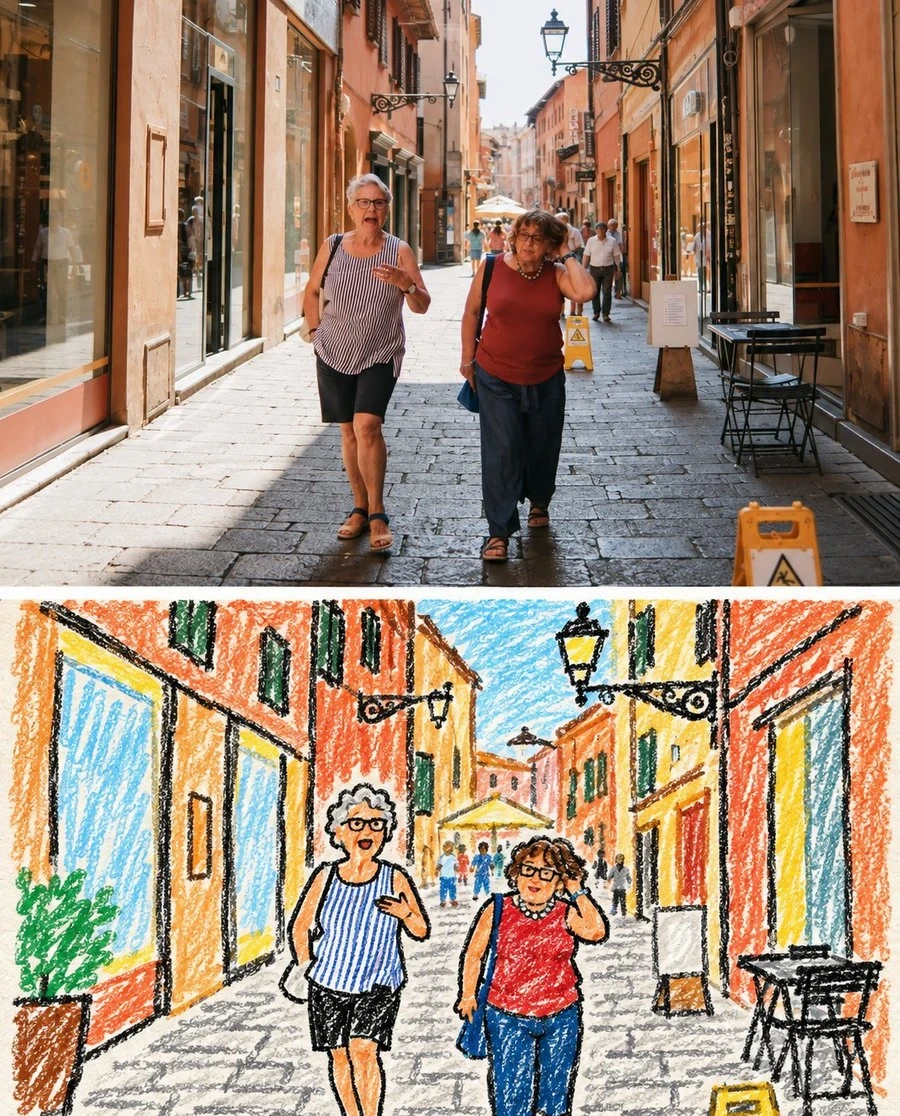
Crayon Travel Poster: the striped top and the red vest both survive the redraw.
Three styles turn the photo into something you could post or frame as an object. Vintage Stamp Postcard carves the scene as an engraved stamp, and passed all six test runs. Photo Memory Stamp is the one style built for portrait-orientation photos. Calligram Word Art rebuilds the subject entirely out of words. It produced the most striking results in the set and also had the lowest hit rate, about one clean run in three. Our guide to making a calligram from a photo covers how to improve those odds.
| Output | Credits | Approximate price | Pixel size (3:4 poster) |
|---|---|---|---|
| 2K image | 100 | about $0.25 | 1792 × 2400 |
| 4K image | 200 | about $0.50 | about twice the 2K size on each side |
| New account bonus | 500 free | five 2K images |
Across 45 real generations, the median wait was 35 seconds and 9 in 10 finished within 66 seconds. Credits start at $5 for 2,000. Browsing the tools, viewing every sample and copying every prompt is free without an account. You need an account only to generate, and a failed generation is refunded automatically. The images you generate are yours to use, including commercially.
When an effect has a lower hit rate, budget for more than one attempt. For the calligram, about three 2K attempts per keeper means roughly 300 credits.
These patterns held across all 34 styles in testing:
Every effect page publishes its full prompt. You can copy it and run it in any image model that accepts a reference photo, such as Nano Banana or GPT Image 2. Most of them follow the same pattern: a strict layout rule (where the photo goes and how much space it takes), a rule to preserve the original photo, a detailed description of the medium, and a list of forbidden outcomes. If you want to write your own, start from one of ours. Our comparison of GPT Image 2 and Nano Banana covers how the two models differ.
It depends on the photo. For daylight landscapes and travel photos, Torn Paper Collage, Fabric Collage, Watercolor Journal and Watercolor Painting were among the most reliable in our tests. For a single object or pet, try Embroidery Patch, Vintage Stamp or Calligram. For people, use Marker Portrait, Couple Diorama or Palette Knife Painting.
On 2Slides, a 2K image costs 100 credits (about $0.25) and a 4K image costs 200 credits. New accounts get 500 free credits, enough for five 2K images. Failed generations are refunded automatically.
No. Every effect keeps your photograph in the poster with only light grading, and puts the artwork beside or below it. Keeping the original photo intact is one of the rules every test run is scored against.
Close-up faces are the weakest case for almost every style, because paint, paper and print reduce faces to shapes. Marker Portrait, Couple Diorama and Palette Knife Painting are built around people and work best with a full or half body, a back view, or a clear pose.
Yes. A 2K poster is 1792 × 2400 pixels, which prints cleanly at poster size, and 4K doubles the resolution for large prints or small type.
Yes. Every prompt is published in full on its effect page. They are written for models that accept a reference photo, so they work best with image-to-image models such as Nano Banana and GPT Image 2.
Choose the style for your photo, not the other way round. Most styles do well with daylight travel photos that have one clear subject. Faces and night shots are where most styles struggle. Start with one of the twelve styles that passed every test run if you want a sure result. Try the calligram when you have a strong silhouette and a few credits to spare. Browse all 34 on AI Photo Effect Tools, where every page shows real samples, its full prompt and its test result before you generate anything.
Create stunning AI-powered presentations in seconds. Transform your ideas into professional slides with 2slides AI Agent.
Try For FreeYour AI Agent for slides. Save time, shine faster with intelligent presentation creation.



© 2026 2slides. All rights reserved.