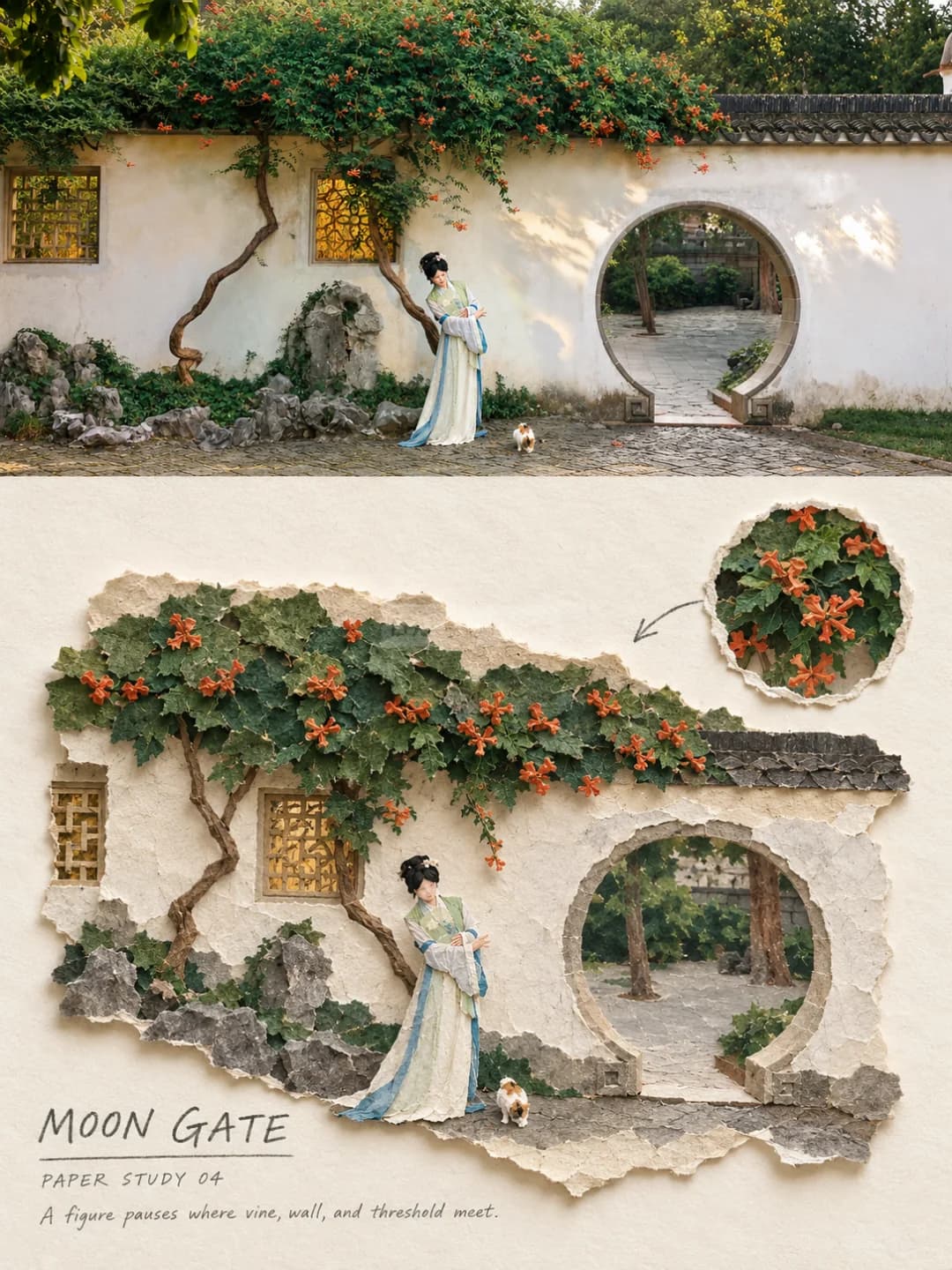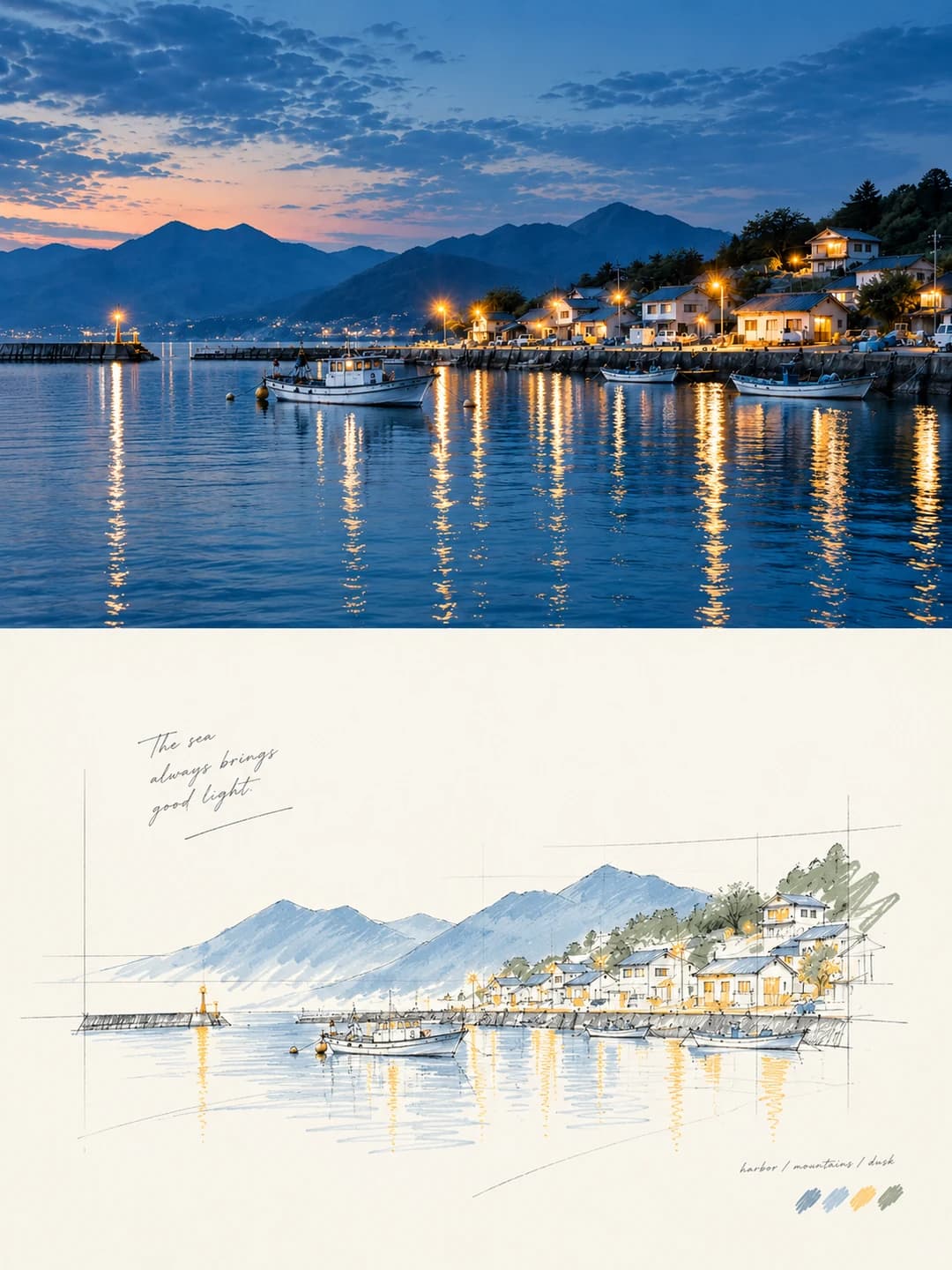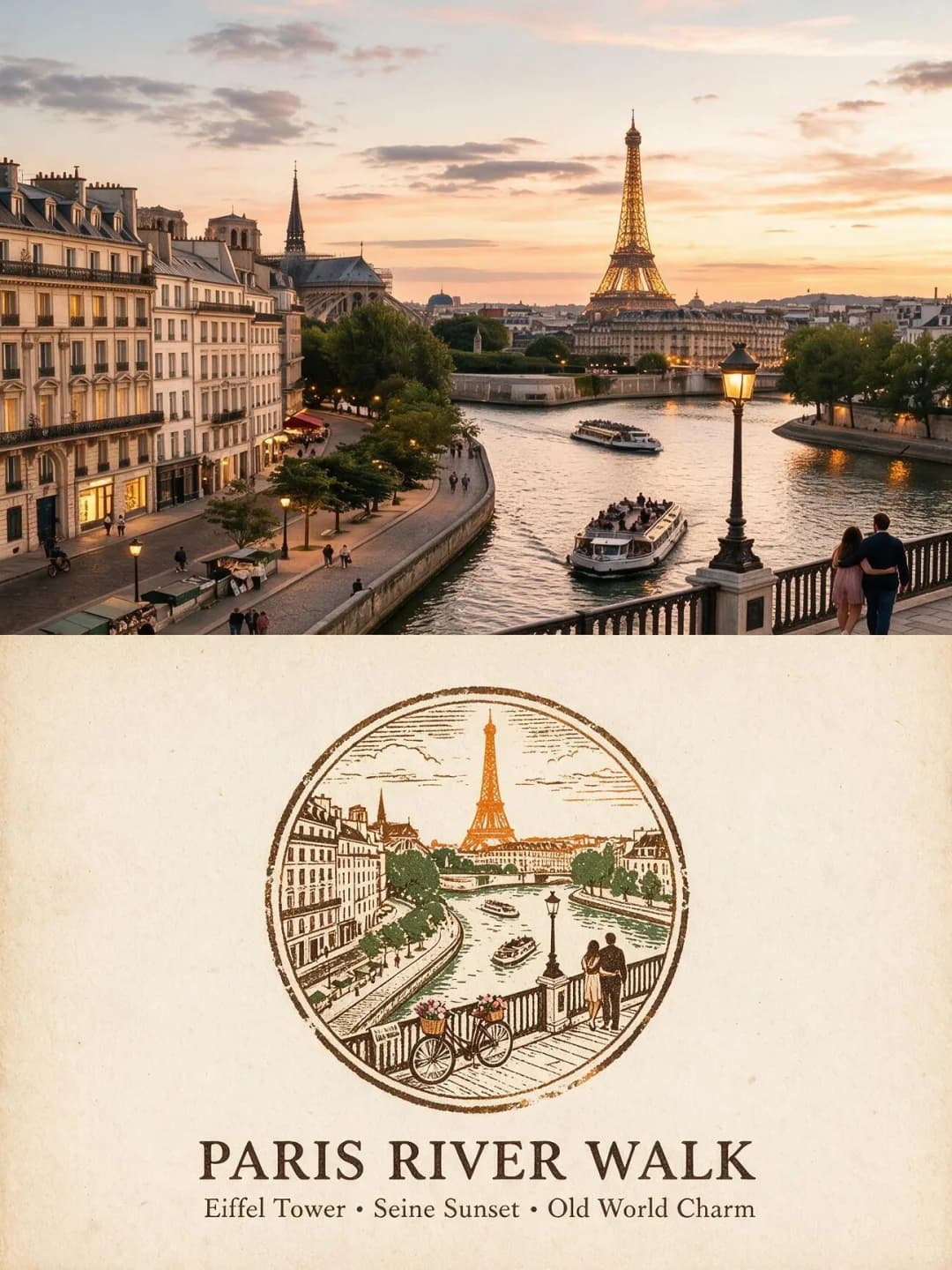
Ukiyo-e Woodblock Poster
Your photo on top, the same place cut as an Edo woodblock print below
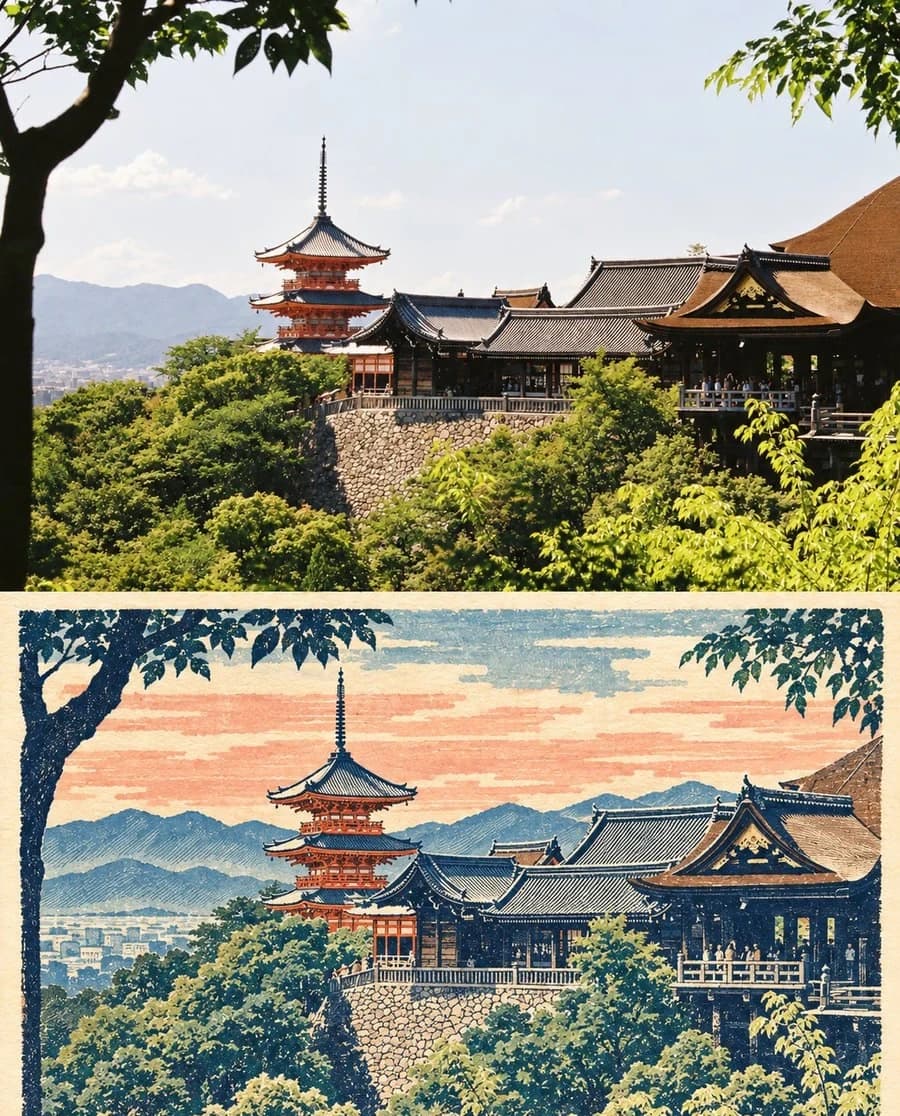
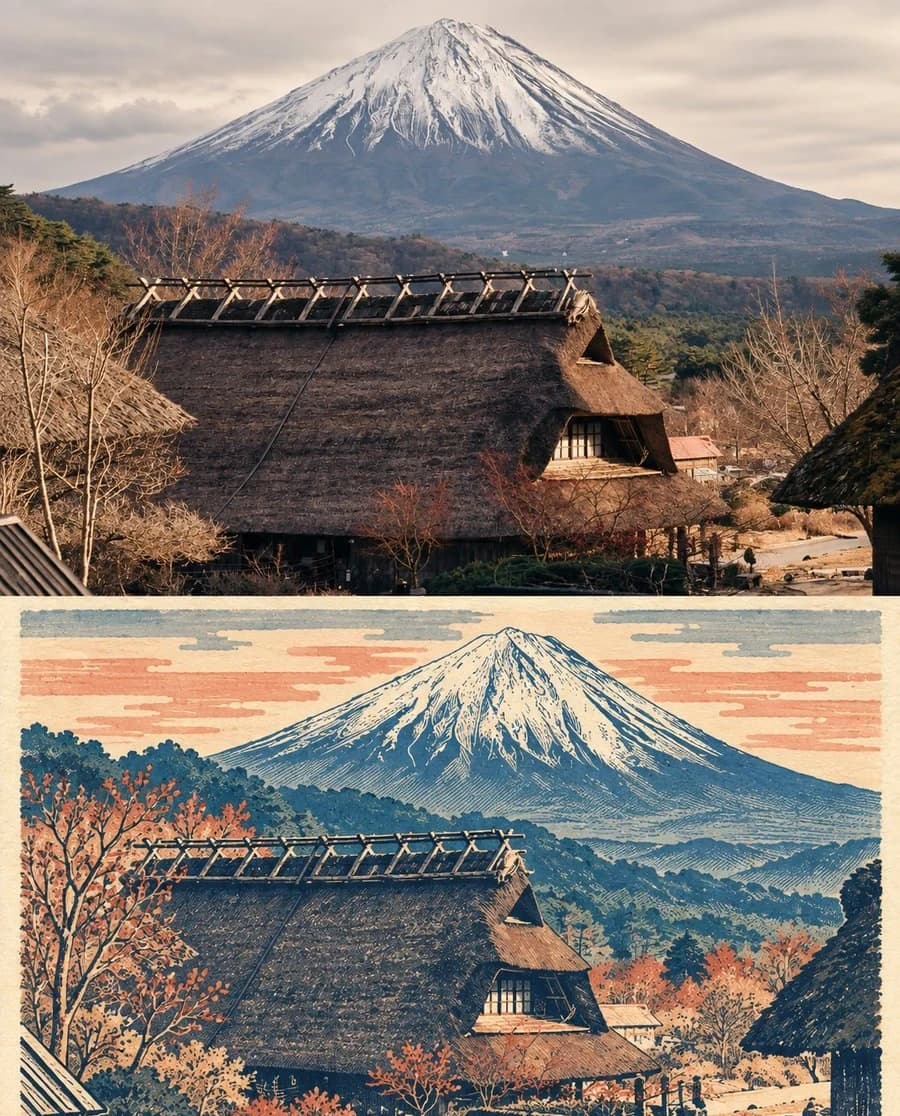
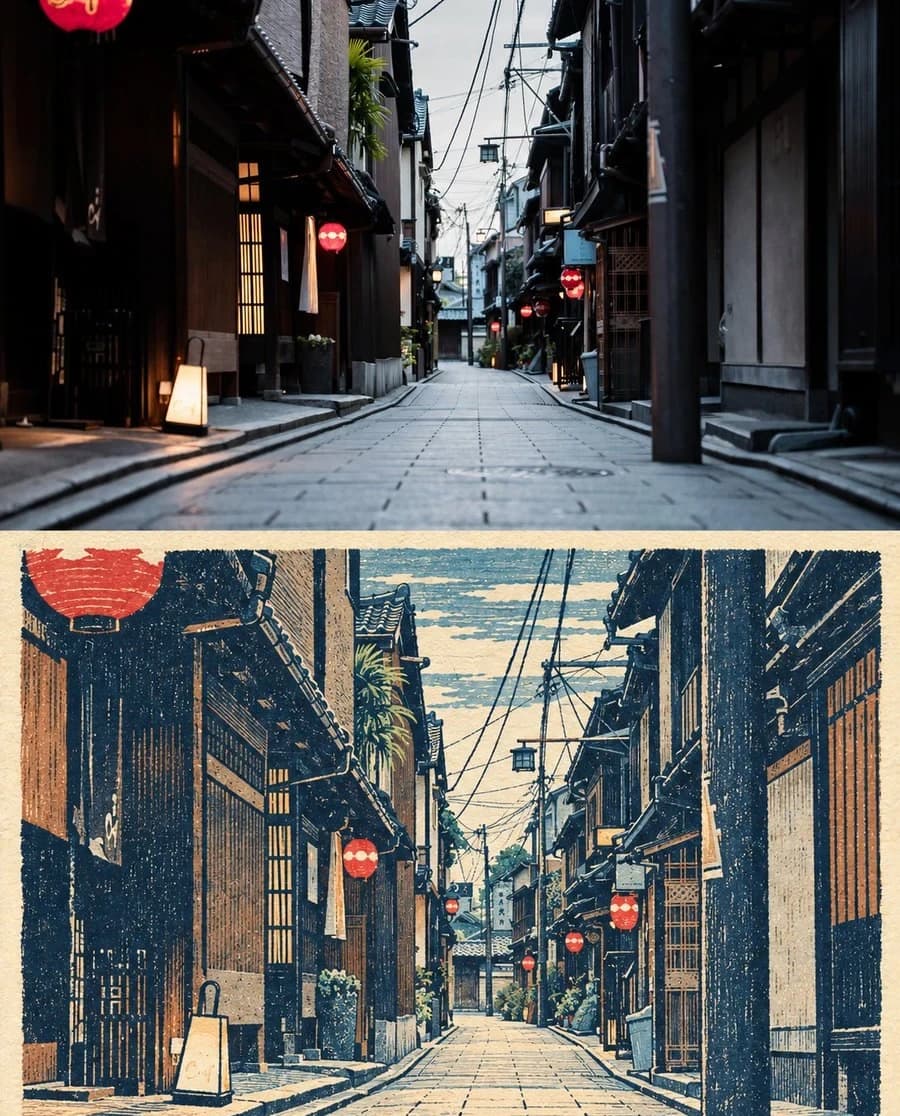
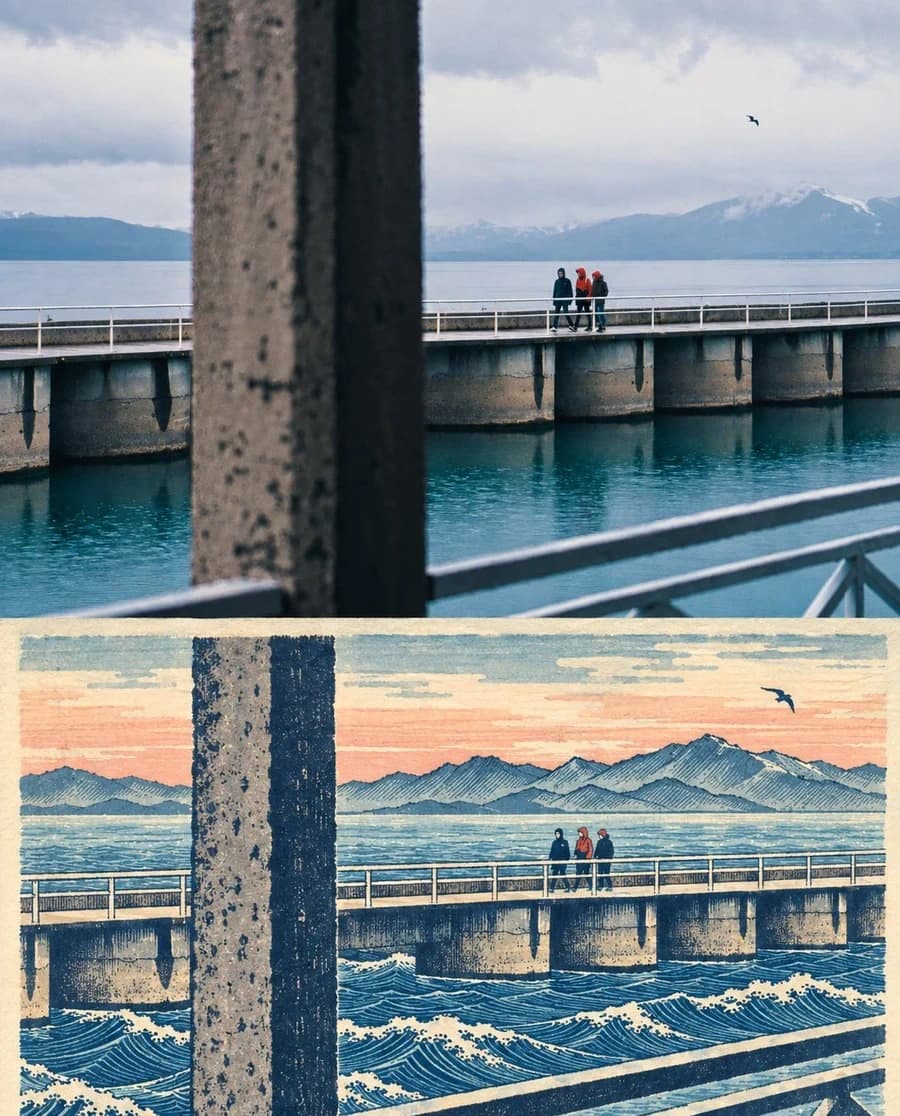
Upload a travel photo and get back a 3:4 poster: your photograph across the top, the same place re-cut underneath as an Edo-period ukiyo-e print — washi paper, indigo and ink outlines, flat overprinted colour and the dry, slightly misregistered marks of a real carved block.
100 credits per image · about a minute · New accounts get 500 credits — 5 free images.
Try it with your own photo
New accounts get 500 credits — 5 free images.
Examples
Every image below was made with the prompt on this page.
What is a ukiyo-e woodblock poster?
A ukiyo-e woodblock poster splits a 3:4 frame into two halves separated by a clean off-white rule. The top half is your photograph, preserved in subject, number, composition, perspective and light with only light publication grading. The lower half re-cuts the same place as a genuine Edo-period woodblock print: an off-white washi ground, deep indigo and ink-black carved outlines, limited overprinting in vermilion, ochre, cyan-blue and grey-green, flat colour fields, diagonal hatching, short chisel marks, dry-brush gaps, ink bleeding into the fibre and slight registration drift. It carries no text at all — no title, no seal, no signature.
Works well with
Landscapes and travel architecture: a temple roofline, a mountain, a lantern-lit street, a pier over water, a village under a ridge. Ukiyo-e is built from flat colour fields and carved outlines, so scenes with strong silhouettes and layered depth translate best.
Struggles with
Portraits and close-ups — this is a landscape tradition, and a face reduced to flat fields loses the likeness. It is also weak on interiors and on night scenes with little structure. Note too what it will refuse to do: the prompt forbids inventing landmarks, people, animals, vehicles or cultural symbols that are not already in your photograph, so it will not decorate a thin scene for you.
The prompt behind this tool
This is the full prompt, translated into English. Copy it and use it with any image model that accepts a reference photo.
Turn the uploaded travel photograph into a single standalone 3:4 vertical before-and-after poster. The top half preserves the original photograph in full, holding the identity and number of the subjects, the composition, the perspective, the key architecture or natural outlines, the original light and the relationships within the scene, with only light publication-grade grading. A clean, restrained off-white horizontal rule separates the two halves. The lower half reorganises the same scene as a genuine Edo-period Japanese ukiyo-e woodblock print, keeping the most recognisable subjects and spatial relationships from the photograph while deliberately changing the information density, the areas of colour and the compositional centre of gravity. It is not a photo filter over the same framing.

Use an off-white washi paper-fibre ground, deep indigo and ink-black carved outlines, and a limited overprint palette of vermilion, ochre, cyan-blue and grey-green: flat fields of colour, diagonal hatching, short chisel marks, layered contours, slight ink starvation, dry-brush gaps, ink bleeding into the paper fibre and a little registration drift. Clouds, foliage, roof tiles, ridgelines, roads, lanterns, buildings and every other element of the setting are distilled into rhythmic woodcut pattern derived from the input photograph. The lower half does not reproduce the photograph's full framing; instead it builds Edo-print breathing space by enlarging or reducing the subject to its essentials, compressing the background and leaving continuous washi white space. Colour is extracted from the original photograph and compressed — do not apply a fixed sea-blue template, and if the original is not a seascape, do not add waves or coastline.

Use only elements genuinely visible in the original photograph. Do not invent landmarks, people, animals, vehicles or cultural symbols. The top half must stay real photography; the lower half must be a woodblock translation of the same place and the same subject. Do not produce an ordinary filter, modern flat vector, flat cartoon, realist oil painting, 3D render or gradient plastic texture; do not turn the whole photograph blue; do not alter the structure of buildings or the outline of mountains. No text, no title, no subtitles, no fake kanji, no seal, no logo, no watermark, no original/AI corner badge and no decorative border.
Frequently asked questions
- Will it change the people or the subject in my photo?
- Not in the top half. The prompt names the identity and number of subjects, the composition, the perspective and the key architectural or natural outlines as things that must be preserved, and allows only light publication grading. The lower half is a translation, so the subject is restated in flat carved fields — but the prompt forbids altering building structure or mountain outlines even there.
- Why is there no headline or caption option?
- Because the source prompt explicitly bans text. Its closing line rules out titles, subtitles, fake kanji, seals, logos, watermarks and decorative borders. A real Edo woodblock would carry a signature and a seal; this effect deliberately does not, so nothing on the print pretends to be an artist's mark. It is the only effect in this set with no caption controls, and that is on purpose.
- Will it add waves or a coastline to my photo?
- No — the prompt specifically forbids it. The most familiar ukiyo-e images are seascapes, so models reach for waves and a fixed sea-blue palette by default. This prompt blocks both: if your original is not a seascape, no waves or coast are added, and the colour is pulled from your own photograph instead of a template.
- Where do the colours come from?
- From your photo, then compressed. The print is built on an off-white washi ground with deep indigo and ink-black outlines, and a limited overprint palette — vermilion, ochre, cyan-blue, grey-green — sampled and reduced from what is actually in your image.
- What are the smudges and misaligned edges?
- Deliberate. The prompt asks for slight ink starvation, dry-brush gaps, ink bleeding into the paper fibre and a little registration drift — the marks a real multi-block print leaves behind. Without them the lower half reads as a vector illustration rather than something pulled from carved wood.
- What size do I get?
- 2K is 1792 × 2400 pixels, which prints cleanly at poster size. 4K doubles that and costs 200 credits instead of 100.
- Can I use my own prompt instead?
- Not in this tool — it runs one fixed prompt. The full text is published on this page, so you can copy it and run your own variations anywhere that accepts image prompts.
- What happens to my photo?
- It is stored privately so the generator can read it, and deleted on a schedule. It is never made public, never shown to other users, and never used to train a model.