Japanese Minimal Watercolor Print
Your photo above, a small quiet watercolour of it below
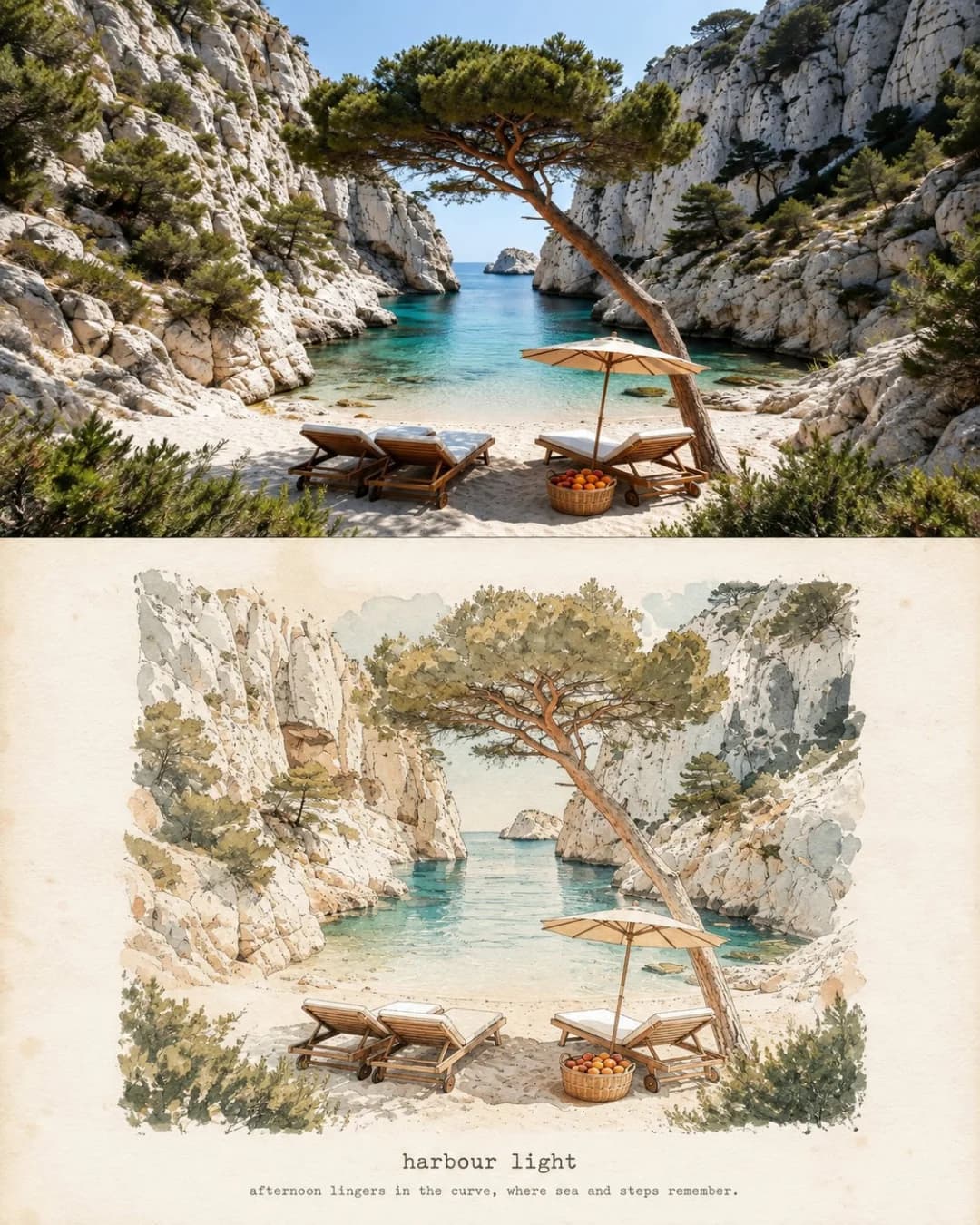
Upload a landscape photo and get back a vertical print: the photograph on top, untouched, and beneath it a deliberately small watercolour of the same scene adrift in a wide field of ivory paper. You set the line of type under the painting.
100 credits per image · about a minute · New accounts get 500 credits — 5 free images.
Try it with your own photo
New accounts get 500 credits — 5 free images.
Examples
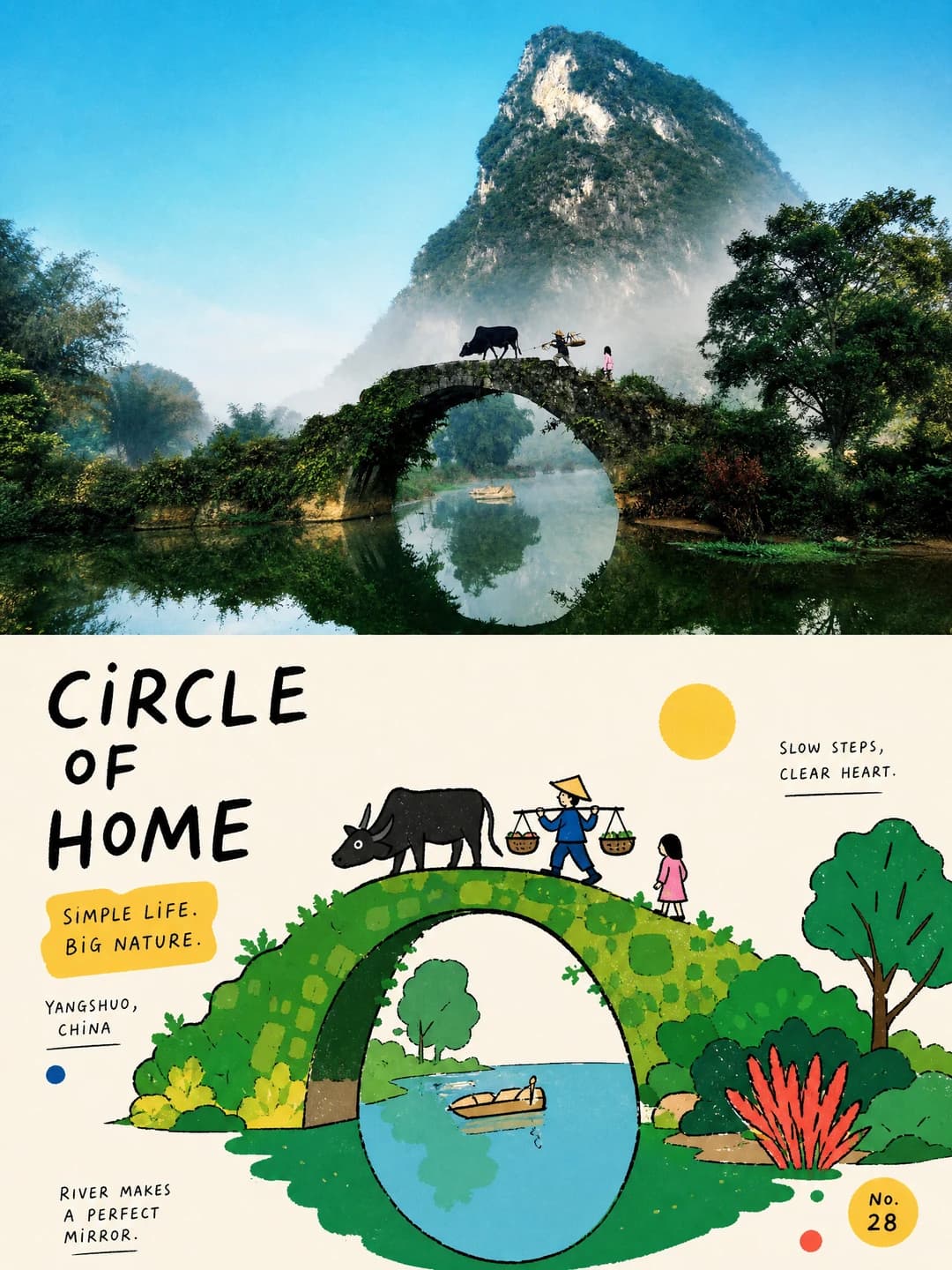
Every image below was made with the prompt on this page.
What is a Japanese Minimal Watercolor Print?
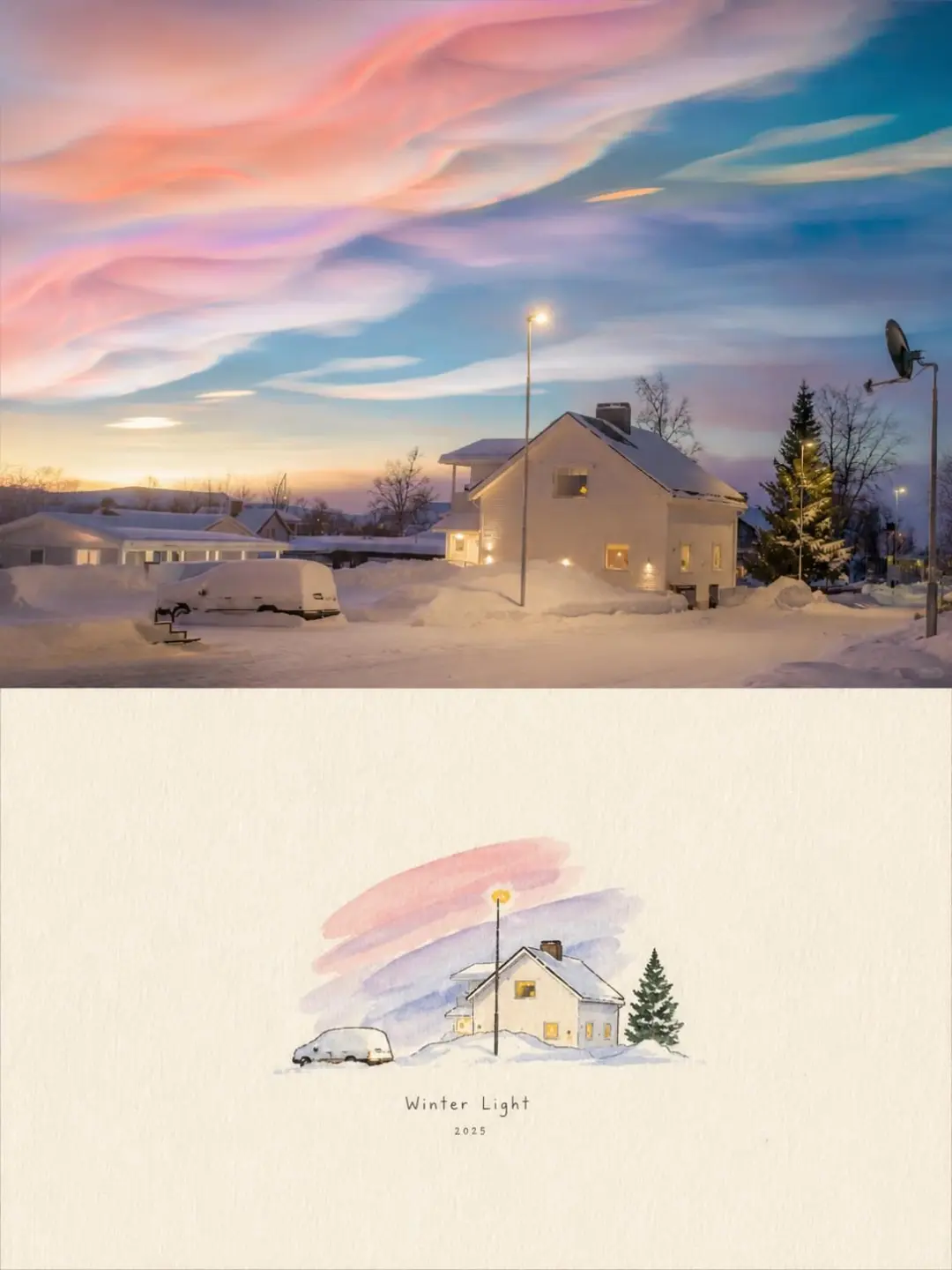
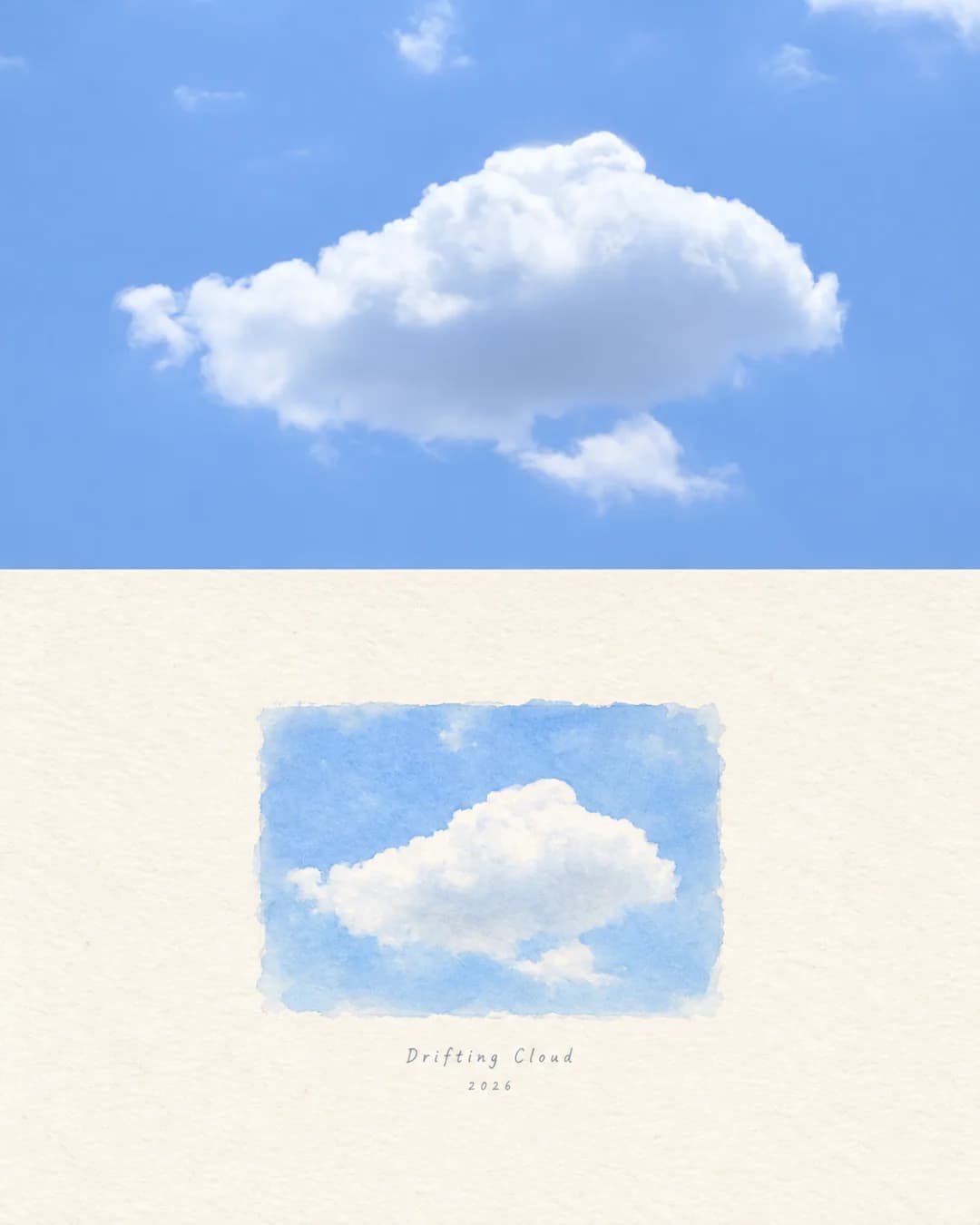
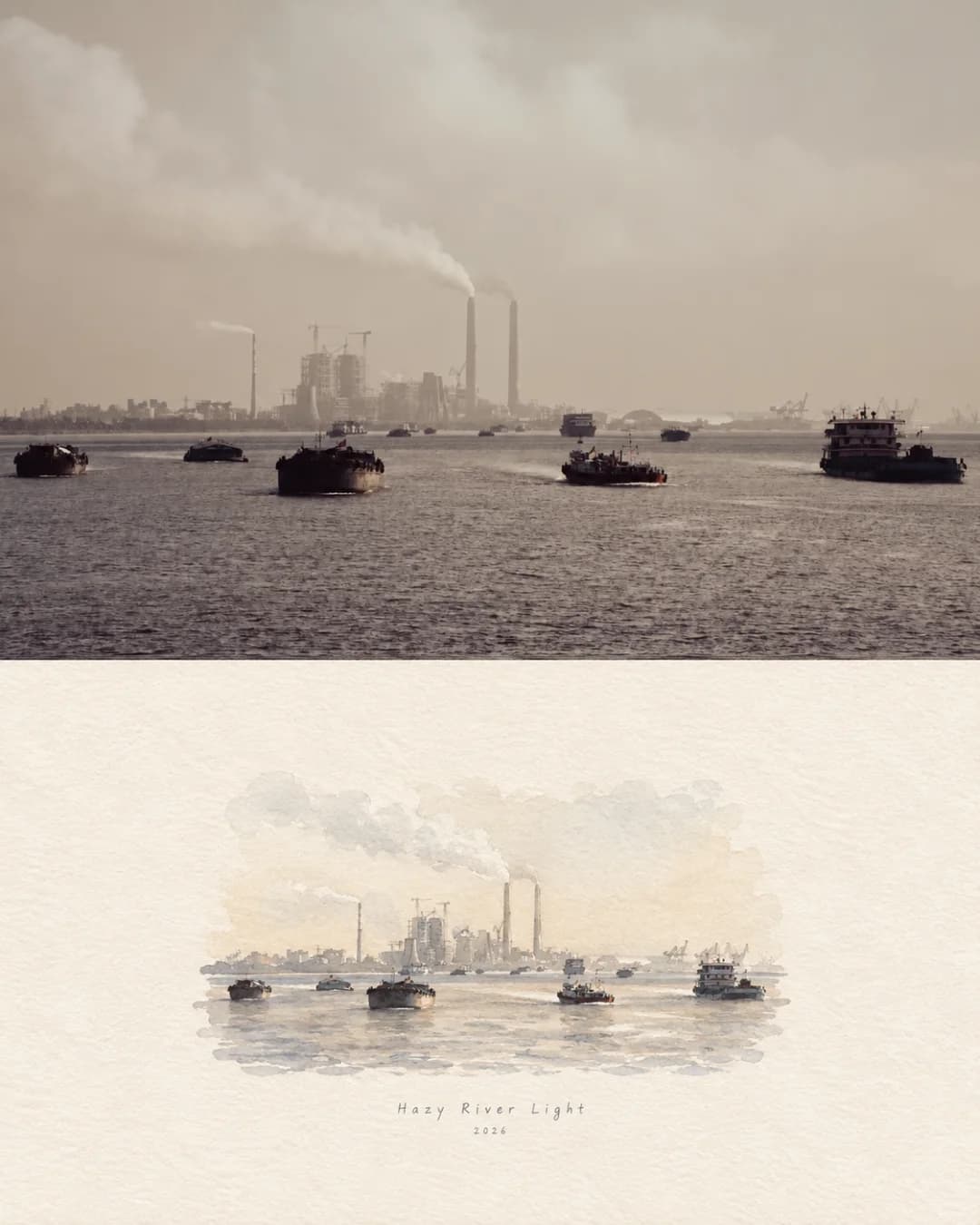
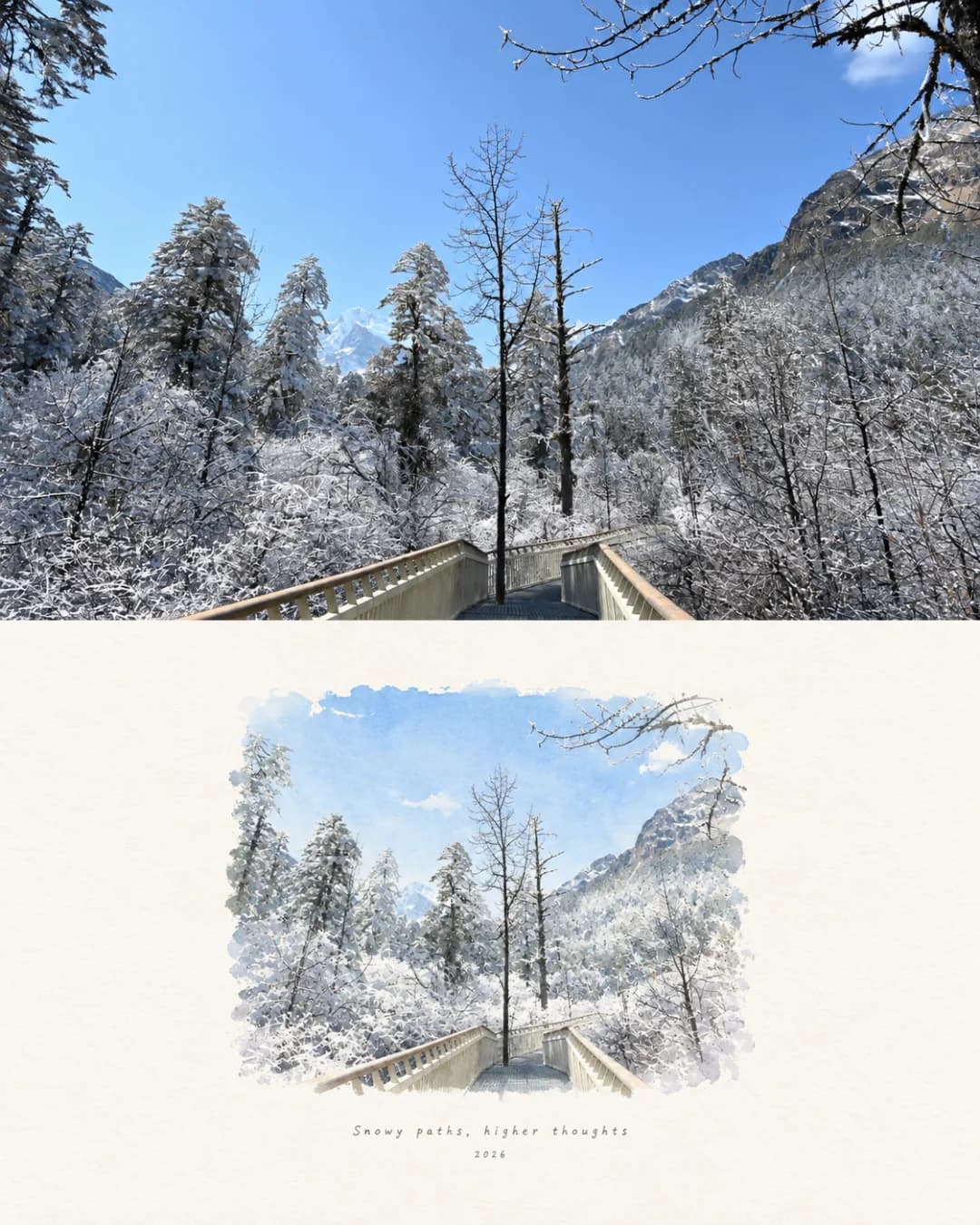
A Japanese minimal watercolor print stacks two panels in a vertical frame. The upper half is your photograph, which the prompt forbids redrawing, recolouring or altering. The lower half is warm ivory watercolour paper carrying a small hand-painted version of the same scene — deliberately kept to roughly a third of the frame's width, with large clean margins left around it. The restraint is the point: this is the composition of a gallery art print rather than a filled illustration panel, and a few words of small type sit directly beneath the painting.
Which photos work well?
Scenes that survive being reduced to a few shapes: a house against a coloured sky, a single cloud, boats on a wide river, a path through snow. Because the painting is small, simple silhouettes and one clear subject read far better than a busy frame.
Which photos struggle?
Photos that depend on detail or on many competing subjects. Shrunk to a third of the frame, a crowded street or a face loses everything that made it worth photographing. This is also the wrong tool if you want the artwork to fill the space — the empty paper is deliberate, and a sibling effect fills the lower panel instead.
How to turn a photo into a Japanese Minimal Watercolor Print
- 1
Pick an effect
Browse the samples on each tool page to see exactly what you will get before you spend anything.
- 2
Upload your photo
JPEG, PNG or WebP, up to 12 MB. Your photo stays private and is never used to train anything.
- 3
Add your own caption
Most effects let you set the text that appears in the final image, in any language.
- 4
Download the result
You get a high-resolution image, yours to use. 2K is 100 credits, 4K is 200.
The prompt behind this tool
This is the full prompt, translated into English. Copy it and use it with any image model that accepts a reference photo.
Use the image I upload as the only reference for content, composition and subject, and produce a stacked before-and-after composite: the original photograph above, a Japanese-minimal watercolour art print below.

The frame is vertical overall. The upper part takes roughly 48-55% of the total height and holds the original photograph directly, kept sharp and real, preserving its composition, viewpoint, proportions, subject, buildings, people, pets, vehicles, mountains, trees, streetscape, sky and lighting exactly as they are. Do not illustrate it, redraw it, recolour it, or add or remove anything.

The lower part takes roughly 45-52%, its background a broad field of warm white or ivory fine watercolour paper with a delicate fibre texture. Working from the photograph above, paint a small Japanese hand-drawn watercolour in the centre, keeping the original's most recognisable elements along with the rough compositional relationships, the position of the subject, the viewpoint, the proportions and the character of the scene. Simplify cluttered detail only; never swap the location or invent content.

The watercolour must be noticeably small — about 28-40% of the total image width — with generous clean margins left all around it. It must not fill the lower area. The whole should carry the considered emptiness of a Japanese travel keepsake, a designer postcard, a gallery art print, an independent art edition.

Style: Japanese minimal hand-painted watercolour, travel sketch, transparent watercolour art print. Colour low in saturation, high in value, clear and restrained, sampled automatically from the photograph. Keep slight bleeding, layered washes, water marks, paper grain and naturally dissipating edges, optionally supported by a few fine pencil or pen lines, drawn naturally rather than ruled. Sky, cloud, distant hills, haze or ambient colour may be reduced to loose blocks of wash, but the subject must stay easy to read. No oil paint, no impasto, no anime, no children's illustration, no 3D, no heavy outlines and no garish colour.

Type · generated
Directly beneath the painting, add a very small amount of English type, generated from this image's actual subject, place, weather, season, time, light or mood rather than fixed copy. It may be a two-to-four-word English title, three keywords joined by a middle dot, a title with one short poetic English line, or a single minimal sentence. The type is small, set in a handwritten, pencil, typewriter or minimal artistic face, slightly letter-spaced, in dark grey, grey-blue or a low-saturation colour that agrees with the picture. A very small year may follow on a line below.

The finished effect: real photography above, a minimal watercolour of the same scene below — quiet, romantic, restrained and clear, like a Japanese travel album, a private keepsake book, or a fine art print.
Frequently asked questions
Will it change the photo in the top panel?
- No. The prompt forbids redrawing, recolouring, cropping or adding and removing objects in the upper half — that panel is your photograph as you uploaded it. Only the lower panel is painted.
Can I choose the line of text under the painting?
- Yes. Type it into the caption field and it is transcribed exactly, with an optional second line beneath. Left blank, the model writes its own short phrase from the scene, the weather and the light.
Why is the painting so small?
- Because that is the effect. The prompt pins the watercolour to roughly 28-40% of the frame width and forbids it filling the lower panel. The empty paper around it is what makes it read as a gallery print rather than an illustration.
How is this different from the watercolor travel print?
- Same two-panel idea, different composition. That one fills the lower panel with an editorial travel-journal illustration; this one paints a small vignette and leaves most of the paper empty. Pick that one for detail, this one for quiet.
Where do the colours come from?
- From your photograph. The palette is sampled from the image and then lightened — low saturation, high brightness, transparent washes with visible water marks and paper grain. Saturated or heavy colour is explicitly ruled out.
What size do I get?
- 2K is 100 credits and 4K is 200. Both come back as a 4:5 vertical image, sized for the two stacked panels.
How long does it take?
- Usually 60 to 90 seconds. A 4K render is a larger job and can run a little longer.
What happens to my photo?
- It is stored privately so the generator can read it, deleted on a schedule, never shown to other users, and never used to train a model.