
2Slides Team
13 min read

An AI presentation API turns a trigger (a new CRM row, a Monday cron, a curriculum spreadsheet, an approved clinical document) into a finished deck without anyone opening PowerPoint. This hub maps 12 production recipes to the teams that run them: Sales, Customer Success, Marketing, Content, Education, Healthcare, Consulting, E-commerce, Finance, HR, and engineering teams building AI agents. Every recipe uses the same 7 endpoints of the 2Slides API, costs a predictable 10 credits per editable PPTX page (about $0.025) or 100 to 200 credits per image-designed page, and works with Zapier, Make, n8n, plain Python or Node, and coding agents via MCP.
Disclosure: 2Slides is our product. Where another vendor covers a recipe, we say so. Gamma's API page publishes a similar set of automation recipes (Make + Claude carousels, n8n + HubSpot onboarding decks, Zapier + Sheets proposals); the developer-level differences between the two APIs are in Gamma Generate API vs 2Slides API.
Key takeaways
POST to one of three generation endpoints → poll GET /api/v1/jobs/{id} every 5 to 10 seconds → deliver the file.This hub is for operations engineers, RevOps and marketing ops leads, edtech and health-tech developers, and agency teams who already generate the content of decks from data and want to remove the manual design step. If you make one deck a week by hand, the web app at 2slides.com/fast-ppt is faster than an integration; the API pays off once decks are repetitive, personalized, or time-triggered.
| # | Team | Trigger | Endpoint(s) | Output | Cost per 10-page deck | Recipe |
|---|---|---|---|---|---|---|
| 1 | Content | New row in a topic sheet or Notion database | create-pdf-slides (4:5 or 9:16), optional generate-narration | Carousel PDF + per-page PNG, optional MP4 | ~1,010 credits ($2.53) | Automate social media carousels |
| 2 | Sales | New prospect row in Google Sheets or CRM export | themes/search + generate | Editable PPTX proposal per account | 100 credits ($0.25) | Personalized sales proposals at scale |
| 3 | Sales | HubSpot deal stage change | generate (async) | Editable PPTX pitch deck attached to the deal | 100 credits ($0.25) | HubSpot sales deck automation |
| 4 | Customer Success | Closed Won webhook; day-85 schedule | generate; optional create-like-this for brand match | Onboarding kickoff deck, 90-day review deck | 100 credits ($0.25) | Automate customer onboarding decks |
| 5 | Marketing | Monday cron on campaign metrics | create-pdf-slides → generate-narration → download-slides-pages-voices | Recap deck + two-speaker narrated MP4 | ~3,110 credits ($7.78) | Marketing report decks and narrated videos |
| 6 | Finance / Ops | Weekly report data in Sheets | generate via Zapier | Editable PPTX weekly report | 100 credits ($0.25) | Weekly reports to slides with Zapier |
| 7 | Education | Curriculum spreadsheet or LMS export | generate per lesson; optional narrated lecture path | Lesson PPTX per class and language; video lectures | 100 credits ($0.25) per lesson | Generate lesson slides programmatically |
| 8 | Education / Language | Word list per level | generate in batch | 100 vocabulary decks | 10,000 credits ($22.50) for 100 decks | Batch-generate vocabulary decks |
| 9 | Healthcare | Approved, de-identified source document | generate per condition and language; create-pdf-slides + narration for staff training | Patient education decks in 20+ languages; narrated in-service videos | 100 credits ($0.25) per patient deck | Patient education slides automation |
| 10 | Consulting / Research | Topic form or schedule | Tavily or Exa → LLM → generate or create-pdf-slides | Sourced 12-slide brief | 120 credits ($0.30) editable; ~1,210 credits image-designed | Research-to-deck pipeline |
| 11 | E-commerce | New SKU or seasonal launch in the catalog | generate for sell sheets; create-like-this with the campaign key visual | Retailer deck + on-brand launch deck | 100 credits ($0.25) / ~1,010 credits ($2.53) | Product catalog to sales decks |
| 12 | Engineering / AI agents | A prompt in Claude Code, Codex, Cursor, or a custom agent | MCP tools themes_search → slides_generate (same API, same credits) | Any of the above, interactively | Same as the endpoint used | Agent Skills vs MCP servers |
Cost figures use the $5 per 2,000 credits tier ($0.0025 per credit). The 40,000-credit pack brings that to $0.002 per credit. Image-designed decks assume 2K resolution and 10 pages; 4K doubles the per-page charge to 200 credits.
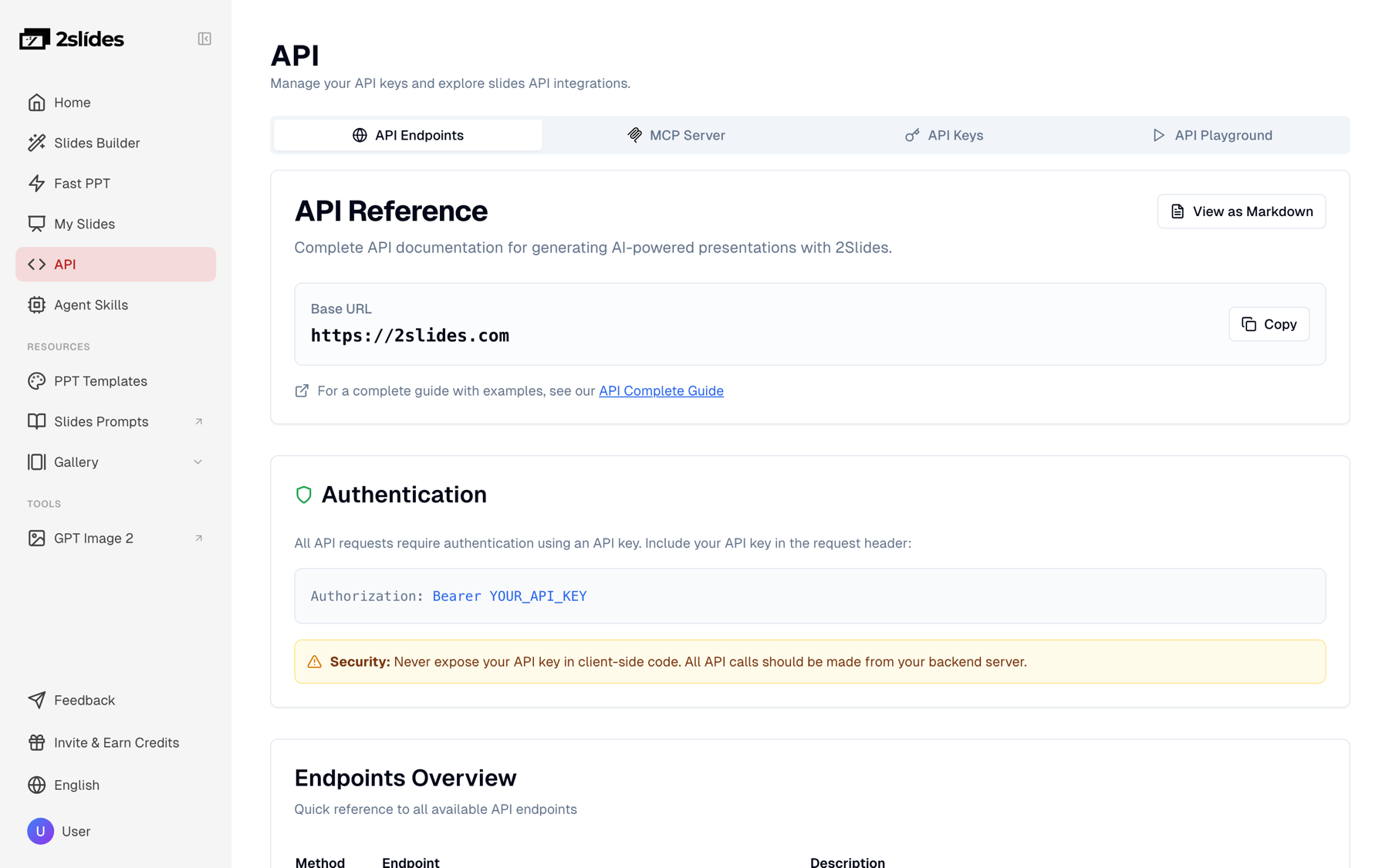
Authorization: Bearer <key>; keys are created on the API Keys tab and must stay server-side.
All 12 recipes share four moving parts.
1. A trigger with structured data. A spreadsheet row, a CRM webhook payload, a cron job that queries a warehouse, or a document that passed review. The quality of the deck is bounded by the quality of this input, so most teams spend more time on the prompt template than on the API call.
2. A prompt built from that data. Either you format the fields into a brief yourself (Company: Acme. Industry: logistics. Pain points: ...) or you have an LLM write a slide-by-slide outline first. Both work; the LLM step matters most when the source is unstructured (research notes, call transcripts).
3. One of three generation endpoints.
| Endpoint | What it makes | Best for | Credits |
|---|---|---|---|
POST /api/v1/slides/generate | Native, editable PPTX from one of 1,500+ templates (themeId) | Anything a human will edit afterward: proposals, reports, lesson decks | 10 per page |
POST /api/v1/slides/create-pdf-slides | Image-designed slides from a designStyle prompt; 512px to 4K; any aspect ratio | Visual-first output: carousels, launch decks, video source | 10 + 100 per page (2K) |
POST /api/v1/slides/create-like-this | Same, but the whole design is derived from a referenceImageUrl | Strict brand matching across hundreds of decks | 10 + 100 per page (2K) |
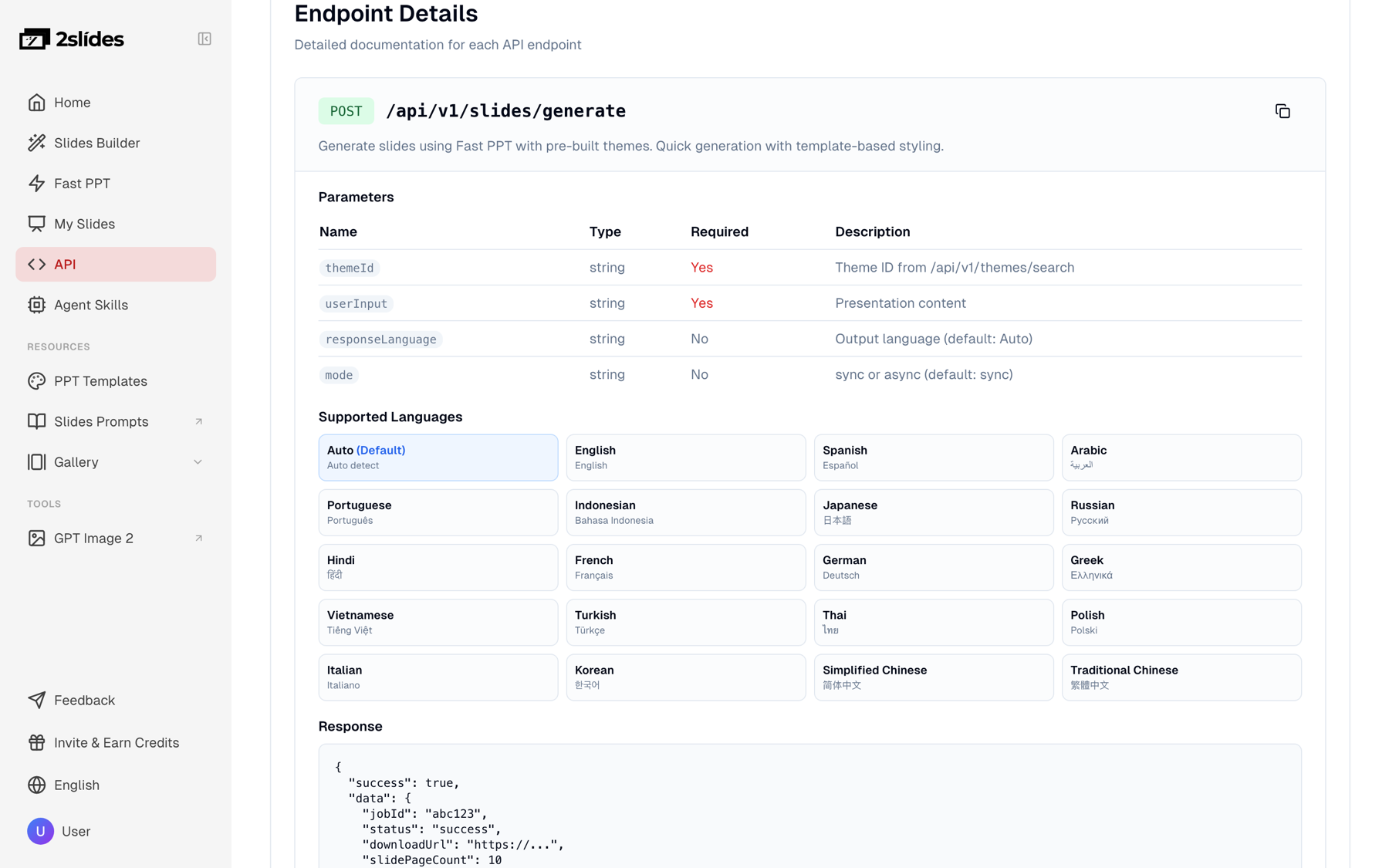
responseLanguage accepts a language name such as "Spanish" and defaults to Auto.
4. Poll, then deliver. Fast PPT generate runs synchronously by default and returns a download URL in one call, which is convenient in scripts. For batches, pass mode: "async", store the jobId next to the record that triggered it, and poll GET /api/v1/jobs/{id} until status is success or failed. Delivery is whatever your stack already does: email the PPTX, post to Slack, save to Drive, attach to the CRM record.
A minimal Node.js worker that every recipe can reuse:
const API = "https://2slides.com/api/v1";
const headers = {
  Authorization: `Bearer ${process.env.SLIDES_API_KEY}`,
  "Content-Type": "application/json",
};

async function generateDeck({ userInput, themeId, responseLanguage = "Auto" }) {
  const res = await fetch(`${API}/slides/generate`, {
    method: "POST",
    headers,
    body: JSON.stringify({ userInput, themeId, responseLanguage, mode: "async" }),
  });
  const { jobId } = await res.json();

  for (let i = 0; i < 60; i++) {
    await new Promise((r) => setTimeout(r, 8000));
    const job = await (await fetch(`${API}/jobs/${jobId}`, { headers })).json();
    if (job.status === "success") return job.downloadUrl;
    if (job.status === "failed") throw new Error(`Job ${jobId} failed`);
  }
  throw new Error(`Job ${jobId} timed out`);
}
Keep a queue in front of this function: generation endpoints allow 6 requests per minute per key, so 200 decks take about 35 minutes of wall-clock time, not 35 minutes of your time.
The recurring question in every recipe is "editable PPTX or image-designed slides?" The answer depends on who touches the deck next.
| Situation | Pick | Why |
|---|---|---|
| A human will edit numbers, pricing, or wording afterward | generate (Fast PPT) | Real text boxes and layouts in the PPTX; 10 credits per page |
| Hundreds of decks must look identical to one brand slide | create-like-this | The design system is derived from your reference image, not a template |
| Output is a carousel, a social post, or a video | create-pdf-slides | Aspect ratio control (4:5, 9:16, 1:1) and per-page PNG export |
| The deck ships as a narrated video | create-pdf-slides or create-like-this → generate-narration | Narration and MP4 export are only available on the image-designed pipelines |
| You need the cheapest possible unit cost at volume | generate | 100 vocabulary decks of 10 pages cost 10,000 credits ($22.50) |
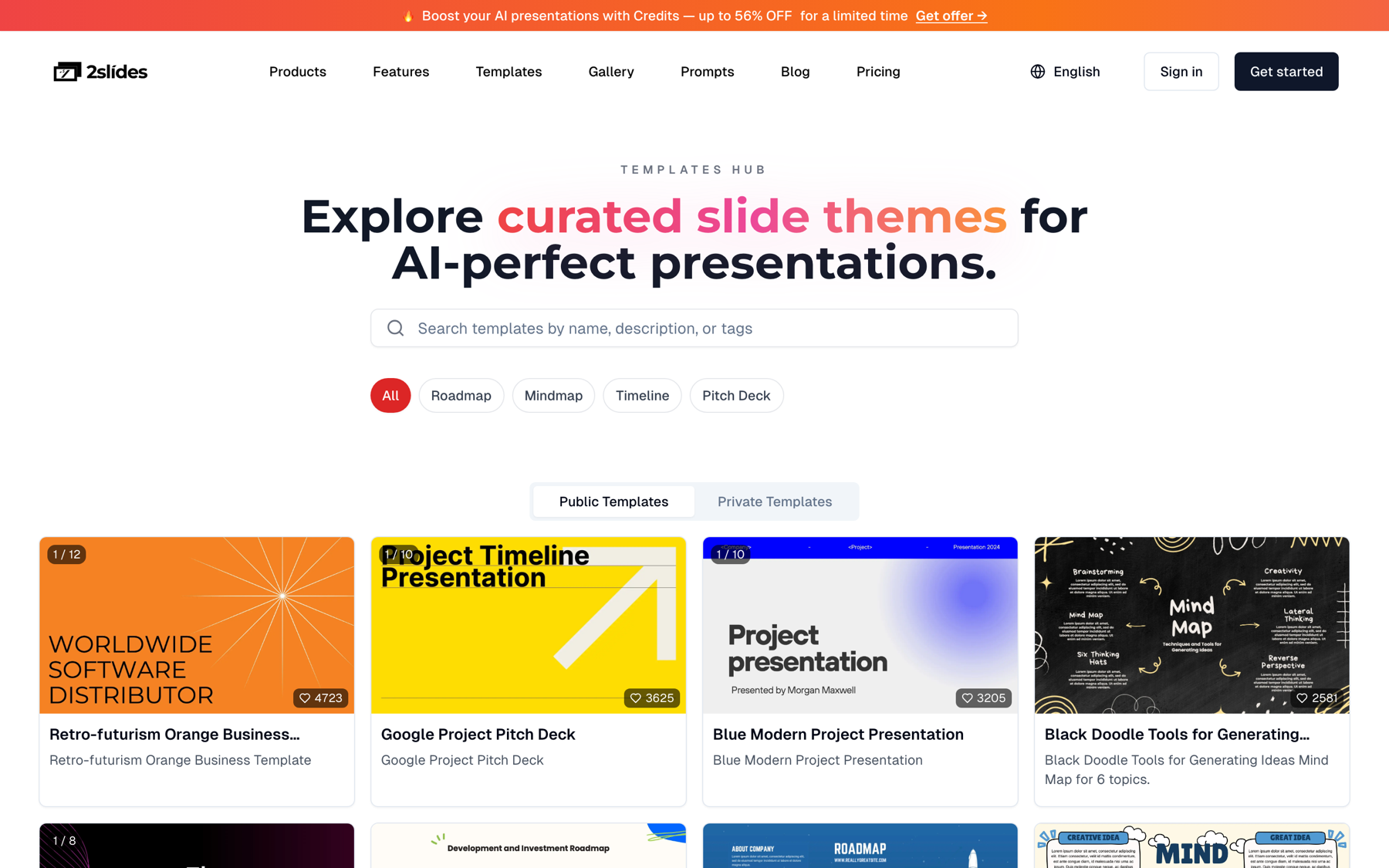
GET /api/v1/themes/search. Pick a theme once, pin its themeId, and every generated deck inherits the design.

referenceImageUrl to create-like-this when you want a specific look without designing it yourself.
Every endpoint above is also an MCP tool (slides_generate, slides_create_pdf_slides, slides_create_like_this, slides_generate_narration, slides_download_slides_pages_voices, themes_search, jobs_get) and the same operations are packaged as a SKILL.md for coding agents. In practice, teams prototype a recipe in a Claude Code or Codex session ("search a consulting theme, generate a 12-slide brief from this research, in German") and only move it to n8n or a cron job once the prompt is stable.
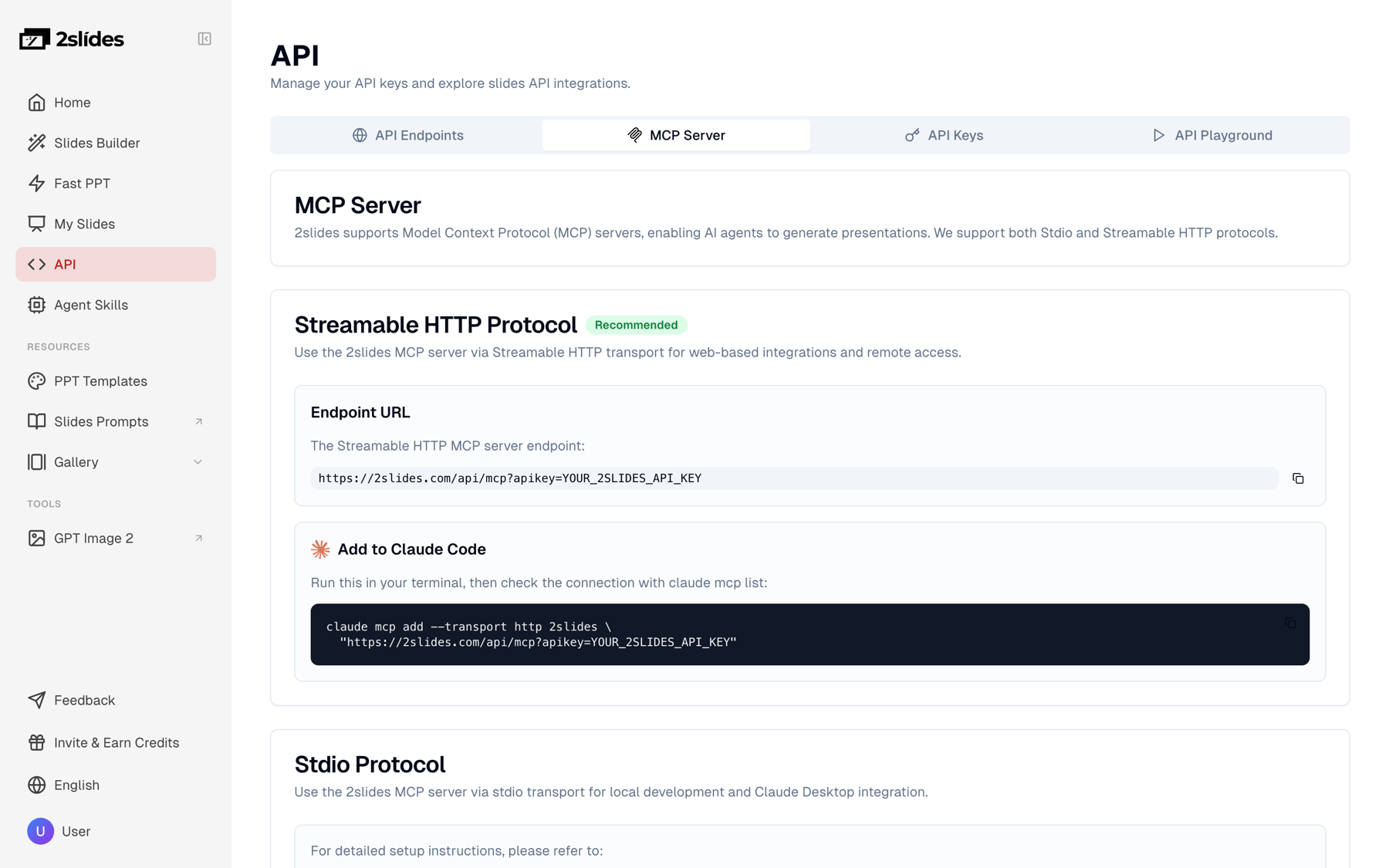
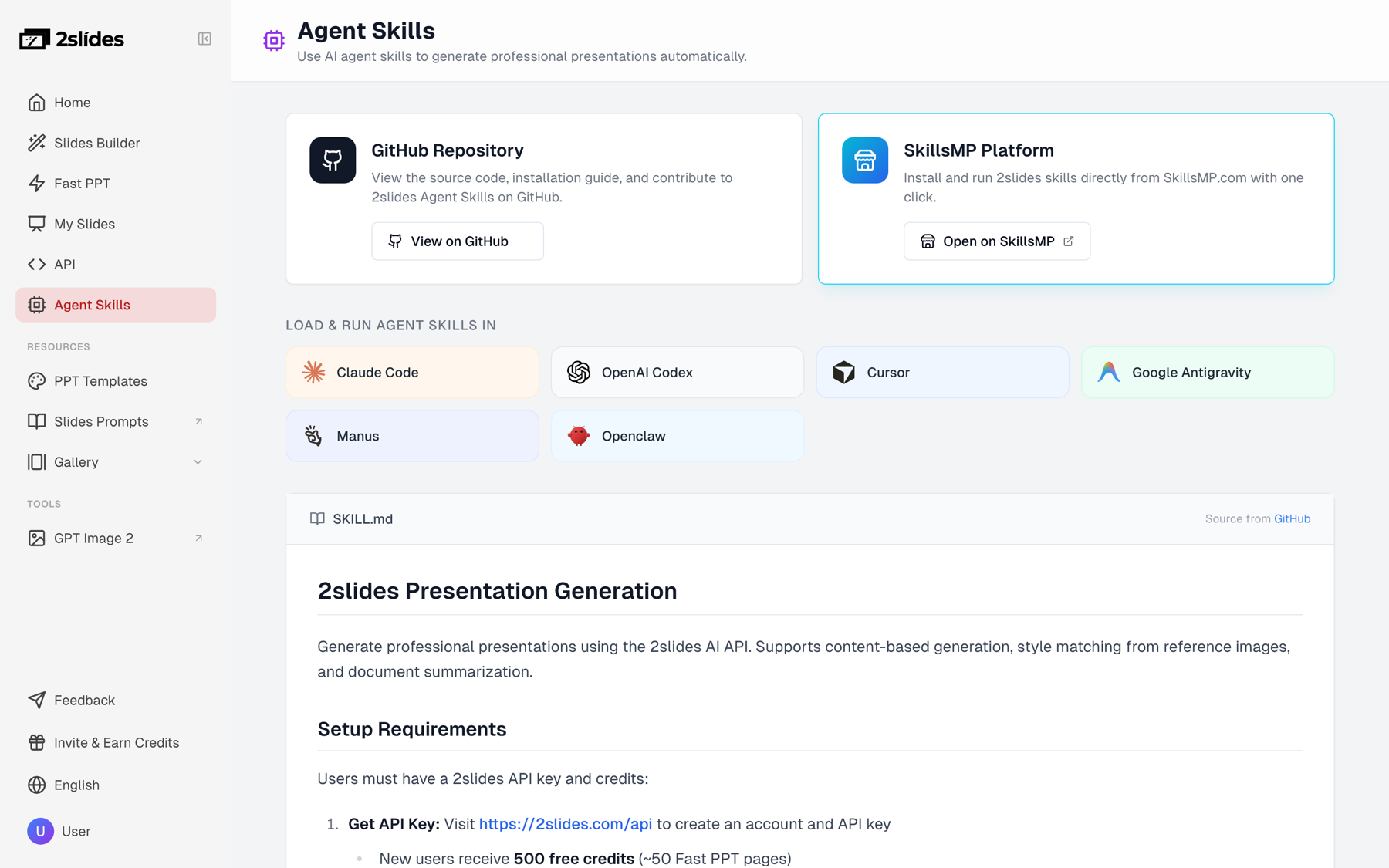
The trade-offs between the two integration styles are covered in Agent Skills vs MCP servers for presentations and the Claude-specific setup in How to use Claude MCP to generate presentations.
| Team and volume | Pipeline | Credits per month | USD per month (at $0.0025) |
|---|---|---|---|
| Sales: 200 proposals × 10 pages | generate | 20,000 | $50 (or $42.50 with the 20,000-credit pack) |
| Customer Success: 60 onboarding + 60 review decks × 10 pages | generate | 12,000 | $30 |
| Marketing: 4 weekly recaps × 8 pages, narrated | create-pdf-slides + narration | ~10,000 | $25 |
| Content: 30 carousels × 7 pages at 2K | create-pdf-slides | 21,300 | $53 |
| Education: 40 lessons × 12 pages | generate | 4,800 | $12 |
| Healthcare: 25 conditions × 8 pages × 6 languages | generate | 12,000 | $30 |
No subscription is required for any row; the optional Pro plan adds 10,000 credits per month for teams that prefer a fixed bill.
generate-narration only accepts jobs from create-pdf-slides or create-like-this. Fast PPT decks cannot be narrated.responseLanguage takes a name ("Japanese"), not "ja".page: 0 lets the model choose the slide count; pass a fixed number when the downstream template expects one.An AI presentation API is used to generate slide decks from structured data or text without manual design, triggered by events in other systems. The most common uses are personalized sales proposals from CRM data, recurring report decks from analytics, onboarding and training decks, lesson slides per class, and social carousels from content calendars.
Teams that produce many similar decks benefit most: sales and customer success (one deck per account), marketing and agencies (one report per client per week), education (one deck per lesson or language), and healthcare communications (one deck per condition per language). Teams that make one bespoke deck a month usually do better with the web app.
No. Any language that can send an HTTPS request works, and the Node.js worker above is complete. Zapier, Make, and n8n are useful when the trigger already lives there (a Sheets row, a HubSpot stage change) and you want the delivery step (email, Slack, Drive) without writing code.
With the 2Slides API, 100 editable PPTX decks of 10 pages cost 10,000 credits, which is $22.50 on the 10,000-credit pack. One hundred image-designed decks at 2K cost about 101,000 credits, roughly $202 at the 40,000-credit pack price of $0.002 per credit. Job polling, theme search, and per-page export are free.
Yes. The seven API operations are exposed as an MCP server (hosted or via npx -y 2slides-mcp@latest) and as an Agent Skill, so Claude Code, Codex, Cursor, and similar agents can search themes, generate decks, add narration, and download results using the same key and credits as the REST API.
Create stunning AI-powered presentations in seconds. Transform your ideas into professional slides with 2slides AI Agent.
Try For FreeYour AI Agent for slides. Save time, shine faster with intelligent presentation creation.




© 2026 2slides. All rights reserved.