2Slides Team
6 min read

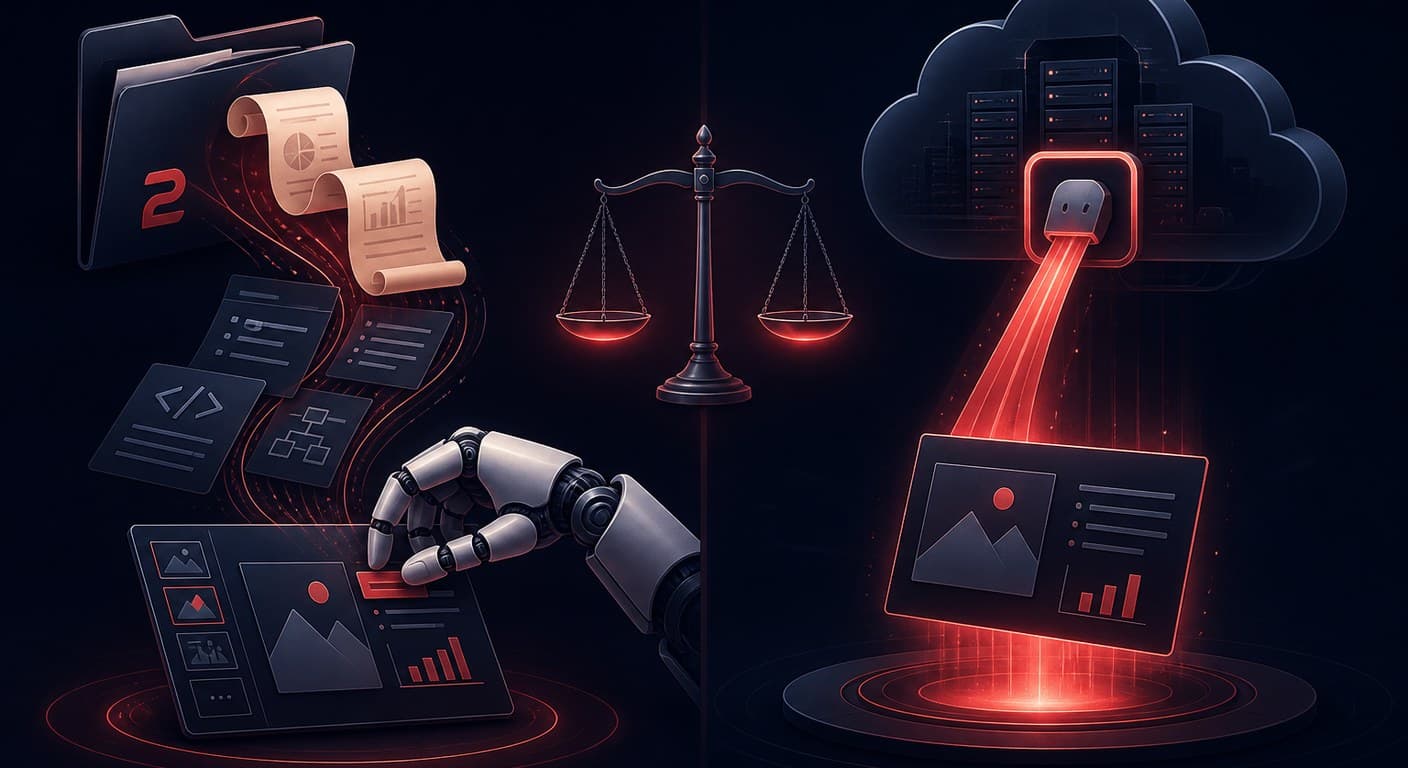
Agent Skills and MCP servers solve the same surface problem — getting an AI agent to produce a real PowerPoint file — through opposite mechanisms. A skill is a folder of instructions and scripts (SKILL.md) the agent loads and executes locally: the agent does the work. An MCP server is a running service that exposes tools the agent calls over the Model Context Protocol: the service does the work. For presentations, skills win on control and offline use; MCP wins on consistency and zero maintenance; mature teams typically end up using both.
Both mechanisms exploded in 2026 — PPT skills with tens of thousands of GitHub stars on one side, an ecosystem of presentation MCP servers on the other — and "which one do I actually set up?" became one of the most-asked questions in agent workflows. Here is the decision, made properly.
An Agent Skill is a folder containing a SKILL.md file — instructions, helper scripts, and resources — that an AI agent discovers and loads when a task matches. The convention is shared across Claude Code, OpenAI Codex, OpenClaw, and Cursor, which is why one PPT skill can serve them all. When you ask for a deck, the agent reads the skill, follows its workflow (plan the outline, write PptxGenJS or python-pptx code, or call an image model per slide), runs the scripts on your machine, and verifies the output — the best skills render slides back to images to catch overflow before delivering the file. Installation is a copy or one installer command; execution happens wherever the agent runs.
An MCP server is a standalone service that exposes typed tools — generate_slides, search_themes, check_job_status — to any client speaking the Model Context Protocol. The agent never sees how slides get made; it calls a tool with parameters and receives a result. A presentation MCP server like 2slides-mcp runs locally via npx -y 2slides-mcp@latest or as a hosted streamable-HTTP endpoint (https://2slides.com/api/mcp?apikey=...), and the actual rendering happens on the provider's infrastructure against maintained templates. Configuration is a JSON or TOML block in the agent's config — Claude Code, Codex, Gemini CLI, and OpenClaw all follow the same pattern.
| Dimension | Agent Skills | MCP Servers |
|---|---|---|
| Who does the work | The agent, locally | The service, remotely |
| Output consistency | Varies with the model's code that session | Locked by the service (templates, rendering engine) |
| Offline / air-gapped use | ✅ Possible (code-composed skills) | ❌ Requires the service |
| Maintenance burden | Yours — skills drift as libraries and models change | Provider's — tools update server-side |
| Capability ceiling | Whatever the agent can code or an image model can draw | Whatever the API offers (e.g., themes, 19+ languages, narration, MP4) |
| Cost shape | Agent tokens + optional image-model fees | Agent tokens + service credits/subscription |
| Portability | One SKILL.md → any skills-capable agent | One server → any MCP client, including non-coding agents |
The strongest 2026 setups pair them: an MCP server as the reliable generation backend, and a thin skill that encodes your conventions — which themes to prefer, house tone rules, where to save files, what to do when a deck exceeds 20 pages — before calling the server's tools. The skill holds your policy; the server holds the rendering. The 2Slides skill is built exactly this way, which means the "skills vs MCP" question is not either/or if your provider exposes both surfaces.
No — they occupy different layers. 2026's skills wave added a "teach the agent locally" option next to MCP's "give the agent a tool" option. High-variance creative work drifts toward skills; repeatable production work stays on services. Most serious workflows now touch both.
MCP, narrowly. One config block and an API key gets you tools in any MCP client. Skills need a skills-capable agent, an install step, and sometimes an image-model key. Both are minutes, not hours.
Yes, and it's becoming the norm for API-first tools. 2Slides ships a SKILL.md for Codex/Claude Code/OpenClaw/Cursor and an MCP server (npx -y 2slides-mcp@latest or hosted HTTP) over the same API and credits — pick per project rather than per vendor.
Code-composed skills do — PptxGenJS or python-pptx generation is fully local. Image-composed skills need an image-model API, and hosted skills need their service. If offline is a hard requirement, that constraint alone makes the decision.
Neither, strictly: it's a first-party capability inside the ChatGPT app. It shares the "skill" name but isn't installable in coding agents. Our @Presentations review covers where it fits next to the two mechanisms here.
Create stunning AI-powered presentations in seconds. Transform your ideas into professional slides with 2slides AI Agent.
Try For FreeYour AI Agent for slides. Save time, shine faster with intelligent presentation creation.




© 2026 2slides. All rights reserved.