2Slides Team
5 min read

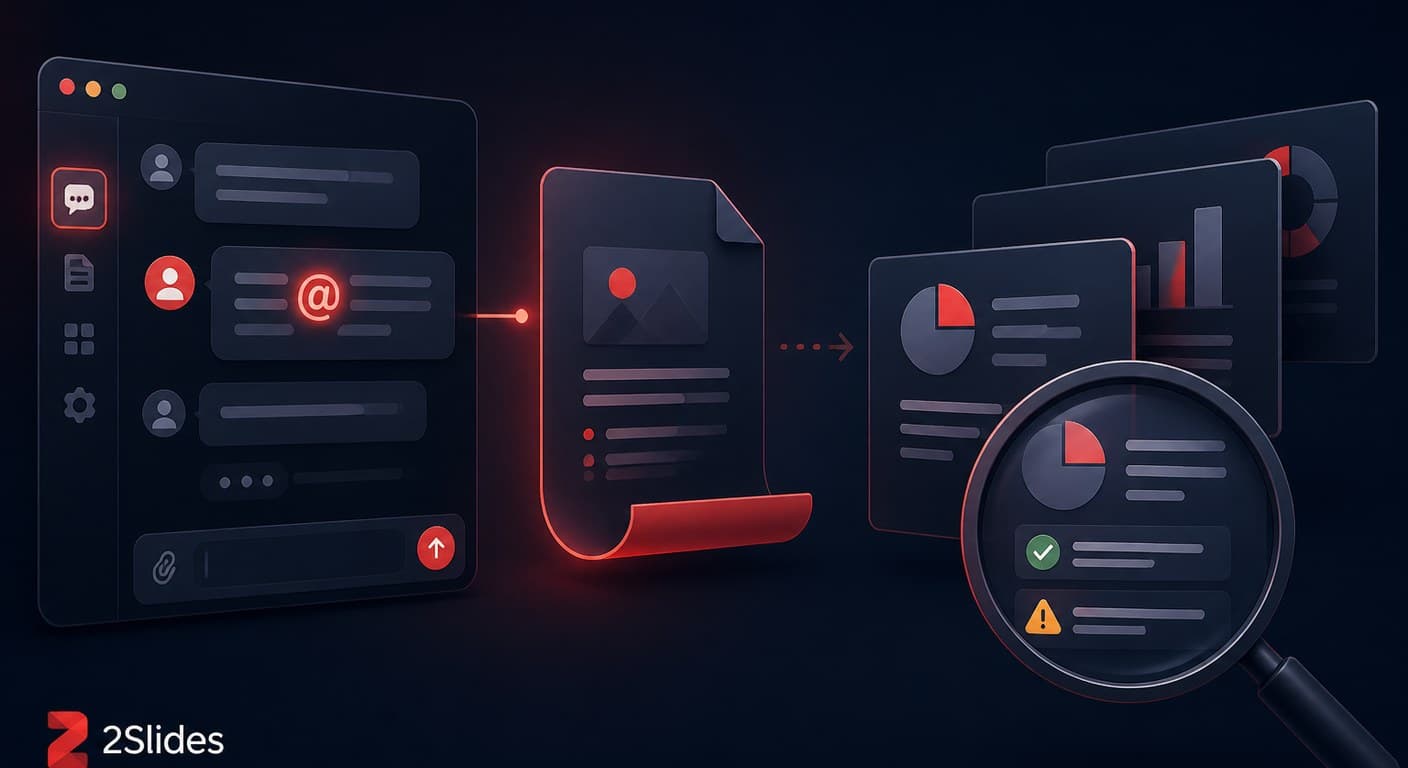
ChatGPT's @Presentations skill turns attached source material — notes, research, data, or an existing deck — into a Google Slides or PowerPoint file from inside a ChatGPT conversation. You invoke it with @Presentations, optionally point it at a template to match, and it plans the slides, builds the file, and validates the rendered output. It's the most accessible way to get a real deck out of ChatGPT — and OpenAI's own documentation is upfront that template matching and advanced formatting "may require manual refinement." This review covers the workflow, the genuine strengths, and the boundaries where you need different tooling.
@Presentations is a first-party ChatGPT capability (documented in OpenAI's ChatGPT use-case guides) that creates, edits, and previews slide files without leaving the chat. It works alongside two companions: the Google Drive connector, which reads source files and can update native Google Slides directly, and a Template Creator that converts an existing PowerPoint into a reusable template. Availability varies by plan and workspace configuration — it's aimed squarely at ChatGPT Work users.
OpenAI's starter prompt captures the intended workflow in one line:
"Use @Presentations to turn the material I've attached into a presentation for its intended audience. If I've included an existing deck or template, match its structure, visual style, and branding."
OpenAI's guide lists the caveats itself, which we'll take at face value plus practical translation:
| Documented limit | What it means for you |
|---|---|
| "Template matching and advanced formatting edits may require manual refinement" | Brand-exact decks aren't automatic; expect hand-fixing on anything with a strict style guide |
| "Claims should be verified against source material" | Standard AI caveat — the hallucination checklist applies |
| "Feature availability varies by subscription plan and workspace configuration" | Not everyone in your org can run the same workflow — a real problem for shared processes |
To these, add the structural boundaries no chat-app skill can cross: there is no API surface — you can't script it, schedule it, or call it from a pipeline; no repo or database context — it sees what you attach, not your codebase or warehouse; and no batch mode — fifty per-client variants of one deck means fifty conversations.
It's enough when: you're a ChatGPT Work user making occasional decks from documents, your template tolerance is "close is fine," and the deck's final home is Google Slides.
It isn't when:
The honest framing: @Presentations competes with "making the deck yourself," and wins. It doesn't compete with production pipelines, and OpenAI doesn't claim it does.
It ships with paid ChatGPT plans, with availability tied to plan tier and workspace configuration — OpenAI notes feature access varies. There's no separate per-deck fee beyond your subscription.
Yes — it creates and edits both Google Slides and PowerPoint files, and previews rendered slides in-chat. Post-export formatting fidelity is where OpenAI's "manual refinement" caveat applies most.
It will attempt to match an attached deck's structure, visual style, and branding, and the Template Creator can turn a house deck into a reusable template. Exact brand compliance still typically needs a manual pass — or a template-fill system where the layout is enforced rather than imitated.
Same "skill" vocabulary, different worlds: @Presentations lives in the ChatGPT app for interactive use; coding-agent skills are installable packages that run with repo context, scriptability, and chaining. The Codex skills guide covers that side of the fence.
No — it's a ChatGPT app capability, not an API endpoint. For programmatic slide generation you need a presentation API; our developer comparison with code examples walks through the options.
Create stunning AI-powered presentations in seconds. Transform your ideas into professional slides with 2slides AI Agent.
Try For FreeYour AI Agent for slides. Save time, shine faster with intelligent presentation creation.




© 2026 2slides. All rights reserved.