
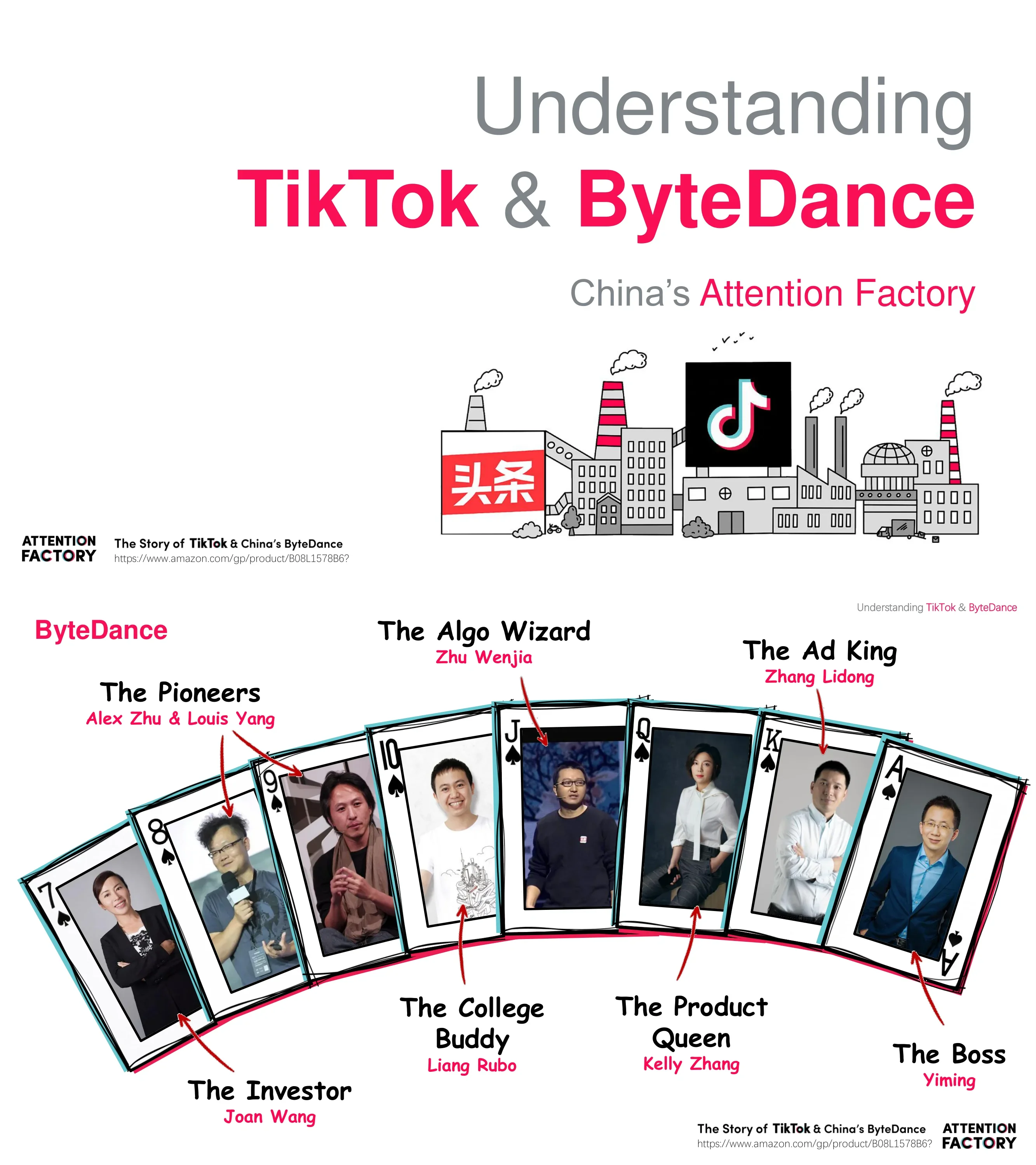
Understanding TikTok & ByteDance: China's Attention Factory
Quick Navigation
Tags
Share the slides
Understanding TikTok & ByteDance: China's Attention Factory
Detailed view of each slide page, including layout, key content and visual elements.
Title slide introducing the presentation theme — 'China's Attention Factory' — with factory illustration featuring Toutiao and TikTok logos
Centered title with subtitle, factory cityscape illustration at bottom
Playing card fan layout introducing 7 key ByteDance figures: The Pioneers (Alex Zhu & Louis Yang), The Algo Wizard (Zhu Wenjia), The Ad King (Zhang Lidong), The Investor (Joan Wang), The College Buddy (Liang Rubo), The Product Queen (Kelly Zhang), and The Boss (Yiming)
Full-width playing card arc with labeled portraits and role titles
Complete mapping of ByteDance's app portfolio split between China and International markets across Video, Information, Education, Social, Enterprise, and Others categories
Two-column grid (China vs International) with category rows and app icons connected by arrows
Timeline showing the evolution from Mindie (Paris, 2013) to Musical.ly (Shanghai, 2014) to Douyin (Beijing, 2016) to TikTok (Beijing, 2017) with app screenshots and Gantt-style timeline
Horizontal flow of phone screenshots with timeline bar chart below
S-curve growth chart showing three flagship eras: News aggregation (Toutiao, 2012-2016), Short video (Douyin, 2016-2018), and International (TikTok, 2018-present), with supporting app icons at each stage
Growth curve chart on left, explanatory text on right
Five-section outline: I. Structure (p7), II. People (p15), III. Products (p25), IV. Recommendation (p30), V. Monetization (p40). Adapted from the book 'Attention Factory'
Book cover image on right, numbered list on left with page numbers, disclaimer at bottom
Section divider for 'Structure' chapter with photo of ByteDance's fishbowl glass meeting room at AVIC Plaza headquarters in Beijing
Split layout — pink 'Structure' title on black left, large photo on right in hand-drawn frame
Organizational chart showing ByteDance's three core functional departments: User Growth, Technology, and Commercialization, with sub-units including Algorithms, Interactive Entertainment, Product Tech, and Vertical Products
Hierarchical org chart on left, explanatory text on right
Detailed architecture diagram of ByteDance's shared 'Middle Platform' showing Frontend Platform (business apps), Technical Middle Platform, Businesses Middle Platform, Data Middle Platform, Video Middle Platform, and Backend Platform layers
Stacked architecture layers on left, explanatory paragraphs on right
Explains how ByteDance shares user profile data across all its apps through a Central User Profile Interest Graph, enabling cross-app personalization
Text explanation on left, three-step flow diagram on right with app screenshots
Complete technology stack: Customized Business Systems (data warehousing, common services), Development Systems (performance, governance, stability, RPC), Computing (CaaS/PaaS/FaaS), and Storage (message queues, NoSQL databases)
Layered architecture diagram with categorized black boxes
Map and photos of ByteDance's Beijing headquarters evolution: Jinqiu Gardens (2012-2013), Yingdu Mansions (2013-2016), and AVIC Plaza (2016-present), all in the Zhongguancun tech district
Beijing city map on left, zoomed campus map on right, three office photos at bottom
Origin story of the ByteDance name, inspired by Steve Jobs' quote about technology married with liberal arts. Chinese name 字节跳动 literally translates as 'Byte Bounce.' Shows logo evolution from 2012 to 2018
Text narrative on left, logo comparison on right (original 2012 vs current 2018)
Corporate hierarchy showing ByteDance Ltd. (Cayman) at top with subsidiaries: TikTok Ltd (Cayman), Lark Technologies, Lemon Inc, ByteDance Inc (US), and ByteDance HK Limited, each with regional operating entities
Corporate tree diagram on center-right, explanatory text on left, app icons at bottom
Section divider for 'People' chapter with the playing card portrait arc of key ByteDance figures on dark background
Black background with card arc at top, pink 'People' title at bottom left
Profile of ByteDance founder Zhang Yiming — computer science graduate, serial entrepreneur, personally led development of the recommendation engine. Time Magazine 2019 quote: 'By many quantitative metrics, Zhang Yiming is the top entrepreneur in the world'
Large portrait photo on left, biography text and quote on right
Profile of Zhang Lidong, Chairman of ByteDance China — former journalist and newspaper ad exec who fast-tracked monetization. Legal representative for 36+ ByteDance branch companies. Quote from Lin Chufang: 'ByteDance has two irreplaceable people—one is Zhang Yiming, and the other is Zhang Lidong'
Text and quote on left, portrait photo on right grey background
Profile of Kelly Zhang, CEO of ByteDance China — hired in 2013 with her startup Picture Bar, oversaw development of TikTok, Douyin, Huoshan, and Neihan Duanzi. Expert in cultivating online communities
Portrait photo on left, biography text on right
Profile of Zhu Wenjia, widely considered the best algorithm engineer at ByteDance. Hired from Baidu in 2015, his team's 2017 upgrade of Douyin's backend led to explosive user growth. Now CEO of Toutiao
Title and text on left, speaking photo on right
Profile of Liang Rubo, Employee Number 3 — Zhang Yiming's university roommate at Nankai University in Tianjin. Often listed as a 'founder' of Douyin. Has held Director of Technology role and shifted to HR. Douyin was registered under his name via 'Beijing Weibo Vision Technology'
Portrait photo on left, biography text on right
Profiles of Musical.ly co-founders Alex Zhu and Louis Yang who pioneered the 15-second full-screen vertical short video format. ByteDance cloned, then acquired Musical.ly, merging it into TikTok. Alex became VP of Product and Strategy; Louis focuses on educational AI products
Text on left, two portrait photos stacked on right
Profile of Joan Wang, managing director at SIG China — the most important investor in ByteDance history. SIG owned ~12% in 2013 and remained the largest institutional investor. She believed in Zhang Yiming when most prominent VCs turned ByteDance down
Professional portrait on left, biography text on right
Full organizational chart of ByteDance's senior leadership under Zhang Yiming (Global CEO), including ByteDance China division (Zhang Lidong, Kelly Zhang) and global roles (Kevin Mayer, Alex Zhu, Chen Lin, Xie Xin, Liang Rubo, Hua Wei, Yan Shou) with their respective areas of responsibility
Hierarchical org chart with portrait photos, role boxes below each executive
Line chart comparing ByteDance's headcount growth (35 in 2012 to 100,000 in 2020) against Google, Alibaba, Tencent, and Facebook. ByteDance grew faster than all peers. The company aggressively poaches talent with above-market compensation
Growth chart on left, 2014 team photo on right, explanatory text at bottom
Section divider for 'Products' chapter featuring a factory conveyor belt illustration with ByteDance app icons rolling off the production line
Black background, pink 'Products' title bottom-left, conveyor belt illustration center-right
Same comprehensive app ecosystem map as page 3 — China vs International across all categories
Two-column grid with category rows
Detailed table of all Chinese apps with Logo, Name, Description, Year launched, and Official website — covering 20+ apps from Toutiao (2012) to Tomato Novels (2019)
Two-column data table with app icons
Two tables: International apps (TikTok, CapCut, Lark, DailyHunt, etc.) and Discontinued apps (Implied Jokes, Musical.ly, Flipagram, News Republic, Helo, TopBuzz, Vigo) with operation dates and shutdown notes
Side-by-side tables — International on left, Discontinued on right
Story of ByteDance's first app 'Hilarious Goofy Pics' (搞笑囧图) — a meme feed app created before the company was even officially registered. Early reputation for 'trashy mindless click-bait content' before transforming with Douyin/TikTok
Text on left, app screenshots in center, app logo on right
Section divider with long-tail content distribution chart showing three distribution methods: Subscription (1%), Social Distribution + Search (30%), and Community + Personalized Recommendation (100%)
Long-tail popularity curve at top, pink 'Recommendation' title at bottom
Comparison of desktop (2005) vs mobile (2016) usage patterns. Desktop had two long sessions (work + evening); mobile is fragmented into 30-40 short sessions throughout the day — perfect for short video format
Two-row timeline comparison (Desktop 2005 vs Mobile 2016) with activity labels
30-year timeline of information distribution methods: Curation (1991), Search (1995), Subscription (1999), Social (2003), and Recommendation (2011). Shows progression from information scarcity to information overload
Horizontal timeline with overlapping era arrows, explanatory text on right
Contrasts Pull model (search engines — active, people seeking information) with Push model (recommendation engines — passive, information finding people). Push model is better suited for mobile's fragmented time and small screens
Two-row diagram — Pull model on top, Push model on bottom, text explanation on right
Visual comparison of Musical.ly's weak personalization (limited to lip-sync and dance) vs TikTok's strong personalization (diverse niche categories). TikTok's superior video classification and recommendation enabled content diversification beyond teen lip-sync
Side-by-side funnel diagrams — Musical.ly (narrow) vs TikTok (wide, many niches)
Calendar grid showing 30+ short video apps launched from 2011-2016 in China. Douyin (A.me) launched late 2016 as a late mover in an already saturated market — even ByteDance's own staff were not optimistic
Monthly calendar grid with app logos, text explanation on right
Douyin DAU growth chart from A.me 1.0 (Sep 2016) to 200M DAU (Nov 2018). Key milestones: rebranding to Douyin, Zhu Wenjia's team taking over recommendation, Douyin ID system, livestream launch, and heavy ad spending. Q4 2017 was the critical inflection point
Area chart showing DAU growth with milestone callout boxes, explanatory text on left
Technology adoption lifecycle curve showing Douyin's repositioning from niche (teen/lip-sync/music) to mainstream ('Record beautiful life'). Musical.ly failed to cross the chasm in the US, but Douyin succeeded in China by shifting positioning to neutral/mainstream
Bell curve adoption diagram with positioning labels, text on right
Two reinforcing flywheel loops: Content Flywheel (better UX → more users → more creators → larger content pool → better UX) and Data Flywheel (enrich user profile → better matching → better UX → more time in app → enrich profile)
Two circular flywheel diagrams side by side with labeled steps
Origin story of TikTok's logo — a musical note in the shape of letter 'd' (for Douyin, meaning 'shaky beat'). Designer was inspired at a rock concert and used a glitch effect. Color scheme inspired by Chinese video app Meipai. Shows 16 original design concepts
A.me logo and text on left, 4x4 grid of logo design concepts on right
Section divider for 'Monetization' chapter with photo of TikTok advertising on the London Underground escalator (December 2018)
Black background, pink 'Monetization' title on left, London Underground photo on right
Stacked area chart showing China's digital media market share 2015-2019 H1. ByteDance grew from 2% to 18%, becoming second-largest player. Baidu halved from 29% to 15%. TikTok poses a challenge to Google/Facebook duopoly in the West
Market share stacked chart on left, brand logos on right edge, text on far right
Douyin's estimated 2019 revenue breakdown: 80% advertising, 8% extended businesses (games, paid knowledge, e-commerce), 7% platform services, 6% others (blue tick fees, DOU+ boost system). Total: 140 Billion RMB
Text explanation on left, donut chart on right
Douyin as a window into TikTok's future — China market is 12-18 months ahead. Screenshots showing Douyin's monetization models: in-feed video ads, gaming center, virtual gifts, and livestream e-commerce
Text on left, four phone screenshots in a row on right
China internet advertising by category (2018-2020e) in USD billions. Short video grew from 4% to 17%, surpassing search engine advertising (24% → 15%). E-commerce remained dominant at 35-39%
Stacked bar chart with category labels on right, text explanation on left
Promotion for 'Attention Factory' book by Matthew Brennan, edited by TechCrunch journalist Rita Liao — over 300 pages of original analysis and exclusive reporting. Available in Paperback and Kindle
Large book logo on left, stacked book photo on right, Amazon link at bottom
Closing slide with credits — Composition and Research by Matthew Brennan and Rita Liao, Illustrations by Valentina Segovia. Same factory illustration as title slide
Title repeated with credits on left, factory illustration on right
Common questions about this slide and the underlying presentation content.
This 46-slide presentation covers five major areas: ByteDance's corporate structure and organizational design, key people and leadership profiles, the complete product ecosystem (30+ apps across China and international markets), the recommendation algorithm and content distribution strategy, and monetization models including advertising revenue and e-commerce.
This presentation is adapted from 'Attention Factory: The Story of TikTok & China's ByteDance' by Matthew Brennan, a China internet specialist and internationally recognized speaker. It was edited by TechCrunch journalist Rita Liao, with illustrations by Valentina Segovia.
Yes, this template is ideal for corporate strategy presentations, investment research, MBA case studies, conference talks, and digital marketing workshops. Its professional design with custom illustrations, data charts, and organizational diagrams makes it suitable for both business and academic contexts.
The presentation features a unique 'attention factory' industrial theme with hand-drawn illustrations, a playing card motif for executive profiles, a consistent pink/teal/black color scheme, and rich data visualizations including growth curves, market share charts, and architecture diagrams.
Yes, the presentation extensively covers both platforms, comparing the Chinese market (Douyin) and international market (TikTok) side by side. It explains how Douyin pioneered features 12-18 months before they appeared on TikTok and maps the complete app ecosystem for both markets.
The presentation includes ByteDance's headcount growth data (35 to 100,000 employees), China digital advertising market share trends (2015-2019), Douyin's revenue breakdown (140 billion RMB), DAU growth from launch to 200 million users, and China internet advertising category breakdown by year.
Yes, you can download the PPTX file and customize the content, data, and visual elements to fit your specific presentation needs. The structured layout with section dividers, data slides, and profile pages provides a solid framework for creating your own ByteDance/TikTok analysis.
The presentation contains 46 slides organized into five sections: Structure (slides 7-14), People (slides 15-24), Products (slides 25-29), Recommendation (slides 30-39), and Monetization (slides 40-44), plus title, table of contents, and closing slides.

Create Your Own Slides
Turn your ideas into professional presentations in seconds with 2slides AI.
Reference professional designs, choose your style, and generate slides with perfect text rendering. Powered by Nano Banana—start creating your presentation now.
Your AI Agent for slides. Save time, shine faster with intelligent presentation creation.




© 2026 2slides. All rights reserved.