
The Social Hub Impact Report FY22-23 — 'Walking the talk', an annual ESG / sustainability report covering Environmental, Social and Governance progress across hotel and hybrid hospitality properties in Europe
Quick Navigation
Tags
Share the slides
The Social Hub Impact Report FY22-23 — 'Walking the talk', an annual ESG / sustainability report covering Environmental, Social and Governance progress across hotel and hybrid hospitality properties in Europe
Detailed view of each slide page, including layout, key content and visual elements.
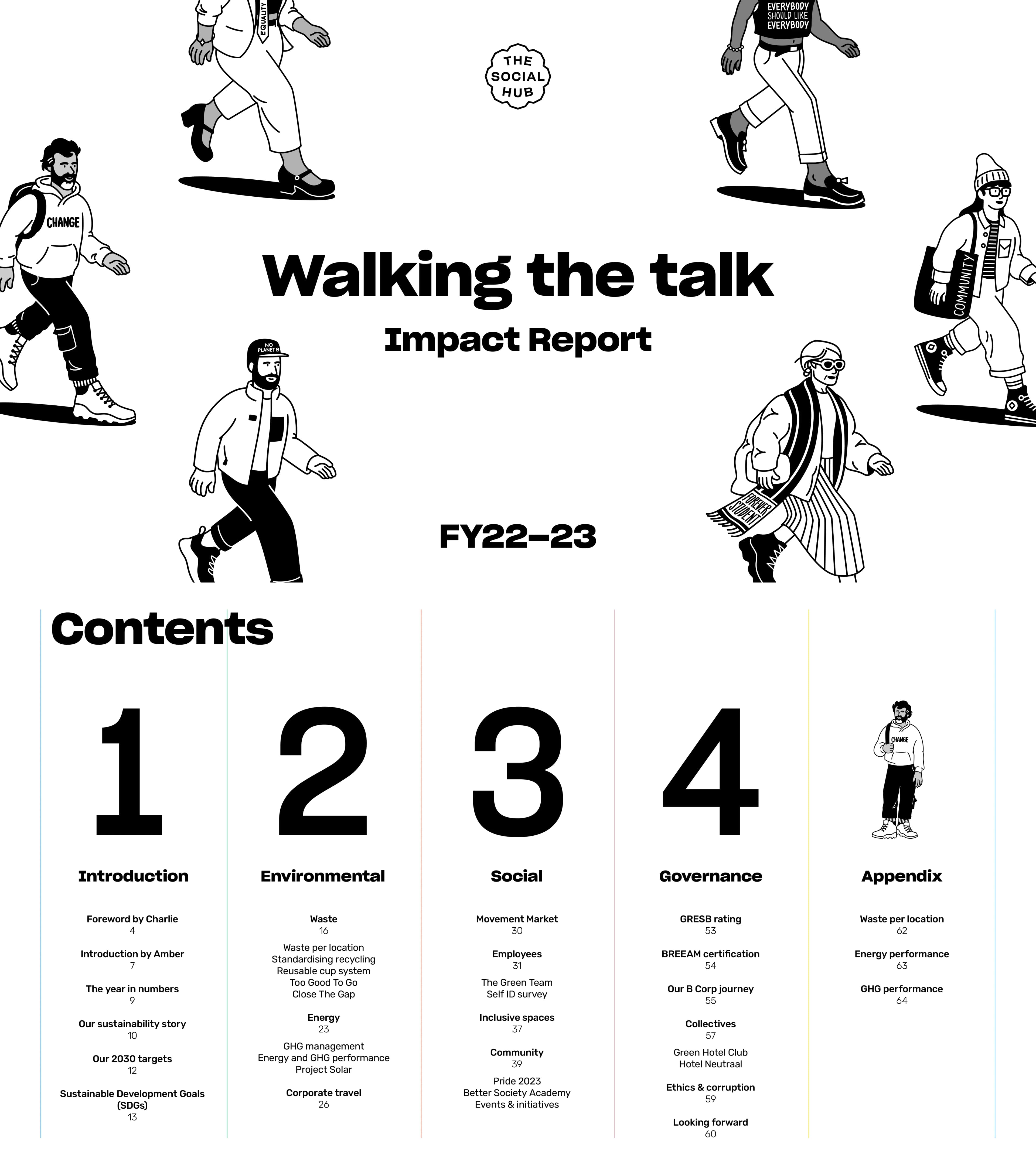
Title cover with the report name 'Walking the talk', subtitle 'Impact Report' and reporting period 'FY22-23' centered on a white canvas with The Social Hub logo at top.
Centered title with surrounding ring of seven character illustrations 'walking' across the page; logo top-center; subtitle below the main wordmark.
Five-section table of contents — Introduction, Environmental, Social, Governance, Appendix — with sub-topics and page numbers under each numbered column.
Five vertical columns separated by colored vertical rules (blue, green, red, yellow, grey); each column headed by a giant numeral 1–4 plus an illustrated character for section 5.
Section opener for the Introduction chapter, welcoming the reader into the report's narrative arc.
Full-bleed blue background, large left-side character illustration, big bold black headline running right.
CEO and founder Charlie MacGregor opens the report, reflecting on the rebrand to The Social Hub, B Corp progress, MOTG (Movement on the Ground) NGO partnership, and a Syria fundraiser that built a hospiteer pop-up hospital.
Editorial spread — large 'Foreword by Charlie' headline left, photo portrait in middle-left, three columns of body copy on the right.
Charlie's letter continues — explaining the rebrand from 'The Student Hotel', the No Sleep Till Inclusion campaign, the Better Society Academy launch, and an invitation to readers to engage with the report.
Multi-column text spread on the left, building exterior photograph on the right with a pull-quote overlay underneath.
Introduces six branded character mascots — Eco Jake, Community Ruby, Governance Giselle, Indigo Inclusive, Stacey Study, Impact Idris — each representing a sustainability/impact theme used throughout the report.
Six equal columns, each with a name, role description and full-body character illustration.
Director of Sustainability & Impact Amber Westerborg introduces the sixth annual report, highlights PowerNEST roof solution at Eindhoven, and points to a 50% on-site renewable energy target by 2030.
Two-column body text left, large studio portrait of the Director of Sustainability right with a green pull-quote box overlaying the photo.
Sustainability Director continues — covering the Green Team, B Corp certification effort, community programming, Pride initiatives and a closing personal sign-off.
Full-bleed photograph (women in conversation) on the left, white pull-quote overlay, three columns of body copy on the right.
Headline metrics dashboard — 57,467,386 litres of water donated, 10,000 trees planted, 2,075,432 room nights hosted, 6,293 meals saved from waste, 1,072 hours volunteering, 24 Green Ambassadors, 4,105 events, 3 toilets in Ghana, 2 Pride Hubs, 1 PowerNEST acquired, 2 reusable cup systems, 1st Better Society Academy.
Bento-style grid of metric tiles with photos and number-led stats on a vivid blue background.
Narrative bridge slide explaining The Social Hub's commitment to building responsible hotels, engaging with communities and setting realistic, measurable goals.
Big left-aligned three-line headline, short body paragraph below; floating character illustrations populate the right two-thirds.
Three-pillar mission framework explaining how the company acts, connects and inspires — supported by responsibility, partnerships and storytelling.
Full-width photo top half (community gathering); three numbered cards (1, 2, 3) with colored underline accents in the bottom half.
List of 2030 sustainability targets — 78% Scope 1+2 GHG reduction, 49.8% Scope 3 reduction per € value added, 100% of unavoidable emissions offset, 50% on-site energy, 'Paris Proof' 50 kWh/m² portfolio, BREEAM In-Use certification, 100% waste diversion, supplier monitoring, 10,000 volunteer hours, gender equality.
Photo left of hand holding a 'TSH Goes Circular' menu, target list right with bulleted bullet points.
First two highlighted SDGs: Gender equality (internal mobility programme, women into senior roles) and Clean water and sanitation (Made Blue × The Social Hub partnership donating 152,071,686 litres of clean water; 2,083 people with water access for 10 years).
Three-column SDG layout — gender equality text left, clean water text middle, photograph + pull-quote right; large SDG headline at the bottom.
Three more SDGs: The Good Roll x The Social Hub (toilet-paper sales fund three toilets in Ghana), Affordable & clean energy via PowerNEST, and Sustainable cities & consumption (inclusive design toolkit and Lesvos refugee volunteering trip).
Multi-card layout with three columns of text and two photographs (toilet-paper product stack and PowerNEST building) plus a snowy mountain photo.
Section opener for the Environmental chapter.
Full-bleed kelly-green background, character illustration on the left, three-line bold black headline on the right.
Waste sub-section opener — recycling, eliminating disposable cups, partnership with Too Good To Go, e-waste focus.
Title and goal pull-quote on the left, full-height photograph (mushrooms growing in soil) on the right.
Nine donut charts showing waste composition (Organic, Paper, Glass, Residual, Plastics, Other) for Amsterdam City, Amsterdam West, Groningen, Maastricht, Berlin, The Hague, Eindhoven, Delft and Barcelona Poblenou — including total kg per location.
3x3 grid of donut charts with a shared color legend in the bottom-left corner; large title bottom-left.
Description of new standardized recycling bins, signage and the 'Bin there, done that' coworker poster rolled out across hubs.
Body text two columns left, large photograph right showing the recycling poster framed on a wall.
Introduces a reusable cup deposit system replacing disposable cups, with three numbered steps: 1) buy a beverage and get a reusable cup, 2) enjoy your drink, 3) return your cup to be washed and reused up to 1,000 times.
Photo top-left, three-paragraph context text middle, large numerals 1, 2, 3 across the bottom with step descriptions and a pull-quote.
Two reusable cup partnerships described — BillieCup (Netherlands & Germany hubs, 50% reusable adoption at The Hague), Vytal (Berlin, 99.2% container return rate via app-based packaging).
Two side-by-side case studies separated by a vertical rule; each has a heading, body text and a small product photo.
Two more waste partnerships — Too Good To Go saved 6,293 meals (16,991 kg of CO₂ avoided) and Close The Gap, an IT recovery social enterprise, where the team donated 2,994 IT items including laptops, phones and screens.
Headline left, photo of person holding Too Good To Go bag in the middle, body copy spread across multiple columns; second case-study heading mid-page.
Editorial transition slide setting up the energy chapter — close-up photograph of women laughing while sorting clothing on hangers, with pull-quote about waste-reduction innovation.
Full-bleed photograph with a small white text block bottom-right.
Energy section explainer — Scope 1 and 2 emissions reduction (7% target vs FY21-22), 'Paris Proof' portfolio target of 50 kWh/m² by 2030, Science Based Targets initiative (SBTi) alignment and the difference between switching suppliers and reducing consumption.
Full-bleed mint-green background; bold black title and goals pull-quote on the left, two columns of body copy on the right.
Detailed performance table for 16 hub locations covering Electricity (kWh), Gas (m³), District heating & cooling (kWh), Water (m³), Scope 1 and Scope 2 GHG emissions in tonnes.
Full-page data table with column headers in colored underlines and one row per location; a 'See appendix for year-on-year comparison' note bottom-right.
Story of the rooftop renewable strategy — PowerNEST acquired at the Eindhoven hub, delivering 6–10x more energy than traditional solar via a 'crown' of micro-wind turbines and solar panels; expected to supply ~17% of property energy.
Three columns of body copy on the left, two stacked photographs on the right (building facade and rooftop solar panels), goal pull-quote bottom-left.
First fully operational post-COVID travel year (FY22-23) — Scope 3 from business travel makes up 5% of emissions, target of 0.35% YoY reduction, 25% reduction in flight emissions vs FY18-19 but 18.6% increase in flight emissions vs FY21-22.
Three columns of body text left, photograph of a suitcase in front of a business traveller right with a yellow pull-quote of the goal overlaid.
FY21-22 vs FY22-23 flight metrics — FY21-22: 2.4M km flown, 511,000 kg CO₂; FY22-23: 3.49M km flown, 948,800 kg CO₂; pull-quote on consistently reducing emissions per SBTi pathway.
Two columns of body copy on the left half; pull-quote and two cloud-shaped data callouts (paper-plane illustrations) on the right.
Section opener for the Social chapter.
Full-bleed brand-red background, large character illustration left ('Community' tote), three-line bold headline right.
Editorial transition spread emphasizing the company's commitment to safe and welcoming spaces; features a high-impact photograph of two drag performers at a hub event.
Full-bleed photograph with a small white pull-quote bottom-right.
Partner initiative with Movement on the Ground (MOTG) — donation cards in lobbies let community members buy specific items for refugee camps; piloted in FY22-23 at Amsterdam City and Florence Lavagnini.
Body text left, photograph of two people in front of an orange MOTG kiosk centre, pull-quote right.
Description of the Green Team programme — 24 Green Ambassadors across hubs supporting general managers and the Sustainability & Impact team; sharing best practices and innovative ideas.
Title and photograph of team dinner on the left half, three columns of body text on the right.
Self ID survey overview — 230 participants vs 113 in FY21-22; 66% of respondents at Support Hubs, 34% at local hubs; engagement up 10% YoY.
Body text left two columns, mosaic of 18 employee portrait photos right (3x6 grid).
Three top-line takeaways: 91% find the survey useful (+3% YoY), 89% feel TSH is inclusive and diverse (slight YoY drop in 'strongly agree'), 26% increase in agreement with disability inclusivity.
Full-bleed Pride parade photograph as background; three numbered insight cards (1, 2, 3) overlaid as floating white cards.
Donut charts comparing FY21-22 vs FY22-23 for age (16-25 +6%, 26-35 -3%, 36-45 +2%) and gender identity (female -3%, male +4%, non-binary unchanged at 1%, undisclosed -1%).
Two rows of side-by-side donut charts (FY21-22 vs FY22-23) with a YoY commentary column on the right.
Donut charts comparing ethnicity (white +2%, mixed-race +2%, all others down vs FY21-22) and religion (non-religious unchanged at 58%, Christian -3%, Muslim/Buddhist +1%, spiritual -7%, undisclosed +5%).
Same template as page 34 — two pairs of donut charts with a commentary column.
Donut charts comparing disabilities (3% increase in developmental and mental/emotional disabilities) and migration (10% drop in expats to 31%; ~5% non-disclosure).
Same template as page 34/35 with two pairs of donut charts and a YoY commentary column.
Discusses the design pillar of D&I strategy — updates to interior design toolkit beyond Disability Discrimination Act compliance, accommodating gender, neurodivergence, vision and hearing needs.
Body text left two columns, large photograph of a candlelit dinner with diverse guests right.
Deep dive on inclusive public bathrooms — Mijksenaar 'Beyond the Binary' wayfinding standards, retrofitting existing hubs, gender-neutrality challenges, future redesign criteria.
Five columns of body text with two minimalist toilet/urinal icon callouts in the top-right corner.
Introduction to the Pride 2023 campaign — LGBTQIA+ events, celebrations, transformation of hotels into 'Pride Hubs', preview of the upcoming Pride section.
Bold 'Community' title left, body text below it, large vibrant photograph right of a Pride event with rainbow runway and 'The Social Hub' branded backdrop.
Recap of the 'No Sleep Till Inclusion is Real' campaign — full-blown rollout, 60+ events spanning six days of Pride including Better Society Academy launch, Filipino-European forum, Pride University and queer integration programme.
Three-column body text left with three small social-media post mockups bottom-left; large group photograph right with overlay pull-quote.
Two Pride Hub case studies — Madrid (events, brand ambassadors Tuviérra, Paco Leon, Barry Brandon) and Amsterdam (sexual orientation/gender identity space, mental health sessions, Pride Amsterdam organisation collaboration).
Two side-by-side case studies separated by a vertical rule; each combines body copy and a photograph.
Pride University — masterclasses with VU, HvA, InHolland, UvA, ROC van Amsterdam universities; Pride Canal Parade — TSH-themed boat with Queen Elizabeth's quote 'A fan is the only suitable gift for a Queen'; €3,900 donated to LGBTQIA+ Asylum Support.
Body copy left, two photographs (drag performer in pink, Pride parade boat) top-right; second body block bottom-right.
Introduction to the Better Society Academy (BSA) — three-day immersive programme launched in 2023 in partnership with Hyper Island, focused on social changemakers; planning to scale.
Body text left two columns, photograph of immersive learning space (multi-screen, ambient lighting) right with green pull-quote underneath.
Article by Lucien van Geffen, Head of TSH Academy — reflects on partnership with Hyper Island, the LGBTQIA+ activist focus of the first cohort, 30 participants, 10 lectures, panels and field trips, exploring topics like 'Making cultural institutions more equitable'.
Bold byline title left, body text in three columns, two photos (BSA workshop, BSA presentation) integrated in the middle.
Continuation — early roundtable feedback, schedule tweaks based on participant input, looking forward to growing the BSA community; 32% more comfortable launching a business or NGO post-programme.
Two columns of body text left, large photograph right of participants celebrating with a teal pull-quote overlay.
Participant breakdown — 25 participants from 8 countries; 16 entrepreneurs, 4 corporate professionals, 3 performing artists, 1 social worker, 1 politician; gender mix 18 female, 7 male, 1 dual-gender, 1 non-binary; benchmarking results: +32% confident in identifying partners, +27% in stakeholder mapping, +20% in business case building, +29% prepared for legalities, NPS +66.
Title left, stats list middle, illustrated map of Europe with country markers (UK 10, Netherlands 1, Germany 2, Austria 3, France 1, Spain 5, Italy 2) on the right; benchmarking stats column far right.
Editorial transition spread emphasizing partnerships, with high-fashion photograph of an ambassador; pull-quote bottom-left.
Full-bleed dark photograph; pull-quote bottom-left.
Amsterdam City partnered with BYBORRE and Reconstruct (female design collective) on a sustainable upcycling fashion show with brand ambassador Boré Akkersdijk; sparked conversations on conscious consumerism and circular fashion.
Title across the top, three-column body text below, large studio fashion photograph right.
Two community-dinner initiatives — Maastricht's monthly NOAH Serve the City dinners with up to 80 attendees; Groningen's Christmas brunch for lonely seniors with three-course meal sponsored by Bidfood, The Choco Company and Marne Mosterd.
Two-up layout — Maastricht story top-left with photo of community dinner, Groningen story top-right with photo of seniors at table; titles bookend the spread.
Madrid hosted a 'Linguistic Lunch' on inclusive language with Michelle Rodriguez Chiv from Lingüísticamente hablando (published in La Vanguardia); Barcelona hosted an International Women's Day 'Women of Impact' roundtable on gender inequity and women's work.
Body text columns left, central photograph (woman speaking with a microphone) right; two case studies separated horizontally.
Florence Lavagnini hosted 'The Power of Love: Kiki Ball' — a Ballroom-scene event with 10 fashion show categories, judges including legendary pioneer La B. Fujiko 007 and Amber Juicy Couture; Bologna and Florence Lavagnini partnered with Moaconcept on a shoe-recycling drive (400+ pairs donated, free drink in exchange via QR code).
Two-up layout — Kiki Ball case study left with photograph of dancers in front of Florence skyline, Moaconcept case study right with photograph of person with sneakers.
Section opener for the Governance chapter.
Full-bleed bright yellow background, character illustration on the left ('Equality' sash), three-line bold headline right.
GRESB (Global Real Estate Sustainability Benchmark) results — Standing assets up to 81 (2023), Assets in development at 88 points; three-star rating across both reports; goal to keep increasing scores yearly.
Photograph of Eindhoven property left with goal pull-quote overlay; body text right; two star-rating ratings cards bottom-right.
Three new BREEAM New-Build certifications in FY22-23 — Madrid 'Very Good', Toulouse 'Very Good', Barcelona 'Excellent' (first TSH property to achieve Excellent).
Goal block bottom-left, body text top-middle, three property photographs bottom-right (Toulouse, Madrid, Barcelona).
Explains why B Corp matters for The Social Hub — community is at the heart of programming, dissatisfaction with prior certifications that under-weight social impact, B Corp's balanced environmental + social scoring.
Full-bleed yellow background, six character illustrations of changemakers walking on the left, body text right.
Walks through the B Corp process — under Director of Sustainability & Impact for two years; assembling B Corp team; initial assessment scored just below 80; aiming for 100+ points; assessment submission planned for Q1 2024; cliff-hanger ending.
Body text in four columns left, large photograph of employees in branded shirts right.
Co-founded the Green Hotel Club (GHC) in Amsterdam in March 2023 with high-quality, future-proof hospitality businesses. Initial projects: food-waste campaign with Amsterdam municipality, Royal Hospitality Netherlands group and Samen Tegen Voedselverspilling; F&B inspiration sessions; collective F&B purchasing platform with last-mile delivery.
Title 'Collectives' bottom-left, GHC sub-section top, body text in two columns, photograph right of two people clinking glasses.
Rotterdam-based collective 'Hotel Neutraal' formed alongside GHC — 16 hotels including The Social Hub Rotterdam, BlueCity, Rotterdam Partners and the municipality; baseline assessment fall 2022; quick environmental wins; next step in summer 2023 to address complex themes requiring long-term collaboration.
Body text in two columns left, large photograph right of person cooking; Hotel Neutraal logo callout in middle-bottom.
Whistleblowing policy expanded to include all stakeholders, supplier code of conduct introduced; no incidents reported in FY22-23; Executive Board receives regular updates from internal trust councillors.
Body text left in two columns, large photograph right of three people in conversation outside.
Closing reflection — fiscal year already in full swing; CSRD compliance work; deepening materiality assessments; ESG data and reporting requirements; BREEAM In-Use recertification of Dutch portfolio; food-waste, hiring and supplier initiatives; B Corp journey continues.
Bold title top-left, three columns of body text on the left, large photograph right of branded mosaic-tile bench at a hub.
Section opener for the Appendix chapter.
Full-bleed grey background, monochrome character illustration on the left ('CHANGE' sweatshirt), 'Appendix' label right.
Detailed FY21-22 vs FY22-23 waste composition table for nine hubs (Amsterdam City, Amsterdam West, The Hague, Groningen, Eindhoven, Maastricht, Delft, Berlin, Barcelona) across Organic, Paper, Glass, Residual, Plastics, Other.
Full-page wide data table with color-coded column rules; footnote explaining Berlin and Barcelona data limitations.
Full FY21-22 vs FY22-23 energy data — Electricity (kWh), Gas (m³), District heating & cooling (kWh), Water (m³) — for 17 hub locations including Amsterdam City, Rotterdam, The Hague, Groningen, Eindhoven, Maastricht, Florence Lavagnini, Berlin, Vienna, Paris, Delft, Bologna, Madrid, Toulouse, Barcelona.
Full-page wide data table with YoY columns; footnote about Madrid/Toulouse/Barcelona Q4-2022 opening.
FY21-22 vs FY22-23 GHG data — Scope 1, Scope 2, Total emissions (tonnes), Total emissions (kg/m²) — across 16 hubs including Amsterdam City, Rotterdam, The Hague, Groningen, Eindhoven, Maastricht, Florence Lavagnini, Berlin, Vienna, Paris, Delft, Bologna, Madrid, Toulouse, Barcelona.
Full-page wide data table with YoY columns and percentage deltas.
Closing thank-you and contact email — sustainability@thesocialhub.co — for collaborations, partnerships or suggestions.
Full-bleed black background, white text top-left, large white circular 'The Social Hub' logo bottom-left.
Common questions about this slide and the underlying presentation content.
Yes — every page is built from clean, modular layouts (covers, table of contents, section dividers, two-column editorial spreads, donut-chart dashboards, KPI bento grids, data tables and closing slides) that you can swap with your own copy, images, charts and brand colors.
65 pages organized into five sections: Introduction, Environmental, Social, Governance and Appendix. It includes covers, executive forewords, KPI dashboards, SDG case studies, performance tables, employee surveys, community case studies and a full data appendix.
It works for sustainability/impact reports, ESG and CSRD updates, B Corp progress narratives, GRESB/BREEAM stakeholder briefings, DEI reports and community/Pride recap decks — especially in hospitality, real estate, lifestyle and purpose-driven brands.
Yes — there are donut chart matrices for waste composition by location, before/after demographic charts, a flight-emissions cloud-callout layout, and three full data tables for waste, energy and GHG performance with year-over-year comparison columns.
Absolutely. Each section uses a single dominant color (blue Introduction, green Environmental, red Social, yellow Governance, grey Appendix). Swap the section colors, update the headlines and your report instantly takes on a new visual identity.
The character illustrations are a strong design accent, but every page also balances illustrations with photography, data, and typography — so you can fully replace illustrations with your own product/people photos, icons or brand mascots without breaking the layout.
Yes. You can keep the editorial covers, foreword spreads, framework slides and case-study templates, and trim the data appendix down to a single table that matches your company's footprint. The structure scales up or down comfortably.
You can download the editable PowerPoint (.pptx) source for full layout control, plus the original PDF reference so you can review the design before opening it in PowerPoint or converting to Google Slides/Keynote.

Create Your Own Slides
Turn your ideas into professional presentations in seconds with 2slides AI.
Reference professional designs, choose your style, and generate slides with perfect text rendering. Powered by Nano Banana—start creating your presentation now.
Your AI Agent for slides. Save time, shine faster with intelligent presentation creation.




© 2026 2slides. All rights reserved.