
Part of Investor presentation examples · Australian investor presentation examples
Mesoblast ASX Investor Day Presentation November 2026 — Mesoblast Ltd's (ASX: MSB; Nasdaq: MESO) 20-slide CEO presentation at the ASX Investor Day, lodged with the ASX on November 15, 2026. It covers FY2026 results from the first year of the U.S. commercial launch of RYONCIL (remestemcel-L-rknd), including net revenue of US$115M. It also covers the company's IP and manufacturing moat, its allogeneic mesenchymal stromal cell pipeline, the adult SR-aGvHD label-extension trial, the rexlemestrocel-L Phase 3 chronic low back pain program, heart failure and Group 2 pulmonary hypertension opportunities, and the next major milestones.
Uses this deck’s cover as a style reference for slides made from your own content. Or pick any page below to use its layout as the reference.
Quick Navigation
Tags
Share the slides
Mesoblast ASX Investor Day Presentation November 2026 — Mesoblast Ltd's (ASX: MSB; Nasdaq: MESO) 20-slide CEO presentation at the ASX Investor Day, lodged with the ASX on November 15, 2026. It covers FY2026 results from the first year of the U.S. commercial launch of RYONCIL (remestemcel-L-rknd), including net revenue of US$115M. It also covers the company's IP and manufacturing moat, its allogeneic mesenchymal stromal cell pipeline, the adult SR-aGvHD label-extension trial, the rexlemestrocel-L Phase 3 chronic low back pain program, heart failure and Group 2 pulmonary hypertension opportunities, and the next major milestones.
Detailed view of each slide page, including layout, key content and visual elements.
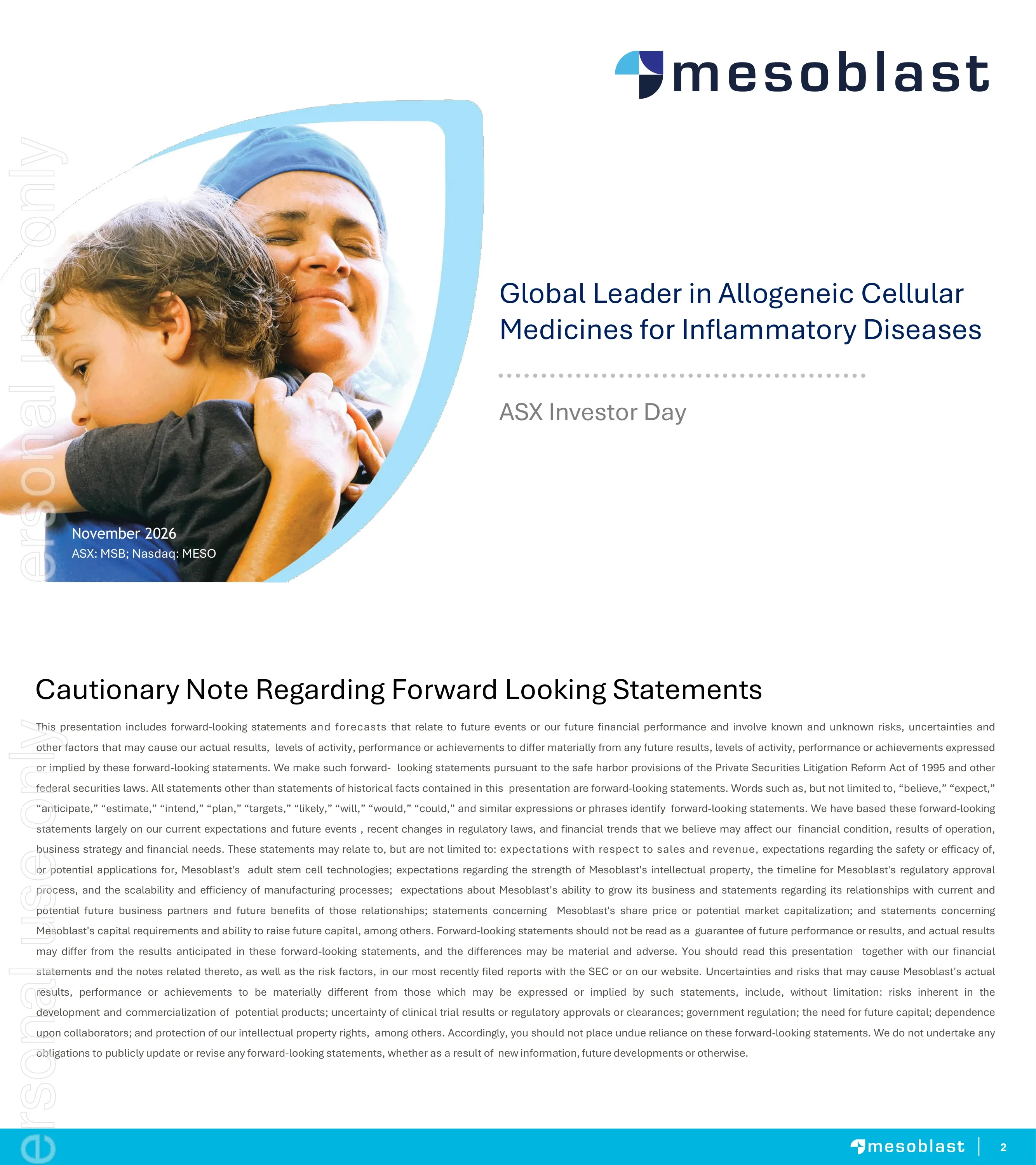
This is the cover slide, which positions Mesoblast as a global leader in allogeneic cellular medicines for inflammatory diseases. It is dated November 2026 and gives the tickers ASX: MSB and Nasdaq: MESO.
Split layout: a patient photo in a leaf-shaped frame on the left, with the logo, title and subtitle on the right
This is a standard safe-harbor disclaimer under the Private Securities Litigation Reform Act of 1995. It lists risks including clinical trial and regulatory uncertainty, manufacturing scalability, intellectual property, partner relationships and the need for future capital. Readers are referred to the company's SEC filings.
Single full-width block of justified text below the title
In the first year of the U.S. commercial launch of RYONCIL, FY2026 net revenue was US$115M and gross profit on total sales, excluding amortization expense, was US$110M. Milestones achieved: 350 patients treated in the Phase 3 chronic low back pain (CLBP) trial; alignment with FDA on filing for approval in end-stage heart failure; an adult SR-aGvHD label-extension registration trial now enrolling, targeting 40 U.S. sites; and FDA clearance of the IND for a pediatric Duchenne Phase 3 trial. The company also entered a US$125.0 million five-year non-dilutive credit facility that consolidates and retires two higher-cost facilities.
Two-section bullet and checklist on the left, with a product vial image and RYONCIL logo on the right
Mesoblast lists its competitive advantages. Its global IP portfolio of >1,100 patents and patent applications provides protection through >2044, and RYONCIL is described as the first and only MSC approved by FDA. Further claims cover the use of FDA guidance for label extensions, large completed U.S. randomized trials, leadership in cell manufacturing, next-generation tissue-homing technology, and an experienced executive team.
Single-column checklist of eight items
The slide has three pillars. First, Ryoncil, the only FDA-approved MSC: net revenue of US$115M in FY2026, its first full year post launch, described as highly profitable on a stand-alone basis, with opportunities in adult aGvHD and pediatric inflammatory diseases such as Duchenne muscular dystrophy. Second, commercial capability: >50 centers onboarded, 98% of US lives covered and a J-code obtained. Third, rexlemestrocel-L as the engine for blockbuster opportunities in chronic low back pain and pulmonary hypertension in left heart failure.
Three columns, each with an icon tile, heading and supporting text
The pipeline chart covers assets wholly owned and unencumbered in U.S. markets. RYONCIL is approved for pediatric SR-aGvHD and is in development for adult SR-aGvHD and Duchenne's. Rexlemestrocel-L (STRO3+) is in development for end-stage adult HFrEF, Class II/III HFrEF, pulmonary hypertension and CLBP. The chart states TAMs of ~US$1B (SR-aGvHD), >US$1B (Duchenne's), >US$10B (cardiopulmonary) and >US$10B (CLBP). Notes state that JCR holds certain Japanese MSC rights, Grünenthal licenses CLBP rights in Europe and Latin America/Caribbean, and Tasly holds chronic heart failure rights in China. The chart is labelled figurative.
Pipeline table with Product, Indication, Phase 2, Phase 3 and Approved columns, progress bars, TAM circles on the right, and footnotes
This section divider introduces the RYONCIL program in steroid-refractory acute graft versus host disease.
Section divider: photo in an orange leaf-shaped frame on the left, with the title on the right
More than 2,000 U.S. adults have SR-aGvHD each year, and ~50% of them have Grade III/IV disease. The registration trial randomizes 180 Grade III/IV SR-aGvHD adults 1:1 to ruxolitinib or ruxolitinib + RYONCIL. The primary endpoint is Day 28 overall response and the secondary endpoint is Day 180 overall survival. The trial targets ~40 U.S. centers, representing >50% of annual allo transplants, and is expected to last 18-24 months. An interim analysis is planned when the first 102 patients (57% enrolled) reach Day 28, and is expected in Q4 CY2027.
Bullet list on top, with a dark blue banner below containing a pie chart and the interim-analysis callout
This section divider introduces the rexlemestrocel-L program in chronic low back pain due to degenerative disc disease.
Section divider: photo in a blue leaf-shaped frame on the left, with the title on the right
The slide describes targeted, minimally invasive delivery of rexlemestrocel-L to the degenerated disc. It lists four milestones to commercial launch: the P3 trial is fully enrolled with 350 patients; the primary endpoint is 12-month pain reduction and the secondary endpoint is improved function; trial readout is expected in H2 CY2027, followed by a BLA filing; and potential approval in CY2028.
Left: anatomical illustration of a healthy versus degenerative disc with a delivery catheter. Right: a numbered milestone list.
About 7M US patients have moderate to severe degenerative disc disease within 5 years of diagnosis that is refractory to medical therapies, including opioids. The treatment pathway runs from conservative treatments (NSAIDs, physical therapy, chiropractic, acupuncture, anticonvulsants) to opioid analgesics, interventional therapies (epidural steroid injections, radiofrequency ablation, spinal cord stimulation, intrathecal pumps) and then surgery (spinal fusion, disc replacement). Rexlemestrocel-L targets moderate-to-severe CLBP, positioned across the opioid and interventional stages.
Four color-coded columns representing treatment stages, with a bracket above the middle two columns
This section divider introduces the rexlemestrocel-L heart failure program.
Section divider: photo in a teal leaf-shaped frame on the left, with the title on the right
The slide argues that an LVAD BLA approval could open label-extension potential in two further blockbuster indications with the same mechanism. Three indications are shown: end-stage HFrEF with LVAD (159-patient LVAD trial: reduction in major GI bleeding and RV dysfunction); NYHA Class II/III HFrEF (565-patient DREAM-HF trial: reduction in cardiac death, MI and stroke); and Group 2 pulmonary hypertension (DREAM-HF: improved diastolic function, pulmonary hypertension and survival). The common mechanism is a reduction in M1 macrophage and T-cell burden (IL-1β, IL-6, IL-12, IFN-γ), improved endothelial/NO signaling, and improved LV, pulmonary arterial and RV function.
Three teal header cards on top, with arrows pointing up from a mechanism-of-action box at the bottom
LVAD II 6-month major mucosal bleeding events (MMBE rate per 100 patient months), control versus rexlemestrocel-L: all subjects (N=159) 15.6 vs 3.8 (p<0.0001); destination therapy (n=59) 20.4 vs 2.5 (p=0.0007); bridge to transplant (n=100) 12.9 vs 4.6 (p=0.0172), all nominal p-values. Mesoblast plans to file with FDA for full approval in patients with LVADs. Major GI bleeding is an FDA-acknowledged indication for which rexlemestrocel-L has Orphan Drug designation, and FDA confirmed that the BLA filing may proceed for patients with life-threatening major GI bleeding.
Data table at the top center, with three bullets below
The slide explains how left-heart disease raises pulmonary pressure and right ventricular load. LV or valve disease raises left atrial pressure, the pressure backs up into the lung veins and capillaries, and the higher pulmonary pressure increases RV afterload.
Three-step left-to-right process diagram with illustrations and captions
In DREAM-HF, 219 HFrEF patients had established Group 2 pulmonary hypertension, defined as PASP >35 mmHg. A single intra-cardiac injection improved LV diastolic function measured by Doppler echocardiography and reduced Left Atrial Volume Index over 36 months. It also reduced cardiac mortality by 53% in HFrEF patients with Type 2 PH and active inflammation, defined as CRP >2 mg/L (p=0.036).
Text-only slide with four bullets
Group 2 PH is the most common PH group, at approximately 40% of left-sided heart failure, and no drugs currently used for HFrEF or HFpEF have any effect on it. The illustrative U.S. patient funnel shows 6.5M total heart failure patients (3.0M HFrEF, 3.5M HFpEF). Of these, ~35% have sPAP >35 mmHg (1.05M HFrEF, 1.225M HFpEF), and ~50% of those have CRP ≥2 (0.5M HFrEF, 0.6M HFpEF). That gives a potential target population of ~1.1M patients.
Left: clinical-context card with star bullets. Right: three-tier funnel inside a bordered panel.
This section divider introduces the closing summary.
Section divider: photo in a light-blue leaf-shaped frame on the left, with the title on the right
There are three workstreams. (1) Commercial and label expansion for RYONCIL: grow the pediatric SR-aGvHD revenue base, complete the adult second-line Grade III/IV registration trial, and extend into pediatric inflammatory rare diseases including Duchenne; the adult SR-aGvHD market is described as ~3x the pediatric market. (2) The CLBP blockbuster program: patient treatment in the pivotal Phase 3 was completed in August, follow-up continues through 12 months, and trial completion is targeted for mid-CY2027, followed by a BLA filing. (3) The heart failure blockbuster program: complete the BLA for end-stage heart failure patients on LVADs, pursue label extensions into PH and NYHA II/III HFrEF, and seek a cardiopulmonary strategic alliance.
Three-column card layout with colored top bars, numbered circles, stage tags and a bottom callout box in each column
This is the closing slide, with the Mesoblast logo and a thank-you message.
Photo in a leaf-shaped frame on the left, with the logo and 'Thank You' on the right
Common questions about this slide and the underlying presentation content.
It is a 20-slide CEO presentation that Mesoblast Ltd (ASX: MSB, Nasdaq: MESO) gave at the ASX Investor Day and lodged with the ASX on November 15, 2026. It reviews FY2026 performance, the RYONCIL launch, the rexlemestrocel-L pipeline and upcoming milestones.
The deck reports FY2026 net revenue of US$115M, the first full year after RYONCIL's U.S. launch. It reports gross profit on total sales, excluding amortization expense, of US$110M. All figures are in US dollars.
Mesoblast's fiscal year ends June 30, so FY2026 runs from July 1, 2025 to June 30, 2026. Calendar-year milestones in the deck are labelled CY, for example Q4 CY2027 and CY2028.
The deck expects an interim analysis of the adult SR-aGvHD trial in Q4 CY2027. For CLBP, slide 10 gives a Phase 3 readout in H2 CY2027 followed by a BLA filing, and slide 19 targets trial completion for mid-CY2027; potential CLBP approval is CY2028. It also plans a BLA filing for rexlemestrocel-L in end-stage heart failure patients on LVADs.
In LVAD II, the 6-month rate of major mucosal bleeding events per 100 patient months was 15.6 for control versus 3.8 for rexlemestrocel-L across all 159 subjects (nominal p<0.0001). Results are also shown for the destination therapy and bridge to transplant subgroups.
The pipeline slide shows TAMs of ~US$1B for SR-aGvHD, >US$1B for Duchenne's, and >US$10B each for the cardiopulmonary indications and chronic low back pain. The Group 2 pulmonary hypertension funnel estimates a U.S. target population of ~1.1M patients.
RYONCIL (remestemcel-L-rknd) is Mesoblast's allogeneic mesenchymal stromal cell therapy for pediatric steroid-refractory acute graft versus host disease. The deck describes it as the first and only MSC approved by the FDA, with >50 centers onboarded, 98% of US lives covered and a J-code obtained.
Investors, biotech analysts and industry professionals tracking Mesoblast, allogeneic cell therapy, or treatments for chronic low back pain, heart failure and graft versus host disease. They will find a short summary of FY2026 results, the pipeline and catalyst timelines.

Create Your Own Slides
Turn your ideas into professional presentations in seconds with 2slides AI.
Reference professional designs, choose your style, and generate slides with perfect text rendering. Powered by Nano Banana—start creating your presentation now.
Your AI Agent for slides. Save time, shine faster with intelligent presentation creation.


© 2026 2slides. All rights reserved.