
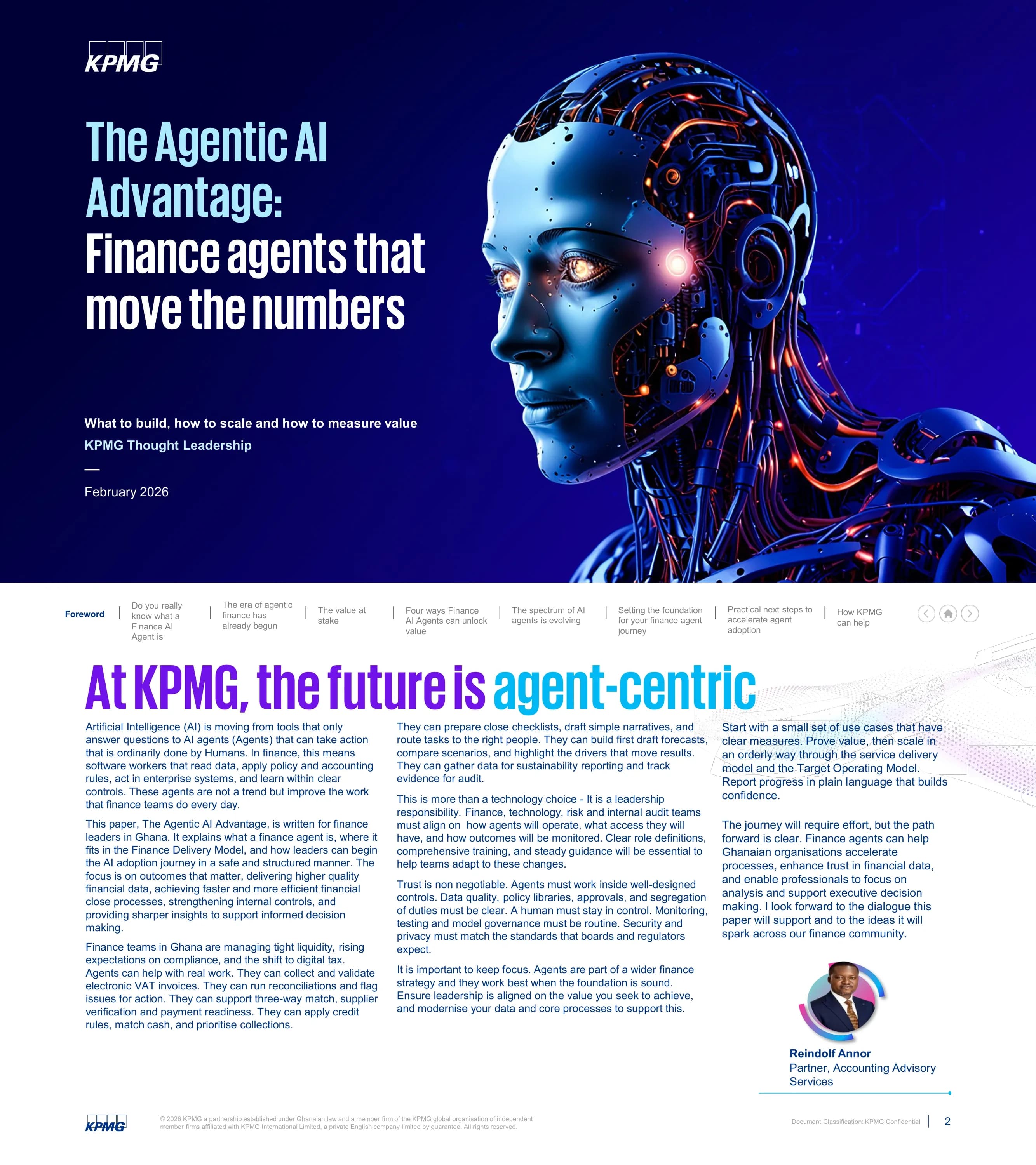
The Agentic AI Advantage: Finance Agents That Move the Numbers
Quick Navigation
Tags
Share the slides
The Agentic AI Advantage: Finance Agents That Move the Numbers
Detailed view of each slide page, including layout, key content and visual elements.
Title slide with KPMG branding. Subtitle: What to build, how to scale and how to measure value. KPMG Thought Leadership, February 2026.
Left-aligned title text with AI robot face illustration on right, deep blue/purple gradient background
Foreword by Reindolf Annor, Partner at KPMG Accounting Advisory Services. AI moving from tools to agents that take action in finance. Focus on outcomes: quality financial data, faster close, stronger controls. Trust is non-negotiable. Start with small use cases, prove value, then scale.
Navigation bar at top, three-column text layout with author photo and bio at bottom right
Table of contents with eight sections: What a Finance AI Agent is (04), Era of agentic finance (05), Value at stake (07), Four ways to unlock value (08), Spectrum of agents evolving (10), Foundation for finance agent journey (14), Practical next steps (23), How KPMG can help (26).
Two-column numbered contents list with blue numbers, abstract wave graphic at bottom
Definition of a Finance AI Agent: a digital worker that fulfils finance objectives by combining LLMs with planning, orchestration, data retrieval, and governance. Reads structured and unstructured data, applies accounting policies and tax rules, takes action in systems, learns from feedback.
Large title, three-column capability description, architecture diagram at bottom showing AI agents + LLM + Instructions + Planning + Knowledge + Tools
KPMG Quarterly Pulse Survey data: 65% of companies piloting AI agents (up from 37% last quarter), 99% planning production deployment, but only 11% have implemented in production. GenAI builds digital assistants; agentic AI fully automates.
Hero banner with AI robot image, two circular stat graphics (65%, 99%), and explanatory text right
AI adoption in Ghana growing 28% annually since 2017. National AI Strategy (2023-2033) and One Million Coders Program. Global AI market expected to grow 25-fold from $189B to $4.8T by 2033. KPMG GenAI Value Assessment: 17 million companies, 3 billion data points. Agentic AI best positioned for high-complexity tasks.
Split layout - Ghana AI context on purple background left, KPMG GenAI Value Assessment steps right with icons
Two of four value propositions: 1) Agents widen the aperture for automation - taking on tasks like invoice checking, journal preparation, reconciliation, VAT validation, credit rules. 2) Agents do not sleep - continuous operation, parallel processing, responding to off-hour events.
Large title with two sections, each with icon and descriptive text
Two more value propositions: 3) Agents are wired for change - adapt to new workflows, reduce change management needs, auto-adjust to policy changes. 4) Agents convert knowledge into action - capture tacit expertise into policies and playbooks, then act on them for reporting, collections, compliance.
Continuation layout matching previous slide with two sections and icons
KPMG TACO Framework introduction: Taskers, Automators, Collaborators, Orchestrators. Progressive classification by complexity. Consistency in core components (LLMs, knowledge, MCP) but key distinctions in goal complexity. Concept of centralized AI factory.
Split layout - text description left, 3D pyramid/mountain TACO framework diagram right showing four tiers
Taskers: single goals, low complexity, clear instructions, trusted data. Automators: complex goals across many systems, tacit knowledge, manage dependencies. Case study: online trading company streamlined procure-to-pay with KPMG and Ema multi-agent system (accrual process: hours instead of 10 days by 3 FTEs).
Three-column layout - Taskers left, Automators center, case study right. Example applications listed below each.
Collaborators: adaptive teammates working with people on multi-dimensional goals. Orchestrators: advanced control towers coordinating many agents across entities and markets. Each TACO agent is inherently a multi-agent system with sub-agents.
Three-column - Collaborators left, Orchestrators center, TACO explanation right. Example applications below.
Comprehensive comparison table across Taskers, Automators, Collaborators, and Orchestrators. Rows: Overall complexity, Primary use, Planning capabilities, Value propositions, Required knowledge and tools including MCP needs.
Full-width comparison table with four columns (one per agent type) and five rows of criteria
Agentic AI may be more disruptive than generative AI. Outcomes can be set within 12-36 months. Four foundations to address: Strategy, Workforce, Governance/Trust, Technology/Data/Security.
Large title, silhouette photo of person looking at digital screen, text callout box on right
Three strategic pillars: Review enterprise strategy (shorten cycles, test scenarios, quantify value), Shape agent strategy (decide posture, select high-value areas, use simple measures), Evolve partner ecosystem (choose trusted providers, balance platforms with specialists).
Strategy icon with three-column guidance layout, reference citations at bottom
Codify the ways you work: divide into structured work (near-term agent potential) and tacit work (harder but higher impact). 78% would use agentic AI for complex data analysis, 66% for routine admin. Functions benefiting most: IT (76%), operations (56%), risk/compliance (56%), finance (39%), marketing (35%).
Two-column with Workforce section left, Driving Adoption panel right with bullet points
Change management: behavioral approaches over top-down mandates. Fluid hybrid organization: agents as digital co-workers with reporting lines and performance management. Examples: month-end close agents, order-to-cash credit rules, procure-to-pay three-way match.
Three-column with change management left, hybrid org center, human-agent examples right with icons
AI agents require more stringent controls and Trusted AI principles. Four areas: Elevate security and privacy (stress testing, bias detection, fail-safe mechanisms), Avoid ethical violations (establish ethics protocols early), Put humans on-the-loop (not in-the-loop for autonomous agents).
Governance icon with three-column guidance layout, handshake icon
Ensure proprietary data is accessible, high quality, and agents can interact with each other. Build vs Buy vs Partner analysis for acquiring agents. Build: customization and control but requires expertise. Start building agentic supply chain.
Technology icon, two-column with data foundation left, Build option detail right
Buy: rapid execution, 67% preferred method per KPMG survey, but limited customization and potential obsolescence. Partner: combines benefits of both, shares risk and cost, but less control. Key questions for evaluating which avenue to take.
Two-column continuation with Buy option and Partner option details, data foundation guidance left
Agent identity and security: unique identity, scoped permissions, runtime isolation, auditable actions. Common standards for cross-agent communication using MCP (Model Context Protocol). MCP components: Client, Server, Transport. Enables smaller, more targeted AI systems.
Two-column with security guidance left, MCP explanation and three-component diagram right
Most companies still exploring or piloting. Need clear vision, solid rationale for scaling, and accelerated data transformation and Trusted AI governance. Photo of professional working at computer screens.
Large title, three bullet points on blue overlay over photo of person coding
Step 1: Articulate the vision - define how agents transform the business, identify pain points. Step 2: Start agentic pilots - three approaches: Focus on hot spots, Go deep into a function, Broad utilisation across value stream.
Two numbered sections with icons and detailed guidance text
Step 3: Scale agents within key functions using KPMG TACO Framework. Step 4: Evolve Trusted AI governance playbook with living catalog and monitoring. Step 5: Implement Trusted AI evaluations with AI system cards, purple teams, and trust scores.
Three numbered sections with icons and guidance text
Step 6: Establish agentic talent performance metrics - evaluate pilot impact, gather stakeholder feedback, develop clear performance metrics, implement telemetry. Closing quote: laying groundwork now positions organizations to supercharge operations and businesses.
Single step section with closing italic quote in bordered callout box
Five service areas: AI Strategy (vision and business case), AI Technology (replicable proof-of-concept, TACO Framework), AI Jumpstart (rapid solutions, proof-to-scale), AI Workforce (upskilling, governance), AI Trust (safe scaling, 10 ethical AI pillars).
Five service cards in grid layout with icons and bullet points, blue introduction text at top
Three contacts: Reindolf Annor (Partner, Accounting Advisory Services), Nathaniel Adjin-Tettey (Associate Director), Frank Osei Tutu (Assistant Manager). All KPMG Ghana with phone and email. Social media links.
Three-column contact cards on purple gradient background with headshots, social media icons at bottom
Common questions about this slide and the underlying presentation content.
This is a KPMG Thought Leadership paper titled The Agentic AI Advantage: Finance Agents That Move the Numbers, published in February 2026. It explains what finance AI agents are, how they fit into the Finance Delivery Model, and how organizations can begin their AI adoption journey in a structured and safe manner, with a focus on the Ghana market.
TACO stands for Taskers, Automators, Collaborators, and Orchestrators. It is a four-tier classification system for AI agents based on increasing complexity: Taskers handle single goals with clear instructions, Automators manage multi-step processes across systems, Collaborators work alongside humans on complex goals, and Orchestrators coordinate many agents across entities and markets as advanced control towers.
The four ways are: 1) Agents widen the aperture for automation by taking on tasks like invoice checking and reconciliation, 2) Agents do not sleep and can operate continuously 24/7, 3) Agents are wired for change and adapt to new workflows without extensive retraining, and 4) Agents convert knowledge into action by capturing tacit expertise and turning it into coordinated operations.
According to the KPMG AI Pulse Survey Q1 2025, 65% of companies are already piloting AI agents (up from 37% the previous quarter), 99% are planning to put agents into production, but only 11% have actually implemented agents in production so far.
The four foundations are: 1) Strategy - review enterprise strategy, shape agent strategy, evolve partner ecosystem, 2) Workforce - codify work processes, drive adoption, manage organizational change, 3) Governance and Trust - elevate security and privacy, avoid ethical violations, implement human-on-the-loop oversight, and 4) Technology, Data, and Security - build robust data platforms, strengthen agent identity, and adopt standards like MCP.
The six steps are: 1) Articulate the vision for AI agent integration, 2) Start agentic pilots focusing on hot spots or deep function embedding, 3) Prepare to scale agents within key functions using the TACO Framework, 4) Evolve your Trusted AI governance playbook, 5) Implement Trusted AI evaluations with system cards and purple team testing, and 6) Establish agentic talent performance metrics with telemetry and continuous improvement.
The presentation contains 26 slides with a professional KPMG design aesthetic featuring a blue and white color scheme with purple accents, futuristic AI robot imagery, clean typography with large bold section titles, structured comparison tables, and consistent navigation bars. It includes diagrams like the TACO pyramid framework and MCP architecture diagram.
Yes, the presentation dedicates content to explaining MCP as a standard for cross-agent communication. It describes the three core components: MCP Client (AI app connecting to servers), MCP Server (programs leveraging data sources and systems), and MCP Transport (communication layer between clients and servers). The TACO Framework also maps MCP complexity requirements for each agent tier.

Create Your Own Slides
Turn your ideas into professional presentations in seconds with 2slides AI.
Reference professional designs, choose your style, and generate slides with perfect text rendering. Powered by Nano Banana—start creating your presentation now.
Your AI Agent for slides. Save time, shine faster with intelligent presentation creation.




© 2026 2slides. All rights reserved.