
The Enterprise Guide to AI Governance: Three Trust Factors That Can't Be Ignored
Quick Navigation
Tags
Share the slides
The Enterprise Guide to AI Governance: Three Trust Factors That Can't Be Ignored
Detailed view of each slide page, including layout, key content and visual elements.
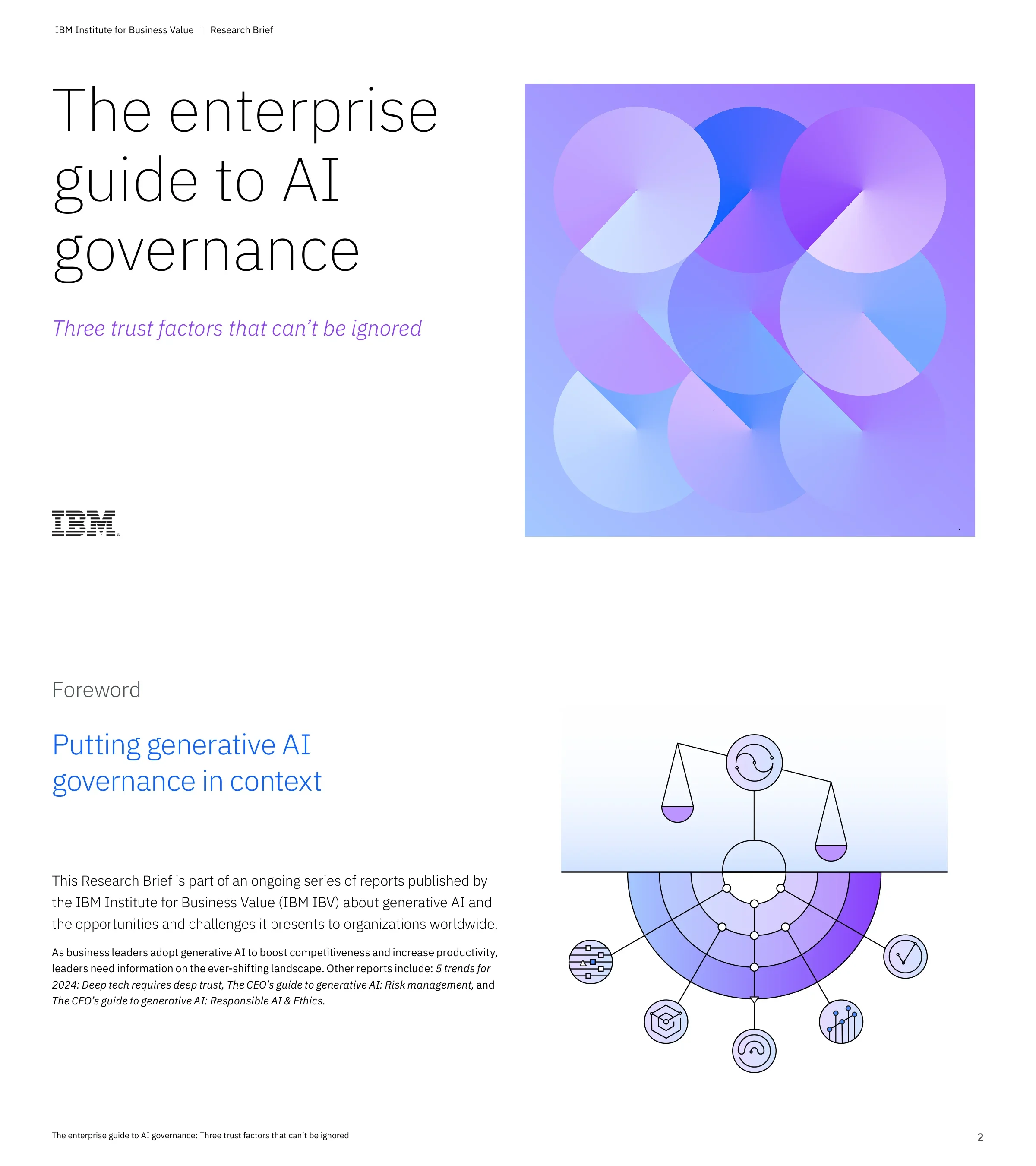
Title slide with IBM Institute for Business Value branding. Subtitle: Three trust factors that can't be ignored.
Left-aligned title with large typography, abstract purple/blue geometric artwork on the right, IBM logo at bottom left
Introduction to the IBM IBV research series on generative AI. Explains the report is part of an ongoing series about generative AI opportunities and challenges for organizations worldwide.
Two-column layout with text on left and governance-themed illustration on right featuring a balance scale and connected icons
77% of business leaders say gen AI is market ready. Gen AI is cutting coding time, personalizing interactions, automating cybersecurity. AI-related risks are rising: compliance, data bias, reliability, and loss of trust. Governance establishes frameworks aligned with ethical and human values.
Two-column text layout with decorative progress indicator circles at top showing varying states of completion
74% of respondents believe governance will have high impact in next 3 years as gen AI adoption barriers are removed. However, only 21% believe their organization's maturity around governance is leading.
Left text column with key findings, right side features a large Venn diagram data visualization with 74% and 21% statistics
63% of CROs and CFOs focused on regulatory and compliance risks. 60% of CEOs looking into mandating additional AI policies. However, only 29% of CROs and CFOs say these risks have been sufficiently addressed. 27% of public companies cited AI regulation as a risk in SEC filings.
Left text column, right side features stacked circle infographic with 63%, 60%, and 29% statistics
Trust Factor 1: Accountability (Who is in charge of AI governance?). Trust Factor 2: Transparency (How do you assess sources of data and what is shared about them?). Trust Factor 3: Explainability (How do you explain the output of AI systems and models?).
Three-column layout with icon headers, each column dedicated to one trust factor with description text
Defines transparency, explainability, and provenance. Governance relies on transparency, explainability, and provenance to direct, evaluate, monitor, and take corrective action at all stages of the AI lifecycle.
Full-width three-column text layout with process flow indicators at top
60% of C-suite executives have placed clearly defined gen AI champions. 59% have a direct report responsible for organization-wide AI integration. 80% have a separate risk function dedicated to AI or gen AI.
Section opener with Trust Factor 1 banner, left text column, right side features workflow/approval illustration
47% have established a generative AI ethics council. Spending on AI ethics increased from 2.9% in 2022 to 4.6% in 2024, expected to reach 5.4% in 2025. 68% of CEOs say governance for gen AI must be integrated upfront in the design phase.
Three-column text layout with spending growth statistics callout on the right showing year-over-year progression
5 action items: 1) Empower senior-level executive to lead AI governance. 2) Prioritize responsible AI development and deployment. 3) Ensure senior leadership aligns principles with practices. 4) Develop cultural foundation for governance structures. 5) Foster collaboration with stakeholders and ecosystem partners.
Large left-side call-to-action text, five numbered recommendations in three columns to the right
The Data & Trust Alliance (D&TA) established in 2020 by leading companies including Deloitte, GM, IBM, Johnson & Johnson, Mastercard, Meta, Nike, UPS. 27 members across 18 industries. Quote from Saira Jesani, Executive Director.
Case study section opener with light blue background, three-column layout with organization description, quote on right
D&TA created 22 metadata fields for cross-industry data provenance standards. IBM tested the standards in early 2024 for data clearance of foundational model training datasets. Results: 58% reduction in data clearance processing time for third-party data, 62% reduction for IBM-owned data.
Three-column text continuation of case study with light blue background
90% of data available in the world was generated in the last two years. ~400 million terabytes of data created daily, 150 zettabytes estimated for 2024. Almost half of surveyed CEOs concerned about accuracy and bias.
Section opener with Trust Factor 2 banner, left text column, right side features transparency-themed illustration
Figure 3 presents 8 important questions organizations must answer: Who is accountable? Was data gathered with consent? Does it represent all communities? Do experts agree on correct data? How does model compare to human? What goes into algorithm? How often is model audited? How and for what is it audited?
Left text columns with right-side grid of 8 question cards with icons
4 action items: 1) Establish a multidisciplinary AI governance team. 2) Train everyone in transparency. 3) Ask questions beyond regulatory compliance. 4) Embrace ideas from outside the organization (OECD principles referenced).
Large left-side call-to-action text, four numbered recommendations in three columns
Australia Post ($5.8B revenue, 4,310 locations) using gen AI for customer service. After testing thousands of customer calls and employee keystrokes, gen AI is routing queries and answering questions. Goal: handle 40-60% of calls via gen AI. Post conducted data review, creating strict data governance procedures.
Case study with light blue background, three-column layout, highlighted quote at bottom
AI acceptance is at a crossroads. 35% of respondents in the 2024 Edelman Trust Barometer accept AI innovation, but nearly 30% reject it. Demonstrating trustworthiness of AI will be key to optimizing its impact.
Section opener with Trust Factor 3 banner, left text column, right side features explainability-themed illustration
Figure 4: 78% maintain robust documentation with explainability. 74% conduct ethical impact assessments to evaluate potential of initiatives on stakeholders. 70% conduct user testing for risk assessment and mitigation.
Left text column, right side features Figure 4 with three stacked metric cards showing 78%, 74%, and 70%
3 action items: 1) Design AI systems that facilitate human-AI collaboration and oversight. 2) Prioritize AI output that is explainable and auditable. 3) Incentivize employees to speak up and speak out if AI output is confusing.
Large left-side call-to-action text, three numbered recommendations in three columns
Can generative AI be trusted? Yes, but only if organizations approach governance with commitment and enthusiasm. Governance needs to be embedded at every phase of the AI lifecycle. 79% say it is important for CEOs to speak about ethical use of technology. AI governance is a core strategy for value creation, growth, and innovation.
Left heading with circular human-AI illustration, three-column text body with concluding arguments
Authors: Phaedra Boinodiris (Global Leader for Trustworthy AI, IBM Consulting), Brian Goehring (Associate Partner and AI Research Lead, IBM IBV), Milena Pribic (Design Principal, Ethical AI Practices), Catherine Quinlan (VP AI Ethics, IBM Chief Privacy Office). Related reports listed with URLs.
Four-column layout: Authors, Contributors, IBM IBV description, Related reports
20 numbered references and citations including IBM research, Forbes, Wall Street Journal, IEEE, OECD, World Economic Forum, and Exploding Topics.
Two-column numbered reference list
Copyright IBM Corporation 2024. Produced in October 2024. Standard IBM legal disclaimers, trademark notices, and environmental certifications (FSC, Green-e).
IBM logo at top, legal text in right column, certification logos at bottom
QR code linking to ibm.co/consulting-ai
Minimal back cover with QR code at bottom left
Common questions about this slide and the underlying presentation content.
The guide focuses on three critical trust factors: Accountability (who is in charge of AI governance), Transparency (how you assess data sources and what is shared about them), and Explainability (how you explain the output of AI systems and models). Each factor includes detailed analysis, statistics, and a dedicated action guide.
This template is designed for C-suite executives, AI governance leaders, compliance officers, chief privacy officers, and enterprise risk management professionals who need to build, present, or communicate AI governance strategies within their organizations.
The deck includes IBM IBV research data such as: 74% believe governance will have high impact in 3 years, only 21% report mature governance, 63% of CROs/CFOs focus on regulatory risks, 60% of CEOs want additional AI policies, AI ethics spending grew from 2.9% to 4.6%, and 78% maintain documentation with explainability.
Yes, it includes two detailed case studies: The Data & Trust Alliance (D&TA) demonstrating cross-industry data provenance standards with 58-62% efficiency improvements, and Australia Post showing how a government-owned corporation implements AI transparency while aiming to handle 40-60% of customer calls via gen AI.
The presentation contains 24 professionally designed slides covering the complete AI governance framework including title, introduction, three trust factor sections with action guides, two case studies, conclusion, author credits, and references.
Yes, this template provides a comprehensive framework that can be adapted to your organization's specific AI governance needs. The three trust factors, action guides, and data points serve as a foundation that you can customize with your own organizational data, policies, and case studies.
The presentation features IBM's clean, professional design with a distinctive purple and blue gradient color palette, abstract geometric data visualizations, consistent iconography, and a clear typographic hierarchy. The design balances visual impact with readability for executive audiences.
Each trust factor includes a dedicated Action Guide: Accountability offers 5 steps (executive leadership, responsible AI, cultural foundation), Transparency provides 4 steps (multidisciplinary teams, training, going beyond compliance), and Explainability gives 3 steps (human-AI collaboration, auditable outputs, employee empowerment).

Create Your Own Slides
Turn your ideas into professional presentations in seconds with 2slides AI.
Reference professional designs, choose your style, and generate slides with perfect text rendering. Powered by Nano Banana—start creating your presentation now.
Your AI Agent for slides. Save time, shine faster with intelligent presentation creation.




© 2026 2slides. All rights reserved.