
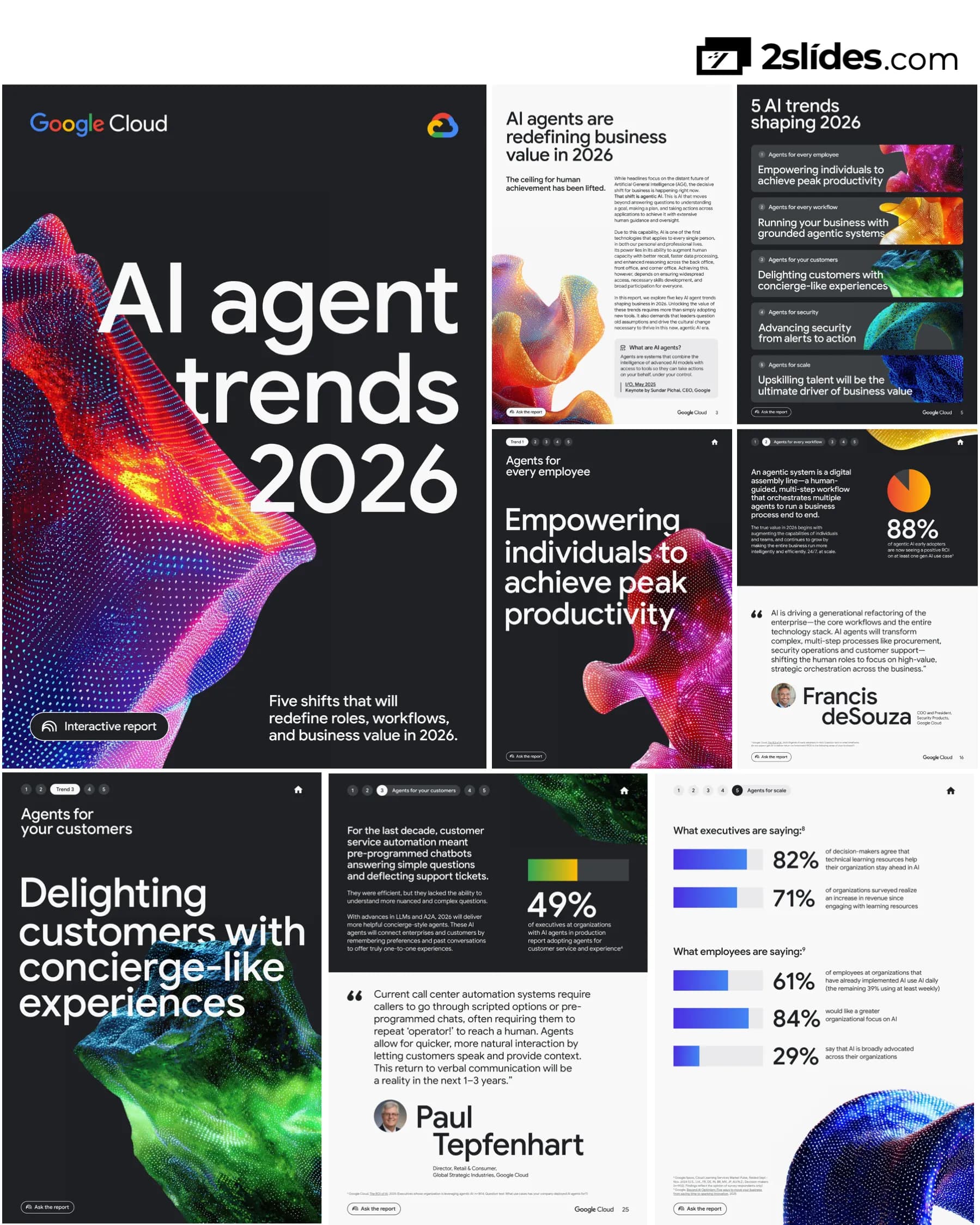
2Slides Logo
Preview

Google Cloud AI Agent Trends 2026 Report

49 slides

AI Agent Trends 2026: Five Key Shifts Redefining Business Value, Roles, and Workflows

338 likes
29 downloads

Quick Navigation

Tags

AI agents
Agentic AI
Google Cloud
Business transformation
Future of work

Share the slides

Description

Main Topic

AI Agent Trends 2026: Five Key Shifts Redefining Business Value, Roles, and Workflows

Key Benefits

  • •Provides forward-looking insights and strategic framework for AI agent adoption in 2026
  • •Offers real-world case studies, technical resources, and customer stories for practical application
  • •Highlights the transition from task-based AI to intent-based, agentic AI systems
  • •Emphasizes the human-centric shift towards strategic orchestration and talent upskilling
  • •Delivers actionable trends to drive innovation, efficiency, and competitive advantage

Target Audience

  • •Business leaders and C-suite executives (CEO, CTO, CIO, CAIO)
  • •AI and digital transformation strategists
  • •IT and operations directors
  • •HR and talent development leaders
  • •Marketing, customer service, and security department heads
  • •System integrators and consulting partners

Use Cases

  • •Developing corporate AI strategy and roadmap for 2026
  • •Executive briefings on AI trends and business impact
  • •Internal training and upskilling programs on agentic AI
  • •Sales and marketing presentations to showcase AI thought leadership
  • •Partner and client workshops on AI implementation
  • •Investor communications regarding AI innovation and ROI

Unique Value Propositions

  • •Proprietary data and insights from Google Cloud's global survey of 3,466 enterprise decision-makers
  • •Integration of qualitative analysis using NotebookLM and Google AI Studio
  • •Interactive report format with "Ask the report" functionality via NotebookLM
  • •Endorsements and quotes from Google Cloud and customer executives (e.g., TELUS, Salesforce, Elanco)
  • •Focus on five holistic, interconnected trends rather than isolated technologies
  • •Strong emphasis on human-AI collaboration, ethics, security, and responsible scaling

Slide Pages (49)

Detailed view of each slide page, including layout, key content and visual elements.

Page 1
Title Slide

Cover Page

Content

Title slide introducing the report: "Google Cloud AI Agent Trends 2026. Five shifts that will redefine roles, workflows, and business value in 2026."

Layout Structure

Minimalist, bold typography with gradient accent. Central title block on a dark background.

Key Visual Elements

  • •Google Cloud logo
  • •Large, impactful typography for "AI agent trends 2026"
  • •Subtitle explaining the report's value proposition
  • •Gradient color bar (blue/purple)
Page 2
Introduction / Methodology

About This Report

Content

Explains the report's purpose, methodology (qualitative/quantitative data, customer case studies, The ROI of AI 2025 report), and interactive features via NotebookLM.

Layout Structure

Two-column text layout with a prominent header and a callout box for "Ask the report" feature.

Key Visual Elements

  • •Header with "#" symbol
  • •Body text in clear sections
  • •Icon and call-to-action for interactive NotebookLM version
  • •Page footer with branding and page number
Page 3
Executive Summary / Vision Statement

AI Agents Are Redefining Business Value in 2026

Content

Sets the stage: the shift is happening now with agentic AI (goal-oriented, plan-making AI). Discusses its universal applicability and the need for access, skills, and cultural change.

Layout Structure

Full-page narrative with a key quote callout from Sundar Pichai defining AI agents.

Key Visual Elements

  • •Large header
  • •Pull quote with speaker attribution and date
  • •"Ask the report" prompt
  • •Clean, spacious text layout
Page 4
Supporting Quote / Testimonial

Executive Perspective Quote

Content

A single, powerful quote from Oliver Parker (Google Cloud) emphasizing the mindset and cultural shift from 'add-on' to 'AI-first'.

Layout Structure

Centered, large-text quote with attribution and title.

Key Visual Elements

  • •Large quotation marks as graphical element
  • •Bolded quote text
  • •Speaker name, title, and company
  • •Minimal background distraction
Page 5
Agenda / Trends Overview

The 5 AI Trends Shaping 2026

Content

Visual agenda listing the five trends: 1) Agents for every employee, 2) for every workflow, 3) for your customers, 4) for security, 5) for scale.

Layout Structure

Numbered list with icons and brief descriptions for each trend.

Key Visual Elements

  • •Large "5 AI trends" header
  • •Numbered circles (1-5) with associated icons
  • •Concise trend title and sub-description
  • •Consistent color scheme
Page 6
Chapter Title Slide

Trend 1: Agents for Every Employee

Content

Title slide for the first trend: empowering individuals for peak productivity.

Layout Structure

Full-page title with trend number, name, and tagline.

Key Visual Elements

  • •Large "Trend 1" indicator
  • •Primary trend title
  • •Supporting explanatory tagline
  • •Page indicator showing trend 1 is active
Page 7
Trend Explanation with Data

Trend 1 - The Employee-Centric Transformation

Content

Describes the shift from instruction-based to intent-based computing. Includes statistics on AI agent adoption and use cases from the ROI of AI 2025 report.

Layout Structure

Main narrative on left, supporting statistics in a highlighted box on the right.

Key Visual Elements

  • •Page header showing active trend (1) among 5
  • •Key statistic callout box with percentages and use cases
  • •Footnote citations for data sources
Page 8
Supporting Quotes / Case Study Teaser

Executive & Customer Perspectives on Trend 1

Content

Features two quotes: one from Saurabh Tiwary (Google Cloud) on agent-managed workflows, and one from Jaime Tatis (TELUS) on productivity gains.

Layout Structure

Two-column layout with individual quote boxes for each speaker.

Key Visual Elements

  • •Headshots or company logos (implied for TELUS)
  • •Distinct quote boxes with clear attribution
  • •Page trend indicator
Page 9
Concept Deep Dive / Framework

The New Integrated Working Model

Content

Details the new role of employees as human supervisors/orchestrators of AI agents. Lists new responsibilities: delegate, set goals, outline strategy, verify quality. Includes a definition of "grounding."

Layout Structure

Main content body with a breakout sidebar explaining "grounding in AI."

Key Visual Elements

  • •Bulleted list of employee responsibilities
  • •Sidebar with colored background defining "grounding"
  • •"Learn more" call-to-action link
Page 10
Regional Testimonial / Supporting Quote

Regional Perspective on Democratization

Content

Quote from Hiroyuki Koike (Google Cloud Japan) on enabling employees via tools like Gemini Enterprise, especially in SI-reliant markets.

Layout Structure

Centered quote with attribution.

Key Visual Elements

  • •Speaker name, title, and region
  • •Page trend indicator
Page 11
Use Case Scenario / Application Example

How It Works: The 10x Marketing Manager

Content

Introduces a use-case scenario: a marketing manager orchestrating AI agents. Shows an example UI (Gemini Enterprise home page) with connectors to various tools.

Layout Structure

Narrative introduction on left, visual UI mockup on the right.

Key Visual Elements

  • •Scenario title "The 10x marketing manager"
  • •Screenshot/mockup of a software interface
  • •Labels explaining UI components (Ask anything, connectors)
Page 12
System Breakdown / Component Details

The Marketing Manager's Specialized Agent System

Content

Details five specialized agents the marketing manager orchestrates: Data, Content, Reporting, Analyst, and Creative agents. Includes a "Data tip" callout.

Layout Structure

Grid layout with an icon and description for each of the five agents.

Key Visual Elements

  • •Icons representing each agent type
  • •Clear labels (Data agent, Content agent, etc.)
  • •Brief functional description for each agent
  • •Tip box with "Learn more" link
Page 13
Customer Case Study / Proof Point

Customer Story: Suzano

Content

Case study on Suzano (pulp manufacturer) using an AI agent with Gemini Pro to query SAP data, resulting in 95% time reduction. Includes a call-to-action for Gemini Enterprise.

Layout Structure

Narrative case study with a prominent "Try now" button.

Key Visual Elements

  • •Company name and description
  • •Key result metric (95% reduction)
  • •Call-to-action button ("Try now")
  • •Page trend indicator
Page 14
Myth Busting / Clarifying Perspective

Clarifying the Human Role (Media & Entertainment Example)

Content

Quote from Albert Lai (Google Cloud) addressing the misconception of loss of control, using the media industry to illustrate the enduring critical role of human creativity and strategy.

Layout Structure

Centered, lengthy explanatory quote.

Key Visual Elements

  • •Comprehensive quote with specific industry examples
  • •Speaker attribution
Page 15
Chapter Title Slide

Trend 2: Agents for Every Workflow

Content

Title slide for the second trend: running your business with grounded agentic systems.

Layout Structure

Full-page title with trend number, name, and tagline.

Key Visual Elements

  • •Large "Trend 2" indicator
  • •Primary trend title
  • •Supporting explanatory tagline
Page 16
Trend Explanation with Data

Trend 2 - The Digital Assembly Line

Content

Defines agentic systems as digital assembly lines. Highlights value and ROI (88% of early adopters see positive ROI). Includes a quote from Francis deSouza on generational refactoring.

Layout Structure

Main definition and value prop on left, key statistic and quote on right.

Key Visual Elements

  • •Large key statistic (88%)
  • •Pull quote from executive
  • •Page trend indicator (2 of 5)
Page 17
Industry-Specific Example

Industry Example: Telecommunications

Content

Quote from Angelo Libertucci (Google Cloud) illustrating an integrated agentic workflow for telecom (network ops, field services, contact centers).

Layout Structure

Centered quote with attribution.

Key Visual Elements

  • •Quote detailing a multi-step autonomous sequence
  • •Speaker attribution
Page 18
Technical Deep Dive / Architecture

Digital Assembly Line: Orchestrating Agentic Systems

Content

Explains the enabling technology: Agent2Agent (A2A) protocol and Model Context Protocol (MCP). Uses a diagram to show how agents connect across boundaries.

Layout Structure

Explanatory text on left, technical diagram on the right.

Key Visual Elements

  • •Diagram showing agents, MCP, APIs, and A2A protocol connections
  • •Labels for key components (LLM, Vertex AI, APIs)
  • •Explanatory callouts for A2A and MCP
Page 19
Partner & Customer Proof Points

Partner & Customer Examples: Salesforce and Elanco

Content

Shows two examples: 1) Salesforce partnership using A2A protocol, 2) Elanco using Gemini for document processing, saving up to $1.3M. Includes a "Data tip" CTA.

Layout Structure

Two-column layout, one example per column.

Key Visual Elements

  • •Company logos (Salesforce, Elanco)
  • •Brief case descriptions and results
  • •"Get started" call-to-action link
Page 20
Future Outlook / Vision Statement

Future Vision: Cross-Industry A2A Operations

Content

Quote from Marcel Silva (Google Cloud) on future growth of A2A, with examples like media-retailer connections and hospital-lab-insurance integrations.

Layout Structure

Centered quote with attribution.

Key Visual Elements

  • •Speaker attribution
  • •Page trend indicator
Page 21
Use Case Scenario / Problem-Solution

How It Works: Agentic Ecommerce in Action

Content

Introduces challenges and opportunities of agents in payments (Google Agent Payments Protocol AP2). Uses a diagram showing merchant, agent, and payment ecosystems.

Layout Structure

Problem statement on left, ecosystem diagram on the right.

Key Visual Elements

  • •Diagram with three connected nodes (Merchant, AI Agent, Payment)
  • •Rhetorical questions highlighting key challenges
Page 22
Use Case Detail / Partner Highlight

Agentic Ecommerce Example & Partner

Content

Provides a concrete example of an agent purchasing a jacket based on criteria. Mentions PayPal's adoption of Google's AP2 protocol.

Layout Structure

Use case narrative on left, partner logo and mention on right with a "Try Vertex AI" CTA.

Key Visual Elements

  • •Example command in quotation marks
  • •PayPal logo and endorsement statement
  • •"Get started" call-to-action button
Page 23
Industry-Specific Future Vision

Industry Example: Financial Services Compliance

Content

Quote from Toby Brown (Google Cloud) on agentic compliance systems scaling in financial services by 2026.

Layout Structure

Centered quote with attribution.

Key Visual Elements

  • •Speaker name, title, and industry focus
  • •Hashtag style header (#TobyBrown)
Page 24
Chapter Title Slide

Trend 3: Agents for Your Customers

Content

Title slide for the third trend: delighting customers with concierge-like experiences.

Layout Structure

Full-page title with trend number, name, and tagline.

Key Visual Elements

  • •Large "Trend 3" indicator
  • •Primary trend title
  • •Supporting explanatory tagline
Page 25
Trend Explanation with Data

Trend 3 - From Chatbots to Concierge

Content

Contrasts old chatbots with new LLM-powered concierge agents. Includes adoption statistic (49% for customer service). Quote from Paul Tepfenhart on natural verbal interactions.

Layout Structure

Narrative contrast on left, key stat and quote on right.

Key Visual Elements

  • •Key statistic (49%)
  • •Pull quote from industry director
  • •Page trend indicator (3 of 5)
Page 26
Concept Illustration / Comparison

Personalization at Scale

Content

Illustrates the difference between a generic chatbot and an agentic concierge using a personalized greeting example. Mentions Home Depot's "Magic Apron" agent.

Layout Structure

Side-by-side comparison of a chatbot prompt vs. an agent greeting, with a customer story below.

Key Visual Elements

  • •Two contrasting speech bubbles (Chatbot vs. Agentic Concierge)
  • •Home Depot customer story with implied results
  • •Visual of a chat interface
Page 27
Extended Application / Supporting Quote

Personalization Beyond Consumers (Manufacturing)

Content

Quote from Praveen Rao (Google Cloud) extending the personalization concept to B2B/industrial settings like manufacturing floor management.

Layout Structure

Centered quote with attribution.

Key Visual Elements

  • •Speaker attribution
  • •Page trend indicator
Page 28
Solution Framework / Product Promotion

How It Works: Insightful and Always-On Help

Content

Describes proactive, insight-driven customer service. Promotes Google's Customer Engagement Suite with breakdown of components: Agent Studio, Agent Assist, Insights, Omnichannel gateway.

Layout Structure

Explanatory text on left, product/service component breakdown on the right with a CTA.

Key Visual Elements

  • •Four-component breakdown with icons and names
  • •"Get started" call-to-action button
  • •Service/Product name header (Customer Engagement Suite)
Page 29
Detailed Use Case / Customer Proof

Proactive Service Scenario & Customer Story

Content

Presents a detailed, step-by-step scenario of a logistics concierge agent proactively resolving a delivery failure. Includes Danfoss case study on automating order processing.

Layout Structure

Detailed numbered scenario on left, customer case study on right.

Key Visual Elements

  • •Numbered steps (1-4) in the proactive scenario
  • •Example customer notification text
  • •Danfoss logo and quantified results (80% automated, 42h to real-time)
Page 30
Industry Vision Statement / Supporting Quote

Vision for Healthcare

Content

Quote from Aashima Gupta (Google Cloud) on the promise of agentic AI to create predictive, proactive learning health systems in healthcare.

Layout Structure

Centered quote with attribution.

Key Visual Elements

  • •Speaker name, title, and industry
  • •Page trend indicator
Page 31
Chapter Title Slide

Trend 4: Agents for Security

Content

Title slide for the fourth trend: advancing security from alerts to action.

Layout Structure

Full-page title with trend number, name, and tagline.

Key Visual Elements

  • •Large "Trend 4" indicator
  • •Primary trend title
  • •Supporting explanatory tagline
Page 32
Problem-Solution Introduction with Data

Trend 4 - The Challenge of Alert Fatigue

Content

Describes the problem of alert fatigue in SOCs (82% of analysts concerned). Positions AI agents as a solution beyond SOAR. Mentions Secure AI Framework 2.0 and DeepMind's CodeMender. Includes adoption stat (46% for security ops).

Layout Structure

Problem statement, solution introduction, and supporting statistics/data.

Key Visual Elements

  • •Key statistic (82% concerned)
  • •Adoption statistic (46%)
  • •Mention of specific Google tools/frameworks (Secure AI Framework 2.0, CodeMender)
  • •Page trend indicator (4 of 5)
Page 33
Leadership View & Customer Proof

CISO Perspective & Customer Example

Content

Quote from Jon Ramsey (Google Cloud) on agents decreasing risk and elevating analysts. Case study on Specular using Gemini 2.5 Pro for offensive security automation.

Layout Structure

Executive quote on left, customer case study on right.

Key Visual Elements

  • •Pull quote from security leader
  • •Specular logo and description of their platform's function
Page 34
Process Diagram / Framework

The Semi-Autonomous Security Operations Cycle

Content

Explains the agentic SOC with a cycle diagram. Shows the flow from Alert to Response, highlighting AI agent roles and human-managed stages (Recommendation, Escalation).

Layout Structure

Circular/cycle diagram central with supporting explanatory text.

Key Visual Elements

  • •Circular flowchart with icons for each stage (Alert, Detection, Investigation, Response, etc.)
  • •Color coding for AI agent vs. human-managed stages
  • •Callouts for enabling tech (MCP support, A2A)
Page 35
Supporting Quote / Expert Perspective

Threat Intelligence Perspective

Content

Quote from Sandra Joyce (Google Cloud Threat Intelligence) on AI as a dual-use tool for both attackers and defenders.

Layout Structure

Centered quote with attribution.

Key Visual Elements

  • •Speaker name and title
  • •Page trend indicator
Page 36
Role Transformation / Solution Highlight

How It Works: Elevating the Security Analyst

Content

Describes the new strategic roles for human analysts: Threat Hunting, Supervising Agents, and Defending. Includes a CTA for Google Security Operations and a Torg case study with quantified results.

Layout Structure

Three-role description on left, product CTA and customer story on right.

Key Visual Elements

  • •Three strategic activities with brief examples
  • •"Get started" CTA button
  • •Torg logo and impressive metrics (90% automation, 95% decrease, 10x faster)
Page 37
Key Takeaway / Call to Action

The Need for Bilingual Professionals

Content

Quote from Francis deSouza on the expanding attack surface and the critical need for security professionals to be "bilingual" in AI and security.

Layout Structure

Centered quote with attribution.

Key Visual Elements

  • •Speaker name and title
  • •Page trend indicator
Page 38
Chapter Title Slide

Trend 5: Agents for Scale

Content

Title slide for the fifth trend: upskilling talent as the ultimate driver of business value.

Layout Structure

Full-page title with trend number, name, and tagline.

Key Visual Elements

  • •Large "Trend 5" indicator
  • •Primary trend title
  • •Supporting explanatory tagline
Page 39
Trend Explanation / Human-Centric Argument

Trend 5 - The Critical Element: People

Content

Argues that people, not just technology, are critical. Discusses the shrinking half-life of skills (4 years, 2 in tech). Quote from Andrew Milo on the 2026 opportunity to move "from guessing to knowing."

Layout Structure

Narrative argument with a central, impactful quote.

Key Visual Elements

  • •Key concept: "half-life of a professional skill"
  • •Pull quote from learning services director
  • •Footnote citation
  • •Page trend indicator (5 of 5)
Page 40
Supporting Data / Survey Results

What Executives and Employees Are Saying (Data)

Content

Presents survey data in two sections: Executive priorities (82% agree learning helps stay ahead, 71% see revenue increase) and Employee sentiment (61% daily AI use, 84% want more focus).

Layout Structure

Two-column layout with statistics presented in large, bold fonts.

Key Visual Elements

  • •Large percentage figures for each data point
  • •Clear headings for "Executives" and "Employees"
  • •Footnote citations for surveys
Page 41
Problem Statement / Supporting Quote

The Emerging Skills Gap

Content

Quote from Shweta Maniar on the new skills gap created by the need for "agent orchestrators" and "Chief of Staff for AI" roles.

Layout Structure

Centered quote with attribution.

Key Visual Elements

  • •Speaker attribution
  • •Page trend indicator
Page 42
Framework Introduction / Step 1

How It Works: The 5 Pillars of AI Learning (Pillar 1)

Content

Introduces the first of five pillars for building an AI-ready workforce: "01 Establish Goals." Provides an example goal (100% AI tool adoption) and guidance on measurability.

Layout Structure

Large pillar number and title, with explanatory text and an example.

Key Visual Elements

  • •Large numeral "01"
  • •Pillar title "Establish goals"
  • •Concrete example in a colored text box
Page 43
Framework Details / Steps 2 & 3

The 5 Pillars of AI Learning (Pillars 2 & 3)

Content

Details Pillar 2: "Secure Sponsorship" (defining roles of Executive Sponsor, Groundswell Lead, AI Accelerator). Details Pillar 3: "Sustain Momentum and Reward Innovation" (digital hub, gamification, communication).

Layout Structure

Two-column layout, one pillar per column, with bulleted explanations.

Key Visual Elements

  • •Pillar numbers "02" and "03"
  • •Pillar titles
  • •Bulleted lists explaining key roles and strategies
  • •Page trend indicator
Page 44
Framework Details / Steps 4 & 5

The 5 Pillars of AI Learning (Pillars 4 & 5)

Content

Details Pillar 4: "Integrate AI into Daily Workflows" (hackathons, Field Days). Details Pillar 5: "Prepare for Increasing Risks with Trusted Frameworks" (security training, data usage policies).

Layout Structure

Two-column layout, one pillar per column, with bulleted explanations.

Key Visual Elements

  • •Pillar numbers "04" and "05"
  • •Pillar titles
  • •Bulleted lists of activities and principles
Page 45
Customer Proof Point / Product Promotion

Customer Success Story: TELUS Upskilling

Content

Showcases TELUS's training results: 96% confidence increase and commitment to apply tools. Promotes Google Skills training with a CTA.

Layout Structure

Customer quote/results on left, training product promotion with CTA on right.

Key Visual Elements

  • •TELUS logo and representative quote
  • •Strong metrics (96%, doubled impact)
  • •"Get started" CTA button for Google Skills
Page 46
Ethical Consideration / Supporting Quote

Ethical Upskilling Perspective (Financial Services)

Content

Quote from Georgina Bukeley on the need to upskill teams in critical thinking and ethical judgment, using internal rollouts as a testing ground.

Layout Structure

Centered quote with attribution.

Key Visual Elements

  • •Speaker attribution
  • •Page trend indicator
Page 47
Conclusion Title Slide

The 2026 Opportunity: A Path to Business Growth

Content

Title slide for the conclusion section.

Layout Structure

Full-page, minimalist title with evocative phrasing.

Key Visual Elements

  • •Large, spaced-out text: "The 2026 opportunity: A path to business growth"
  • •Simple background
Page 48
Conclusion / Summary & Call to Action

Conclusion: The Human-Centric Opportunity

Content

Summarizes the five shifts. Emphasizes the steep curve but greater value in the journey. Concludes with a powerful, human-centric message about freeing teams for creative/strategic work and the responsibility for ethical AI. Final quote from Anil Jain.

Layout Structure

Full-page narrative conclusion with a final executive quote.

Key Visual Elements

  • •Brief recap of the five trends
  • •Inspirational closing paragraph
  • •Final quote from a managing director
Page 49
Contact Slide / Call to Action

Call to Action / Contact

Content

Final slide prompting the reader to connect with Google Cloud to discuss what the trends mean for their business.

Layout Structure

Minimalist contact slide with Google Cloud logo and a simple prompt.

Key Visual Elements

  • •Google Cloud logo
  • •Short text: "See what these trends mean for your business. Get in touch."
  • •Clean, open layout

Frequently Asked Questions

Common questions about this slide and the underlying presentation content.

What exactly is "agentic AI" and how is it different from the AI we use today?

Agentic AI refers to AI systems that go beyond answering questions or generating content. They can understand a high-level goal, formulate a plan, and take a series of actions across different applications and systems to achieve that goal, operating under human guidance and oversight. It's a shift from instruction-based computing ("do this task") to intent-based computing ("achieve this outcome").

Who is the primary audience for this trends report?

This report is designed for business leaders and decision-makers, including C-suite executives (CEOs, CTOs, CIOs, Chief AI Officers), digital transformation strategists, and department heads in IT, Operations, HR, Marketing, Customer Service, and Security. It's also valuable for system integrators and consultants advising enterprises on AI strategy.

Does this report suggest AI agents will replace human jobs?

No, the report strongly emphasizes a human-AI collaboration model. It argues that AI agents will augment human capacity, not replace it. The human role evolves from performing tasks to orchestrating and supervising agents—setting strategy, providing context, making nuanced judgments, and verifying quality. The goal is to free employees from repetitive work to focus on higher-value creative and strategic activities.

What is "grounding" and why is it critical for enterprise AI agents?

Grounding is the process of anchoring an AI model's responses to a specific, verifiable set of facts—an enterprise's own internal data, systems, and knowledge. This prevents hallucinations and ensures agents operate on accurate, relevant information. For businesses, grounding agents in their proprietary context (CRM, ERP, past projects) is what unlocks true, reliable value and personalized outcomes.

What are the biggest barriers to adopting AI agents at scale, according to the report?

The report identifies three key barriers: 1) Cultural and Mindset Shift: Moving from an AI "add-on" to an "AI-first" process requires profound changes in workflow and corporate culture. 2) Skills Gap: The expertise to orchestrate and manage AI agents is new and scarce. Upskilling is the "ultimate driver of business value." 3) Security and Trust: As agents take more actions, ensuring security, accountability (e.g., in payments), and ethical outcomes is paramount and requires new frameworks and protocols.

How does Google Cloud position its own products within these trends?

The report showcases Google Cloud's integrated ecosystem as an enabler of these trends. Key products and frameworks mentioned include Gemini Enterprise and Gemini APIs for building agents, Vertex AI as a platform, NotebookLM for interactive analysis, the Agent2Agent (A2A) and Model Context Protocol (MCP) for orchestration, the Agent Payments Protocol (AP2), Customer Engagement Suite, Security Operations, and Google Skills for training. Customer stories (TELUS, Suzano, Elanco) demonstrate their application.

Is the data in this report credible? What are its sources?

Yes, the report is based on a blend of credible sources: 1) Quantitative data from "The ROI of AI 2025" report, a global survey of 3,466 enterprise decision-makers commissioned by Google Cloud. 2) Qualitative insights from internal interviews with Google Cloud, Google DeepMind, and customer AI leaders. 3) Analysis augmented by Google's own AI tools like NotebookLM and Google AI Studio. Key statistics are footnoted with their sources.

What is the "Ask the report" feature mentioned on many slides?

"Ask the report" refers to the interactive capability powered by NotebookLM. Users can click the icon to access a version of the report within NotebookLM, where they can ask questions in natural language to deepen their understanding of the trends, get summaries, or find specific information, making the static PDF content dynamically explorable.

2slides

Create Your Own Slides

Turn your ideas into professional presentations in seconds with 2slides AI.

Create World-Class Slides in Seconds

Reference professional designs, choose your style, and generate slides with perfect text rendering. Powered by Nano Banana—start creating your presentation now.

© 2026 2slides. All rights reserved.