
Part of Investor presentation examples
Anthropic IPO Factsheet (Japan, November 2026) is the 14-page Japanese-language factsheet (IPOファクトシート) that Anthropic, PBC published for the Japanese public offering of its Class A common stock ahead of a planned Nasdaq Global Select Market listing under the ticker ANT on November 19, 2026. The original is in Japanese and is posted on Anthropic's IPO site; this page describes every page in English. It covers the offering outline and schedule for Japan, the company mission, an overview of Claude, core strengths, enterprise adoption metrics, the financial model, growth strategy, disclaimers, and appendix financial statements with GAAP to non-GAAP reconciliations. This page is an archive of a publicly posted document for design and research reference; it is not an offer of securities or investment advice, and readers should rely on the prospectus.
Uses this deck’s cover as a style reference for slides made from your own content. Or pick any page below to use its layout as the reference.
Quick Navigation
Tags
Share the slides
Anthropic IPO Factsheet (Japan, November 2026) is the 14-page Japanese-language factsheet (IPOファクトシート) that Anthropic, PBC published for the Japanese public offering of its Class A common stock ahead of a planned Nasdaq Global Select Market listing under the ticker ANT on November 19, 2026. The original is in Japanese and is posted on Anthropic's IPO site; this page describes every page in English. It covers the offering outline and schedule for Japan, the company mission, an overview of Claude, core strengths, enterprise adoption metrics, the financial model, growth strategy, disclaimers, and appendix financial statements with GAAP to non-GAAP reconciliations. This page is an archive of a publicly posted document for design and research reference; it is not an offer of securities or investment advice, and readers should rely on the prospectus.
Detailed view of each slide page, including layout, key content and visual elements.
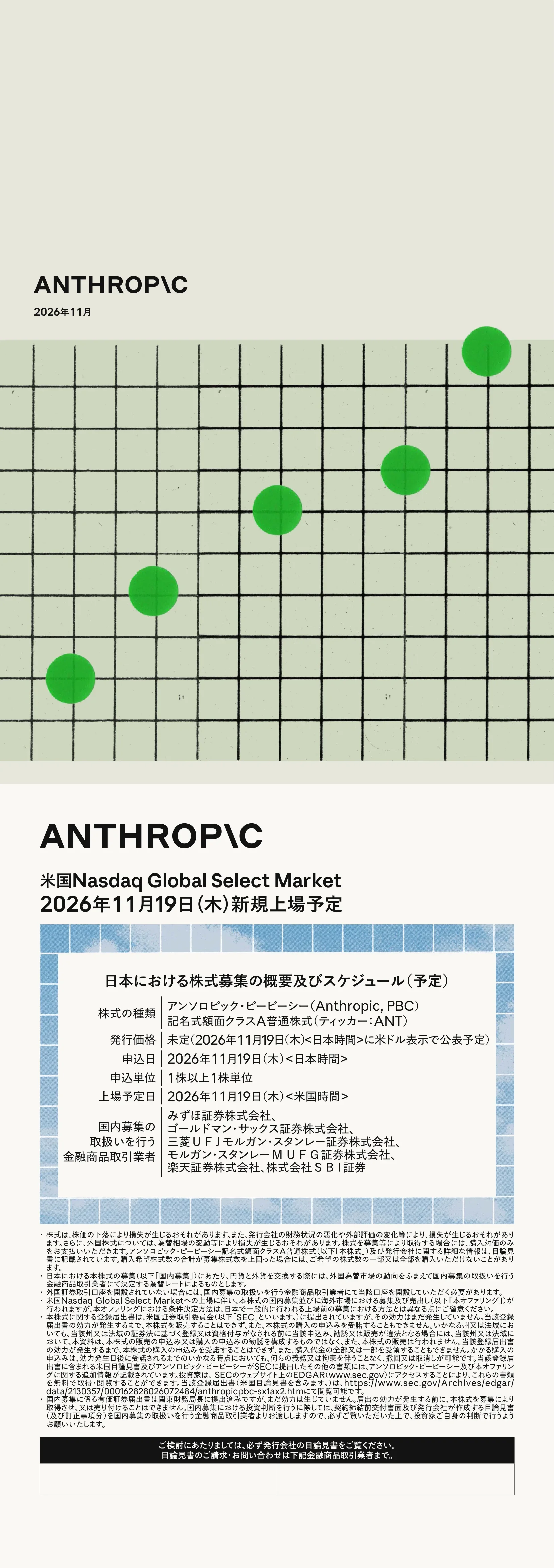
Cover page with the Anthropic wordmark and the date 2026年11月 (November 2026) above an illustration of a hand-drawn grid with five green dots rising from lower left to upper right.
Upper third is empty warm off-white space with the wordmark and date at left; the lower two thirds are a full-width sage green illustration panel.
States a planned new listing on the US Nasdaq Global Select Market on Thursday, November 19, 2026. The table lists the security as Anthropic, PBC registered Class A common stock (ticker ANT), an issue price that is not yet set and is to be announced in US dollars on November 19, 2026 Japan time, an application date of November 19, 2026 Japan time, an application unit of one share, a planned listing date of November 19, 2026 US time, and the financial instruments firms handling the Japanese offering: Mizuho Securities, Goldman Sachs Japan, Mitsubishi UFJ Morgan Stanley Securities, Morgan Stanley MUFG Securities, Rakuten Securities and SBI Securities. Fine print covers risk of loss from share price and currency movements, the need for a foreign securities trading account, and the fact that the SEC registration statement and the Japanese securities registration statement are filed but not yet effective, with a reminder to read the prospectus.
Large wordmark and two-line headline at top, a framed two-column terms table in the middle, dense bullet-point legal notes below, and a black notice bar with two empty boxes for distributor contact details at the bottom.
Mission statement: to responsibly develop and maintain advanced AI for the long-term benefit of humanity. The lower half says the company is at the entrance to exponential growth and sizes the opportunity at more than US$40 trillion for knowledge work and more than US$2 trillion for life sciences, with further markets in robotics, drug discovery, materials science and advanced manufacturing. The curve is labeled from the start of commercialization to US$17.0 billion of revenue in the third quarter of 2026.
A sage green banner with the mission at top, then a two-column lower half: headline and paragraph at left, market size figures stacked at right over a rising curve that spans the page. Footnotes at the bottom.
Describes Claude as the company's frontier AI delivered through models, a platform and applications, and as moving from a tool that answers single prompts to a virtual collaborator that carries out complex, long-running work. Four reasons customers choose Claude: access to frontier AI that delivers real-world results, a trusted partner for mission-critical and regulated workflows, faster time to value from integrated models, platform and apps, and close integration into enterprise processes. A loop diagram shows each Claude version helping to build the next, with the figure that more than 90% of the code added to the company's codebase in September 2026 was written by Claude.
Page title, a two-by-two block of short paragraphs separated by hairlines, a four-column row of reasons, and a shaded panel with a four-step vertical flow and one large statistic at right.
Three headline facts: all seven co-founders are still at the company, regretted attrition is about 1% on a trailing twelve month basis as of Q3 2026, and compute efficiency improved more than four times from Q1 2025 to Q3 2026. Five strengths follow: mission and focus (a public benefit corporation with a Long-Term Benefit Trust of four trustees that can in principle elect a majority of the board), talent and culture, frontier and safety research, an approach to compute that manages capacity across AWS Trainium, Google TPU, NVIDIA GPU and AMD GPU as one pool, and an enterprise strategy.
Shaded three-figure KPI band at top, then five rows, each with a bold label in a narrow left column and a paragraph in a wide right column, separated by hairlines.
Presents Claude Code and Claude Chat plus Cowork as virtual collaborators and shows logos of named enterprise customers including AIG, Bristol Myers Squibb, DoorDash, Jane Street, Lilly, Mercado Libre, Mozilla, PayPal, Rakuten, SAP, Shopify, Travelers, UST, Verizon and Walmart. Go-to-market is described as intelligence-led growth, direct sales and Applied AI, and partnerships. Metrics as of Q3 2026: more than 11,900 customers with US$100,000 or more of trailing twelve month revenue (about eight times the Q4 2025 count), more than 1,900 at US$1 million or more, about 250 at US$10 million or more, more than 30% of the Global 2000 and more than 50% of the Fortune 500 spending US$100,000 or more, net revenue retention of about 900%, more than 50% of enterprise customers using both the platform and at least one product, and customer cost reductions of about 25% (Fable 5.1 versus Fable 5) and about 40% (Opus 5.5 versus Opus 5).
Two columns at top (product description and customer logo grid), a middle band with go-to-market text and a shaded outcomes box, and a lower section of three stacked four-column KPI rows.
Headline: rapid revenue growth combined with compute efficiency and operating efficiency while continuing large long-term investment. Figures: more than 12 times year-over-year revenue growth as of Q3 2026 and run-rate revenue of about US$81 billion as of October 2026. The revenue chart shows quarterly revenue of US$0.4, 0.8, 1.4, 2.0, 4.7, 11.6 and 17.0 billion from Q1 2025 to Q3 2026. The compute efficiency chart plots revenue against compute and infrastructure cost each quarter, with the ratio moving from 0.40x in Q1 2025 to 2.08x in Q2 2026 and 1.72x in Q3 2026, an improvement of more than four times.
Title and subtitle at top, then two stacked rows, each with large figures in a narrow left column and a chart in a shaded panel at right. Footnotes at the bottom.
Trailing twelve month revenue per employee of more than US$6.6 million as of Q3 2026, with drivers listed as high talent density, an efficient go-to-market strategy and broad internal use of Claude. The adjusted operating margin chart moves from (221)% in Q1 2025 to 19% in Q2 2026 and 15% in Q3 2026, an improvement of 236 points. The lower panel states compute commitments of about US$900 billion, cash and cash equivalents of about US$96 billion, short-term investments of about US$36 billion, capital raised of about US$141 billion and about US$15 billion available under the amended and restated credit facility.
Upper half pairs a figure and bullet list at left with a bar chart panel at right; the lower half is one large shaded panel with a headline, one oversized figure and a two-by-two grid of supporting figures.
Seven strategies stepped along a rising curve: invest in people and culture, invest in compute, improve Claude's intelligence, performance and safety, make Claude available everywhere, drive adoption by existing and new customers, extend the frontier into new markets, and pursue strategic transactions and partnerships.
Page title at top left; seven short headline and caption pairs arranged diagonally from bottom left to upper middle, following an exponential curve that fills the right side.
A flywheel diagram links mission, talent, frontier and safety research, compute efficiency, enterprise adoption and revenue growth around the Anthropic mark. The disclaimer explains that a registration statement on Form S-1 has been filed with the SEC but is not yet effective, that shares cannot be sold until it is, how to obtain the preliminary prospectus from the underwriters named (Goldman Sachs, Morgan Stanley and Citigroup), that the presentation is not an offer or solicitation, and that third-party data has not been independently verified.
Shaded panel with a centered headline and circular diagram on the upper third; a heading and two columns of body text below.
Standard cautionary language: statements about future results, strategy, capital spending and plans involve risks and uncertainties, actual results may differ materially, and the company has no duty to update them. The second column explains why non-GAAP measures are shown, their limits, and that the presentation is a summary that does not contain all information needed to evaluate an investment.
Text-only page with two narrow columns of small type under a small wordmark, leaving the right margin open.
Annual consolidated statements of operations for fiscal 2023, 2024 and 2025: revenue of US$41 million, US$386 million and US$4,585 million, operating loss of US$551 million, US$2,980 million and US$8,060 million, and net loss of US$1,531 million, US$8,309 million and US$41,965 million. Quarterly statements for Q1 2025 to Q3 2026: revenue rises from US$376 million to US$16,956 million, operating income is US$974 million in Q2 2026 and an operating loss of US$567 million in Q3 2026, and net loss is US$23,291 million in Q3 2026, driven mainly by fair value changes on convertible notes, derivative liabilities and SAFEs. Line items include compute and infrastructure, personnel, the Bartz litigation settlement (US$1,500 million in Q3 2025), and sales, marketing and partnerships.
Page title, then two stacked tables (three-column annual and seven-column quarterly) with shaded rows for revenue, operating result, pre-tax loss and net loss. Footnotes below.
Reconciles operating income or loss to adjusted operating income or loss by adding back stock-based compensation, non-cash charitable donations and the Bartz litigation settlement. Annual adjusted operating loss is US$522 million (2023), US$2,788 million (2024) and US$4,854 million (2025), with adjusted operating margins of (1,273)%, (722)% and (106)%. Quarterly adjusted operating margin moves from (221)% in Q1 2025 to (13)% in Q1 2026, 19% in Q2 2026 and 15% in Q3 2026, when adjusted operating income is US$2,463 million.
Two-line page title, then an annual table and a quarterly table with wide row spacing and one shaded row each for adjusted operating income. Footnotes at the bottom.
Defines adjusted operating income and margin, compute efficiency (revenue divided by compute and infrastructure cost), customer, the US$100,000, US$1 million and US$10 million trailing twelve month customer cohorts, net revenue retention (current-period revenue divided by base-period revenue for the same customers, excluding Claude Pro, Max and Ultra subscribers) and run-rate revenue (the last 28 days of usage-based charges times 13 plus monthly subscription charges times 12). The methodology section explains how the knowledge work estimate is built from US Bureau of Labor Statistics wage data, International Labour Organization labor share data and 2025 global GDP.
Page title, then two text columns with section headings for definitions and methodology and bold run-in terms.
Common questions about this slide and the underlying presentation content.
It is a 14-page Japanese-language factsheet (IPOファクトシート) that Anthropic, PBC published for the public offering of its Class A common stock in Japan, ahead of a planned listing on the Nasdaq Global Select Market under the ticker ANT on November 19, 2026. It combines the offering outline for Japan with a summary of the business, key metrics and financial statements.
The original is in Japanese and was posted on Anthropic's IPO site at ipo.anthropic.com. The page-by-page summary here is written in English, with the main Japanese headings kept in brackets so you can match them to the pages.
Page 2 lists the security (Anthropic, PBC registered Class A common stock, ticker ANT), an application unit of one share, an application date and planned listing date of November 19, 2026, and six securities firms handling the offering in Japan. The issue price is shown as not yet determined, to be announced in US dollars on November 19, 2026 Japan time. Dates are marked as planned and can change.
Among others: revenue of US$17.0 billion in Q3 2026, more than 12 times year-over-year growth, run-rate revenue of about US$81 billion as of October 2026, an adjusted operating margin of 15% in Q3 2026, compute commitments of about US$900 billion and about US$96 billion of cash and cash equivalents. The appendix also shows a net loss of US$23.3 billion for Q3 2026, mainly from fair value changes on convertible instruments. All figures are as printed in the document.
No. This is an archive of a publicly posted document, shown as a design and research reference. The factsheet itself says the registration statements were filed but not yet effective and that investors must read the prospectus. For any investment decision, use the official prospectus and filings, not this page.
Yes, the original PDF is available to download from this page. It is an A4 portrait document of 14 pages. No PowerPoint version is offered because the source PDF is protected against modification.
The structure and layout ideas: a one-page terms summary, KPI bands with one large figure and a short caption, chart pages with a figure column beside a shaded chart panel, a stepped strategy page along a curve, and appendix tables with shaded subtotal rows. The palette is warm off-white, sage green and a terracotta accent. The content, logos and illustrations belong to Anthropic.
A factsheet is built to be read on paper rather than presented: A4 portrait pages, more text per page, a dedicated page of offering terms and risk notes, and space for the distributing securities firm's contact details. It is a common format for retail offering materials in Japan.
Original Japanese PDF of the factsheet described on this page

Create Your Own Slides
Turn your ideas into professional presentations in seconds with 2slides AI.
Reference professional designs, choose your style, and generate slides with perfect text rendering. Powered by Nano Banana—start creating your presentation now.
Your AI Agent for slides. Save time, shine faster with intelligent presentation creation.


© 2026 2slides. All rights reserved.