
Alibaba Cloud Machine Learning Platform for AI (PAI)
Quick Navigation
Tags
Share the slides
Alibaba Cloud Machine Learning Platform for AI (PAI)
Detailed view of each slide page, including layout, key content and visual elements.
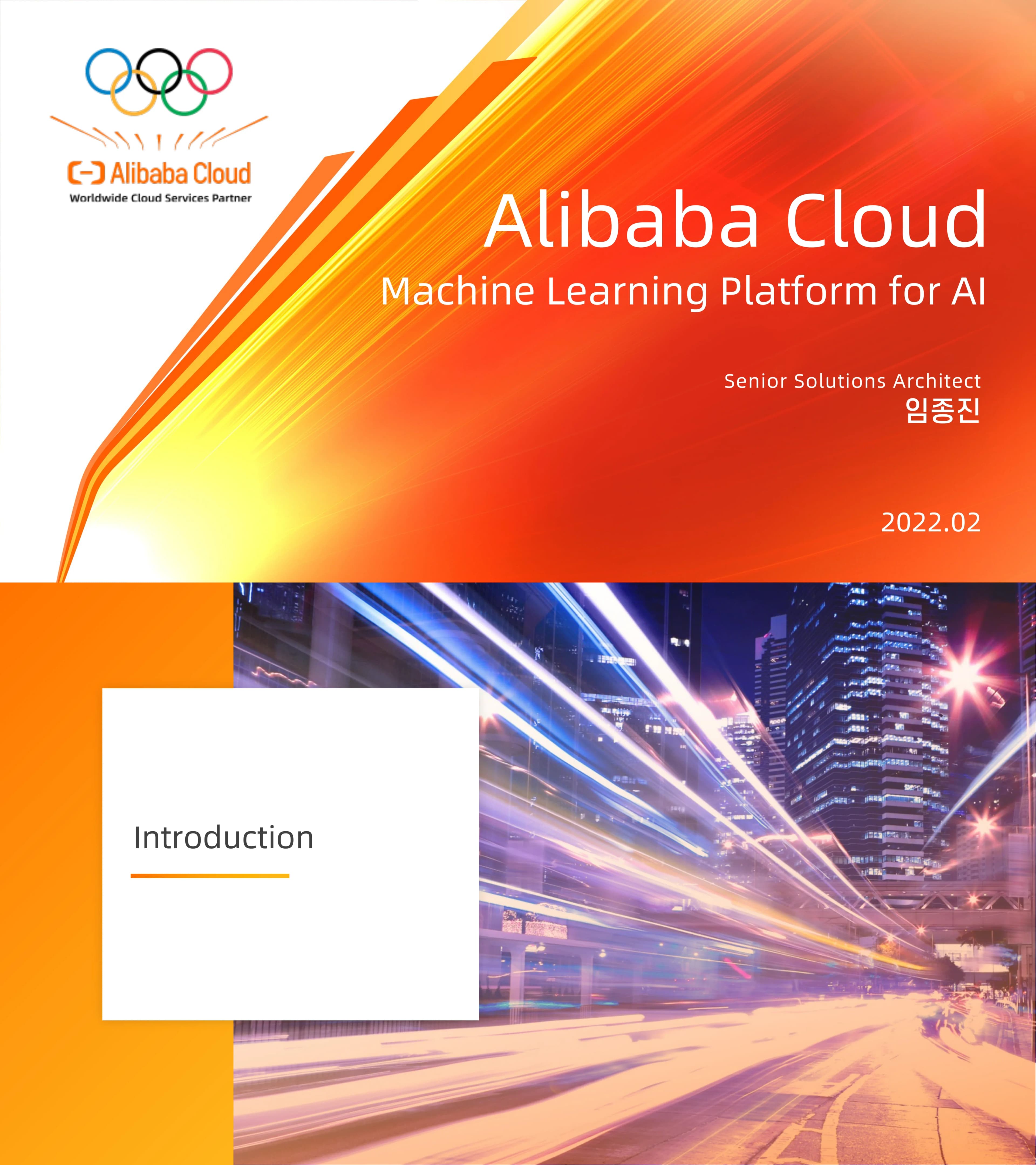
Title slide introducing the presentation on Alibaba Cloud's Machine Learning Platform for AI, presented by Senior Solutions Architect, dated February 2022.
Full-width title slide with orange gradient background, Alibaba Cloud logo and Olympic rings branding in top-left, centered title text with presenter info
Section divider introducing the main content section of the presentation.
Split layout with orange sidebar on left, white card with section title overlaid on cityscape night photography with light trails
High-level overview of PAI as a platform for developing, running, and deploying ML workloads on Alibaba Cloud. Shows the layered architecture from Serverless Big Data Computing Engine through PAI Auto Learning, PAI Studio, and PAI DS Workbook to PAI Elastic Algorithm Service and AI Solutions.
Title bar with orange accent, descriptive text in Korean, layered architecture diagram showing bottom-up flow from data lake to AI solutions
Comprehensive architecture showing all PAI components: Intelligent Labeling, PAI-Studio (visual modeling), PAI-DSW (interactive modeling), PAI-DLC (cloud-native deep training), PAI AutoLearning (automatic learning), PAI-EAS (online prediction), plus underlying ML frameworks and compute engines.
Title bar with orange accent, multi-column grid layout showing all PAI sub-services with feature descriptions, bottom layers for frameworks and compute
PAI-Studio provides a GUI-based ML framework modeling tool with 200+ algorithms, automatic ML tuning (7 methods, 90% resource savings), large-scale matrix training support, and custom PySpark/Spark algorithms.
Title with subtitle, four-column feature highlights at top, two product screenshot panels below showing Rich Algorithm Components and PAI-AutoML Engine
PAI-DSW is a cloud AI notebook supporting heterogeneous GPU/CPU computing for model development, training, and visualization. Features multi deep learning framework support (PAI-TF, TensorFlow, PyTorch), fast neural network GUI builder, and easy GPU/CPU switching.
Title with subtitle, centered description text, three-panel screenshot layout showing framework launcher, neural network GUI, and GPU/CPU switching interface
Cloud-native deep learning training platform with features: fully cloud-based Kubernetes infrastructure, flexible semi/full hosting with elastic scaling, and linear acceleration via data/model parallelism supporting 1B+ classification tasks.
Title with subtitle, three-column feature description at top, bottom split between ECS/DLC cluster architecture diagram and PAI console management panel
Migration learning framework based on PAI-TF with zero-threshold use (beginner friendly), small data requirements via transfer learning, and one-stop solution from data labeling to model training and deployment. Architecture shows business layer, AutoML tuning, network layer (ResNet, LeNet, VGG, etc.), and PAI-TF foundation.
Title with subtitle, left column with three icon-labeled features, right side showing layered architecture from PAI-TF through transfer learning to business applications
PAI-Tensorflow is an optimized TensorFlow framework by Alibaba Cloud's engineering team. Features include model tuning, compilation passes, cost-based graph partitioning, compression/pruning, code generation, and I/O optimization. Supports multiple frameworks (TF, Caffe, PyTorch, MxNet) with ONNX interop and targets CPU, GPU, FPGA, NPU hardware.
Title bar, description text, split layout with bullet list on left and multi-layer compiler architecture diagram on right showing graph optimization through codegen to hardware targets
Cloud-native online algorithm model service with high throughput (400K+ QPS per model), multi-model support (traditional and deep learning), online scaling with blue-green deployment, custom processor SDK, and PAI-Blade model compilation optimization.
Title with subtitle, split layout with feature bullet list on left and PAI EAS Model Deployment diagram on right showing multi-region deployment from PAI EAS CMD, PAI Studio, PAI DSW, and Local Uploading
Detailed cloud-native architecture showing four layers: User Interface (Resources, Models, Services, Monitoring), Plugin Extension (PAI-blade, Model Ensemble), Algorithm Framework (TensorFlow, Caffe, Keras, ONNX, PMML), and Engine Function (high-performance RPC, elastic expansion, blue-green deployment, auto batching) on K8S cluster.
Title with subtitle, split layout with four-layer architecture table on left and multi-region deployment diagram on right (same as previous slide)
Performance benchmarks showing PAI optimization vs open-source TensorFlow: CNN 4x faster, CRNN 1.3x faster, Segmentation 1.3x faster, BERT 2.8x faster, ASR 2.5x faster. Bar chart comparing TensorFlow, TensorFlow XLA, and PAI across multiple model types.
Title with subtitle, split layout with Korean bullet-point benchmark results on left (with orange highlighted speedup numbers) and bar chart comparison on right
Leveraging Volta GPU architecture with automatic mixed precision for FP16/FP32, achieving 3x real-scenario performance improvement. Shows benchmark comparing TF Baseline, TF 1.12+XLA, TAO Compiler, and TAO Compiler+MixedPrecision across CNN, RNN, Transformer, BERT, Embedding, and CNN+RNN+CRF models.
Description text at top, bar chart in center showing four-way comparison, bottom flow diagram showing auto-mixedprecision pipeline from user model to FP32-equivalent accuracy
Complete ML pipeline from data input through DataWorks (data preprocessing, feature engineering), PAI-Studio (item matching, ranking algorithms), model output to PAI-EAS (ranking service, matching service) with REST API results. Includes Redis for feature matching and PAI-Auto Learning configuration.
Title bar, description text, full-width solution architecture diagram showing left-to-right data flow with color-coded components (teal/cyan for services)
Section divider introducing the best practices and case studies section.
Same layout as Introduction divider - split with orange sidebar, white card with section title on cityscape night photography
PAI integrates closely with Alibaba Cloud big data services. Product solution: PAI + MaxCompute + DataWorks. Scenarios include smart marketing, VOC analysis, personalized advertising, image recommendation, and e-commerce applications. Workflow: use PAI Studio for data processing/model training, deploy trained models via PAI EAS.
Title bar, description text, large center diagram showing ecosystem integration (DataHub, MaxCompute, OSS, NAS feeding into PAI Studio/DSW, deploying to PAI EAS) with AI application icons on right
Real-world AI applications within Alibaba Group: CityBrain (vehicle detection), CaiNiao Logistics (semantic segmentation), and Unmanned Store (customer detection). FPGA-based CNN system deployed in real-world video analytics - one FPGA card replaces 10 CPU servers.
Title bar, description text, three-column layout with labeled example images showing vehicle detection, semantic segmentation, and person detection with bounding boxes
Alibaba's internal recommendation system training millions of features and billions of samples. PAI-TF shows 125-232% performance improvement over baseline across models (deepctr1/2, video-embedding, double-dnn, dram, taocoin, graph-sage). Uses RDMA and NCCL protocols for improved communication efficiency.
Title bar, split layout with Taobao product page screenshot on left and performance benchmark bar chart on right, explanatory text below
Customer uses PAI to build recommendation system. Architecture: Application DB connects to DataWorks for data refinement, PAI Studio for modeling, PAI EAS for model deployment, Redis for real-time data query acceleration. Shows complete offline data pipeline and real-time model execution flow.
Title bar, full architecture diagram on left showing customer DC to Alibaba Cloud pipeline, scenario description text on right in Korean
Modernizing traditional retail systems using Alibaba Cloud services including PAI. Data stored in RDS/POLAR DB, refined via Alibaba Cloud big data services (MaxCompute, DataWorks), processed through PAI for model development. Complete architecture from underlying data through offline training to online recommendation serving.
Title bar, large detailed architecture diagram on left showing three-tier system (underlying data, offline processing, online serving), scenario description on right
Announcement slide for Alibaba Cloud Korea data center opening in March 2022, with Korean tagline 'Asia's Super Rookie Finally Arrives in Korea!'
Alibaba Cloud logo top-left, large Korean headline text, date announcement, Alibaba Cloud mascot character (cloud-shaped) with Korean landmark illustrations
Closing slide with Alibaba Cloud branding and 'Worldwide Cloud Services Partner' tagline.
Full orange gradient background with centered Alibaba Cloud logo and Olympic rings, diagonal light streak effects
Common questions about this slide and the underlying presentation content.
Alibaba Cloud PAI (Platform for AI) is a comprehensive machine learning platform that covers the entire ML lifecycle - from data labeling and preprocessing through model training, evaluation, and deployment. It includes PAI-Studio for visual modeling, PAI-DSW for notebook-based development, PAI-DLC for distributed deep learning, PAI-AutoLearning for zero-code ML, and PAI-EAS for elastic online prediction serving.
This presentation contains 22 slides covering Alibaba Cloud's Machine Learning Platform for AI (PAI). It includes platform overview, detailed component breakdowns (PAI-Studio, PAI-DSW, PAI-DLC, PAI-AutoLearning, PAI-EAS, PAI-Blade), performance benchmarks, solution architecture, best practices, customer case studies for e-commerce and retail, and the Korea data center announcement.
PAI demonstrates significant performance gains: CNN models run 4x faster, BERT models 2.8x faster, ASR models 2.5x faster, and CRNN/Segmentation models 1.3x faster compared to open-source TensorFlow. The PAI Compilation with mixed precision optimization achieves up to 3x performance improvement in real-world scenarios.
This presentation is designed for both technical and semi-technical audiences. It includes high-level architecture overviews suitable for decision makers, detailed technical diagrams for engineers, performance benchmarks for technical evaluation, and real customer case studies that demonstrate business value. The bilingual Korean/English format makes it ideal for Korean market presentations.
The presentation includes two detailed customer case studies: (1) an e-commerce recommendation system using DataWorks for data refinement, PAI Studio for modeling, and PAI EAS with Redis for real-time serving, and (2) a retail modernization project using the full Alibaba Cloud stack including RDS, MaxCompute, PAI, and Faiss vector search for intelligent product recommendations.
Yes, this presentation uses Alibaba Cloud's official branding with orange gradient themes, consistent header layouts, and standardized architecture diagram styles. The 22-slide structure provides a comprehensive template that can be adapted for ML platform demos, technical sales presentations, or cloud migration proposals targeting the Korean market.
PAI supports a wide range of frameworks including TensorFlow (with PAI-optimized PAI-TF), PyTorch, Caffe, Keras, MxNet, ONNX, and PMML. The PAI-DSW notebook environment supports multiple Python versions with TensorFlow and PyTorch pre-installed, while PAI-EAS can serve models from any supported framework via RESTful APIs.
This presentation is bilingual, primarily in Korean with English technical terms and product names. It was created by a Senior Solutions Architect at Alibaba Cloud for the Korean market, making it ideal for Korean enterprise clients, data science teams, and technical decision makers evaluating cloud ML platforms.

Create Your Own Slides
Turn your ideas into professional presentations in seconds with 2slides AI.
Reference professional designs, choose your style, and generate slides with perfect text rendering. Powered by Nano Banana—start creating your presentation now.
Your AI Agent for slides. Save time, shine faster with intelligent presentation creation.




© 2026 2slides. All rights reserved.