
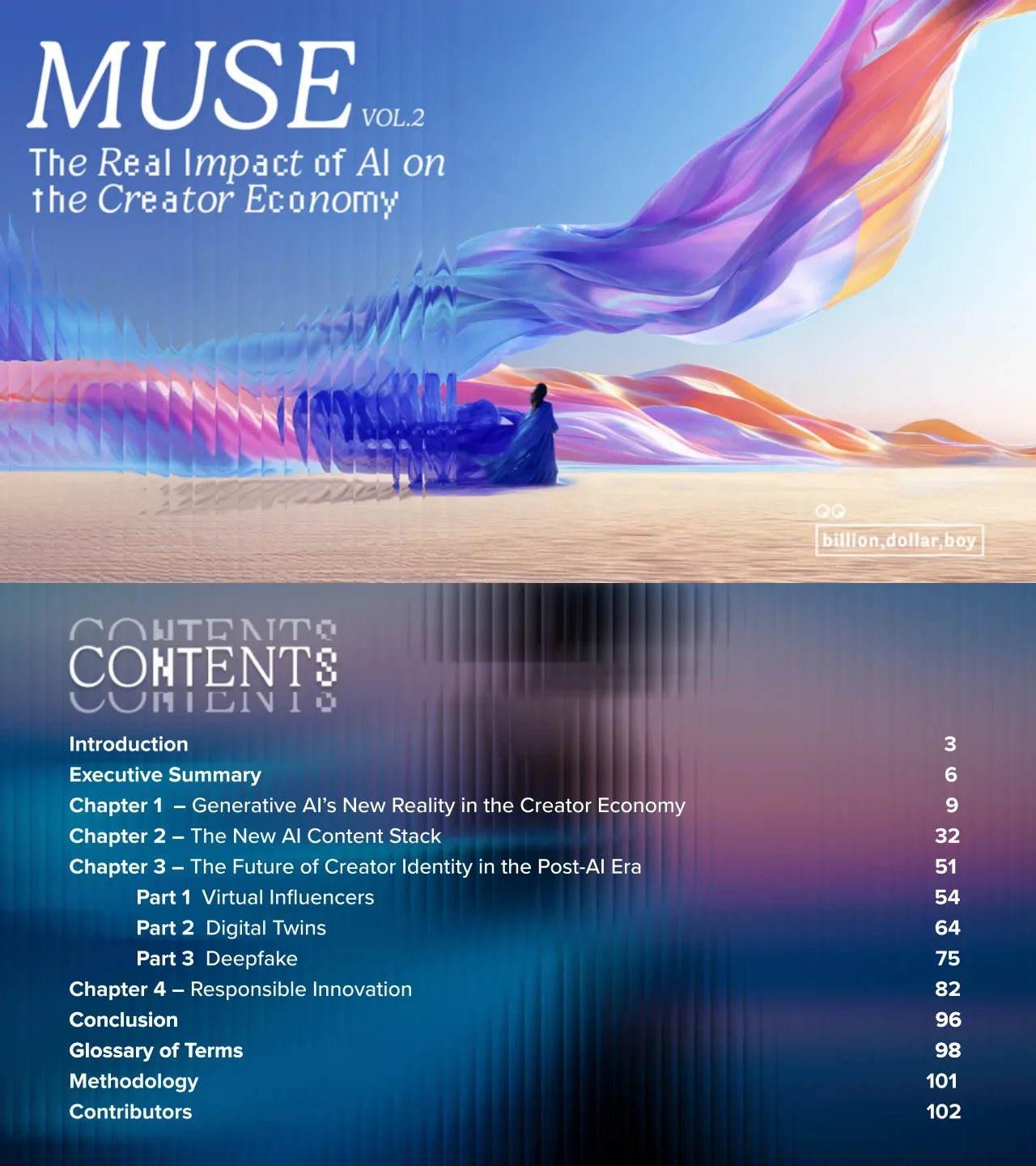
MUSE Vol. 2: The Real Impact of AI on the Creator Economy is a 103-page premium industry research report by Billion Dollar Boy, based on a Censuswide study (June–July 2025) of 4,000 consumers, 1,000 content creators, and 1,000 senior marketing decision-makers across the UK and US. It delivers longitudinal 2023–2025 data on how generative AI is reshaping creator content, brand spend, and consumer trust—covering the AI Content Stack framework, virtual influencers, digital twins, deepfakes, and responsible-innovation principles. Designed for marketers, agency strategists, and creator-economy leaders, it pairs hard performance benchmarks with expert commentary and brand case studies from L'Oréal, Diageo, and H&M.
Quick Navigation
Tags
Share the slides
MUSE Vol. 2: The Real Impact of AI on the Creator Economy is a 103-page premium industry research report by Billion Dollar Boy, based on a Censuswide study (June–July 2025) of 4,000 consumers, 1,000 content creators, and 1,000 senior marketing decision-makers across the UK and US. It delivers longitudinal 2023–2025 data on how generative AI is reshaping creator content, brand spend, and consumer trust—covering the AI Content Stack framework, virtual influencers, digital twins, deepfakes, and responsible-innovation principles. Designed for marketers, agency strategists, and creator-economy leaders, it pairs hard performance benchmarks with expert commentary and brand case studies from L'Oréal, Diageo, and H&M.
Detailed view of each slide page, including layout, key content and visual elements.
Full-bleed editorial cover featuring draped purple and orange fabric in a desert setting, establishing the premium visual identity of the report.
Full-bleed photographic background with centered display title, volume label, and Billion Dollar Boy logo bookmark at bottom-left
Table of contents listing all report sections—Introduction, Executive Summary, Chapters 1–4, Conclusion, Glossary, Methodology, and Contributors—with page references.
Dark background with two-column contents list using typographic hierarchy; chapter titles in display font, subsections in body weight
Chapter divider marking the Introduction section, featuring a rainbow fluted-glass abstract photograph as the full-bleed background.
Full-bleed abstract photographic background with large pixelated/typewriter accent font label centered or anchored
Sets the scene two years after generative AI emerged, noting that audiences are now pushing back against low-quality 'AI slop' content.
Dark slate background with white body text in a single wide column; editorial pull-quote treatment
Continues the introduction by framing the central industry challenge: whether brands and creators can scale AI responsibly without sacrificing authenticity.
Dark slate background, single-column body text, continued from previous page with consistent typographic style
Chapter divider marking the Executive Summary section, using abstract gradient or photographic imagery as the full-bleed background.
Full-bleed photographic or abstract gradient background with pixelated/typewriter accent font section label
Side-by-side white card summaries distilling the key findings of Chapter 1 (GenAI's New Reality) and Chapter 2 (The New AI Content Stack).
Two equal-width white rounded cards on a dark or colored background, each with chapter title, icon, and three-to-five bullet summary points
Side-by-side white card summaries distilling the key findings of Chapter 3 (Future of Creator Identity) and Chapter 4 (Responsible Innovation).
Two equal-width white rounded cards on a dark or colored background, mirroring the layout of the previous executive summary spread
Full-bleed chapter divider opening Chapter 1, introducing the theme of generative AI's evolved role in creator and marketing ecosystems.
Full-bleed photographic or abstract background with bold chapter number, chapter title in display font, and chapter strip at bottom
Introduces the 2023 baseline period when generative AI first entered the creator economy amid widespread optimism and a 'honeymoon phase' of adoption.
Dark background with editorial headline, subheading, and introductory body paragraph; timeline or year label as visual anchor
Presents three headline 2023 data points—70% of marketers increased GenAI creator spend, 69% of creators predicted positive disruption, and 60% of consumers preferred AI creator content—visualized as donut rings over a sunset photograph.
Three white donut/ring percentage charts overlaid on a full-bleed sunset photograph; each chart paired with a bold percentage and short label
Shows that in 2025, 77% of marketers plan to divert budgets toward AI creator content (up from 65% in 2023) and 75% agree AI is more cost-efficient, with UK/US breakdowns.
White or light card with large percentage headline stats, year-over-year comparison arrows, and UK/US sub-metric callouts
A 'Decoded' editorial card interpreting the data, arguing that AI has moved beyond experimentation to delivering measurable, hard business results for marketers.
Accent-color card with 'Decoded' pixelated typewriter label, analyst commentary paragraph, and graphic or icon accent
Case study showing how L'Oréal used seven AI-assisted creators to produce the Revitalift Laser Peptide Serum campaign, bridging theory and measurable practice.
Dark card with brand logo, campaign imagery, creator count callout, and key results or quote; 'Theory to Practice' label in accent font
Horizontal bar chart spread showing four metrics around AI ad spend—79%, 79%, 76%, and 77%—comparing past 12 months versus the next year outlook.
Dark background with four horizontal colored bars, percentage labels, and past vs. future period comparison labels
Decoded card revealing that three-quarters (71%) of US marketers and about half (52%) of UK marketers invest more than $1 million annually in AI creator content.
Accent-color 'Decoded' card with bold percentage callouts for US and UK, supporting commentary, and typewriter-style label
Case study detailing how Diageo allocated a £2.7B/$3.7B budget to build a virtual content studio serving 34 brands, cutting development/production costs from 21% to 14% with a 10% target.
Dark brand case study card with Diageo logo, budget figure, brand count, and cost-reduction metric arrows; 'Theory to Practice' label
Shows creator adoption rising sharply, with workload alleviation up from 79% to 84%, earnings from 78% to 85%, and 87% reporting increased AI output over the past 12 months.
Before/after percentage cards with upward trend arrows and donut ring or bar visuals; paired metrics with growth indicators
Reveals brand expectations are shifting, with 33% of marketers requiring emerging technology use, 51% expecting AI content creation tools, and 31% citing lack of innovation as a disqualifier.
Three-metric layout with percentage callouts, short descriptive labels, and supporting iconography on a dark or neutral background
Contrasts marketer/creator confidence (73–78% say AI performs better) against a sharp consumer preference drop from 60% in 2023 to just 26% in 2025.
Split-panel or two-column layout contrasting positive brand/creator data cards with declining consumer stat; visual tension design
Tracks the shift in consumer sentiment: Positive Disruptors dropped from 34% to 31%, Negative sentiment rose from 18% to 32%, and 'Unsure' grew from 30% to 37%.
Three-segment before/after comparison using donut or stacked bar charts with sentiment labels and color-coded percentage change annotations
Decoded commentary noting the growing gap: creators remain 73% optimistic (vs. 68% in 2023) while marketer confidence dropped to 70% (vs. 75%), signaling a widening trust divide.
Accent 'Decoded' card with creator vs. marketer comparison stats, year-over-year arrows, and explanatory paragraph
Reviews platform-level responses to AI content concerns: YouTube monetization updates, Pinterest AI content labels, TikTok auto-labeling, and Meta's AI information disclosures.
Four-platform grid with brand logos, short policy descriptions, and icon badges on a dark background
Highlights Meta's AI content strategy evolution alongside the launch of OpenAI Sora 2, framing the intensifying competition among platforms to shape AI content creation tools.
Two-column or side-by-side platform comparison cards with brand logos, product names, and brief strategic context text
Introduces the dual themes of content quality and diversity as critical measures of AI's impact on the creator economy, setting up the audience-specific data that follows.
Editorial intro layout with section headline, two-phrase subheadings ('Quality' / 'Diversity'), and short framing paragraph on a dark background
Shows consumer-reported improvements: 38% say AI improves content quality (up from 35% in 2023) and 41% say it improves diversity (up from 35%), displayed as donut rings.
Two donut ring charts side by side with year-over-year percentage labels, audience label 'Consumers', and minimal dark background
Creators are more bullish: 82% say AI improves quality (up from 74%) and 84% say it improves diversity (up from 74%), with stronger year-over-year gains than consumers.
Two donut ring charts with creator audience label, larger percentage values, and year-over-year growth annotations matching the consumer-page layout
Marketers show slight year-over-year dips: 76% say AI improves quality (down from 80%) and 77% say diversity (down from 82%), suggesting tempered expectations after early enthusiasm.
Two donut ring charts with marketer audience label and downward year-over-year indicators, consistent with consumer and creator page layouts
Decoded interpretation arguing that AI's value is not in producing more content but in enabling richer creativity, greater accessibility, and more varied storytelling.
Accent 'Decoded' card with three supporting sub-points—creativity, accessibility, storytelling—and a brief concluding commentary paragraph
Summarizes Chapter 1's central finding: generative AI has moved from novelty to necessity, but brands must balance machine capability with irreplaceable human creative instinct.
Summary card or full-width statement with bold summary headline, supporting body paragraph, and chapter label
Side-by-side expert quote cards from Katrine Rasmussen (CMO of Pixelz) and Omar Karim (Creative Technologist & AI Filmmaker) on the implications of AI in the creator economy.
Two quote cards with circular portrait crops, speaker name and title, pull-quote text, and brand/affiliation logo
Full-bleed chapter divider opening Chapter 2, introducing the concept of the AI Content Stack as a new framework for understanding AI-generated content categories.
Full-bleed photographic or abstract gradient background with bold chapter number, chapter title, and bottom chapter strip
Frames Chapter 2 by explaining how the content mix is being reshaped by AI and introduces the AI Content Stack as the report's central analytical framework.
Editorial intro with section headline, framing paragraph, and introductory AI Content Stack diagram or label
Defines the three top-level AI content categories: AI-Driven (Fully Synthetic), AI-Enabled (Visible AI), and AI-Assisted (Invisible AI), with brief descriptions of each.
Three-column or stacked card layout with a category title, parenthetical label, and descriptive paragraph per category on a dark background
Presents the full AI Content Stack visual—a layered diagram with 'design with intention' as the guiding principle tying the five content layers together.
Central layered stack diagram with five labeled layers, Artistry↔Utility axis labels, and 'Design with Intention' headline treatment
Detailed table mapping each of the five stack layers—Experimental (Artist), Exploration (Amplifier), Innovation (Collaborator), Applied (Assistant), Engine (Executor)—along the Artistry-to-Utility spectrum.
Five-row table with layer name, persona label, description column, and Artistry↔Utility axis indicator; clean dark background with white rows
Provides guidance on diagnosing a brand's current content mix, focusing specifically on the Innovation Layer and Exploration Layer as priority areas for strategic AI investment.
Two-column diagnostic cards for Innovation and Exploration layers, with questions or criteria for brands to self-assess their position in the stack
Explains the Exploration Layer as home to 'vibe marketing'—content that prioritizes emotion, tone, and atmosphere over hard product information to create brand feeling.
Single-focus editorial page with 'Exploration Layer' label, vibe marketing definition, and atmospheric imagery or gradient treatment
Showcases three creator accounts—@joooo.ann, @arthur_chance, and @officialshanikwa—as exemplars of the Exploration Layer approach to AI-enabled creative expression.
Three-creator grid with social handle labels, profile imagery, and short description of their AI-enabled creative style
Argues that as AI floods feeds with homogeneous content ('Sea of Sameness'), authentic human creators become more—not less—valuable as differentiators of quality and originality.
Editorial statement page with bold 'Sea of Sameness' concept, supporting argument paragraph, and strong contrast design treatment
Featured quote from Matthew Drinkwater (Head of Fashion Innovation Agency, London College of Fashion) on why human creator perspective remains indispensable in an AI-saturated landscape.
Full-width quote card with circular portrait crop, pull-quote text, speaker name, title, and institutional affiliation
Presents a strategic 2×2 matrix mapping AI content approaches across the axes of Experimentation vs. Efficiency and Artistry vs. Utility to help brands locate their current position.
Classic 2×2 quadrant grid with four labeled quadrants, axis labels, and example content types or strategies positioned in each quadrant
Reveals that 66% of creators experience creative fatigue, and 77% of marketers and 82% of creators agree AI helps by solving real creative and operational bottlenecks.
Metric-led layout with 66% creative fatigue callout, two-audience agreement stats, and brief framing paragraph on a dark card background
Shows that AI enables both more assets (82% marketers / 87% creators) and wider conceptual exploration (81% marketers / 85% creators), expanding creative possibility.
Two paired metric cards—one for 'more assets', one for 'wider concepts'—each with marketer and creator split percentages and short descriptor
Finds that 80% say AI strengthens brand personality and 77–78% report improved emotional resonance, indicating AI's role in deepening rather than diluting brand expression.
Two metric cards for brand personality and emotional resonance, with percentage callouts and short label descriptions on a dark background
Demonstrates that 84% of creators and 80% of marketers now recognize emotional engagement as a direct performance driver, not just a soft metric.
Two-audience percentage cards with bold stat headlines, audience labels, and supporting interpretation sentence on a dark or accent background
Featured quote from Simon Harwood (Global Effectiveness Director at Billion Dollar Boy) explaining how facial coding research validates emotion as a measurable performance signal in AI-generated content.
Full-width or prominently placed quote card with circular portrait crop, pull-quote, speaker name, title, and BDB affiliation
Finds only 33% of consumers find AI creator content emotionally resonant and just 26% prefer it, indicating consumers remain cautious even as brands invest heavily.
Two-metric consumer focus layout with 33% and 26% donut rings or stat cards, contrasting with brand-side data from earlier pages
Practical guidance page outlining four categories: 'Use AI When', 'Avoid Over-Using AI', 'Rule of Thumb', and 'Useful for All', giving brands a tactical decision framework.
Four-quadrant or four-card grid with heading labels, bullet-point guidance lists, and distinct icon or color coding per category
Summarizes Chapter 2 with the core thesis: AI accelerates the production of content, but only human purpose and creative intent give that content meaning.
Clean summary card with bold chapter conclusion headline, supporting paragraph, and chapter label treatment matching the Chapter 1 summary style
Full-bleed chapter divider opening Chapter 3, setting up the exploration of how AI is challenging and redefining creator identity through virtual personas.
Full-bleed photographic or abstract background with bold chapter number, chapter title in display font, and bottom chapter strip
Introduces the Billion Dollar Boy AI Council as the expert advisory body whose insights on AI creator identity and policy inform Chapter 3's findings.
Dark editorial intro with AI Council name prominently featured, brief description of the Council's composition, and contextual framing paragraph
A structured table comparing the three AI persona formats—Virtual Influencers, Digital Twins, and Deepfakes—across format characteristics, risks, benefits, and predicted consumer reactions.
Three-column comparison table with row headers (Format/Risks/Benefits/Consumer Reaction), color-coded column differentiation, and clean typography
Section divider introducing the Virtual Influencers sub-chapter, using abstract or fashion-editorial imagery to signal the premium, aspirational nature of virtual personas.
Full-bleed photographic or stylized background with 'Virtual Influencers' display-font label and pixelated/typewriter accent treatment
Introduces the virtual influencer landscape with reference to Lil Miquela, Noonoouri, and Imma as pioneers, and highlights Mia Zelu's appearance at Wimbledon as a landmark cultural moment.
Editorial intro with virtual influencer imagery, named persona callouts, Wimbledon event reference, and contextual framing paragraph
Illustrates the spectrum of virtual influencer aesthetics: photorealistic, stylized humanesque, and highly stylized forms, showing the breadth of approaches brands can deploy.
Three-column visual showcase with example images for each aesthetic category and short descriptive label below each
Key data: 76% of consumers trust virtual influencer recommendations and 68% say they influence purchasing decisions, while marketers are drawn to the control and scale they offer.
Two-metric data cards with 76% trust and 68% purchasing influence stats, plus a 'Marketers Drawn to Control & Scale' editorial sub-section
Despite strong metrics, 62% of creators are concerned about competition from virtual influencers and 59% worry about market oversaturation, framing the dynamic as remix not replacement.
Two-metric creator concern cards with 62% and 59% callouts, plus framing statement 'Not a Replacement, Just a Remix' as editorial headline
Featured quote from Lewis Davey (Co-Founder of Pixel.ai) offering perspective on how virtual influencers are redefining creativity and brand partnership models.
Full-width quote card with circular portrait crop, pull-quote text, speaker name, title, and company affiliation
Side-by-side quotes from Mary Bekhait (CEO YMU) and Danae Mercer (Journalist & Creator) offering contrasting perspectives on virtual influencers and creator authenticity.
Two quote cards with circular portrait crops, pull-quote text, speaker names, and titles/affiliations
H&M campaign with virtual influencer Kuki delivered 11× ad recall improvement, 91% decrease in cost-per-person, and a 38% decrease in cost compared to prior video campaigns.
Brand case study card with H&M + Kuki branding, three headline KPI callouts, and 'Theory to Practice' label treatment
Two mini case studies: Vogue's AI-generated Guess model (August 2025) and SheerLuxe's AI-enhanced editor Reem, illustrating virtual personas entering premium editorial and fashion contexts.
Two side-by-side mini case study cards with brand logos, AI persona names, dates, and brief outcome descriptions; 'Theory to Practice' label
Concludes the Virtual Influencers section: they can expand and enrich creator culture, but only when deployed with clear labeling and transparent disclosure to audiences.
Summary card with bold conclusion statement, labeling/transparency emphasis, and section label treatment
Section divider opening the Digital Twins sub-chapter, using abstract or glass-refraction imagery to introduce the concept of AI-powered creator replicas.
Full-bleed abstract or photographic background with 'Digital Twins' display-font label and pixelated/typewriter accent treatment
Defines digital twins as AI-powered replicas of real creators built and deployed with the creator's informed consent, distinguishing them from unauthorized deepfakes.
Editorial definition card with bold term, definitional paragraph, and consent-emphasis subpoint on a dark background
McKinsey projects the digital twin market will reach $73.5B by 2027 at a 60% CAGR; 85% of creators are open to digital twins, with 52% citing burnout and 37% considering leaving the industry.
Three-metric layout: $73.5B market projection, 85% creator openness, and paired 52%/37% creator burnout/attrition stats
Featured quote from Phil Hughes (Partner at Lewis Silkin / Eleven Advisory / Digital Creator Association) on the legal and ethical frameworks needed to protect creator rights in digital twin deployment.
Full-width quote card with circular portrait crop, pull-quote, speaker name, multi-title affiliation
Side-by-side quotes from Ash Xu (Videographer & Creator) and Jo Burford (Former Head of Creators, TikTok) on the appeal and risks of digital twins from practitioner perspectives.
Two quote cards with circular portrait crops, pull-quote text, speaker names, and titles/affiliations
Consumer data shows only 31% are in favor of digital twins, while 57% believe they erode trust between creators and their audiences.
Two-metric consumer data cards with 31% and 57% callouts, trust-erosion framing, and brief interpretive paragraph
H&M leads the way as a vertical-specific pioneer, creating 30 model digital twins while ensuring the models retain creative ownership of their likenesses.
Brand spotlight card with H&M logo, '30 models' callout, ownership-retention emphasis, and 'Pioneers' section label
Reviews platform responses: TikTok Symphony Digital Avatars, Calvin Chen's 15-hour broadcast on Douyin using a digital twin, and Meta's decision to scrap celebrity AI accounts.
Three-platform story cards with logos, event descriptions, and outcome notes; 'Platforms Responding' section header
Second Ash Xu quote focusing specifically on the risk of audience deception when digital twins are used without transparent disclosure, framing effort and honesty as core principles.
Full-width single quote card with circular portrait crop, pull-quote, speaker name, and creator title
Side-by-side quotes from Katrine Rasmussen (CMO of Pixelz) and Zoe Clapp (Founder & ex-MD YouTube Creative Studio) on digital twin governance and creator empowerment.
Two quote cards with circular portrait crops, pull-quote text, speaker names, and titles/affiliations
Summarizes the Digital Twins section with three action principles: go slow, educate audiences, and label all AI-generated content clearly before scaling digital twin programs.
Three-point summary card with 'Go Slow / Educate / Label' action principles, section label, and brief closing statement
Section divider opening the Deepfakes sub-chapter, using stark abstract or dark photographic imagery to signal the serious and complex nature of this topic.
Full-bleed dark or stark photographic background with 'Deepfakes' display-font label and pixelated/typewriter accent treatment
Frames deepfakes as the clearest symbol of innovation outpacing responsibility in the creator economy, setting up the evidence and policy discussion that follows.
Editorial intro card with bold conceptual headline, framing paragraph, and strong typographic design on a dark background
Data reveals that 44% of marketers and 54% of creators see deepfakes as a widespread and growing challenge, with both groups identifying them as damaging to industry trust.
Two-audience data cards with 44% marketer and 54% creator callouts, trust-damage framing, and brief supporting paragraph
65% of consumers say deepfakes harm their trust; 58% of creators want to legally copyright their likeness, voice, and identity—underscoring the urgent need for IP guardrails and ethical frameworks.
Warning-tone layout with 65% consumer trust-harm callout, 58% likeness-copyright demand, and four action imperatives: protect IP, build guardrails, train teams, enforce ethics
Documents real-world deepfake harm cases: Taylor Swift, Selena Gomez, Joe Rogan, and Elon Musk impersonations, plus creator Arielle Lorre Skaind's fake Instagram ad using her likeness.
Case incident cards listing named individuals, platform context, and harm type; 'Theory to Practice' label in accent font
Covers YouTube's expansion of its AI likeness-detection system as a key platform response to the deepfake threat, signaling the beginning of systematic protective infrastructure.
Platform spotlight card with YouTube logo, likeness-detection system description, expansion scope, and 'Platforms Responding' section header
Concludes the Deepfakes section with the key principle: AI itself is not the risk—irresponsible human choices about how to use it are the true source of harm.
Summary card with bold reframing headline ('AI isn't the risk, how we use it is'), supporting paragraph, and section label
Full-bleed chapter divider opening Chapter 4, introducing the theme of responsible innovation as the framework for sustainable AI adoption in the creator economy.
Full-bleed photographic or abstract background with bold chapter number, chapter title, and bottom chapter strip
Introduces the chapter's overarching theme: how brands, creators, and platforms can scale AI adoption with the confidence that comes from robust governance and trust-building practices.
Editorial intro card with bold thematic headline, framing paragraph, and chapter context sub-header
Decreased trust metrics across consumers (48%), creators (52%), and marketers (55%), with fewer than 45% of consumers able to identify AI content and 60% of creators admitting to regulatory breaches.
Three-audience trust decline cards with percentage callouts, plus two additional warning stats—45% identification gap and 60% regulatory breach—as secondary metrics
Decoded editorial card framing the trust gap data as an industry wake-up call, arguing that restoring trust is not optional but a commercial imperative.
Accent 'Decoded' card with wake-up call framing, trust-restoration imperative statement, and typewriter label
Argues that clear and consistently enforced regulation is the primary mechanism for providing audience reassurance and rebuilding trust across the AI creator ecosystem.
Editorial statement page with bold regulation thesis, supporting paragraph, and regulatory landscape intro heading
Structured table of current regulatory frameworks covering US bodies (FTC, BBB, CARU, SAG-AFTRA, US Copyright Office, FCC) and UK frameworks (Online Safety Act 2023, Ofcom, Platform policies).
Two-column US/UK regulatory table with body names, policy descriptions, and scope annotations; clean dark tabular layout
Identifies critical governance gaps: 55–53–52% report IP infringement concerns, only 57% of marketers vs. 45% of creators believe adequate protections exist, and 58% want to copyright their face, voice, and identity.
Multi-metric layout with IP infringement triangle of three audience stats, marketer vs. creator protection gap callout, and 58% likeness-copyright demand
Decoded card spotlighting the US No Fakes Act as bipartisan legislation addressing the likeness-protection gap, offering the first federal protection for AI-generated replicas.
Accent 'Decoded' card with No Fakes Act name, bipartisan label, legislative description, and US-specific context
Side-by-side quotes from Mary Bekhait (CEO YMU) and Kelsey Farish (Media Lawyer) on creator rights, IP governance, and the urgency of regulatory reform in AI creator content.
Two quote cards with circular portrait crops, pull-quote text, speaker names, and titles/affiliations
Case study covering Sora 2's launch in September 2025 and the viral flood of Jake Paul AI cameo videos (9.8M, 5.1M, 15.4M, and 3.7M views) as a real-world stress-test of platform moderation.
Two-part case study card: Sora 2 launch detail and Jake Paul cameo metrics with four view-count callouts; 'Theory to Practice' label
Structured risk matrix covering five categories: IP Misuse, Audience Deception, Creative Homogeny, Unconscious Bias, and Regulatory Lag—with impact description and mitigation notes for each.
Five-row risk table with category name, impact description, and mitigation column; clean alternating-row design on dark background
Outlines the three pillars of a creator rights framework: the right to control their likeness and data, co-ownership of AI-generated work, and preserved creative agency in all partnerships.
Three-pillar layout with bold rights terms, definitional paragraphs, and a 'Creator Rights' section label treatment
Presents five actionable trust-restoration principles: clear labeling, AI transparency, authenticity benchmarks, explicit consent frameworks, and IP education for all stakeholders.
Five-principle card grid or list with bold principle titles, short action descriptions, and a 'Restoring Trust' section header
Closes Chapter 4 with the report's overarching thesis: creativity can and should scale with AI, but trust must lead every decision about how that scaling is pursued.
Clean summary card with bold closing thesis headline, supporting paragraph, and chapter label matching prior summary pages
Full-bleed section divider marking the Conclusion, using elegant abstract or photographic imagery to signal the report's final synthesis.
Full-bleed photographic or abstract gradient background with 'Conclusion' display-font label in pixelated/typewriter accent treatment
Delivers the report's three-part Rules of Engagement framework for AI in the creator economy: use AI Intentionally, use it Responsibly, and use it Distinctively to stand out.
Three-rule card layout with bold rule titles (Intentional/Responsible/Distinctive), definitional paragraphs, and a 'Rules of Engagement' master header
Section divider opening the Glossary, using clean typographic or abstract design to transition the reader from analysis into reference material.
Full-bleed or dark background with 'Glossary of Terms' display-font label in pixelated/typewriter accent treatment
Provides clear, accessible definitions for three foundational terms: Generative AI, AI Personas, and Virtual Influencers, giving non-technical readers shared vocabulary.
Three-term glossary layout with bold term headers, definitional paragraphs, and clean white-on-dark typography
Completes the glossary with definitions of Digital Twins and Deepfake, ensuring executive readers can navigate the report's most technically complex and legally sensitive concepts.
Two-term glossary layout with bold term headers, definitional paragraphs, and consent/harm distinctions highlighted
Describes the research methodology: a Censuswide study conducted June–July 2025 across 4,000 consumers, 1,000 content creators, and 1,000 senior marketing decision-makers in the UK and US, adhering to ESOMAR principles.
Clean methodology page with study details, sample sizes, geography, date range, and ESOMAR compliance statement
Credits the full AI Council (Ash Xu, Jo Burford, Katrine Rasmussen, Kelsey Farish, Lewis Davey, Mary Bekhait, Matthew Drinkwater, Omar Karim, Phil Hughes, Zoe Clapp) and the Billion Dollar Boy research team.
Two-section contributors page: AI Council member grid with names and titles, plus Billion Dollar Boy team list including Becky Owen CMO, Simon Harwood, Thomas Walters, and others
Closing page with Billion Dollar Boy contact details: mail@billiondollarboy.com, Instagram, and LinkedIn links for readers to engage with the agency directly.
Clean closing page with BDB logo, email address, social media icons, and brief call-to-action paragraph on a brand-colored background
Common questions about this slide and the underlying presentation content.
MUSE Vol. 2 is designed for CMOs, senior brand marketers, agency strategists, creator-economy leaders, content creators, and AI/innovation directors who need authoritative, data-backed insight on how generative AI is reshaping creator content, campaign investment, and consumer trust in 2025.
The report is based on a Censuswide study conducted in June–July 2025 covering 4,000 consumers, 1,000 content creators, and 1,000 senior marketing decision-makers across the UK and US, all conducted in accordance with ESOMAR research principles. Where noted, 2023 data from the original MUSE Vol. 1 study is included for year-over-year comparison.
Yes—this presentation template is available in the 2Slides gallery precisely for teams who want to adapt its premium editorial aesthetic for their own research reports, agency decks, or strategy presentations. The design system—full-bleed photographic covers, donut ring data visualizations, white rounded content cards, and pixelated accent typography—can be customized with your own brand colors, data, and copy.
The report analyzes three distinct AI persona formats: Virtual Influencers (fully synthetic AI-generated personas such as Lil Miquela and Noonoouri), Digital Twins (AI-powered replicas of real creators built with their informed consent), and Deepfakes (unauthorized or harmful AI-generated likenesses used without consent). Each format is examined for its risks, benefits, and current consumer reaction.
The report's Chapter 4 and Conclusion outline a five-principle trust-restoration framework—clear labeling, AI transparency, authenticity benchmarks, explicit consent, and IP education—as well as three Rules of Engagement: use AI Intentionally (with creative purpose), Responsibly (within ethical and legal guardrails), and Distinctively (to differentiate rather than homogenize). Brands that prioritize these principles are better positioned to scale AI without alienating audiences.
Yes. All quantitative data is drawn from a dual-market study with nationally representative samples in both the UK and United States. Where statistically significant differences exist between markets—such as the 78% UK vs. 76% US budget diversion stat, or the marketer investment level split (52% UK vs. 71% US investing over $1M annually)—the report presents both figures separately for regional planning purposes.
The AI Content Stack is a proprietary framework introduced in Chapter 2 that categorizes AI-assisted content into five strategic layers arranged along an Artistry-to-Utility spectrum: Experimental (Artist), Exploration (Amplifier), Innovation (Collaborator), Applied (Assistant), and Engine (Executor). The framework helps brands and agencies diagnose their current content mix, identify where AI adds the most value, and make intentional creative choices rather than defaulting to volume-driven automation.

Create Your Own Slides
Turn your ideas into professional presentations in seconds with 2slides AI.
Reference professional designs, choose your style, and generate slides with perfect text rendering. Powered by Nano Banana—start creating your presentation now.
Your AI Agent for slides. Save time, shine faster with intelligent presentation creation.




© 2026 2slides. All rights reserved.