
The Founder's Playbook: Building an AI-Native Startup — a 36-page ebook-style presentation from Anthropic's Claude team that remaps the four core startup stages (Idea, MVP, Launch, Scale) for founders who use AI agents, agentic coding, and workflow automation as core infrastructure, with stage-by-stage goals, exit criteria, failure modes, hands-on exercises, and a curated resource list.
Uses this deck’s cover as a style reference for slides made from your own content. Or pick any page below to use its layout as the reference.
Quick Navigation
Tags
Share the slides
The Founder's Playbook: Building an AI-Native Startup — a 36-page ebook-style presentation from Anthropic's Claude team that remaps the four core startup stages (Idea, MVP, Launch, Scale) for founders who use AI agents, agentic coding, and workflow automation as core infrastructure, with stage-by-stage goals, exit criteria, failure modes, hands-on exercises, and a curated resource list.
Detailed view of each slide page, including layout, key content and visual elements.
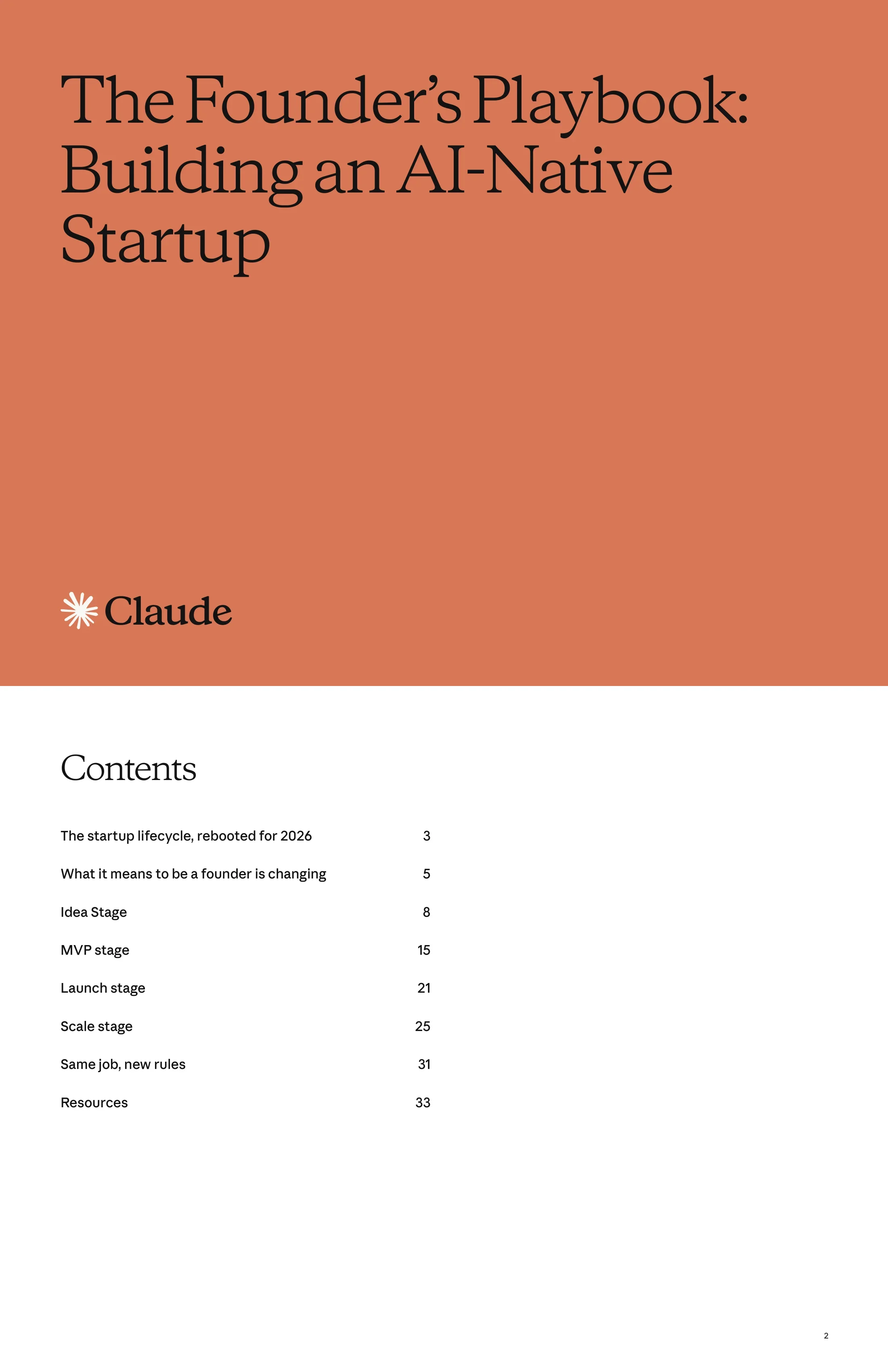
Cover page presenting the ebook title with the Claude wordmark and logo at the bottom left.
Full-bleed terracotta background, large three-line serif title top-left, brand logo bottom-left
Table of contents listing eight sections with page numbers: startup lifecycle rebooted for 2026, what it means to be a founder, Idea, MVP, Launch, Scale, Same job new rules, and Resources.
White background, serif heading top-left, left-aligned list of section titles with right-aligned page numbers in a single narrow column
Chapter divider introducing the first chapter on how AI has reset the startup lifecycle.
Full-bleed sage green background, hand-drawn illustration top-right, chapter pill label and large serif title bottom-left
Explains how AI lets founders who have never coded ship production apps, replaces the validate → raise → hire → build cycle, and introduces the four remapped stages (Idea, MVP, Launch, Scale).
White background, chapter badge and serif headline at top, single left column of body paragraphs with empty right column
Chapter divider for the section on how the founder role is shifting from individual contributor to orchestrator of AI agents.
Full-bleed lavender-purple background, abstract illustration top-right, chapter badge and two-line serif title bottom-left
Describes how AI dissolves the wall between technical and non-technical founders, shifts the founder into orchestrating agents, and introduces three AI capability areas, starting with conversational intelligence and research (deep research, document drafting, strategic thinking partner).
White background, headline top-left, two-column body text with bold subheadings and a bulleted list in the right column
Covers agentic coding as an always-available engineer, workflow automation as an on-demand ops team, and why timing and orchestration of these tools is the founder's key skill.
White background, two-column text with three sans-serif subheadings and italic 'Think:' framing lines; right column ends mid-page
Chapter divider for the Idea stage.
Full-bleed pale mint background, large hand-drawn lightbulb illustration top-right, chapter badge and serif title bottom-left
Defines the Idea stage goal as research-oriented validation, lists the key founder questions, and sets three exit criteria for problem-solution fit (real and specific problem, solution addresses the actual problem, enough signal to justify building).
White background, chapter badge and headline top-left, two columns with subheadings, a bullet list on the left and a numbered list on the right
Details three AI-era Idea-stage pitfalls: mistaking a prototype for validation (citing the 42% of startups that built something nobody wanted), premature scaling of execution ahead of proof, and confirmation bias amplified by AI research.
White background, two columns each with subheadings followed by italic 'The challenge:' summaries and body paragraphs
Introduces the three AI surfaces (chat, Claude Cowork, Claude Code), explains when to use each via a shaded explainer box and a three-column comparison table, and begins the section on defining and pressure-testing the problem hypothesis with an exercise.
White background, left column with headline and a light beige rounded explainer box; right column with a bordered comparison table inside a beige panel and body text below
Covers using AI as a structured devil's advocate, sizing competitors, synthesizing competitor reviews, building TAM/SAM/SOM models, trend analysis, and introduces planning customer discovery, each with a concrete exercise.
White background, two dense text columns with sans-serif subheadings, italic 'Note:' lines, and bold 'Exercise:' bullets
Guides founders on building a precise target profile, designing interview questions that probe past behavior, analyzing interviews for confirming and disconfirming evidence, and automating outreach and scheduling via connected email and calendar.
White background, two text columns with small bold subheadings and exercise bullets
Explains how to challenge the solution concept from every angle, then build the minimum prototype needed to get a real reaction, closing with the transition to the MVP stage.
White background, left column with two subheadings and exercise bullets, short closing paragraph top of right column
Chapter divider for the MVP stage.
Full-bleed pale lilac background, hand-drawn tangled-thread illustration top-right, chapter badge and serif title bottom-left
Frames the MVP as evidence-gathering about the solution, sets goals (translate a validated problem into a working product, move fast without compounding technical debt, invest in persistent context), defines product-market fit as the exit condition, and introduces agentic technical debt.
White background, chapter badge and headline, two columns with subheadings, bold inline goals, and an italic challenge statement
Warns about mistaking launch spikes for PMF, zero-friction scope creep, and insecure code from inexperience, then begins the 'How Claude can help' section with defining architecture before building.
White background, two text columns with subheadings and italic challenge summaries; larger section heading in right column
Recommends saving architectural decisions as CLAUDE.md context files, defining and enforcing MVP scope, building with Claude Code as execution of decided product choices, and running a security review before any user touches the product.
White background, two text columns with exercise bullets, subheadings, an underlined link, and an italic note
Advises building the metrics framework before launch, automating user feedback logistics, using the Sean Ellis test and effort test as PMF litmus tests, and pivoting when data demands it.
White background, two text columns with subheadings, underlined test names, and bold-labeled bullets
Closes the MVP chapter with an exercise: after three iteration cycles without PMF movement, feed retention data and feedback to AI and ask three diagnostic questions before adjusting, pivoting, or returning to the Idea stage.
White background, single left column with an exercise bullet and nested sub-bullets, rest of the page empty
Chapter divider for the Launch stage.
Full-bleed pale peach background, hand-drawn staircase with bouncing arc line illustration top-right, chapter badge and serif title bottom-left
Defines the Launch goal as turning early traction into a repeatable growth engine, lists three exit criteria (repeatable channel-driven growth, production-ready product, operations without founder bottlenecks), and introduces the challenge of technical debt coming due.
White background, chapter badge and headline, two columns with a numbered exit-criteria list spanning both columns and an italic challenge statement
Covers the founder becoming the bottleneck, security and compliance no longer being deferrable, expanding before ready, and explains how all three AI surfaces compound in the Launch stage, starting with remediating technical debt.
White background, two text columns with subheadings, italic challenge callouts, and a larger section heading in the right column
Explains sequencing remediation via an architectural audit, auditing and automating founder operational load, making security and compliance (SOC 2, GDPR, HIPAA) a product workstream, and standing up lightweight product management processes, each with exercises.
White background, two dense text columns with subheadings, italic note, and bold exercise bullets
Chapter divider for the Scale stage.
Full-bleed muted teal-green background, hand-drawn concentric ring illustration top-right, chapter badge and serif title bottom-left
Describes the founder's shift to public-facing executive, goals of systematic growth and a defensible moat through accumulated depth, the exit threshold (sustainable profitability, IPO-readiness, or acquisition), and the challenge of delegating operations.
White background, chapter badge and headline, two text columns with subheadings, bold inline goals, and italic challenge
Covers maturing and trusting systems, scaling technical operations for enterprise buyers, adding organizational infrastructure (hiring, payroll, legal), building a real go-to-market function, and opens the 'How Claude can help Scale stage founders' section.
White background, two dense text columns with subheadings and italic challenge statements; section heading near bottom of right column
Explains producing a founder bottleneck map, pressure-testing systems for scale, converting institutional knowledge into documentation and SLAs, hardening the codebase for enterprise standards, and bootstrapping GTM resources with AI, each with exercises.
White background, two text columns with subheadings and bold exercise bullets
Describes AI as the tactical GTM execution layer, encoding founder domain knowledge into reusable skills and context, building industry-specific edge-case test suites, and compounding behavioral user data into a defensible advantage.
White background, two text columns with small bold subheadings, an underlined 'Skills' link, and exercise bullets
Explains how deep integrations, APIs, webhooks, and SDKs make a product harder to leave, and gives an exercise to audit workflow integration depth across the top ten customers.
White background, single left column with subheading, body paragraphs, and an exercise bullet; right column empty
Chapter divider for the closing chapter.
Full-bleed lavender-purple background, hand-drawn stacked geometric shapes illustration top-right, chapter badge and serif title bottom-left
Concluding text: the founder's job is unchanged (find a real problem, solve it, scale it) but AI compresses quarters into weeks across all four stages; the bottleneck is now what you choose to build, not what you can build.
White background, chapter badge and headline, three short paragraphs in a single left column
Divider page introducing the Resources section.
Full-bleed warm gray background, hand-drawn spiral notebook illustration top-right, large serif title bottom-left
Lists documentation and guides (building AI agents for startups, Claude Code docs and best practices, CLAUDE.md files, power-user tips, Claude Cowork setup, tutorials) plus founder case studies including YC startups, GC AI, Carta Healthcare, Anything, Cogent, Airtree, Duvo, Zingage, and Kindora.
White background, serif heading, two columns of bulleted link lists with underlined bold titles and descriptions
Finishes the founder stories with Kindora and Wordsmith, then lists startup support options: the Anthropic Startups Program, Claude community forums, and live learning resources.
White background, single left column with bullet continuation, a subheading, and three link bullets; right column empty
Closing page with the Claude logo and wordmark bottom-left and the claude.ai URL bottom-right.
Full-bleed terracotta background, logo bottom-left, small URL bottom-right
Common questions about this slide and the underlying presentation content.
It is a 36-page ebook-style deck from Anthropic's Claude team that remaps the four startup stages (Idea, MVP, Launch, Scale) for founders who use AI for research, agentic coding, and workflow automation. Each stage covers goals, exit criteria, common failure modes, and hands-on exercises.
Startup founders, solo founders, and non-technical builders shipping with AI tools, as well as accelerator program managers, startup advisors, and anyone creating founder education content or a long-form ebook layout.
Yes. The deck uses a repeatable editorial system: a solid-color cover, a table of contents, colored chapter divider pages with line-art illustrations, and two-column body pages with subheadings, callouts, and exercise bullets. Swap the copy, colors, and illustrations to fit your brand.
Yes. Page 11 includes a shaded explainer box and a three-column comparison table showing which surface to reach for depending on whether the task is a quick question, a research or document deliverable, or writing and shipping software.
It highlights AI-era traps such as mistaking building for validating, premature scaling, confirmation bias amplified by AI research, agentic technical debt, false product-market fit, zero-friction scope creep, insecure code from inexperience, the founder becoming a bottleneck, and expanding before you are ready.
Nearly every content page includes bold 'Exercise:' prompts, such as pressure-testing your problem hypothesis, mapping competitors by tier, auditing interview questions, saving architecture decisions as CLAUDE.md files, running a pre-launch security review, and building a founder bottleneck map.
Yes. The final chapter lists documentation links for building with Claude, founder case studies from companies like Carta Healthcare, Duvo, Zingage, and Wordsmith, and startup support options including the Anthropic Startups Program.
The deck is a landscape 4:3-style ebook (792 x 612 points) with 36 pages, available as both PDF and an editable PPTX so you can adapt the chapter structure and text for your own playbook.

Create Your Own Slides
Turn your ideas into professional presentations in seconds with 2slides AI.
Reference professional designs, choose your style, and generate slides with perfect text rendering. Powered by Nano Banana—start creating your presentation now.
Your AI Agent for slides. Save time, shine faster with intelligent presentation creation.


© 2026 2slides. All rights reserved.