
Part of Investor presentation examples · Japanese investor presentation examples
BayCurrent, Inc. (TSE 6532) supplementary earnings presentation for the first half of FY2026 (the fiscal year ending February 2027), dated October 15, 2026, covering H1 results, Q3 outlook, AI, cybersecurity and defense demand, client project case studies and PR activities.
Uses this deck’s cover as a style reference for slides made from your own content. Or pick any page below to use its layout as the reference.
Quick Navigation
Tags
Share the slides
BayCurrent, Inc. (TSE 6532) supplementary earnings presentation for the first half of FY2026 (the fiscal year ending February 2027), dated October 15, 2026, covering H1 results, Q3 outlook, AI, cybersecurity and defense demand, client project case studies and PR activities.
Detailed view of each slide page, including layout, key content and visual elements.
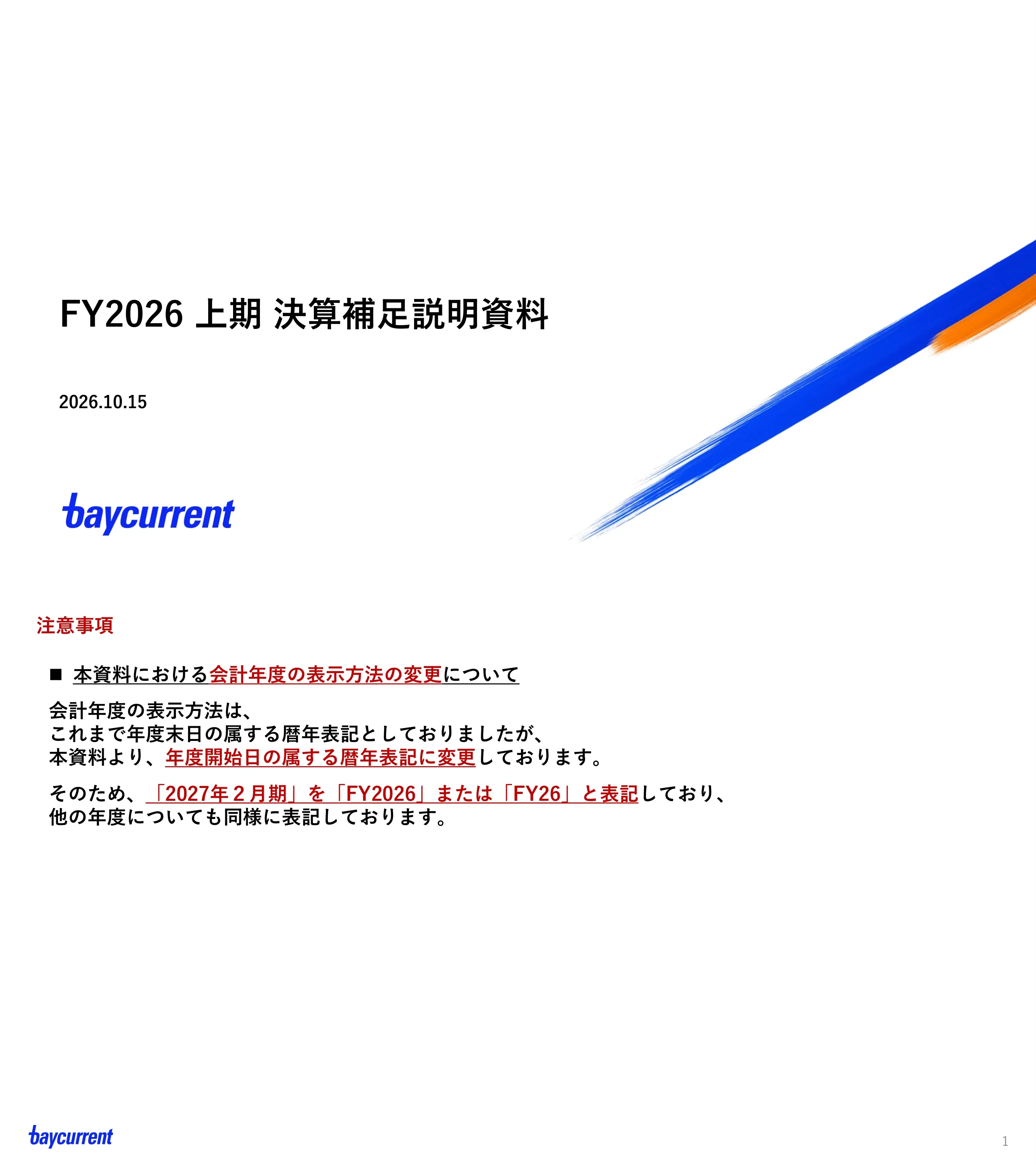
Cover reading 'FY2026 上期 決算補足説明資料' dated 2026.10.15, with the baycurrent logo.
Left-aligned title and date on white, logo bottom-left, diagonal blue and orange brushstroke sweeping from the bottom right.
Fiscal years were previously labelled by the calendar year in which they end; from this deck they are labelled by the year in which they start, so the year ending February 2027 is shown as FY2026 or FY26.
Red heading and single text block with key phrases underlined in red.
Explains that digital innovation is making management issues more complex and that shortages of expertise and talent are increasing demand for full-service consulting firms. BayCurrent positions itself as one of Japan's largest consulting firms and aims to be a comprehensive partner to leading companies.
Bulleted narrative on the left; on the right a circular diagram of five issue clusters (DX/AI, productivity, GX/sustainability, cyber/supply chain, M&A/R&D) surrounded by four external-driver callout boxes.
H1 revenue ¥92,913 million (+35.7% YoY) and EBITDA ¥30,726 million (+29.4% YoY), both above plan after upfront investment to build a repeatable sales model. Initial full-year guidance is revenue ¥190,000 million (+28.1%) and EBITDA ¥66,500 million (+27.6%), and the company expects to beat both and to improve margins in H2.
Two horizontal bands (H1 results, initial guidance), each with a slate-grey label block, large blue figures and bullet commentary on the right.
Revenue +35.7% and EBITDA +29.4% YoY; project count +25.5%; revenue per consultant +6.6%; consultants 6,339 (+30.9%); total employees 8,115 (+29.9%). Growth came from AI demand plus new cybersecurity and defense work, and hiring and training ran ahead of plan.
KPI table with grouped row labels (H1 results, H1 key KPIs), a growth-rate column in blue and a highlights column of bullets.
Q3 revenue and EBITDA are expected to run above plan. KPI ranges: project count +25–28%, revenue per consultant +5–7%, consultants 7,000–7,200 (+32–36%), and about 8,500 total employees (about +32%), reaching the initial full-year targets in Q3.
Same three-column KPI table format as the H1 summary, with a headline sentence above.
Total employees grew from 6,768 (FY25 Q4) to 7,812 (Q1) and 8,115 (Q2), with about 8,500 expected in Q3; consultants rose from 5,590 to 5,676 and 6,339, with 7,000–7,200 expected in Q3. About 710 new graduates joined in Q1, and about 550 are being assigned as consultants from Q2 to Q3.
Bullets on the left beside a grey label block; stacked bar chart on the right with YoY ~25% trend arrows in oval callouts.
H1 revenue reached 48.9% of the ¥190,000 million full-year forecast (Q1 23.5%, Q2 25.4%), ahead of the H1 share of full-year actuals in FY2025 (46.1%), FY2024 (46.6%) and FY2023 (46.5%). Prior full-year revenue was ¥148,332 million, ¥116,056 million and ¥93,909 million.
Horizontal 100% stacked bars for four fiscal years, with a blue bracket marking the H1 share and the revenue total on the right.
H1 EBITDA reached 46.2% of the ¥66,500 million forecast (Q1 22.4%, Q2 23.8%), versus 45.6%, 42.7% and 44.9% in FY2025, FY2024 and FY2023, when EBITDA was ¥52,125 million, ¥43,489 million and ¥35,312 million.
Mirror of the revenue progress chart: horizontal 100% stacked bars with blue H1 brackets.
Revenue and EBITDA usually skew to H2 because of seasonality and hiring and training costs, and the same pattern is expected this year. Quarterly revenue went from ¥34,307 million (FY25 Q1) to ¥48,336 million (FY26 Q2); quarterly EBITDA went from ¥12,455 million to ¥15,838 million.
Two side-by-side quarterly bar charts (revenue, EBITDA); Q3 and Q4 forecast bars are light grey with faded tops.
Quarterly revenue rose within each year, for example from ¥21,718 million to ¥26,192 million in FY2023 and from ¥34,307 million to ¥42,396 million in FY2025. Quarterly EBITDA also peaked in Q4 each year, reaching ¥16,216 million in FY2025 Q4.
Two bar-chart panels split into FY2023/FY2024/FY2025 columns by dotted lines, with dark header bars and red arrows highlighting Q4 peaks.
Revenue grew from ¥93,909 million (FY2023) to ¥116,056 million (FY2024) and ¥148,332 million (FY2025), with ¥190,000 million forecast for FY2026 (about +28%). EBITDA went from ¥35,312 million to ¥43,489 million and ¥52,125 million, with ¥66,500 million forecast (about +28%).
Two annual bar charts with value labels on the bars and blue YoY growth lines; the forecast bar is light grey.
AI-related work made up 50–60% of H1 revenue, and solid demand is expected for the next 3–5 years. Cybersecurity and defense together reached about 10% of revenue and are expected to keep growing toward about 20% by FY2027. Other areas such as energy, semiconductors, data centers and physical AI are emerging gradually.
Four grey category blocks (AI, cybersecurity, defense, other), each with example engagements, linked by vertical brackets to outlook bullets on the right; the defense and cyber outlook is in blue.
Index of 19 engagements labelled a–s: five AI projects (finance, high tech, mobility), five cybersecurity projects (finance, telecom, manufacturing), five defense-related projects (Ministry of Defense, ATLA, heavy industry) and four other projects (power, manufacturing, high tech), each mapped to its detail page.
Four-column table (domain, industry, engagement with letter badge, page reference) with grouped grey domain cells and dashed row lines.
Section divider introducing the appendix.
Full-width slate-grey band across the middle of a white slide with centred white text.
Collects publicly reported multi-year AI and IT investment plans from 12 large Japanese companies, including SMBC, Mizuho, MUFG, Resona, SoftBank, Toyota with NTT, KDDI, Hitachi, AEON, Honda, Nissan and Mitsubishi Electric. The point is that large-scale AI spending should keep demand strong.
Three-by-four grid of company logos, each paired with a grey speech-bubble card of bullets and a person icon.
Summarises recent statements by MUFG, SMBC, Mizuho, TEPCO and JR East about raising cybersecurity spending and preparedness, including MUFG raising its system-investment plan from ¥800 billion to ¥900 billion.
Logo-and-person column on the left with wide grey quote cards of bullet text on the right.
Comments from the Ministry of Defense, Keidanren, Mitsubishi Heavy Industries, IHI and Hitachi point to talent shortages, capacity expansion and growing use of outsourcing in defense. MHI's order backlog is cited at ¥14.103 trillion.
Same logo-plus-quote-card layout as the cybersecurity page.
In May 2026, BayCurrent decided to train 200 security management and engineering consultants using certification courses from Global Security Experts (GSX), covering CISSP for managers and Certified Ethical Hacker (CEH) for engineers.
Bullets on the left; on the right the baycurrent and GSX logos above a two-row table of the certification courses; 'repost' box at top right.
In April 2026, BayCurrent began a strategic partnership with IFS Japan, focused on manufacturing, aerospace and defense, through IFS's partner program. It aims to recruit and train about 200 IFS consultants.
Bullets on the left; IFS and baycurrent logo banner on the right above a three-row table of initiative themes.
Three finance cases: (a) company-wide generative AI rollout and operational transformation, (b) an AI-driven development methodology to standardise system development, and (c) a nationwide rollout of AI agents for corporate sales.
Three rows, each with a rounded photo tile labelled in English (Finance / Generative AI and so on) and a lettered heading with two bullets: client challenge and BayCurrent's role.
(d) For a high-tech manufacturer, an execution plan for AI Optimization (AIO) in the AI-search era, with KPIs and a roadmap to 2030. (e) For an automaker, an FDE-style engagement building an AI agent that derives vehicle verification test items.
Two case-study rows using the photo-tile-plus-text template, with a footnote defining AIO.
Three finance cases: (f) setting up an initial response structure for frontier AI, (g) strengthening global cyber defense, and (h) automating penetration testing, which expanded the number of systems tested each year about tenfold.
Three photo-tile case rows.
(i) Helping a major telecom carrier grow a security business for small and mid-sized companies. (j) Defining ransomware countermeasures across a manufacturer's network of sites through risk assessment and vulnerability diagnosis.
Two photo-tile case rows with open space below.
(k) Reforming common administrative work at the Ministry of Defense to raise productivity, (l) promoting logistics data and AI use for the Air Self-Defense Force, and (m) planning added functions and the future design of ATLA's procurement system.
Three photo-tile case rows.
(n) A combined analysis of function, performance and cost for general-purpose medium unmanned ground vehicles (UGVs) for ATLA. (o) Setting materials R&D strategy for aircraft at a heavy-industry manufacturer.
Two photo-tile case rows with a UGV footnote.
(p) Regulatory compliance and cross-program management for nuclear power plant operations at a utility. (q) Business strategy for semiconductor-package materials combined with co-packaged optics, including M&A screening. (r) Defining an AI data center business strategy for a high-tech manufacturer.
Three photo-tile case rows with a footnote on co-packaged optics.
(s) Assessing commercialisation of physical AI for a high-tech manufacturer across defense and civilian markets, including introducing robotics alliance partners.
Single photo-tile case row with the rest of the slide left white.
BayCurrent joined Nikkei's Generative AI Summit (GenAI/SUM) 2026 as a strategic partner in October 2026 and launched a closed roundtable, GenAI/SUM Executive Round, held three times in 2026 (May, July and October).
Underlined subheading, bullets on the left, GenAI/SUM and baycurrent logos on the right, with two explanatory sub-sections below.
Sessions at GenAI/SUM 2026 included a panel with chief digital officers from Japan's three megabanks and a session on developing cyber talent in the AI era, moderated by BayCurrent staff. Speakers came from SMFG, Mizuho, MUFG, the Cabinet Secretariat, Yokohama National University and NTT Docomo Business.
Two session descriptions at the top, each above a grey two-column table of speaker organisations and titles.
BayCurrent ran a symposium and a workshop at FIN/SUM 2026 (March 2026), a fintech conference co-hosted by the Financial Services Agency and Nikkei. Speakers came from the megabanks, Sumitomo Life, Panasonic, the Digital Agency, the FSA and universities.
Two-column session descriptions with speaker tables; red circular FIN/SUM 10th-anniversary badge at top right.
BayCurrent hosted the second Baycurrent Classic Presented by LEXUS, a PGA Tour event held October 5–11, 2026 at Yokohama Country Club. The company has been the tournament's title sponsor since 2025, after sponsoring the PGA Tour's Japan event in 2023 and 2024.
Bullets at the top above a row of three photos: event poster, hospitality lounge and trophy presentation.
BayCurrent endowed a 'DX and Corporate Management' research course at the University of Tokyo. In July 2026 it published a joint report on how DX organisations evolved, based on 11 companies including MUFG, SMFG, Mizuho, Tokyo Gas, NEC, JR West and LY Corporation.
Two columns: research description with a speaker photo on the left, report summary with a hyperlinked press release on the right.
The Baycurrent Institute has published 39 insight articles so far. The FY2026 articles listed cover satellite data for security, energy self-sufficiency after a Strait of Hormuz crisis, the future of the power industry, mobility, regional banks and US MFN drug-pricing policy.
Intro bullets above a two-column list of article thumbnails with underlined hyperlinked titles.
BayCurrent takes part in the GX League, which METI set up to drive Japan's green transformation. It also teaches a lecture on upheaval in the consulting industry in the University of Tokyo's industry course, which covers consulting from FY2024 to FY2026.
Two-column layout with an underlined heading for each topic, the GX League logo on the left and a University of Tokyo photo on the right.
FY2025 actual vs FY2026 forecast: revenue ¥148,332 million to ¥190,000 million (+28.1%); operating profit ¥50,931 million to ¥64,800 million (+27.2%, margin 34.1%); EBITDA ¥52,125 million to ¥66,500 million (+27.6%, margin 35.0%); net income ¥37,840 million to ¥48,100 million (+27.1%); EPS ¥249.16 to ¥323.79 (+30.0%).
Four-column forecast table with grey row labels, grey prior-year figures, chevron arrows, large black forecast numbers and growth rates.
Standard forward-looking-statement disclaimer: the projections carry risks and uncertainties, are not updated, are not a solicitation to invest, and may not be reproduced without permission.
Single block of body text under a bold heading.
Closing slide showing only the baycurrent wordmark.
Centred logo on a white background.
Common questions about this slide and the underlying presentation content.
For the six months of FY2026 (fiscal year ending February 2027), revenue was ¥92,913 million (+35.7% YoY) and EBITDA was ¥30,726 million (+29.4% YoY), both above plan. Consultants rose 30.9% to 6,339, project count grew 25.5% and revenue per consultant grew 6.6%. H1 revenue reached 48.9% of the ¥190,000 million full-year forecast.
Revenue of ¥190,000 million (+28.1%), operating profit of ¥64,800 million (34.1% margin), EBITDA of ¥66,500 million (35.0% margin), net income of ¥48,100 million and EPS of ¥323.79 (+30.0%). Management says it expects to beat this initial guidance on both revenue and profit.
Starting with this deck, BayCurrent labels fiscal years by the calendar year in which they start rather than the year in which they end. The year ending February 2027 is therefore FY2026 (FY26), and the earlier years in the charts are relabelled the same way.
The page offers the original PDF of the presentation and an editable PPTX converted from the PDF, so you can reuse the KPI tables, charts and case-study layouts in PowerPoint, Keynote or Google Slides.
The original is a Japanese-language 決算補足説明資料 (supplementary earnings presentation) that BayCurrent, Inc. (TSE 6532) filed on TDnet, the Tokyo Stock Exchange's Timely Disclosure network, on October 15, 2026. The slides are shown in Japanese, and the summaries on this page are English translations. Check the original TDnet filing for authoritative figures.
AI-related work made up 50–60% of H1 revenue, and the company expects solid demand for the next 3–5 years. Cybersecurity and defense together accounted for about 10% of revenue, and BayCurrent expects that share to keep growing toward about 20% by FY2027. The deck backs this up with 19 anonymised client case studies.
The deck shows a clean consulting-firm IR style: white slides, slate-grey label blocks, royal-blue highlight numbers, three-column KPI tables, 100% stacked progress bars and photo-tile case-study pages. Upload your own results or notes to 2Slides to generate a presentation with a similar structure, or start from the editable PPTX and swap in your own figures.
It is useful for investors and analysts covering Japanese consulting stocks, finance students learning headcount and productivity KPIs, and IR teams or designers who want a well-structured earnings deck to study.
Original Japanese-language deck

Create Your Own Slides
Turn your ideas into professional presentations in seconds with 2slides AI.
Reference professional designs, choose your style, and generate slides with perfect text rendering. Powered by Nano Banana—start creating your presentation now.
Your AI Agent for slides. Save time, shine faster with intelligent presentation creation.


© 2026 2slides. All rights reserved.