2Slides Team
17 min read

A line sheet template is a fixed page structure for the document wholesale buyers order from: every style with a photo, style number, wholesale price and MSRP, plus colours, sizes, minimums, payment, delivery and contact details. The structure that works for most apparel and accessories brands runs 8 pages: cover with order window, brand, collection overview, three product grids of 4 styles each, an order summary table, and terms. Below is a complete 8-page example, a copyable outline, and a way to generate one in about 7 minutes for roughly $2 in credits.
This guide is for brands moving into wholesale for the first time and for sales reps who rebuild a line sheet every season. Every example number below comes from HALDEN & CO., a fictional brand we made with 2Slides to show the format.
Key takeaways
Contents: What is a line sheet · What to include · The 8-page example · Copyable outline · How to make a line sheet · Line sheet vs lookbook · Common mistakes · FAQ
A line sheet is a wholesale catalog that lists every product in a collection with its photo, style number, wholesale price, suggested retail price (MSRP), colours and sizes, together with the ordering terms a retail buyer needs to place a pre-order. Brands send it to boutiques, department stores and showroom agents before or after a market week, usually as a PDF.
The format comes from the garment industry, where a line sheet traditionally showed a drawing or photo, the style number and a swatch for each piece. The same structure works for accessories, home goods and beauty brands.
A line sheet answers three buyer questions, in this order:
Most vendor guides agree on the same fields. Here is why a buyer needs each one and where it sits in our example.
| Field | Why the buyer needs it | Where it goes |
|---|---|---|
| Brand name, season, collection name | Files your sheet against the right vendor and season | Cover |
| Order window (open and close dates) | Tells them when their open-to-buy budget has to be committed | Cover |
| Delivery month | Lets them plan floor sets and markdown timing | Cover and terms |
| Brand story and proof points | Reasons to take a risk on you: materials, production, stockists, sell-through | Brand page |
| Collection stories and colour palette | Helps them buy a coherent assortment instead of single pieces | Overview page |
| Product photo on a plain background | They judge texture, shape and colour from it | Product grids |
| Style number (SKU) | The reference they write on the purchase order | Product grids and summary |
| Product name | Human-readable reference for their team | Product grids and summary |
| Wholesale price | Their cost | Product grids and summary |
| MSRP | Their selling price and margin; keeps retail pricing consistent across stockists | Product grids and summary |
| Colours and sizes per style | What they can actually order | Summary table |
| Empty quantity column | Turns the sheet into an order form | Summary table |
| Minimum opening order and reorder minimum | Whether they qualify at all | Terms |
| Payment terms | Cash flow: pro forma or Net 30 | Terms |
| Freight policy | Landed cost | Terms |
| Returns policy | Risk | Terms |
| Wholesale contact (email, phone) | Who to send the order to | Terms |
If a field is missing, the buyer has to email you to ask, which slows the order down at the moment you want it to be easy.
HALDEN & CO. is a fictional Nordic knitwear brand. We generated its FW26 "Coastline" line sheet with 2Slides to show a filled-in line sheet rather than a blank template; the brand, prices, stockist count and contacts are all invented. Open the full deck at /gallery/wholesale-line-sheet-example-nordic-knitwear-fw26 to download it as PDF or PPTX.
| Page | Section | What is on it |
|---|---|---|
| 1 | Cover | Brand, "FW26 Wholesale Line Sheet", collection "Coastline", order window 1 Nov to 15 Dec 2026, delivery February 2027 |
| 2 | The brand | Founded 2014 in Bergen; merino and recycled cashmere, knitted in Portugal; 140 stockists, 12 countries, 92% sell-through FW25 (all fictional) |
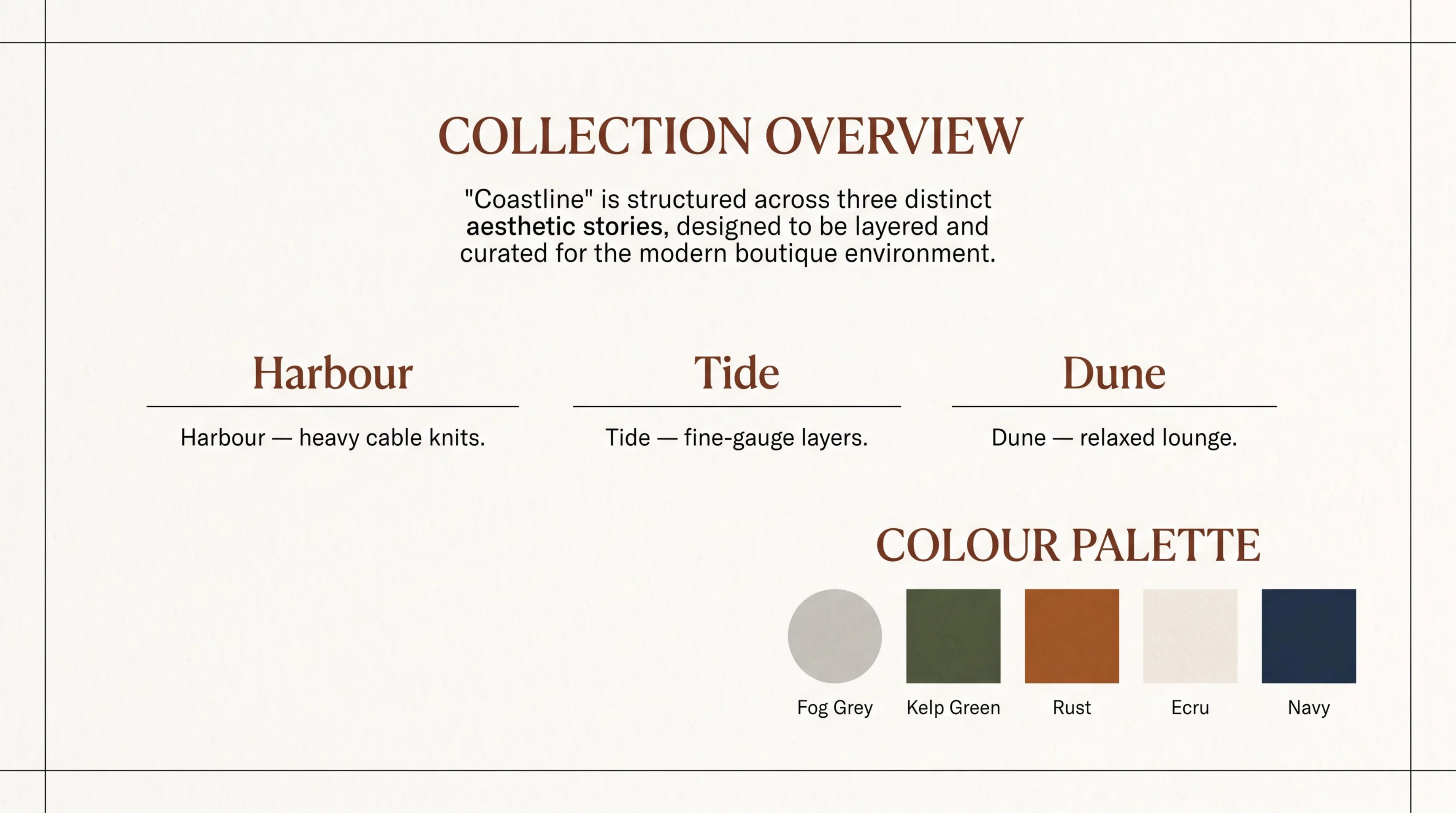
| 3 | Collection overview | 3 stories (Harbour, Tide, Dune) with one line each; 5 colour swatches |
| 4 | Story one: Harbour | 4 heavy cable knits, e.g. HC-101 Fisherman Cable Crew, $78 wholesale / $195 MSRP |
| 5 | Story two: Tide | 4 fine-gauge layers, e.g. TC-204 Long Cardigan, $96 / $240 |
| 6 | Story three: Dune | 4 lounge pieces and accessories, e.g. DC-304 Lounge Socks 2-pack, $12 / $30 |
| 7 | Order summary | All 12 styles with colours, sizes, wholesale, MSRP and an empty Qty column |
| 8 | Terms and contact | $1,500 opening minimum, $500 reorder, Net 30, free freight over $3,000, delivery Feb 2027, defect returns within 14 days |
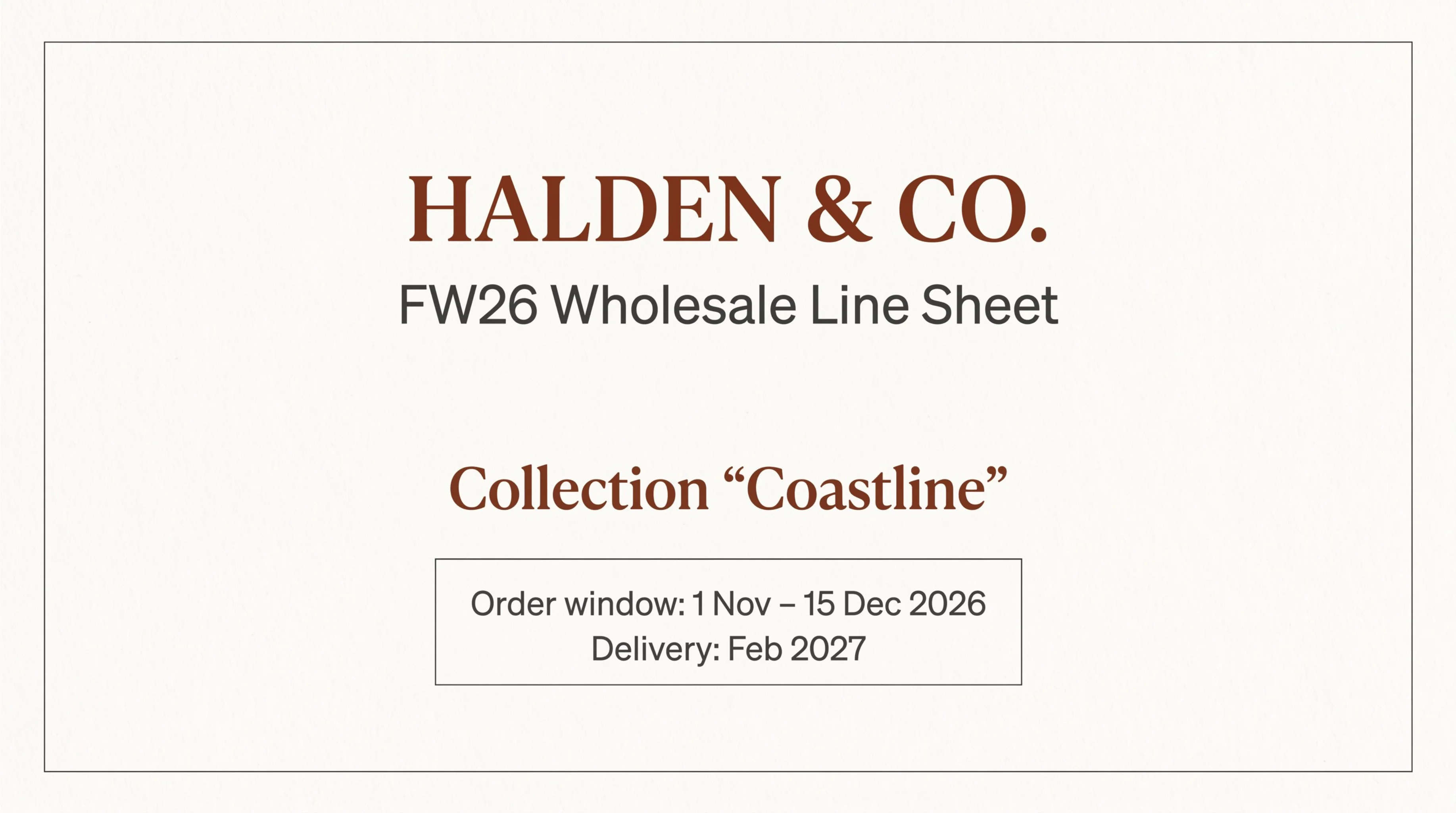
The cover tells the buyer whose sheet this is, which season, and when to order by. The order window and delivery month sit in a framed box so they cannot be missed.
The brand page gives three numbers (stockists, countries, sell-through) and two bullets on materials and production. A brand without stockists yet can use DTC repeat rate, press, or where it is made.
The overview page groups the 12 styles into three stories and declares the five-colour palette once. Showing the stories first invites a buyer to order a story rather than a single sweater, so the product hangs together on their floor.
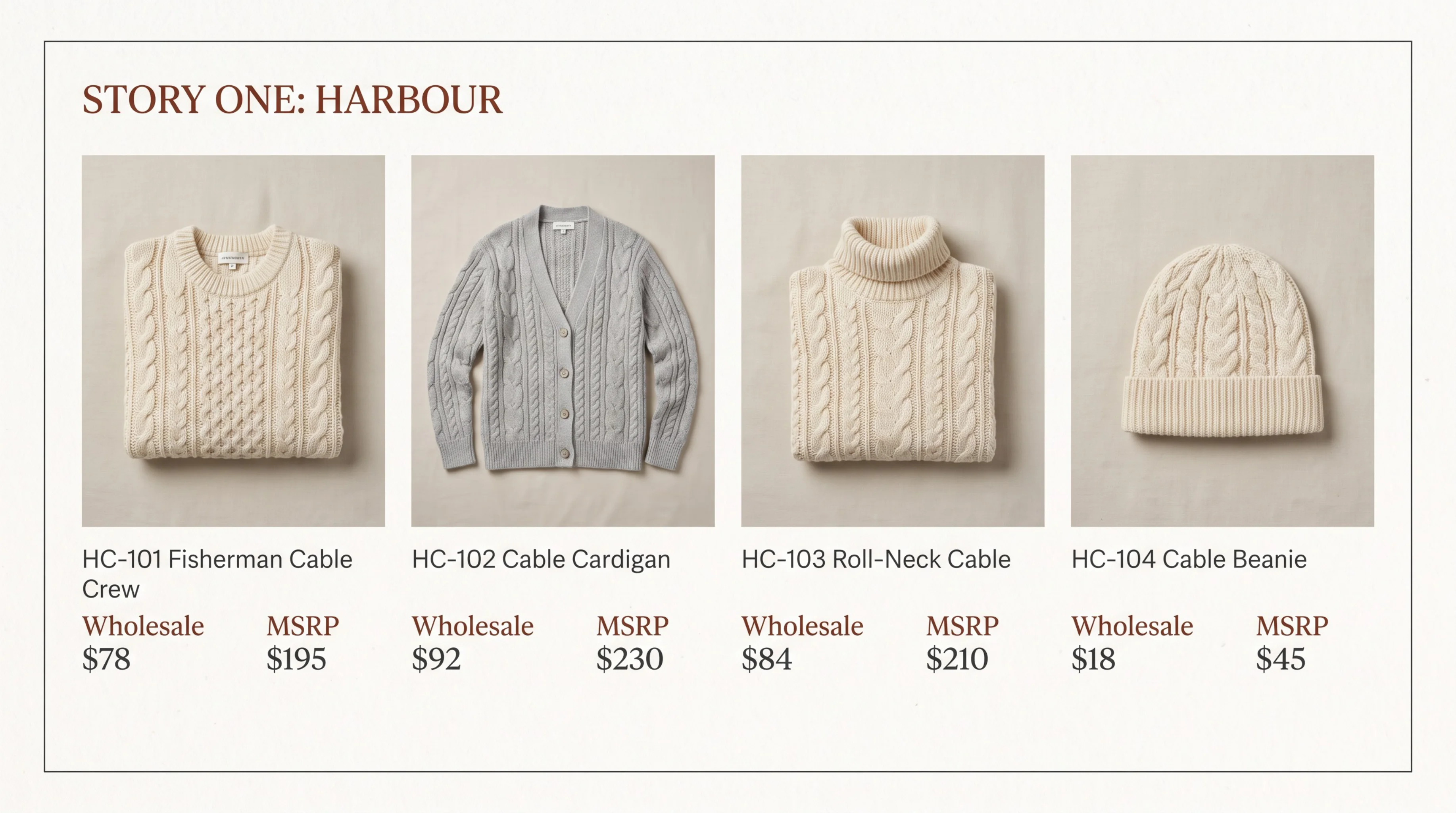
Each tile has exactly four things: photo, style number, name, and a wholesale/MSRP pair. Four tiles per landscape page keeps the knit texture visible. Style numbers carry a story prefix (HC, TC, DC), so the order form maps back to the right page.
Every MSRP in the example is 2.5 times wholesale (HC-101: $78 x 2.5 = $195). Pick one markup rule and apply it across the line. A ratio that drifts from style to style looks like a pricing error and invites questions.
Colours, sizes and fabric are deliberately not on the tiles; they live on page 7 (why is in the proofing section).
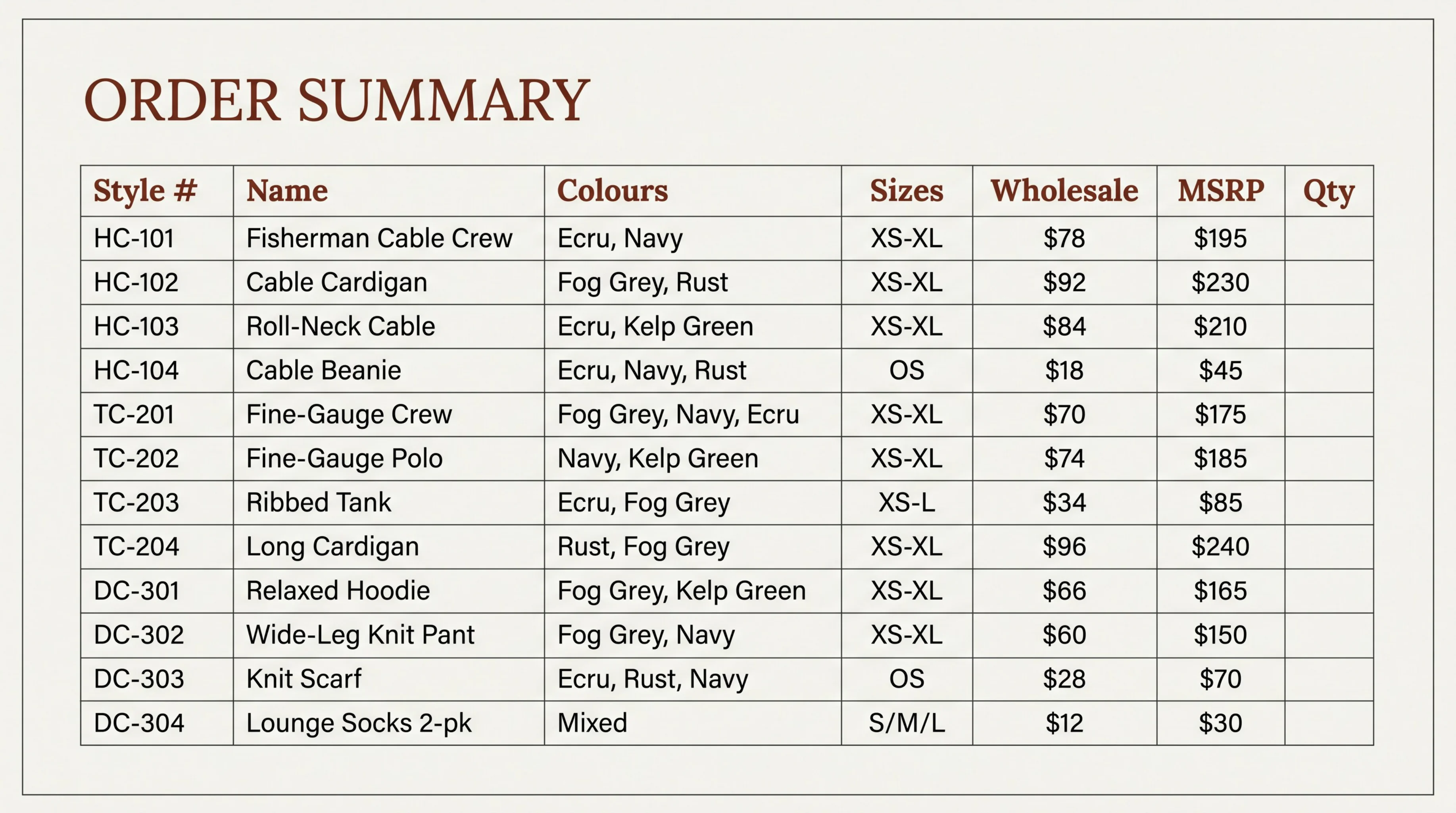
This table repeats all 12 styles with colourways (HC-101 in Ecru and Navy), size ranges (XS to XL for most knits, OS for the beanie and scarf, S/M/L for socks), both prices and an empty Qty column. A buyer can fill in quantities and send it back as a purchase order. If you make only one page, make this one.
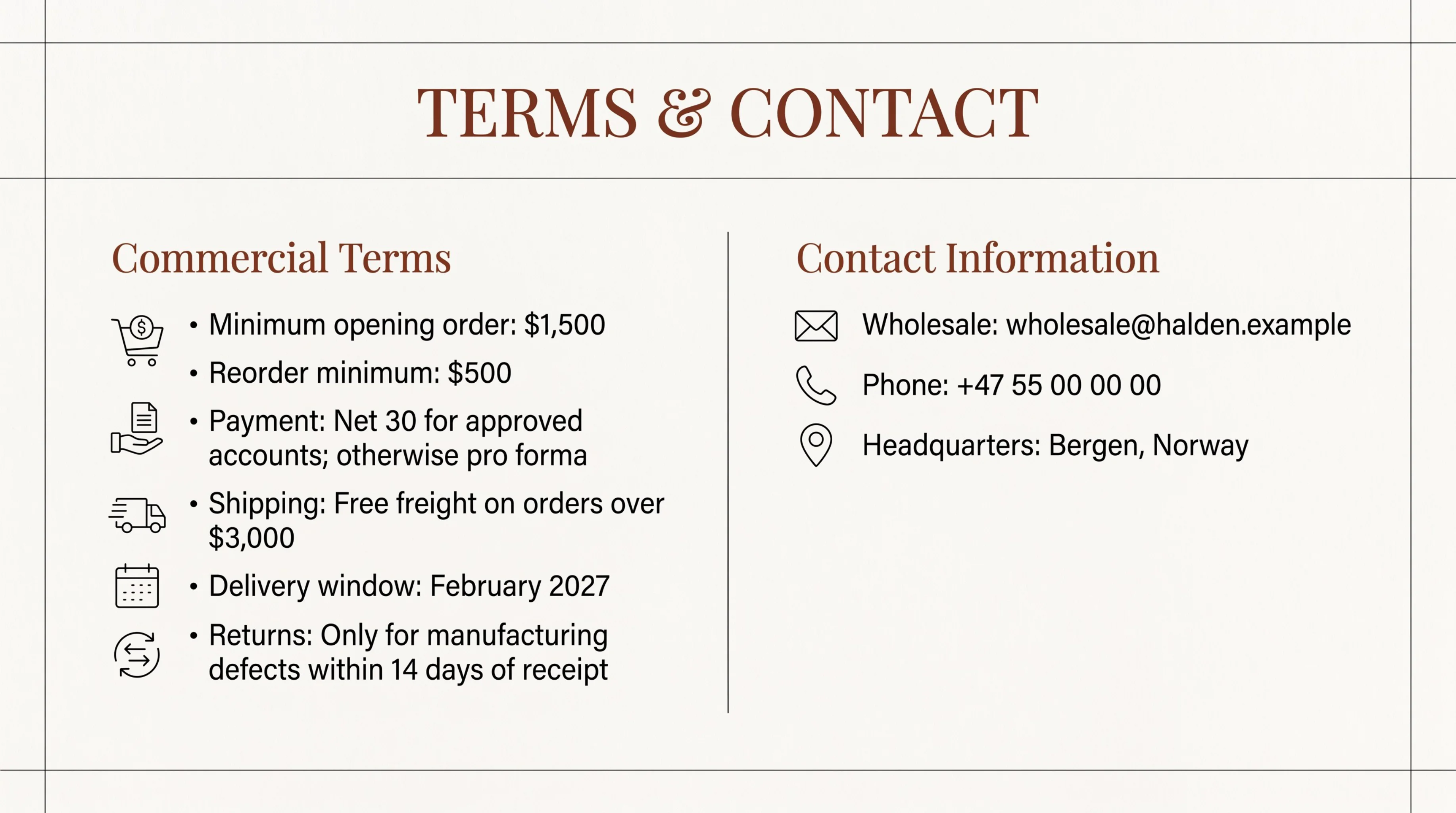
Minimums, Net 30 for approved accounts (pro forma otherwise), freight, delivery and returns each get one line with a small icon, so the page scans in seconds. The contact column uses a placeholder .example email.
Paste this into any tool (Google Slides, Canva, InDesign, PowerPoint, or an AI slide generator) and replace every [bracketed] part. It is the same structure as the HALDEN & CO. deck, with the tile captions trimmed to the fields that render cleanly.
Wholesale line sheet for [Brand name], [Season, e.g. FW26] collection "[Collection name]".
Audience: boutique and department-store buyers placing pre-orders.

Page 1 - Cover: [Brand name] / [Season] Wholesale Line Sheet / Collection "[Collection name]" /
Order window [start date] - [end date] / Delivery [month year].

Page 2 - About the brand: [Founded year and city]. [Materials and where it is made].
Three numbers: [number of stockists], [number of countries], [a sell-through or growth figure].

Page 3 - Collection overview: [number] styles across [number] stories, one line each:
(1) [Story name] - [one-line description]
(2) [Story name] - [one-line description]
(3) [Story name] - [one-line description]
Colour swatches labelled [colour 1], [colour 2], [colour 3], [colour 4], [colour 5].

Page 4 - [Story 1 name]: product grid, exactly 4 equal tiles, one photo per style.
Caption per tile: [Style #] [Product name] / Wholesale $[price] / MSRP $[price]
(x4)

Page 5 - [Story 2 name]: same format, 4 styles.
Page 6 - [Story 3 name]: same format, 4 styles.

Page 7 - Order summary table: all styles, columns Style #, Name, Colours, Sizes,
Wholesale, MSRP, and an empty Qty column.
[Style #] | [Name] | [Colour A, Colour B] | [Size range] | $[wholesale] | $[MSRP] |
(one row per style)

Page 8 - Terms and contact: Minimum opening order $[amount]; reorder minimum $[amount].
Payment [terms]. Free freight on orders over $[amount]. Delivery window [month year].
Returns [policy]. Wholesale contact: [email], [phone].

Use only the facts above. Do not add products, prices or claims.
For more than 12 styles, add product-grid pages (one per 4 styles, or 6 to 8 smaller tiles per page for large catalogs) and let the summary table run to a second page. Do not drop the summary table to save space.
Steps 4 and 5 take most of the time, and they are the part an AI slide tool can take over.
Every sample deck in the 2Slides gallery shows how it was made under "How this deck was made" on the deck page, including the exact content outline and design style. On the line sheet example, click Make one with this recipe, or go straight to /workspace?recipe=wholesale-line-sheet-example-nordic-knitwear-fw26.
The Workspace opens pre-filled with:
[bracketed placeholders] to replace with your products, prices and terms;The guardrails that prevented the problems we hit while making the sample are applied automatically. Replace the placeholders, change the design style if your brand is not Scandinavian knitwear, and generate.
Cost and time, from the 2Slides pricing: image-generated slides cost 100 credits per page at 2K (200 at 4K) plus 10 credits for planning, so an 8-page 2K line sheet is 810 credits. Credit packs start at $5 for 2,000 credits, which makes the whole sheet about $2. New accounts get 500 free credits. Generation takes about 7 minutes, and you can regenerate any single page for 100 credits. Export as PDF (what most buyers expect) or PNG pages.
If you like the look of an existing deck rather than the recipe, use Make slides in this style on any gallery deck, which feeds its cover into Create Slides Like This as a style reference. Each page also has Use this page's style if you only want, say, the order-table layout.
| Line sheet | Lookbook | |
|---|---|---|
| Purpose | Get the order written | Make the buyer want the collection |
| Prices | Wholesale and MSRP on every style | Usually none |
| Photos | Product on plain background | Styled looks, models, locations |
| Key page | Order summary table | The hero looks |
| Sent | After interest, with or before the order window | First, to open the conversation |
A lookbook sells the mood; a line sheet closes the order. A common sequence is lookbook first, line sheet once a buyer asks for pricing, with both using the same style numbers. For the lookbook side, including a full 8-page resortwear example, see our fashion lookbook template and example.
These come from generating the HALDEN & CO. sample and from the fields every line sheet guide agrees buyers need.
Common mistakes: no order window or delivery month; MSRP missing; a markup ratio that drifts between styles; colours and sizes shown only in photos; no summary table, so the buyer has to build their own order form; lifestyle photos where product shots belong.
What we learned generating this line sheet with AI
The dense parts went better than we expected. The 12-row summary table and every price rendered exactly right in every run. The failures were elsewhere:
Proofing checklist before you send
Proof every price yourself. An AI tool lays out your numbers well; it is still your name on the purchase order. Our AI presentation fact-checking guide covers the general method.
As many as your collection needs, in the same order. A 12-style seasonal collection fits in 8 pages: cover, brand, overview, three grids of 4 styles, order summary and terms. Larger collections add product-grid pages and let the summary table run longer; the section order stays the same.
Wholesale is what the retailer pays you. MSRP (manufacturer's suggested retail price) is what you suggest they charge customers. Buyers need both to calculate margin. In the HALDEN & CO. example, MSRP is a consistent 2.5 times wholesale, so HC-101 is $78 wholesale and $195 MSRP.
Yes. One product photo per style on a plain, consistent background is standard. Buyers judge colour, texture and shape from it. Save styled model shots for the lookbook. Keep crops and angles identical across the grid so products are easy to compare.
The outline in this post is free to copy into any design tool, and the HALDEN & CO. deck downloads as PDF or PPTX from its gallery page. Generating your own in 2Slides from the recipe costs 810 credits for 8 pages at 2K, about $2.
Yes, if you give it exact product data. In our tests, prices and a 12-row order table rendered correctly every run. Keep tile captions short, avoid naming colour codes in the style prompt, tell it to use only your facts, and proof every price before sending.
Open the HALDEN & CO. line sheet example, or turn this line sheet template into your own with the one-click recipe. More decks for merchants: e-commerce presentation examples.
Create stunning AI-powered presentations in seconds. Transform your ideas into professional slides with 2slides AI Agent.
Try For FreeYour AI Agent for slides. Save time, shine faster with intelligent presentation creation.


© 2026 2slides. All rights reserved.