2Slides Team
14 min read

A lookbook template gives a clothing brand a fixed structure for its seasonal collection: cover, story, numbered looks with style numbers, a fabric and colour story, and a contact page. Eight pages is enough for a capsule of six looks. Below is a complete fashion lookbook example made with 2Slides, broken down page by page, plus a copyable outline. Generating the same 8-page deck from your own content takes about 7 minutes and 810 credits (roughly $2).
This guide is for small clothing brands and designers who need a lookbook presentation for buyers, stylists or press, sometimes before the professional shoot is booked.
Key takeaways
A lookbook is an editorial presentation of a fashion collection that sells the mood of the season: styled looks on models, each tagged with a look number and the style numbers of the pieces worn, with no prices. Buyers, stylists and editors use it to decide whether the collection fits their store or story. The ordering details (wholesale price, MSRP, sizes, minimums) belong in a separate document, the line sheet.
A fashion lookbook usually travels as an emailed PDF or a deck on a showroom screen, which is why a 16:9 slide format with one idea per page works well.
Lookbooks usually fail in one of two ways: beautiful pictures no buyer can order from (no style numbers), or a catalog in disguise (prices, size grids, too much copy). This checklist keeps you between the two.
| Element | What goes in it | Why it matters | Common mistake |
|---|---|---|---|
| Story | 2–3 sentences on the idea behind the season, plus piece count and main materials | Gives buyers and editors a line to repeat | A paragraph of brand history |
| Looks with style numbers | Each look numbered (Look 01, 02...) and captioned with the style # and name of every piece | Lets a buyer move from "I like that" to an order line | Captions with prices, sizes and colours crammed in |
| Consistent shoot direction | One light, one camera distance, one palette across all looks | Makes six photos read as one collection | Every look shot in a different mood |
| Fabric and colour story | Main materials and the named colourways, shown as swatches | Answers "what is it made of, what colours" without a spec sheet | Hex codes and Pantone numbers on the page |
| Contact for wholesale and press | One email, showroom city and dates | Turns interest into an appointment | Hiding the contact on the last line of the cover |
To show the structure working, we built a complete sample: ATELIER NORI, Spring/Summer 2027 "Salt & Linen", a fictional Lisbon resortwear label. The brand, products, style numbers and contact details are invented, and every image, including the models, was generated by 2Slides. It is 8 pages at 16:9 and 2K.
| Page | Content |
|---|---|
| 1 | Cover: brand, "Spring-Summer 2027 Lookbook", collection name |
| 2 | The story: 18 pieces in European linen and organic cotton |
| 3 | Look 01 + Look 02 side by side |
| 4 | Look 03, one large photo |
| 5 | Look 04 + Look 05 side by side |
| 6 | Look 06, one large photo |
| 7 | Fabric and detail + colour story |
| 8 | Contact: wholesale and press, Lisbon showroom January 2027 |
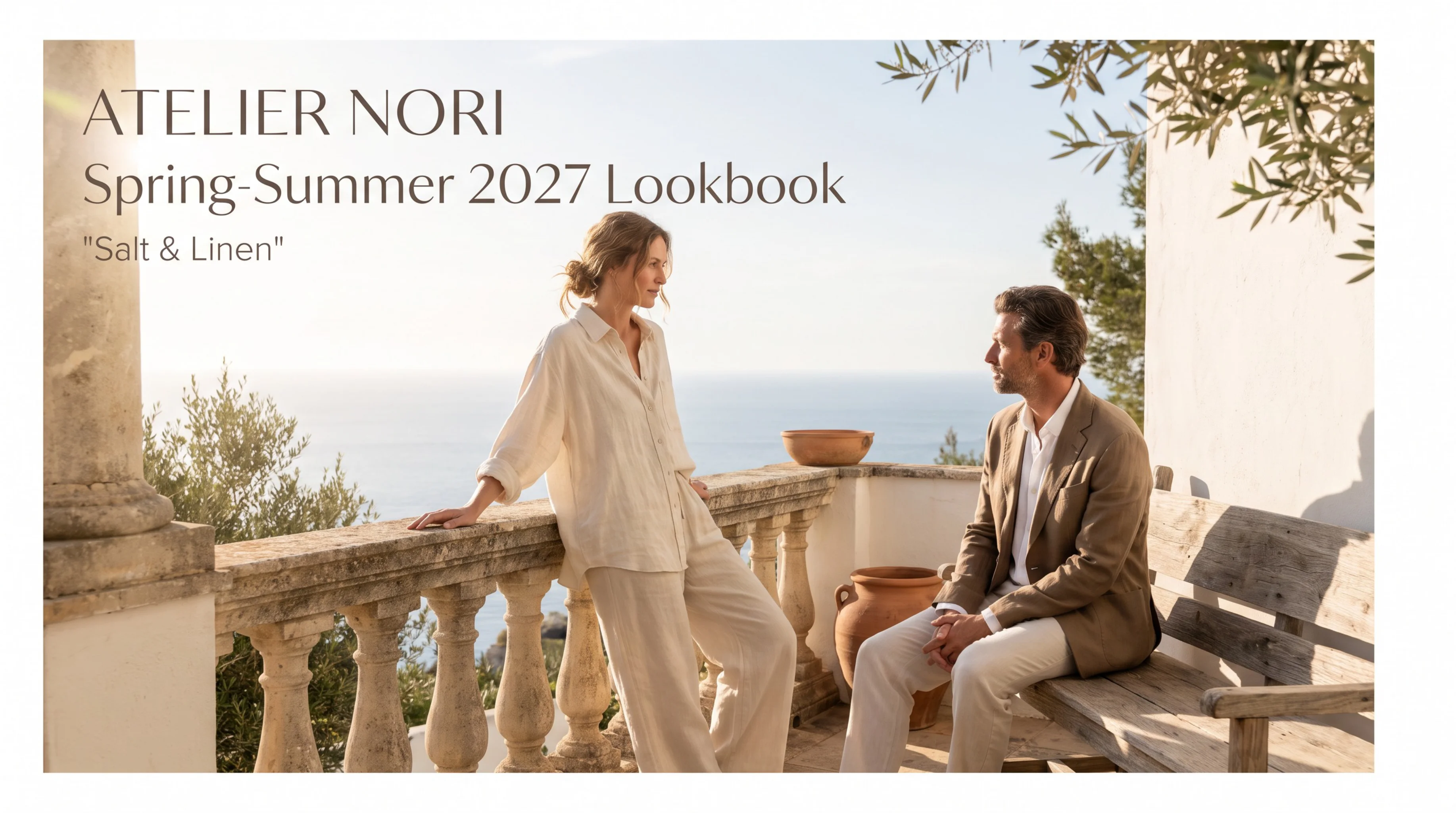
The cover carries only three lines of text: brand, season, collection name. The image does the rest.
Skip the tagline and website. Use your strongest mood image, not necessarily your most sellable look.
One wide image and two short blocks of copy: the idea ("drawn from the Atlantic coast of Portugal") and the facts a buyer files away (18 pieces, European linen and organic cotton). If you write only one thing, write the piece count and materials.
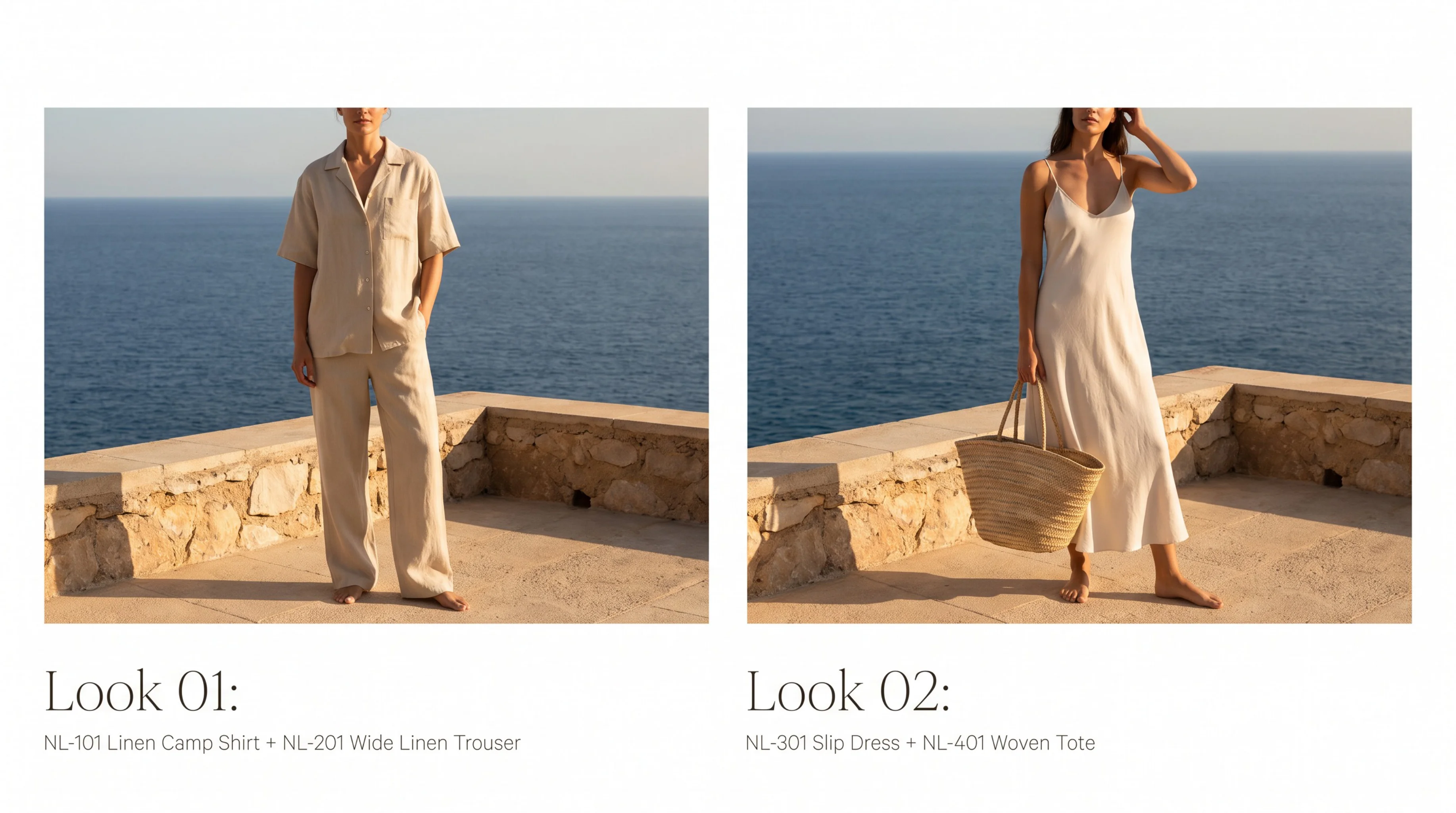
Look 01 and Look 02 share one setting, one light and one framing, so the page reads as a pair.
Six looks over four pages in a pair, single, pair, single rhythm. Each caption is only the look number and the style numbers with names ("Look 01: NL-101 Linen Camp Shirt + NL-201 Wide Linen Trouser"), which is all a buyer needs to find the piece on the line sheet later.
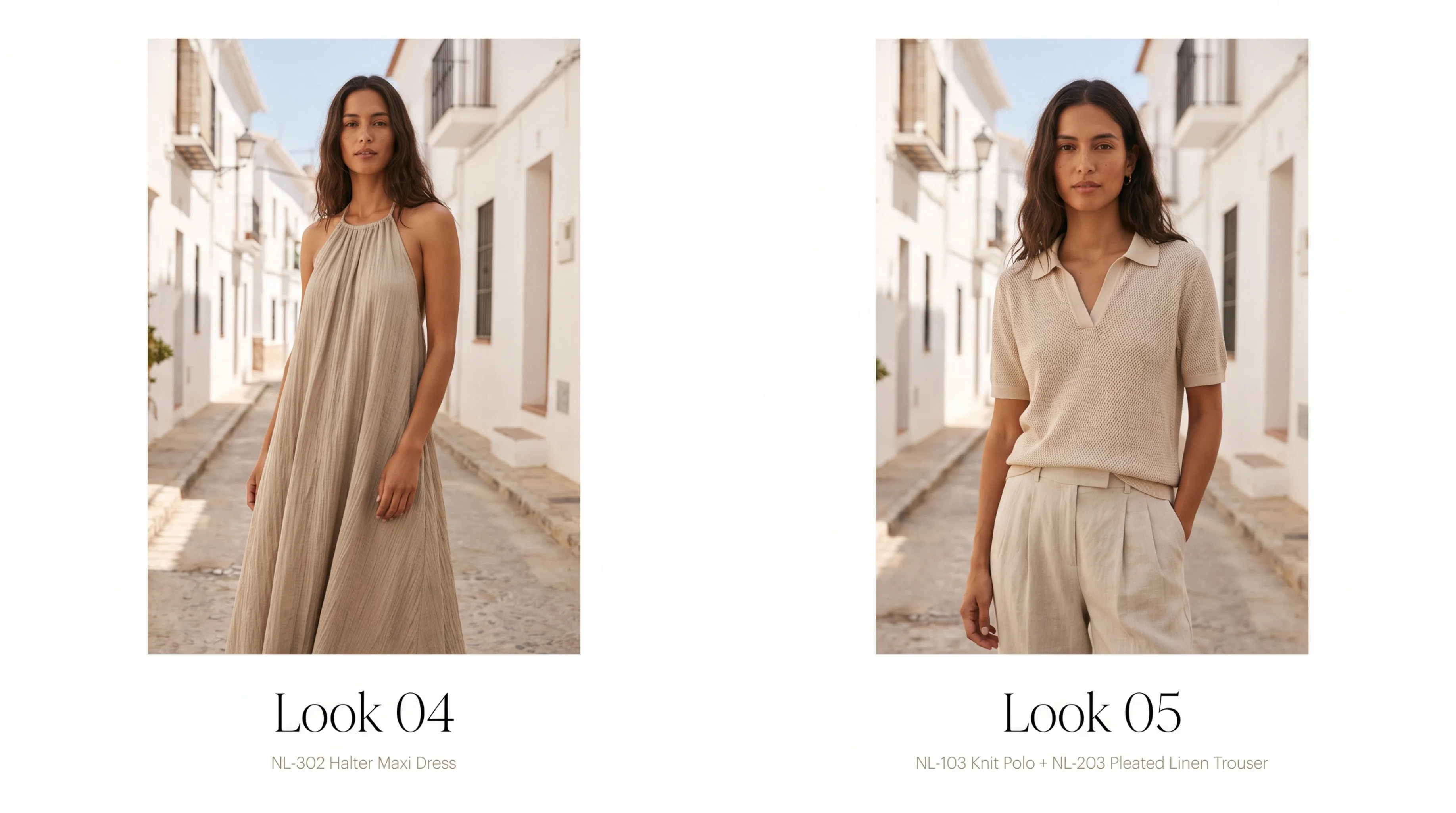
Looks 04 and 05: same lane, same daylight, same full-length framing. Captions stay at look number plus style numbers.
The numbering is systematic: NL-1xx tops, NL-2xx bottoms, NL-3xx dresses, NL-4xx accessories. A scheme like this keeps the lookbook and line sheet in sync.
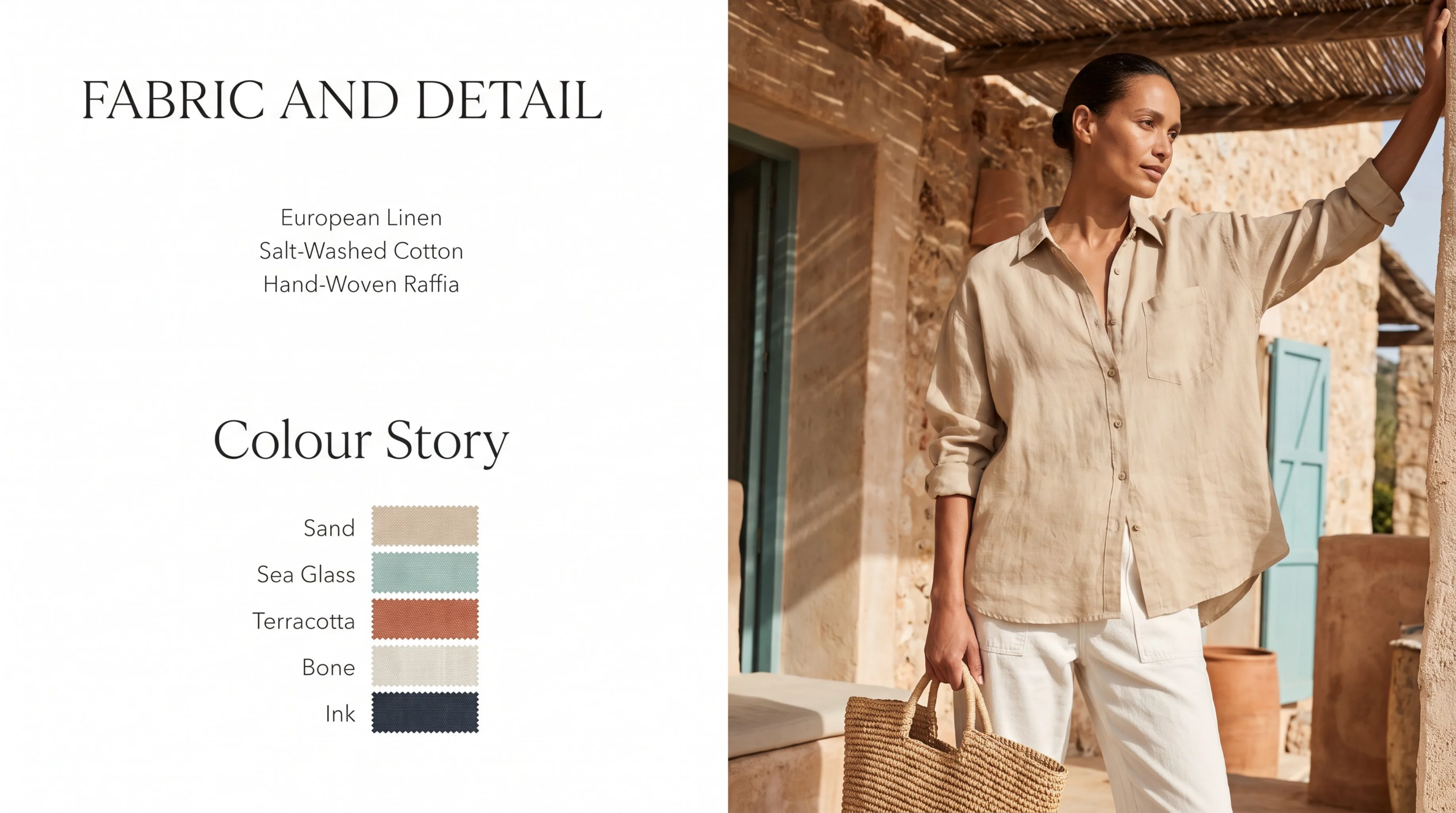
Three materials and five named colourways. No hex codes, no Pantone numbers, no composition percentages.
This page answers "what is it made of, and in what colours". Name colourways the way a hang tag would; fibre composition and care go on the line sheet and tech pack.
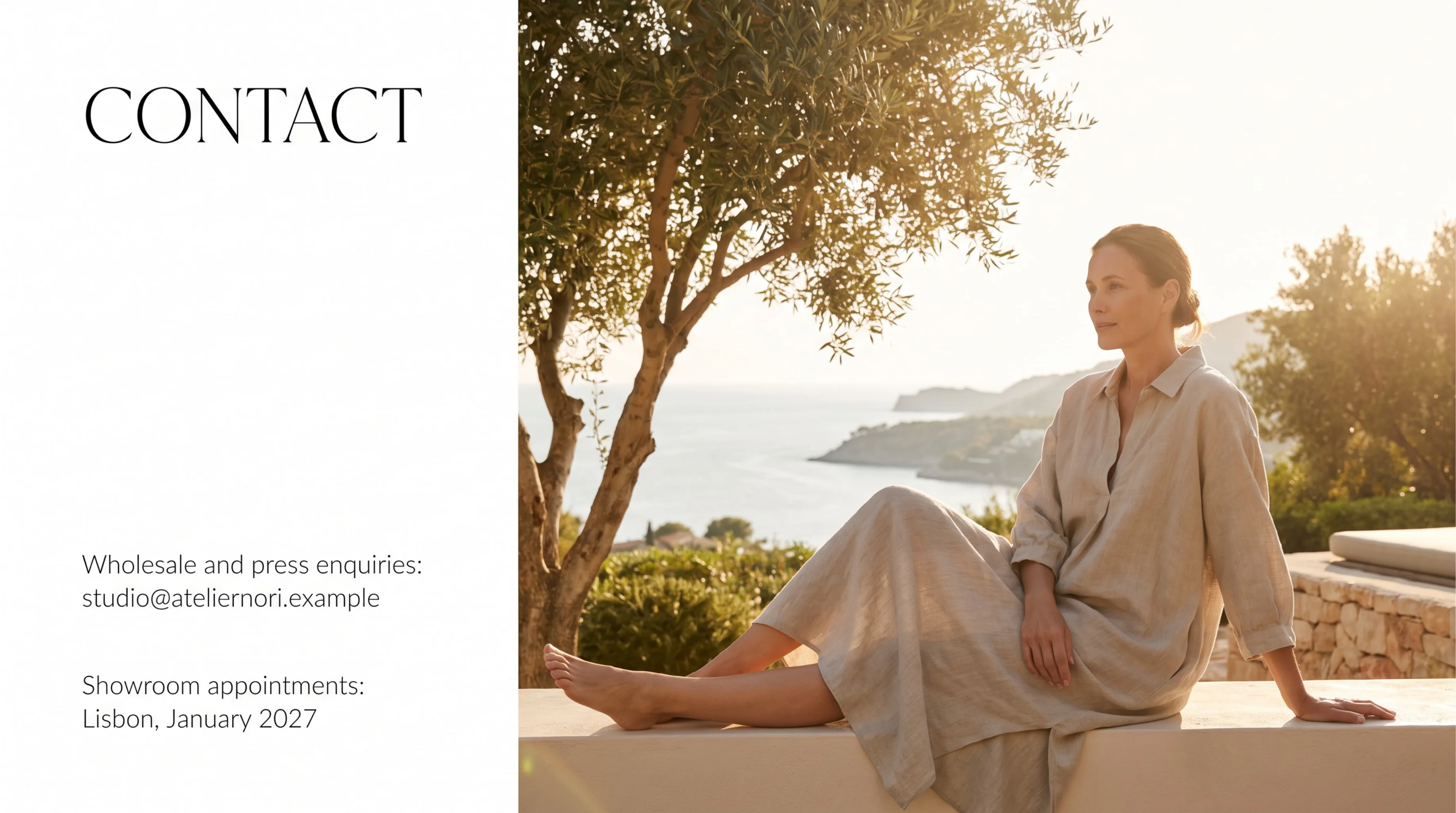
One email for wholesale and press, one showroom city and month.
Make the next step obvious. If you sell through a wholesale platform, its link can go here too.
The hardest part of an AI lookbook is not getting one good image. It is getting six images that look like they came from the same shoot. These rules came out of our own generation runs for the ATELIER NORI sample.
If one page comes out wrong, you do not regenerate the whole deck. In the Workspace any single page can be regenerated for 100 credits.
Paste this into any tool, or into 2Slides, and replace the [bracketed placeholders]. It is the same outline used for the sample.
Seasonal lookbook for [Brand name], [Season, e.g. Spring/Summer 2027] collection "[Collection name]". Audience: boutique buyers, stylists and press.

Page 1 - Cover: [Brand name] / [Season] Lookbook / "[Collection name]".
Page 2 - The story: [Two or three sentences on the idea behind the collection]. [Number] pieces in [main materials].
Page 3 - Look 01 and Look 02 (two full-length editorial photos side by side, one model each, [setting, e.g. a sunlit stone terrace by the sea]). Look 01: [Style #] [Item] + [Style #] [Item]. Look 02: [Style #] [Item] + [Style #] [Item].
Page 4 - Look 03 (one large editorial photo, [setting]): [Style #] [Item] + [Style #] [Item].
Page 5 - Look 04 and Look 05 (two editorial photos side by side, [setting]): Look 04: [Style #] [Item]. Look 05: [Style #] [Item] + [Style #] [Item].
Page 6 - Look 06 (one large editorial photo, [setting]): [Style #] [Item] + [Style #] [Item] + [Style #] [Item].
Page 7 - Fabric and detail: close-up photographs of three materials labelled [Material 1], [Material 2], [Material 3]. Colour story as fabric swatches labelled [colour 1], [colour 2], [colour 3], [colour 4], [colour 5].
Page 8 - Contact: Wholesale and press enquiries: [email]. Showroom appointments: [city, month year].
And the design style we paired with it:
Editorial fashion lookbook. Full-bleed or large natural-light photographs with warm daylight, generous white space, minimal typography. Thin elegant serif for headings, small light sans-serif for captions. Calm, airy layouts like a printed magazine. Models are adults shown in natural relaxed poses. No graphic decorations, no gradients, no icons. Never print colour codes, style instructions or parameter names as text.For a bigger collection, keep the pair/single rhythm: twelve looks fit in about 12 pages.
The sample deck page has the same "Make one with this recipe" button and shows the recipe under "How this deck was made".
Cost in plain numbers: credit packs start at $5 for 2,000 credits, so an 8-page lookbook at 2K is about $2. New accounts get 500 free credits, enough to try a few pages first. See pricing.
Every page of a gallery deck has a "Use this page's style" option, and the deck has "Make slides in this style", which uses the cover as a style reference through Create Slides Like This. This is the route when you already have photography: keep the layout of the paired-look page and swap in your own images and captions. It also keeps a lookbook consistent with an existing brand deck (see on-brand AI slides).
One limit to know: on image-generated slides the text is part of the image. To change a caption you regenerate that page rather than typing over it. If you need editable text boxes, Fast PPT builds a native PPTX from a template at 10 credits per page.
A lookbook sells the mood; a line sheet takes the order. Send the lookbook first to get a buyer interested, then the line sheet when they are ready to write an order.
| Lookbook | Line sheet | |
|---|---|---|
| Purpose | Desire and positioning | Ordering |
| Images | Styled looks on models, in a setting | Each product on a plain background |
| Text | Look number, style numbers, story | Style #, name, colours, sizes, wholesale price, MSRP |
| Prices | Never | Always |
| Terms | Contact only | Minimums, payment, delivery, returns |
| When to send | First touch, press, showroom screen | After interest, during the order window |
The style numbers are the bridge between the two: Look 01's NL-101 should be the same NL-101 on the line sheet. Our companion guide walks through a complete wholesale line sheet template with an example, built the same way for a fictional knitwear brand.
For more fashion and retail decks, see the e-commerce presentation examples, and for a launch narrative around the same collection, how to build a product launch presentation.
A lookbook should include a cover with brand, season and collection name; a short story page; numbered looks captioned with style numbers; a fabric and colour story; and a contact page for wholesale and press. It should not include prices, size charts or ordering terms. Those belong on the line sheet.
Size it to the collection. Six looks fit in 8 pages: cover, story, four look pages, fabric and colour, contact. Each extra pair of looks adds about one to two pages. Alternate paired and single-look pages so the deck does not feel like a grid.
No. A lookbook sells the mood and positioning of a collection; prices pull attention to cost too early. Put wholesale and retail prices on the line sheet, which buyers match to the lookbook by style number.
Generate a mood lookbook with AI: fill in an outline with your looks and style numbers, reuse one light and camera description, and generate. In 2Slides an 8-page lookbook takes about 7 minutes and 810 credits. Replace the images with real garment photography before buyers order.
A lookbook is editorial: styled outfits, a story, a mood, no prices, aimed at buyers and press. A catalog is commercial: every product, prices, sizes and how to buy, aimed at end customers. Many brands make both from the same shoot.
For a mood deck, an early pitch or a photographer brief, yes, and you should say the images are AI-generated. For a lookbook buyers order from, no. The garments in the photos must match the products exactly, and AI images only approximate them.
Start from the finished example: make your lookbook with the ATELIER NORI recipe.
Create stunning AI-powered presentations in seconds. Transform your ideas into professional slides with 2slides AI Agent.
Try For FreeYour AI Agent for slides. Save time, shine faster with intelligent presentation creation.


© 2026 2slides. All rights reserved.