
The Lazy Report - A defence of laziness and rest as catalysts for creativity in the creative industry
快速導航
標籤
分享幻燈片
The Lazy Report - A defence of laziness and rest as catalysts for creativity in the creative industry
每張幻燈片頁面的詳細視圖,包括版面、關鍵內容和視覺元素。
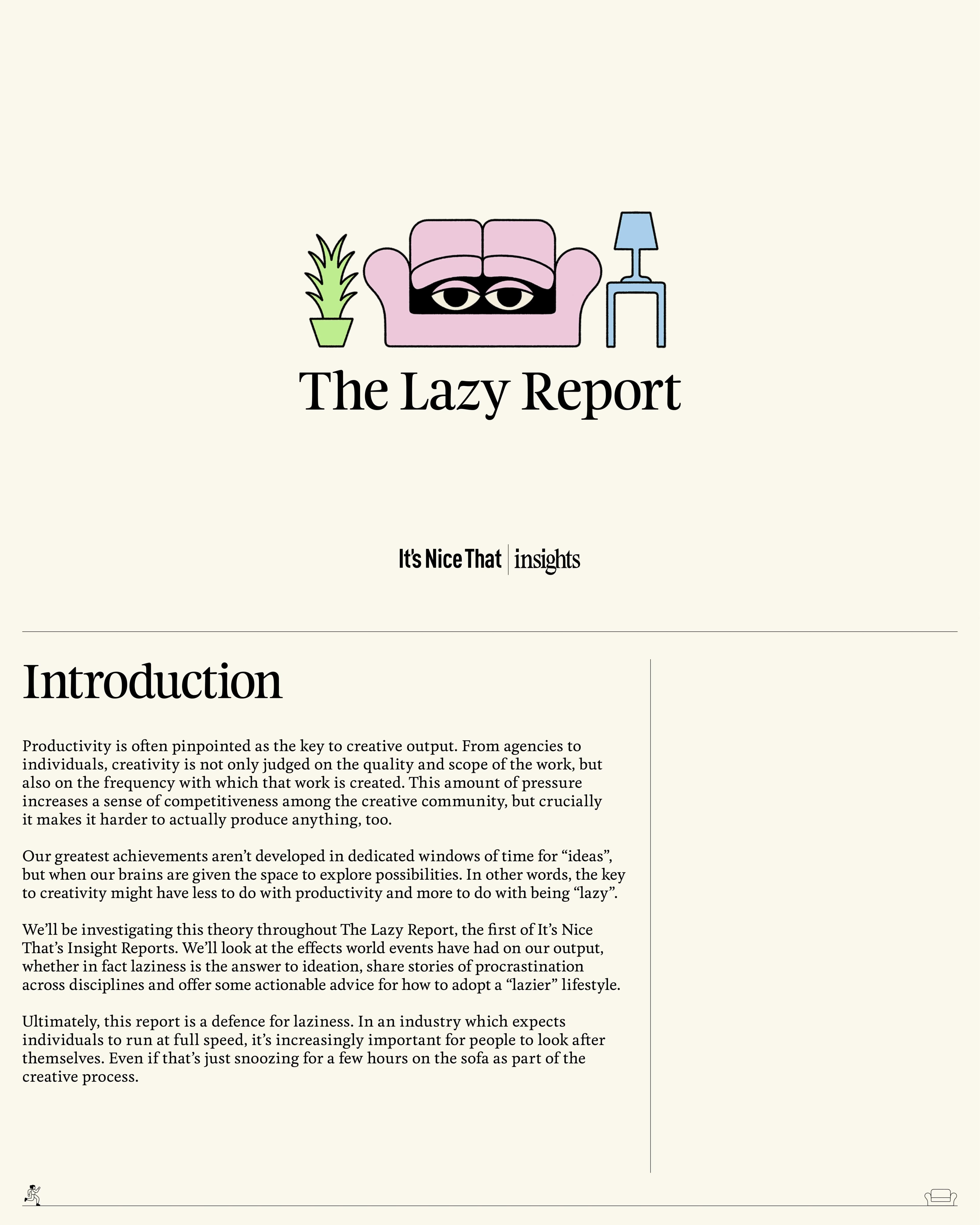
Title page featuring the report name 'The Lazy Report' with the It's Nice That Insights branding
Centered layout with illustrated couch character (eyes peeking from pink sofa), plant, and lamp on cream background
Sets the stage: productivity is seen as key to creative output, but creativity may have more to do with being lazy. The report will investigate laziness, world events' effects on output, and offer advice for a lazier lifestyle.
Large serif heading with body text in a single-column layout on cream background
Three chapter overview: What is The Lazy Movement?, Can Laziness Aid Creativity?, Facilitating Laziness
Three-column grid with illustrated icons above each chapter title on cream background
Chapter opener exploring how the creative industry is shifting away from hustle culture, with individuals redefining the pace of their creativity
Split layout - large illustration on left, heading and body text on right, green background
Highlight statistic: Quiet Quitters make up at least 50% of the US workforce - but are creatives afforded the luxury of sitting back?
Full-page centered quote on green background
Essay exploring the Frog and Toad Twitter bot as comfort, pandemic-driven reassessment of priorities, and the growing desire to be more lazy
Multi-column layout with heading, byline, illustration, and body text on green background
Research on The Great Resignation, Adobe's Future of Time study, Quiet Quitting trend, Gallup statistics, and the Tang Ping movement in China
Mixed layout with pull quote, multi-column text, and Adobe attribution on green background
Asana's finding that 23 hours of the 40-hour workweek are lost to menial tasks. Microsoft data on changing work patterns, meeting-free blocks, and vacation time increases
Pull quote at top, two-column text with illustration in center on green background
Analysis of overwork culture rooted in education, Long Nights questionnaire findings, HeeJae Kim on romanticisation of burnout
Illustration top-left, three-column text with pull quote bottom-left on green background
Conclusion of chapter 1: the need for rest in the creative industry, Frog and Toad closing reference
Two-column text with large pull quote and illustration on green background
A lazy life is on the horizon: creatives are putting up boundaries, taking holidays and telling their boss the work can wait
Full-page centered statement on green background
Survey data: 70% feel overworked since pandemic, 67% find to-do lists longer at end of day, 38% feel best work is in office vs 62% at home, 68% work best setting own structure
Text introduction top-left, two data sections with bold headings and statistics on green background
Survey findings: 56% push back on last-minute requests, 55% prefer holidays over monetary equivalent, 60% prefer meetings over email, 79% feel screen time too high, 59% prioritize salary
Three-section layout with bold headings and supporting statistics on green background
Audience descriptions of their relationship with creativity: drained, boxed in, toxic, stuck, lazy, energising and exhausting, squeezed, tumultuous
Left text block with audience quotes listed on right in table format on green background
Shift in attitude toward creative output is clear. Creatives want autonomy but salary still matters. Leaders need to reconsider the value of laziness.
Large heading, body text paragraphs, illustration bottom-right on green background
Chapter 2 introduction: exploring whether a lazy approach opens paths for ingenuity. Features essay by Madison Utendahl and interview with bare minimum collective
Split layout - cloud and landscape illustration on left, heading and body text on right, pink/lavender background
Creative genius is often only a few lazy days away - Madison Utendahl
Full-page centered quote on lavender background
Personal essay about therapy session that reframed laziness as rest, recovery and self-respect. Introduction to Utendahl Creative's anti-burnout philosophy
Large heading with byline, bio section, illustration, and essay text on lavender background
Deconstructing laziness as societal construct, challenging productivity-based worth, referencing Picasso's prolific output vs quality argument
Bold heading, body text, large pull quote, illustration on lavender background
John Eastwood's psychology of boredom research, Alex Soojung-Kim Pang's Rest philosophy, Utendahl Creative's pro-lazy policies (no meetings before 12PM Monday, five-week closure)
Two sections with bold headings, pull quote, clouds illustration on lavender background
Laziness is a mood that is impermanent and permissible. Encouragement to celebrate stillness rather than shame it.
Bold heading, body text, large pull quote, illustration on lavender background
Introduction to bare minimum collective at ICA London. Group of friends from Cambridge who believe in doing nothing or as little as required.
Large heading, introduction text, decorative line on lavender background
Vera Chapiro and Christie Costello discuss temperament, queerness, interdependency, mutual care, and daily support structures
Pull quote at top, Q&A format with three columns on lavender background
Christie defines laziness as refusal to engage in work in the service of capital. Discussion of work as fetishisation and the politics of refusal.
Large pull quote at top, three-column Q&A text on lavender background
Discussion of guilt, overworking culture in academia, precarious employment, and the structure of the labour market
Pull quote at top, multi-column Q&A format on lavender background
Against work in service of capital but not against work in service of each other. Discussion of being perceived as frivolous but having serious commitments.
Large pull quote at top, three-column text with Q&A on lavender background
Advice for adopting bare minimum ethos: find people to live in solidarity with. Communal life as one of the big answers.
Pull quote at top, multi-column Q&A closing on lavender background
Chapter 2 conclusion: adopting a lazy approach requires evaluating your relationship with work. Simple everyday steps can implement lazy routines.
Large heading, body text, cloud and landscape illustration on lavender background
Chapter 3 introduction: practical advice from creative freelancers and three top lazy tips for your working week
Split layout - person with sleep mask illustration on left, heading and body text on right, blue background
Living life away from art is integral to making art, in my opinion. - Caitlyn Murphy
Full-page centered quote on blue background
New York-based visual storyteller who captures mundane moments through animations, illustrations and linocut artworks. His work evokes visual calm.
Introduction text right, Q&A heading center-left, decorative line on blue background
Discusses creating calming work, the challenge of deciding look and feel before animating, and the importance of stepping away from frustrating projects
Pull quote at top, Q&A format below on blue background
Being bored leads to daydreaming and free association. Downtime is where most ideas are generated. Now actively guards his downtime.
Pull quote at top, Q&A text in multiple columns on blue background
Toronto-based painter working with gouache on watercolour paper, depicting incidental scenes from city walks. Psychogeography concept in her practice.
Introduction text right, Q&A heading center-left, decorative line on blue background
Self-described lazy person who fights it with deadlines. Values colour as most important element. Creates reflexive, serene art using subdued palettes.
Pull quote at top, multi-column Q&A on blue background
Without rest, cannot generate new ideas or energy. Movies, cooking, and reading help. Living life away from art is integral to making art.
Pull quote at top, two-column Q&A on blue background
South Korean contemporary photographer who uses boredom as inspiration, collaborating with nephew Kim Sae-hyun to document joyful moments of childhood idleness.
Introduction text right, Q&A heading center-left, decorative line on blue background
Boredom gives space for miscellaneous thoughts that become work ideas. Time to be lazy frees him from productivity-focused world. Wants to disturb viewer's thinking.
Pull quote at top, three-column Q&A on blue background
For ever-busy creatives, learning how to say no is the top underrated skill they want to master - WeTransfer 2023 Ideas Report
Full-page centered quote on blue background
Time is short in creative industries. Learning to say no protects time for idea generation and laziness. Includes list of polite deflection phrases.
Heading with tip number, illustration, body text, and list of phrases on blue background
Adopt high maintenance approach to be low maintenance daily. Use the Eisenhower Matrix: Do First, Schedule, Delegate, Don't Do.
Heading with tip number, illustration, body text, Eisenhower Matrix on blue background
Strategic laziness: adopt a lazier mentality when starting new roles to set sustainable expectations. Rest as part of professional development.
Heading with tip number, illustration, body text on blue background
Redefining laziness as a mentality encouraging reflection. Contributors demonstrate laziness is healthy. Managers should consider its value. Defocusing may be the key to focusing.
Large heading, body text, illustration bottom-right on blue background
Credits: Editor Lucy Bourton, Researcher Liz Gorny, Art Director Will Knight, Illustrator Dominic Kesterton, Designer Giulia Saporito, Project Manager Sophie Davies. Typeface: Feijoa by Klim Type Foundry.
Two-column layout with credits list and acknowledgements on cream background
Source references: Adobe Future of Time, Asana Anatomy of Work, Microsoft 2022 Work Trend Index, Gallup Quiet Quitting, NYT Tang Ping, Futuress Long Nights, It's Nice That burnout article, WeTransfer Ideas Report
Reference list with page numbers and source names on cream background
Closing page with It's Nice That Insights branding
Centered minimal layout with small couch logo on cream background
Empty end page
Blank cream page
關於此幻燈片和基礎簡報內容的常見問題。
The Lazy Report is the first Insight Report from It's Nice That, exploring how laziness and rest can be catalysts for creativity in the creative industry. It combines research, survey data, personal essays, and artist interviews to make the case that a rested mind leads to better creative work.
The report was developed by It's Nice That's Creative Insights team, edited by Lucy Bourton, with art direction by Will Knight, illustrations by Dominic Kesterton, design by Giulia Saporito, and research by Liz Gorny.
The report covers three main areas: What is The Lazy Movement (examining quiet quitting, The Great Resignation, and shifting work attitudes), Can Laziness Aid Creativity (featuring an essay by Madison Utendahl and interview with bare minimum collective), and Facilitating Laziness (interviews with artists Raj Jeshang, Caitlyn Murphy, and Hyunmin Ryu, plus three actionable lazy tips).
Key findings include: 70% of creative professionals feel overworked since the pandemic, 62% prefer working from home, 67% find their to-do lists longer at end of day, 56% would push back on last-minute boss requests, and 79% feel their screen time is too high.
Contributors include Madison Utendahl (founder of Utendahl Creative), Vera Chapiro and Christie Costello from the bare minimum collective, visual storyteller Raj Jeshang, painter Caitlyn Murphy, and photographer Hyunmin Ryu.
The three tips are: 1) Learn how to say no - protect your time with polite deflection phrases, 2) Be high maintenance - use the Eisenhower Matrix to eliminate unnecessary tasks, and 3) Pick the optimum time to be lazy - set sustainable expectations especially when starting new roles.
Yes, the report provides research-backed evidence that rest and laziness can improve creative output. It includes practical examples like Utendahl Creative's five-week office closure policy and no-meetings-before-noon rule, offering inspiration for managers looking to implement rest-friendly workplace policies.
The report features a distinctive color-coded chapter system (cream for intro/outro, green for Chapter 1, lavender/pink for Chapter 2, blue for Chapter 3), custom black-and-white illustrations by Dominic Kesterton with colored accents, and the Feijoa serif typeface by Klim Type Foundry throughout.

Create Your Own Slides
Turn your ideas into professional presentations in seconds with 2slides AI.
參考專業設計,選擇您的風格,產生具有完美文字渲染的投影片。由 Nano Banana 提供支援—立即開始建立您的簡報。