2Slides Team
13 min read

Quick answer: To turn a photo into a ukiyo-e woodblock print, use the Ukiyo-e Woodblock Poster. For a Chinese ink painting, use the Chinese Ink Wash Poster. Both return your photo on top and the same scene redrawn below. They work best on temples, mountains, water and old streets, and poorly on portraits. A 2K image costs 100 credits, about $0.25.
Ukiyo-e prints and Chinese ink paintings are hard to fake with a simple filter. A woodblock print is built from flat color areas and carved outlines. An ink painting is built from what the painter leaves out. A filter that only shifts colors captures neither.
On 2Slides Photo Effect Tools, each style is a separate, fully written image prompt. You upload one photo, and you get back a poster with your original photo on one half and the same scene redrawn in that medium on the other half. This guide covers three effects from Japanese and Chinese traditions: Ukiyo-e Woodblock, Chinese Ink Wash and Japanese Minimal Watercolor.
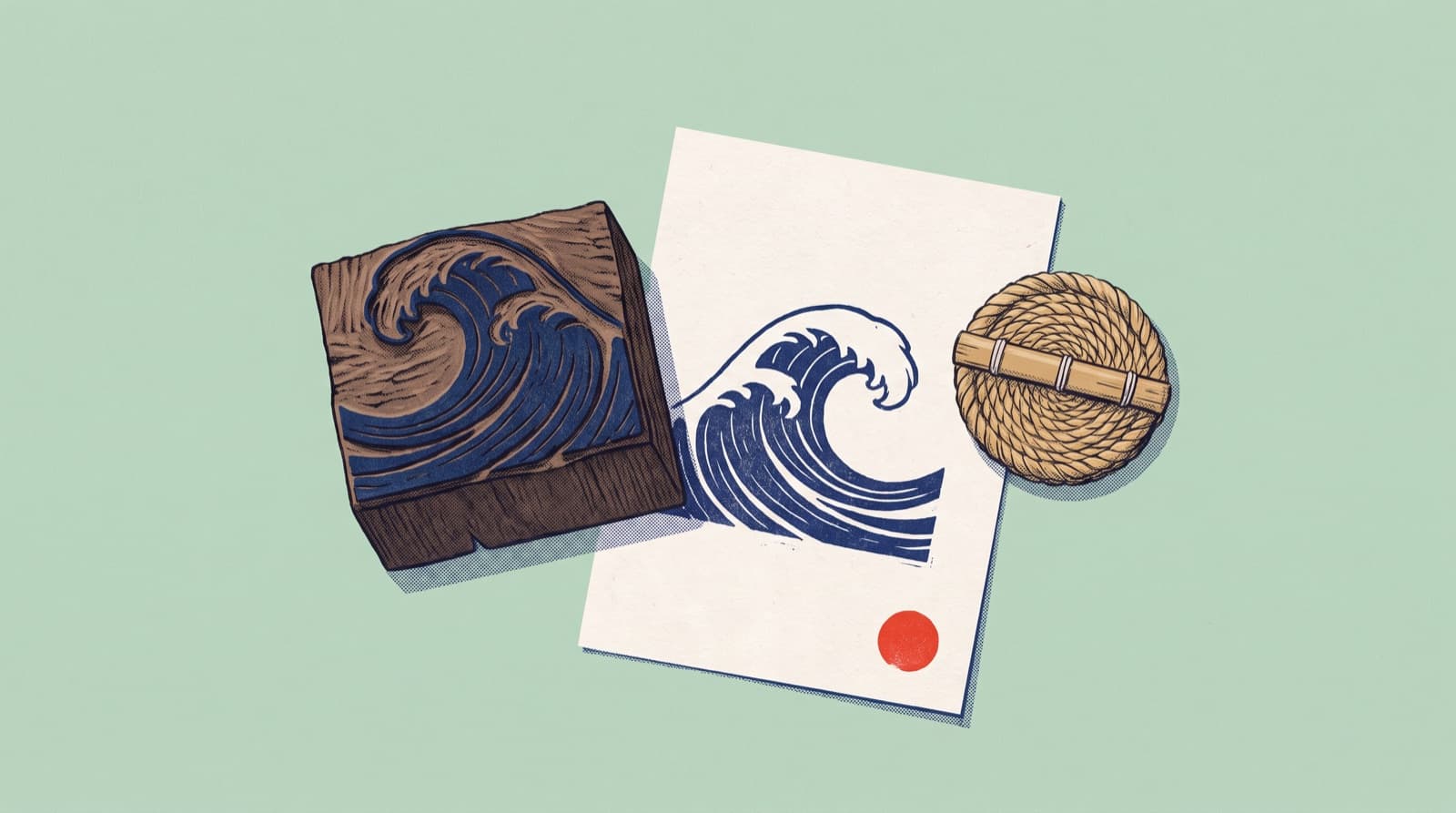
Ukiyo-e is a style of Japanese woodblock print and painting from the Edo period (1603–1868). The name means "pictures of the floating world." Prints were made by carving each color into a separate wooden block and printing the blocks one after another on paper. Katsushika Hokusai and Utagawa Hiroshige are two of the best-known artists, especially for their landscapes.
Because each color came from its own block, ukiyo-e prints have a clear look:
The Ukiyo-e Woodblock Poster asks for all of these: an off-white washi paper ground, indigo and ink-black outlines, a few overprinted colors (vermilion, ochre, cyan-blue and gray-green), short chisel marks, dry-brush gaps and slight registration drift. Without those marks, the result would look like a vector illustration.
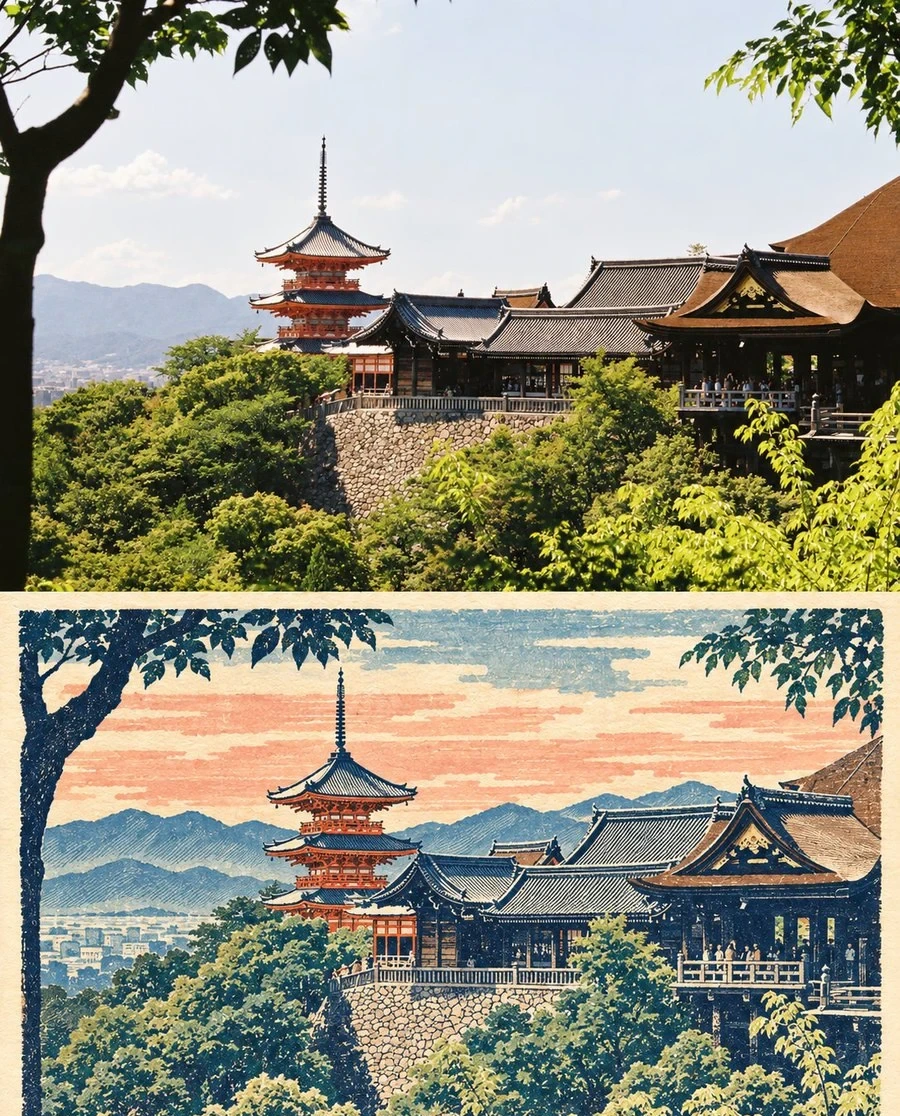
A temple and pagoda above Kyoto. The stone retaining wall becomes a field of short chisel marks.
Chinese ink wash painting uses black ink, diluted with water to many shades of gray, applied with a brush to absorbent paper or silk. Xuan paper, often called rice paper in English, is the traditional paper. The style developed in China over many centuries and is closely linked to landscape painting of mountains and water.
Ink wash works by leaving things out. The painter keeps the outline, the structure and the atmosphere, and lets the rest fade into empty paper. Typical marks include:
The Chinese Ink Wash Poster follows this approach. The lower half sits on an ivory or xuan-paper ground and is built mainly in black, gray and pale ink. The subject fills only about 30–45% of the lower half, and its edges fade into the paper. A little color can appear as a small accent, such as blue-gray, pale gold or cinnabar red. However, the prompt does not allow it to copy your photo's real colors, so ink and empty space stay dominant.
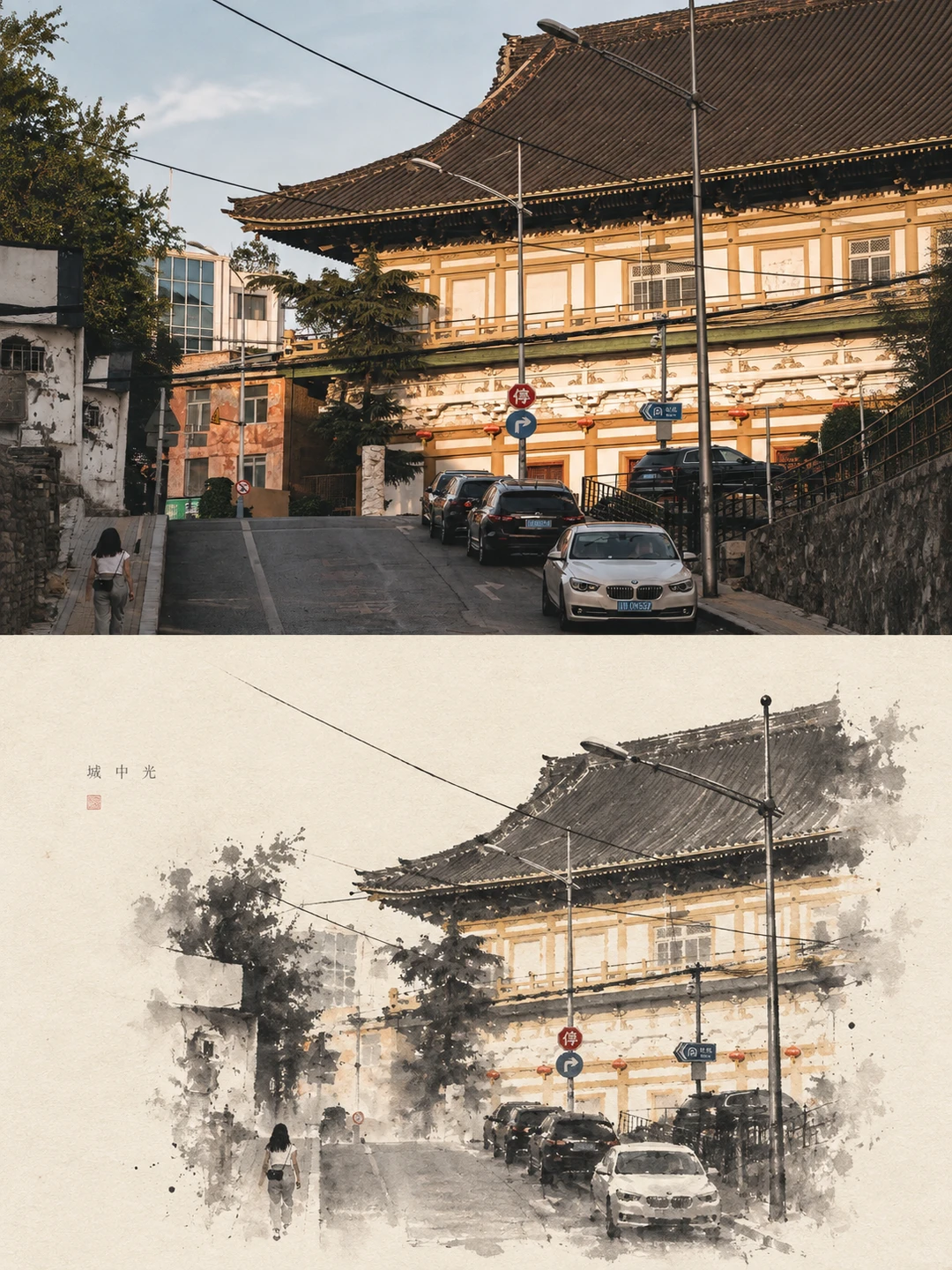
A temple roof above a city street. The overhead wires survive as three ruled lines, and the parked cars dissolve into wash.
All three effects keep your photo in the top half and redraw it in the bottom half. They differ in how much of the scene they keep, how much color they use, and whether you can add text.
| Ukiyo-e Woodblock Poster | Chinese Ink Wash Poster | Japanese Minimal Watercolor Print | |
|---|---|---|---|
| Medium | Edo-period woodblock print on washi | Ink on xuan-paper tone | Small watercolor on ivory paper |
| Color | Indigo and ink outlines, a few flat overprinted colors from your photo | Mostly black, gray and pale ink, with a small accent | Light, low-saturation washes from your photo |
| How much of the scene it keeps | Most of it, as flat carved shapes | The outline and the atmosphere only | A few simple shapes |
| Text on the poster | None (the prompt forbids it) | One short phrase you choose | One line you choose, plus an optional second line |
| Best photos | Temples, mountains, lantern-lit streets, piers over water | Rooflines, rising streets, mountain ridges, bridges, trees in mist | A house against the sky, one cloud, boats on a river, a snowy path |
| Avoid | Portraits, interiors, night scenes with little structure | Portraits, close-ups, photos that depend on color | Busy scenes and faces |
| Poster shape (2K size) | 3:4 (1792 × 2400) | 3:4 (1792 × 2400) | 4:5 (1856 × 2304) |
| Clean test runs | 5/6 | 6/6 | 0/6* |
* The Japanese Minimal Watercolor result needs context. See the section on test results below.
Photos with strong outlines and layered depth work best with all three styles. Temples, mountains, water, bridges and old streets are the ideal subjects. Portraits work worst, because a face reduced to flat color or loose ink loses its likeness. Busy scenes with no clear structure also lose most of their content.
Photos that work well:
Photos that fail or disappoint:
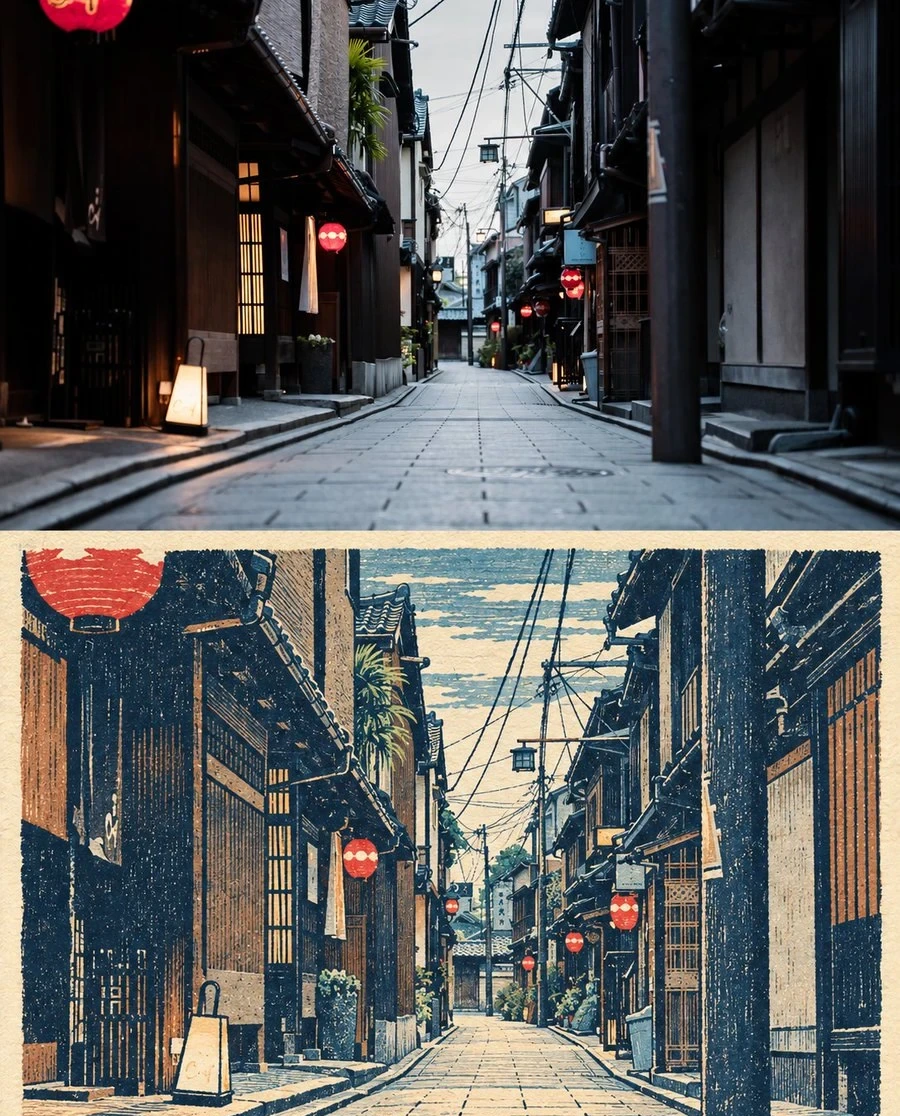
A lantern-lit lane at dusk. The overhead wires survive as single ruled lines across a pale sky.
The Ukiyo-e Woodblock Poster is the right choice when you want a full, detailed print of your scene. It keeps most of the scene and redraws it as flat carved color, with indigo outlines and visible wood-print marks. It has no text option at all.
Two details are worth knowing:
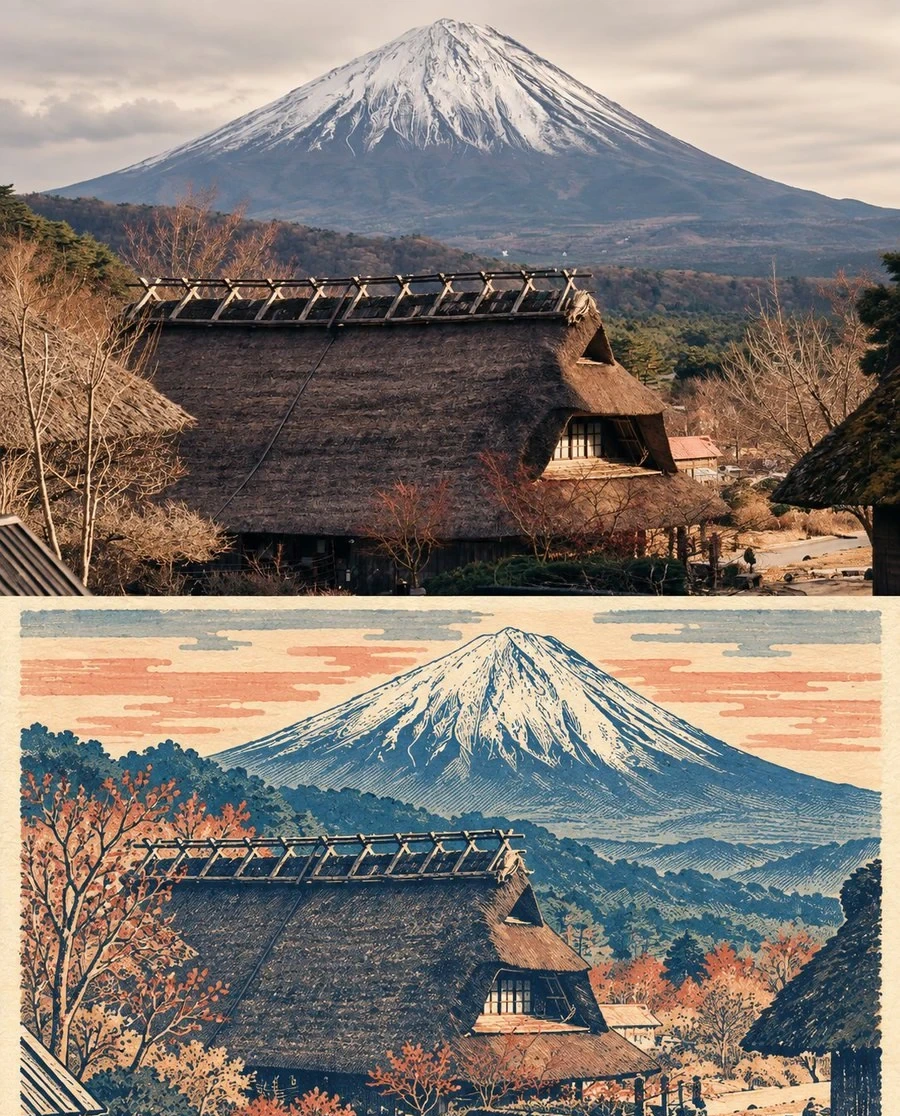
A thatched roof under Mount Fuji. The mountain is carved in indigo hatching, and the maples are printed in vermilion.
The Chinese Ink Wash Poster is the right choice when you want a quiet image with a lot of empty space. It keeps the outline, the structure and the mood, and drops secondary detail such as cars, signs and clutter.
It has one text field, not a title and subtitle. The prompt asks for "a handful of words" set quietly in the empty space. You can write in any language, but a short Chinese phrase fits the form best and takes less space. If you leave the field blank, the model writes its own short phrase from the subject, the place or the mood.
Tip: type your phrase without quotation marks or brackets. In an earlier version of this effect, brackets around a Chinese caption sometimes appeared in the artwork. In the current version, a four-character Chinese caption came out exactly right in all six test runs.
The Japanese Minimal Watercolor Print is for people who want restraint more than detail. Below your photo, it paints a small watercolor of the same scene, about a third of the frame's width, surrounded by wide, empty ivory paper. A short line of text sits under the painting, like a gallery print.
Choose it for simple scenes: a house against a colored sky, a single cloud, boats on a wide river, a path through snow. Do not choose it for a busy street or a face. At this small size, detail disappears.
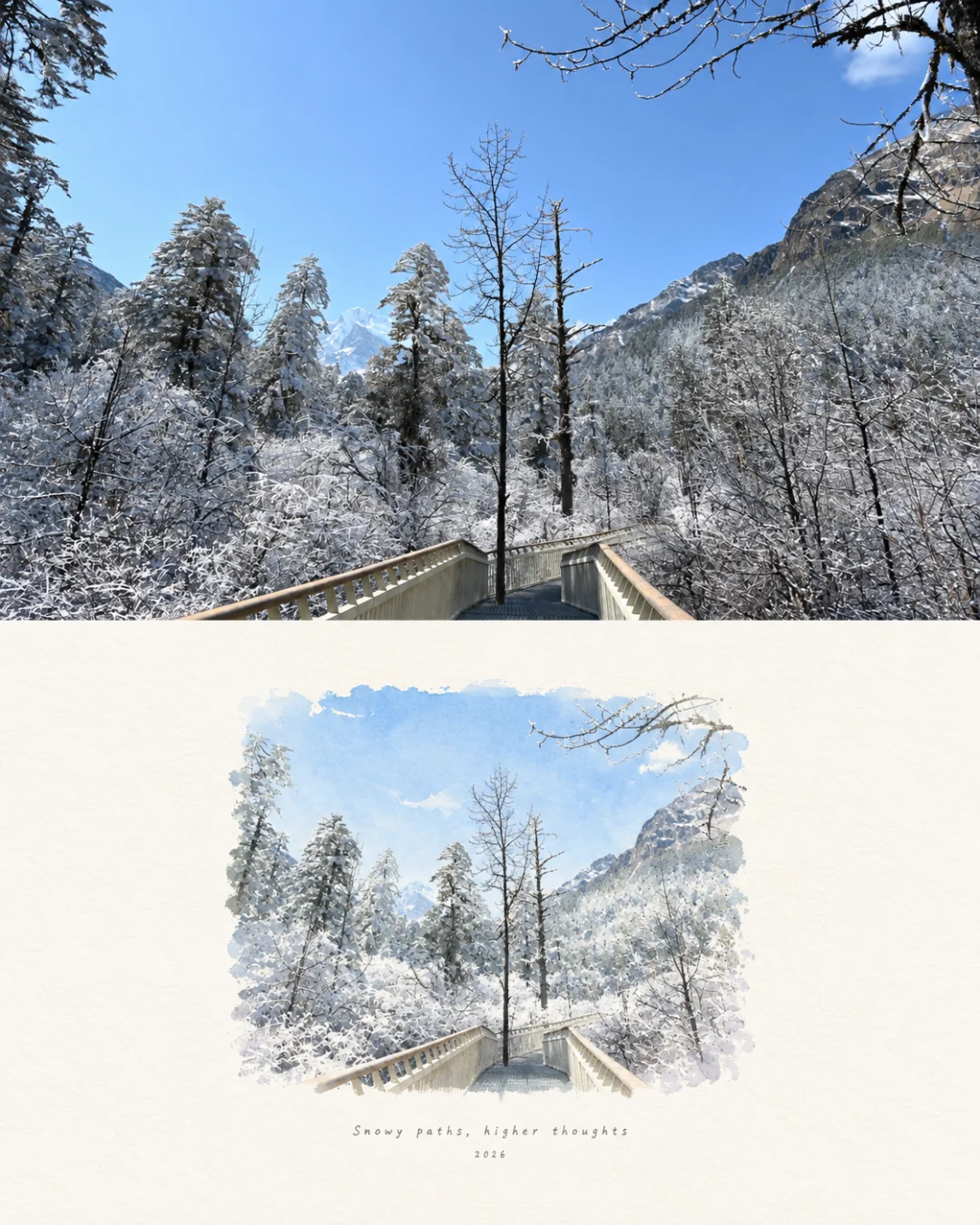
A snowy walkway. It keeps its vanishing point and the bare trunk in the center, and the forest behind becomes stippled texture.
Each effect was tested 4–12 times on fixed test photos before going live. These are small samples, so treat them as a guide, not a guarantee.
For results across all 35 effects, see our comparison of AI photo-to-art styles.
You need an account only to generate. New accounts get 500 free credits, enough for five 2K images.
You can try the Ukiyo-e Woodblock Poster free with the 500 credits every new account receives, which covers five 2K images. The full prompt is also published on the effect page, so you can copy it into an image-to-image model such as Nano Banana or GPT Image 2.
It can try, but portraits are the weakest case for this effect. The prompt is written for landscapes and architecture, and a face reduced to flat color areas loses its likeness. For a photo of a person, choose a wider shot where the setting matters more than the face.
Ukiyo-e is a Japanese woodblock print tradition with carved outlines and flat areas of printed color. Chinese ink wash painting is brushwork in black and gray ink on absorbent paper, with a lot of empty space. In these effects, the ukiyo-e version keeps most of the scene, and the ink wash version keeps only its outline and mood.
Yes, on the Chinese Ink Wash Poster and the Japanese Minimal Watercolor Print. Type your words exactly as you want them, without quotation marks or brackets. The Ukiyo-e Woodblock Poster has no text option, because its prompt forbids titles, characters and seals.
Yes. The images you generate are yours to use, including for commercial purposes. Your uploaded photo is stored privately, deleted on a schedule, never made public and never used to train a model.
Pick the style by what you want to keep. If you want the whole scene, with color and carved detail, use ukiyo-e. If you want only the outline and the mood, use ink wash. If you want a small, quiet image on a lot of white paper, use the minimal watercolor. In every case, start with a photo of a temple, mountain, river or old street, not a face. For most travel photos, the best first try is the Ukiyo-e Woodblock Poster.
Create stunning AI-powered presentations in seconds. Transform your ideas into professional slides with 2slides AI Agent.
Try For FreeΟ Πράκτορας AI σας για διαφάνειες. Εξοικονομήστε χρόνο, λάμψτε πιο γρήγορα με έξυπνη δημιουργία παρουσιάσεων.



© 2026 2slides. Όλα τα δικαιώματα διατηρούνται.