
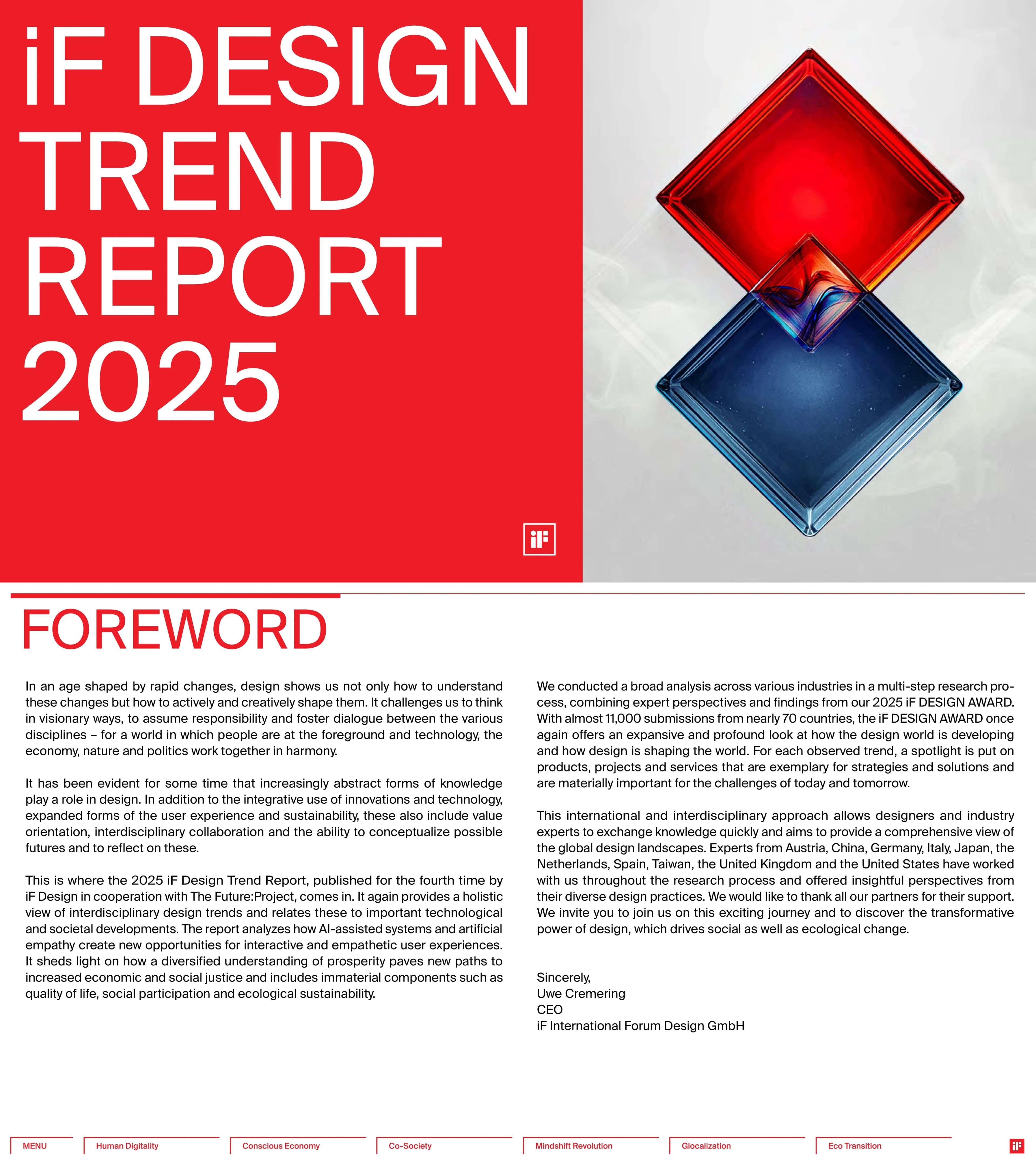
iF Design Trend Report 2025 – Chapter 1: Human Digitality & Human-Machine Teamplay
Quick Navigation
Tags
Share the slides
iF Design Trend Report 2025 – Chapter 1: Human Digitality & Human-Machine Teamplay
Detailed view of each slide page, including layout, key content and visual elements.
Bold cover with red panel, glass diamond 3D objects, and the iF logo; establishes the report as Chapter 1 of the 2025 trend series.
Full-bleed split layout: left dark panel with title typography, right panel with 3D glass/crystal decorative objects on dark background
CEO foreword introducing the report's purpose — making sense of design in an era of complexity — with interactive footer navigation.
Single-column text layout with CEO portrait, iF letterhead, and footer navigation bar
Menu/TOC listing all 6 report chapters: Human Digitality, Conscious Economy, Co-Society, Mindshift Revolution, Glocalization, Eco Transition — each with two sub-trends.
Structured grid menu with chapter numbers, names, and sub-trend labels; interactive navigation design
Intro arguing that in an age of overwhelming complexity, design's core mission becomes creating intuitive simplicity; sets the stage for all six chapters.
Editorial two-column layout with headline and body text, minimal design
Describes the 'omnicrisis' of overlapping global challenges — climate, geopolitics, technology disruption — and how design must respond.
Text-heavy editorial layout with pull quote and supporting imagery
Circular diagram illustrating six macro transformations driving societal change, providing the analytical framework for the full trend report.
Central circular infographic with six radiating segments, minimal surrounding text
Explains the interactive navigation system — footer arrows, chapter menu, trend icons — empowering readers to navigate the PDF non-linearly.
Instructional layout with annotated UI callouts showing navigation elements
Full-bleed red section divider for Chapter 1: Human Digitality, signaling the start of the main content section.
Full-bleed single-color background with large bold white chapter title
Chapter overview with content sub-menu listing three Human Digitality sub-trends: Effortlessness, Body Enhancement, and Companionship.
Chapter landing page with sub-trend navigation tiles and chapter description
Core argument: digitalization is accelerating while society seeks re-humanization; design must mediate the tension between digital efficiency and human experience.
Editorial two-column text layout with headline and body copy
Data slide showing AI market growth to €222.53B and rising adoption across industries, with supporting bar chart.
Data-driven layout with large market figure, bar chart, and explanatory text
Continuation of AI market analysis showing LLM performance growth over time and expanding model capabilities across text, image, and multimodal tasks.
Dual chart layout with trend line and comparative data, editorial annotations
Featured quote from Lydia Hsiao-Mei Lin, CEO of Taiwan AI Association, on the societal implications of AI and the designer's responsibility.
Full-bleed quote slide with portrait photo, large pull quote typography, and speaker credentials
Identifies three critical challenges designers must address: AI trustworthiness and transparency, algorithmic bias, and the energy consumption of AI systems.
Three-column challenge layout with headlines and supporting body text
Side-by-side comparison of leading LLMs (Claude, Gemini, Llama, Phi, GPT) showing capability evolution from 2022–23 to January 2025.
Structured comparison table with model logos, capability columns, and timeline split
Circular diagram showing how design mediates between human needs and technological capabilities, positioning designers as bridge-builders.
Central circular diagram with radiating design principles and surrounding editorial text
Outlines four design challenges in AI interfaces: explainability, controllability, personalization, and ethical accountability.
Four-quadrant layout with challenge headlines and supporting body text
Presents four design method categories for the AI era: participatory design, value-sensitive design, speculative design, and emotional design.
Four-method grid with icons, method names, and descriptions
Introduces the three Human Digitality sub-trends with product photos: Effortlessness, Body Enhancement, and Companionship.
Three-column sub-trend preview with product images and trend labels
Deep-dive into the Effortlessness sub-trend: smart devices that simplify daily routines, including the Reli Birdly Smart Bird Cage as a leading example.
Editorial intro layout with product image and trend analysis text
Showcases two iF Award 2025 winners: S.PetPaw App (AI-powered pet health monitoring) and Reli Birdly Smart Bird Cage (automated smart bird care).
Dual product showcase with large product photos, numbered product titles, and descriptive paragraphs
Two more iF Award winners in pet care automation: a self-cleaning litter box and an all-in-one smart pet feeder with intelligent feeding schedules.
Dual product showcase with large photography and numbered product descriptions
Introduces the Body Enhancement sub-trend: technology worn on or integrated with the human body to augment physical capabilities, featuring Samsung Bot Fit.
Full editorial text layout with right-side product image and trend analysis
Two iF Award winners: angel SUIT (slim wearable robot for elderly mobility) and Samsung Bot Fit (AI-powered walking and exercise coaching wearable).
Dual product showcase with large-scale photography and numbered product descriptions
Two more Body Enhancement winners: Ottobock Paexo Neck (neck support exoskeleton for industrial workers) and Transparent Knee Guard (smart rehabilitation monitoring).
Dual product showcase — industrial worker photo with exoskeleton and close-up knee guard product shot
Full-page feature of MyO, an EMG-based wearable suite for Gen Y/Z fitness enthusiasts providing real-time muscle performance insights.
Full-bleed product photography with floating product components and right-column description
Cionic Neural Sleeve (FDA-cleared bionic garment for MS/stroke patients) and Nuwa Pen (pen-to-digital converter using TRIDENT camera system).
Dual product showcase with medical context photography and product detail shots
Introduces the Companionship sub-trend: AI systems designed to be friends and emotional companions, from Plato's soulmates concept to therapeutic chatbots.
Editorial text layout with right-side product image (Ecure robot with child) and trend analysis
Friend AI Pendant (wearable AI companion responding like a true friend) and LG SmarHome AI Agent Q9 (multi-role home butler/companion with fall detection).
Dual product showcase with product photography and numbered product descriptions
Full-page feature of Ecure — an AR-enabled interactive robot for children with autism (ASD) providing personalized sensory support and social skills training.
Full-bleed child-robot interaction photography with right-column product description
Livia (AI companion app with memory and emotional intelligence) and a11y-ai (generative AI making websites accessible for people with disabilities).
Dual product showcase with app UI screenshots and product descriptions
Analysis of AI's dual role in design: expanding creative possibilities through automation while risking homogenization of creativity; Ana Arriola-Kanada quote.
Editorial two-column text with large pull quote from Ana Arriola-Kanada (YES, Japan) and sidebar callout
Comprehensive listing of AI-assisted design tools by category: Generative Design & 3D Modeling, AI Art & Illustration, AI Graphic Design & Branding, Architecture & Civic Planning.
Four-column reference grid with tool names, use cases, and function descriptions
Expert essay by Martha Tsigkari (Foster + Partners) on how parametric design, GPU computing, and programming are transforming architectural practice.
Essay layout with headline, two-column body text, architectural rendering image, and pull quote
Continuation: discusses VR, digital twins, GPUs, and cloud computing as tools that expand architects' creative and analytical capacity.
Two-column essay continuation with architectural photography and editorial text
Essay conclusion on AI agents automating design processes and voice interfaces; Martha Tsigkari's biography as Senior Partner and Head of Applied R+D at Foster + Partners.
Split layout: left essay text with AI/creativity conclusion, right author bio with portrait photo
Five numbered key learnings summarizing Chapter 1: new culture of interaction, AI capabilities boom, human-animal bonds, technology as skill amplifier, and AI companionship.
Bold numbered list layout on white background with red number accents and bold headlines
Full publication credits: iF International Forum Design GmbH (publisher), The Future:Project AG (editorial), Melville Brand Design (layout); publication date April 29, 2025.
Three-column credits layout with publisher, editorial, and design/layout information
Full list of 16 partner design experts contributing to the report, including leaders from Yes Japan, KISKA, Mattel, Harman, Philips, Harvard, Foster + Partners, McKinsey Design, and more.
Four-column expert directory with names, titles, and organizations
Common questions about this slide and the underlying presentation content.
Published on April 29, 2025, by iF International Forum Design GmbH — the world's oldest independent design organization based in Hanover, Germany — this report identifies and analyzes six macro design trends shaping global society. This excerpt covers Chapter 1: Human Digitality, focusing on human-machine teamplay. The full report spans Human Digitality, Conscious Economy, Co-Society, Mindshift Revolution, Glocalization, and Eco Transition.
Human Digitality describes the evolving relationship between humans and digital technologies, particularly AI. As digitalization accelerates at unprecedented speed, design must mediate the tension between technological efficiency and human experience. The trend encompasses three sub-trends: Effortlessness (technology simplifying daily routines), Body Enhancement (wearables augmenting physical capabilities), and Companionship (AI as emotional companions).
All featured products are iF Design Award 2025 winners. Effortlessness examples include S.PetPaw App, Reli Birdly Smart Bird Cage, self-cleaning litter box, and smart pet feeder. Body Enhancement features angel SUIT, Samsung Bot Fit, Ottobock Paexo exoskeleton, Transparent Knee Guard, MyO wearables, Cionic Neural Sleeve, and Nuwa Pen. Companionship showcases Friend AI Pendant, LG SmarHome AI Agent Q9, Ecure robot, Livia, and a11y-ai.
Yes. The report's professional editorial design — red/white/black palette, bold typography, high-quality photography, and data visualizations — makes it ideal for conference keynotes, boardroom briefings, and design team workshops. It combines authoritative market data (€222.53B AI market), expert quotes from 16 global design leaders, and actionable case studies into a coherent, visually compelling narrative.
Page 33 provides a comprehensive reference covering four categories: Generative Design & 3D Modeling (Autodesk Fusion 360, nTopology, Grasshopper + AI plugins), AI-Assisted Art & Illustration (MidJourney, DALL-E, Stable Diffusion, Runway ML), AI-Assisted Graphic Design & Branding (Adobe Firefly, Canva AI, Looka), and Architecture & Civic Planning (Spacemaker AI, Finch 3D).
Pages 32–36 directly tackle this question. The report argues AI expands creative possibilities through automation (analyzing data, suggesting forms/colors, speeding iteration) while risking homogenization of creative output. Martha Tsigkari's expert essay (Foster + Partners) provides an architectural perspective. The conclusion: designers must embrace AI as a tool while preserving human intuition — 'AI will be powerful, but human ingenuity will still be responsible for pushing boundaries.'
The report features 16 global design experts including: Ana Arriola-Kanada (Chairwoman, YES Japan), Martha Tsigkari (Senior Partner, Foster + Partners), Peter Skillman (Global Head of Design, Philips), Karen Korellis Reuther (Design Critic, Harvard), Yifan Zhang (Managing Partner, Phoenix Design China), Lydia Hsiao-Mei Lin (CEO, Taiwan AI Association), Damian Mackiewicz (VP Design, Harman), and Chris Down (Chief Design Officer, Mattel).
1. New culture of interaction: evolving human-machine interplay demands curiosity, flexibility, and agility. 2. AI boom: capabilities expanding to text, audio, and images require explainable, user-controllable interfaces. 3. Strengthened human-animal bonds: smart pet care reduces routine burden while enhancing relationships. 4. Technology as skill amplifier: human-machine synergy should enhance efficiency and health, not replace human skills. 5. Companionship: AI companions must go beyond accumulated features to foster genuine reflection and broaden user perspectives.

Create Your Own Slides
Turn your ideas into professional presentations in seconds with 2slides AI.
Reference professional designs, choose your style, and generate slides with perfect text rendering. Powered by Nano Banana—start creating your presentation now.
Your AI Agent for slides. Save time, shine faster with intelligent presentation creation.




© 2026 2slides. All rights reserved.