
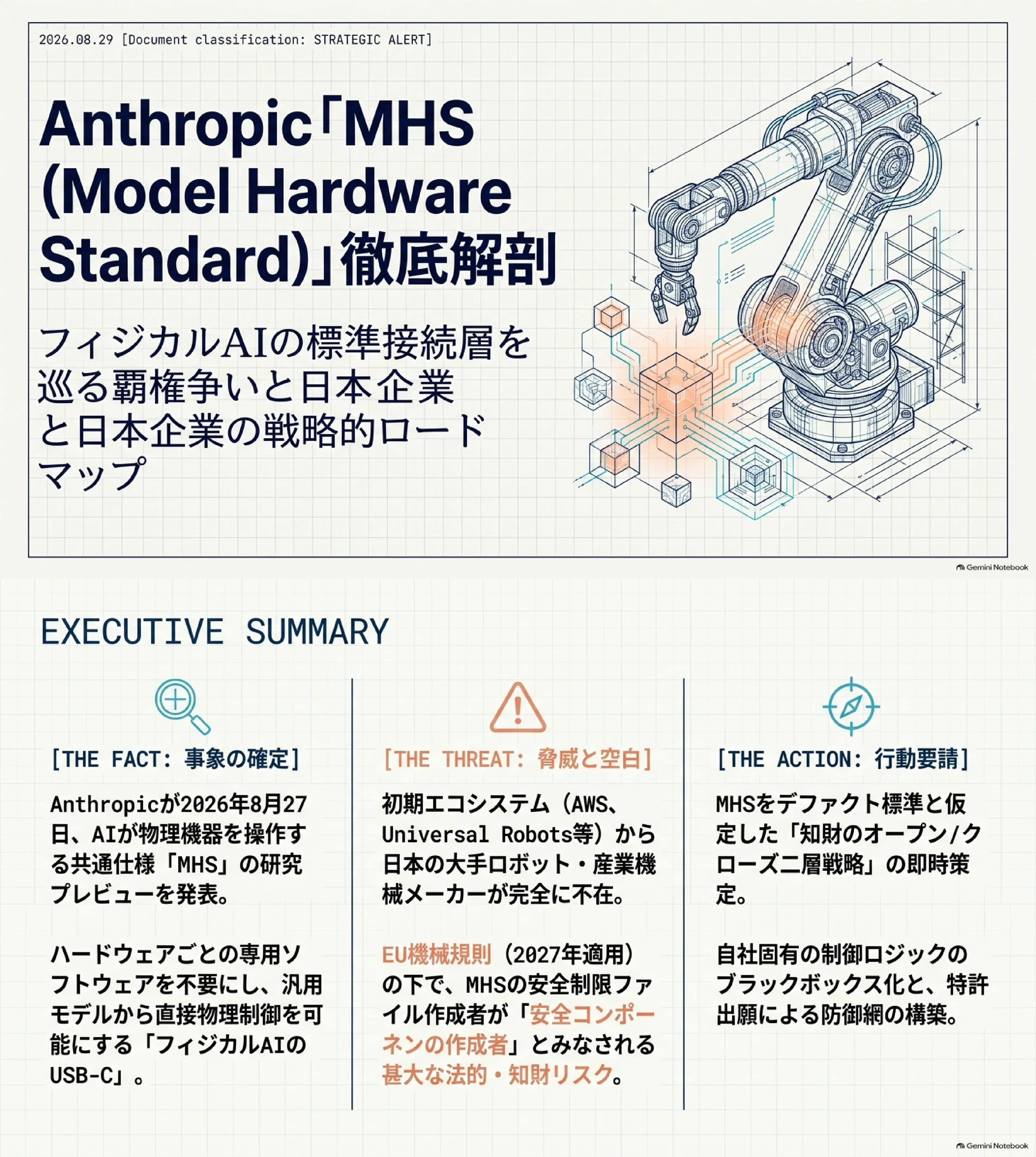
A Japanese-language strategic intelligence briefing that dissects Anthropic's MHS (Model Hardware Standard) — the proposed 'USB-C for physical AI' — and lays out what the emerging standardized connection layer between AI models and physical machines means for Japanese robotics and industrial equipment makers, together with an actionable IP and roadmap response.
Quick Navigation
Tags
Share the slides
A Japanese-language strategic intelligence briefing that dissects Anthropic's MHS (Model Hardware Standard) — the proposed 'USB-C for physical AI' — and lays out what the emerging standardized connection layer between AI models and physical machines means for Japanese robotics and industrial equipment makers, together with an actionable IP and roadmap response.
Detailed view of each slide page, including layout, key content and visual elements.
Title slide for a strategic alert dated 2026.08.29, introducing a deep analysis of Anthropic's Model Hardware Standard and a strategic roadmap for Japanese companies facing the fight over physical AI's standard connection layer.
Split layout — left column holds a classification header line, an oversized three-line headline, and a multi-line subtitle; right half is filled by a large technical illustration. Thin rule frames the whole slide over a graph-paper ground.
Three-part summary: THE FACT — Anthropic previewed MHS on 2026.08.27, a common spec letting AI operate physical equipment directly, the 'USB-C of physical AI'; THE THREAT — Japanese robotics and industrial machinery majors are entirely absent from the initial ecosystem, plus serious legal/IP exposure under the EU Machinery Regulation where the author of MHS safety-limit files may count as a safety component manufacturer; THE ACTION — immediately define an open/closed two-layer IP strategy, black-box proprietary control logic, and build a patent defense.
Three vertical columns separated by thin rules, each headed by a line icon and a bracketed label, with two stacked text blocks beneath.
Explains that MHS's core is a standardized driver that removes the vendor-specific translation programs previously required per device, letting an AI agent discover equipment on the network and operate it with simple read/write commands.
Left-to-right architecture diagram: AI model node on the left, a vertical connector-shaped MHS block in the center, hardware icons on the right, with dashed read/write flows between; a bordered summary box spans the bottom.
Shows the three ways an AI agent reaches the MHS hardware layer — MCP for dynamic tool-calling inference, CLI for direct terminal operation, and API code for deterministic scripted orchestration — arguing MCP is only one path and that long-running or high-speed tasks can bypass inference entirely.
Two anchor blocks (AI Agent left, MHS Hardware Layer right) connected by three horizontally stacked, visually distinct channels; a coral-bordered quote box runs along the bottom.
Details the safety architecture — a reference file declaring limits such as weight_limit 5kg and speed_max 0.5m/s feeding a funnel of device-level pre-motion blocking, mechanical interlock, and emergency stop with human-in-the-loop monitoring — alongside CMU stress-test results reporting 100% blocking across six deliberately induced failure modes.
Two-panel split: left is a vertical funnel diagram with three stacked stage labels ending in a padlock; right is a bordered results card with a coral header and a two-column checklist.
Four partner proof points: QuEra Computing improved laser-lock control success from 58% to 99.3% and held locks unattended for 19 hours; Carnegie Mellon cut a six-instrument integration from weeks to about 8 hours with autonomous rejection and re-runs; Tetsuwan Scientific gained +12% qPCR prediction accuracy over maker spec; and Genentech marks the limit — flow optimization succeeded but the AI could not grasp the physics of foam, requiring expert human guidance.
Two-by-two grid of bordered cards; the top three lead with an oversized glowing metric plus a caption, while the fourth is coral-outlined and image-led to signal a counter-example.
Maps the initial MHS ecosystem across Cloud/Edge, Life Sciences, and Robotics — AWS, Hugging Face, Raspberry Pi, Danaher, Tecan, QIAGEN, Automata, Universal Robots, Doosan Robotics — and highlights that no major Japanese manufacturing or robotics company appears among launch partners, flagging the risk of losing early rule-making voice.
Radial hub-and-spoke map: MHS at the center of concentric ellipses with partner nodes arrayed around it, sector labels at the perimeter, a hatched gap zone at the bottom, and a callout box connected by a bold arrow.
Compares Anthropic MHS, NVIDIA Halos, Open Robotics ROS 2, and OPC Foundation OPC UA across target layer, design philosophy, and current status, concluding that MHS is unlikely to replace ROS 2 and will more probably act as a complementary AI-specialized translation layer sitting above it.
Four-column comparison table with three labeled rows, framed in navy rules; a rounded coral-bordered insight box sits beneath the table.
Projects the IP path to platformization with three facts — no MHS trademark filing confirmed at USPTO as of 2026.08.29; MCP was donated to the Linux Foundation in December 2025 and became a de facto standard; Anthropic holds related patents such as US 12,566,913 on interface automation — inferring that an open strategy of spreading the standard to own the physical AI connection layer is far more likely than trademark exclusivity.
Horizontal timeline axis with an August 2026 map-pin marker and a rising adoption curve to the right; three bordered fact boxes drop from the axis via arrows, with an inference callout across the bottom.
Frames the collision between MHS's AI-enforced limits and EU/ISO regulation — under the EU Machinery Regulation 2023/1230 applying January 2027, whoever authors the MHS safety-limit reference file risks being treated as a safety component manufacturer, with third-party Notified Body assessment mandatory for high-risk machinery, while ISO 10218:2025 demands firm alignment on collaborative robot force and pressure limits; Japan's softer human-in-the-loop guidance diverges from EU requirements and raises global design cost.
Center-stage illustration of two meshing gears with a clash burst at the contact point; supporting text boxes flank it — Japanese soft law on the left, EU and ISO requirements stacked on the right.
Presents the integrated strategy as a cutaway sphere — the outer shell, covering MHS protocol, communication interface, and basic read/write compliance, is deliberately opened as the ecosystem grows, while the inner core of proprietary control logic, calibration methods, and advanced safety parameters is black-boxed as patents and trade secrets to prevent data extraction by the platformer.
Single large centered cutaway-sphere illustration with two annotation lines running to bracketed labels and explanatory paragraphs in the lower left and lower right corners.
A three-horizon action plan: immediate (within 1 month) — apply to the research preview to secure early voice, and re-check USPTO for MHS trademark filings in 2-4 weeks; short-term (1-3 months) — legal gap analysis against EU Machinery Regulation 2027 and ISO 10218:2025, plus competitor patent monitoring in the physical AI connection layer; mid-term (3-12 months) — finalize the open/closed two-layer IP portfolio and run a multi-track strategy through JARA standardization alongside ROS 2 and NVIDIA ecosystems.
Three vertical time-horizon columns divided by rules, each headed by a bracketed timeframe on an arrowed axis, with two checkbox action items beneath.
Defines four monitoring signposts that should each trigger a specific strategic pivot — publication of trademark and specification licensing terms (patent non-assertion, SEP policy) triggers executing the open/closed line; donation to the Linux Foundation, AAIF, or ISO/IEC confirms de facto standardization and raises resource priority to high; proven operation on non-Claude models lowers vendor lock-in risk and greenlights company-wide adoption; and a major Japanese robot maker announcing partnership triggers an immediate shift to standard-following mode.
Four equal-width vertical cards in a row, each with a status dot, a bracketed monitor header in its own bordered band, and a paragraph beneath; the fourth card is coral-filled to mark highest urgency.
Lists primary sources — Anthropic's 2026.08.27 'Previewing the Model Hardware Standard', the official MHS site, US Patent 12,566,913, Japan's MIC/METI AI Business Operator Guidelines v1.2, and ISO 10218-1/2:2025 — and secondary sources including Quartz, The Next Web, NVIDIA's Halos for Robotics announcement, and OSRA, closing with a note that all partner metrics are self-reported as of Aug 29, 2026.
Single-column bulleted list split into two bracketed sections, primary above secondary, with an italic disclaimer note at the bottom.
Common questions about this slide and the underlying presentation content.
It is built for strategic intelligence briefings — the kind of deck that analyzes an external development (a new standard, a competitor launch, a regulatory change), assesses the threat it poses, and recommends a concrete response. Its structure works equally well for technology scouting reports, IP strategy proposals, and competitive landscape reviews.
Yes. The content is Japanese, but the structure is language-independent: an executive summary triad, architecture diagrams, a comparison table, an ecosystem map, a timeline, a three-horizon roadmap, and a monitoring framework. Replace the text with your own and the layout logic holds. Several headers and labels are already bilingual, which makes English adaptation straightforward.
It uses a technical blueprint aesthetic — a graph-paper background, navy line art with dimension lines, coral and teal accents, and monospace labels in square brackets. The effect is analytical and credible rather than promotional, which suits engineering, manufacturing, robotics, deep-tech, and consulting audiences. It would feel out of place in a consumer marketing pitch.
Fourteen slides: a title slide, a three-column executive summary, three technical architecture pages, a metrics page, an ecosystem map, a four-way comparison table, an IP timeline, a regulatory risk page, a strategy concept page, a three-horizon roadmap, a monitor-and-trigger page, and a references page. That set covers a full analysis arc from what happened through to what to do about it.
No. The diagram slides are reusable patterns rather than subject-specific art: a source-to-destination translation layer, three parallel paths between two endpoints, a funnel of sequential gates, a hub-and-spoke ecosystem map, two colliding gears, and a cutaway sphere showing an open outer layer over a closed core. Each maps onto plenty of non-hardware arguments.
It splits the message into THE FACT, THE THREAT, and THE ACTION — what is verified, what the exposure is, and what to do — in three parallel columns. Executives can read only that slide and still leave with a decision. It is a reliable pattern for any briefing where you need to separate confirmed information from risk assessment.
Deliberately and visibly. Claims are labeled as fact, insight, or inference; a gap in the ecosystem map is marked (Unconfirmed); the metrics slide is headed with a self-reported disclaimer; and the references page repeats that note. If you present to audiences who will challenge your sourcing, this labeling discipline is one of the more valuable things to carry over.
Yes, and they work well as a pair. The roadmap breaks actions into immediate, short-term, and mid-term columns with checkboxes ready to be assigned to owners, while the trigger slide pre-commits the organization to specific pivots when defined signals appear. Together they turn analysis into something a team can actually be held to.

Create Your Own Slides
Turn your ideas into professional presentations in seconds with 2slides AI.
Reference professional designs, choose your style, and generate slides with perfect text rendering. Powered by Nano Banana—start creating your presentation now.
Your AI Agent for slides. Save time, shine faster with intelligent presentation creation.




© 2026 2slides. All rights reserved.