
Gartner Top 10 Strategic Technology Trends for 2026
Schnellnavigation
Tags
Folien teilen
Gartner Top 10 Strategic Technology Trends for 2026
Detaillierte Ansicht jeder Folien-Seite, einschließlich Layout, wichtigem Inhalt und visuellen Elementen.
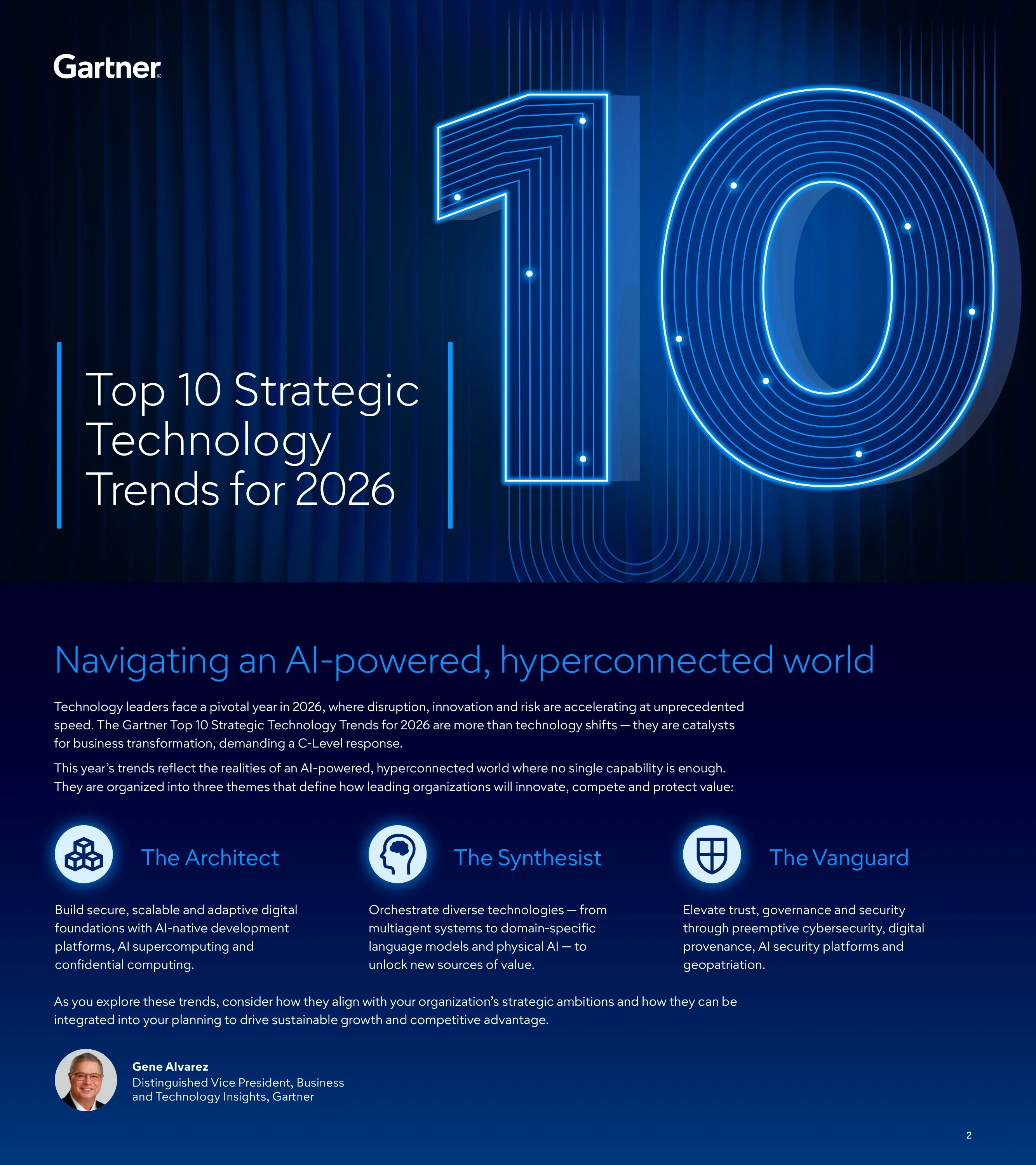
Title slide with Gartner branding and neon blue 10 graphic on dark blue background.
Full-bleed dark blue background with illuminated 10 numeral and left-aligned title text
Introduction by Gene Alvarez, Distinguished VP at Gartner. Three themes introduced: The Architect (secure foundations), The Synthesist (orchestrate technologies), The Vanguard (trust and security). Trends are catalysts for business transformation requiring C-Level response.
Three-column theme layout with icons, descriptions, and author bio at bottom
Visual map of all 10 trends organized by three themes with Now (1-3 years) and Near (3-5 years) timeline indicators. The Architect: 1-3. The Synthesist: 4-6. The Vanguard: 7-10.
Three-fan visual diagram with numbered trends, timeline indicators, and theme descriptions below
Build secure, scalable and adaptive digital foundations. Focus on creating AI-ready foundations that enable speed, security and scalability in an AI-powered, hyperconnected world.
Large title text left with description box right, dark blue gradient background
AI-native platforms use generative AI to create software faster. 80% of organizations will evolve to smaller AI-augmented teams by 2030. 40% of apps built using AI-native platforms by 2030 (up from 2%). Tiny teams concept: fewer people, more AI agents.
Split layout - trend description with What is it/Why trending left, statistics and Before/Now comparison right
5-step action plan: Establish platform team, Implement security guardrails, Pilot AI-native development, Adopt AI-first mindset, Upskill teams. Key players: CIO, IT partners, Business partners with specific roles.
Action plan table with 5 steps (Steps/Expected outcome/Action rows) plus three-column key players section
Massive processing power for training and running advanced AI models. 40% of enterprises will adopt hybrid computing by 2028 (up from 8%). 20+ vendors will offer unified platforms by 2028. Architecture diagram showing layers from hardware to use cases.
Split layout - trend description left, statistics and platform architecture diagram right
5-step plan: Identify high-impact workloads, Invest in unified software stacks, Develop phased integration, Streamline development, Plan for governance. Key players mapped to CIO, IT, and Business partners.
Action plan table plus three-column stakeholder section
Hardware-based trusted execution environments (TEEs) to protect data in use. 75% of processing in untrusted infrastructure secured by confidential computing by 2029. Pyramid diagram showing controls to limit CSP data access.
Split layout - trend description left, statistic and pyramid control diagram right
5-step plan: Audit sensitive workloads, Pilot TEEs for AI models, Enable secure collaboration, Establish key management, Prepare for integration. Stakeholder roles for CIO, IT, and Business partners.
Action plan table plus three-column stakeholder section
Orchestrate diverse technologies for new value. Focus on integrating specialized models, multiagent systems and physical AI to create adaptive, intelligent ecosystems.
Large title text left with description box right, dark blue gradient background
Collections of specialized AI agents that collaborate on complex workflows. 70% of MAS will use narrowly specialized agents by 2027. 60% of MAS will support multivendor interoperability by 2028. 1,445% surge in MAS inquiries from 1Q24 to 2Q25. Three-phase evolution: Single platform, Cross-platform, Internet of agents.
Split layout - trend description left, statistics and three-phase evolution diagram right
5-step plan: Identify high-value use cases, Design modular agents, Implement governance and observability, Adopt interoperability standards, Upskill teams. Stakeholder roles mapped.
Action plan table plus three-column stakeholder section
DSLMs are AI models trained on specialized datasets for specific industries. 60%+ of enterprise GenAI models will be domain-specific by 2028. 30% of GenAI workloads will run on-premises or on-device by 2028. Paths to creating DSLMs diagram showing ModelOps, MLOps, and DataOps layers.
Split layout - trend description left, statistics and DSLM creation pipeline diagram right
5-step plan: Identify high-impact use cases, Strengthen data governance, Pilot DSLMs in critical domains, Build cross-functional teams, Monitor and optimize. Stakeholder roles mapped.
Action plan table plus three-column stakeholder section
Intelligence in the real world through robots, drones, vehicles, and smart devices. 80% of warehouses will use robotics or automation by 2028. Categorization diagram showing Digital AI vs Physical AI spectrum with examples (chatbots, forecasting vs robots, wearables, autonomous devices).
Split layout - trend description left, statistic and AI categorization diagram right
5-step plan: Audit operational domains, Pilot physical AI systems, Build cross-functional teams, Educate stakeholders, Plan for multiagent coordination. Stakeholder roles mapped.
Action plan table plus three-column stakeholder section
Elevate trust, governance and security. Emphasis on proactive security, transparent governance, and digital integrity to protect reputation, ensure compliance, and maintain stakeholder confidence.
Large title text left with description box right, dark blue gradient background
AI-driven techniques to anticipate, disrupt, and neutralize attacks before they occur. 50% of security software spending on preemptive solutions by 2030. 1M documented vulnerabilities expected annually by 2030. The 3 Ds framework: Deceive, Disrupt, Deny.
Split layout - trend description left, statistics and 3 Ds circular diagram right
5-step plan: Assess security architecture, Pilot PCS in high-risk areas, Define vendor criteria, Socialize PCS strategy, Integrate with existing tools. Stakeholder roles mapped.
Action plan table plus three-column stakeholder section
Verifies origin and integrity of software, data, and media using BOMs, attestation databases, and watermarking. EU AI Act requires watermarking and provenance tracking. Filter-by-digital-provenance flow diagram showing content types filtered through provenance tools.
Split layout - trend description left, regulatory note and filter flow diagram right
5-step plan: Deploy BOMs, Implement attestation database, Adopt disinformation security, Apply digital watermarking, Strengthen governance. Stakeholder roles for CIO, IT, and Business partners.
Action plan table plus three-column stakeholder section
AISPs consolidate controls to secure third-party and custom AI applications. 50%+ of enterprises will adopt AISPs by 2028. 80% of unauthorized AI transactions from internal policy violations, not external attacks. Platform capability mapping showing AI usage control and AI application cybersecurity pillars.
Split layout - trend description left, statistics and platform capability diagram right
5-step plan: Assess AI risk landscape, Pilot AISP solutions, Favor unified platforms, Integrate security testing, Monitor vendor innovation. Stakeholder roles mapped.
Action plan table plus three-column stakeholder section
Relocating workloads from global hyperscale clouds to sovereign or local environments. 75% of enterprises will geopatriate workloads by 2030. Scatter chart showing cloud benefits vs geopolitical risks with various deployment options.
Split layout - trend description left, statistic and benefits-vs-risks scatter diagram right
5-step plan: Assess workload criticality, Evaluate sovereign options, Plan hybrid strategies, Implement governance controls, Monitor geopolitical trends. Stakeholder roles mapped.
Action plan table plus three-column stakeholder section
Four resource cards: IT Strategic Plan template, Gartner Benchmarking and Diagnostics tool, 2025 Gartner Hype Cycle, and Trending Questions on AI and Emerging Technologies.
Four card grid with icons, descriptions, and CTA buttons on dark blue background
Promotional slide for Gartner BuySmart platform. Access to 100+ templates, customizable checklists, collaboration features, and standardized vendor scoring. Process flow: Research, Shortlist, Evaluate, Negotiate.
Split layout - product description left, product screenshot right, process icons at bottom
Contact information: U.S. 1 855 811 7593, International +44 (0) 3330 607 044. Links to Gartner for CIOs, social media (LinkedIn, X, YouTube), and conferences. Copyright 2025 Gartner.
Contact details with social media icons and conference link on dark blue background
Häufige Fragen zu dieser Folie und dem zugrunde liegenden Präsentationsinhalt.
The 10 trends are: 1) AI-native development platforms, 2) AI supercomputing platforms, 3) Confidential computing, 4) Multiagent systems, 5) Domain-specific language models, 6) Physical AI, 7) Preemptive cybersecurity, 8) Digital provenance, 9) AI security platforms, and 10) Geopatriation. They are organized into three themes: The Architect, The Synthesist, and The Vanguard.
The trends are organized into three themes: The Architect (trends 1-3) focuses on building secure, scalable digital foundations; The Synthesist (trends 4-6) focuses on orchestrating diverse technologies for new value; The Vanguard (trends 7-10) focuses on elevating trust, governance, and security. Each trend is also classified by timeline: Now (1-3 years) or Near (3-5 years) adoption horizon.
Each trend follows a consistent two-slide format. The first slide covers What is it (definition), Why trending (business drivers), Whats next (key statistics and predictions), and a visual framework or diagram. The second slide provides a 5-step action plan with expected outcomes and specific actions, plus implementation guidance for three stakeholder groups: CIO, IT partners, and Business partners.
Key AI predictions include: 80% of organizations will evolve to smaller AI-augmented teams by 2030, 40% of apps will be built using AI-native platforms by 2030, 70% of multiagent systems will use specialized agents by 2027, 60%+ of enterprise GenAI models will be domain-specific by 2028, and 50%+ of enterprises will adopt AI security platforms by 2028.
The presentation contains 29 slides with a premium Gartner corporate design featuring a consistent dark blue color scheme, neon blue accents, clean data visualizations, architectural diagrams, and a structured layout system. Each trend uses a two-slide format with consistent placement of statistics, definitions, and action plans.
This presentation is an excellent reference for annual technology strategy planning. Each trend includes actionable implementation steps, stakeholder mapping, and specific predictions with timelines, making it ideal for IT roadmap development, investment prioritization, and executive briefings on emerging technology priorities.
Four trends address security and trust: Preemptive cybersecurity (AI-driven threat anticipation), Digital provenance (verifying content origin and integrity), AI security platforms (securing AI applications against prompt injection and rogue agents), and Geopatriation (relocating workloads to sovereign environments to reduce geopolitical risk). Together they represent The Vanguard theme.

Create Your Own Slides
Turn your ideas into professional presentations in seconds with 2slides AI.
Referenzieren Sie professionelle Designs, wählen Sie Ihren Stil und generieren Sie Folien mit perfekter Textdarstellung. Angetrieben von Nano Banana—beginnen Sie jetzt mit der Erstellung Ihrer Präsentation.
Your AI Agent for slides. Save time, shine faster with intelligent presentation creation.




© 2026 2slides. All rights reserved.