
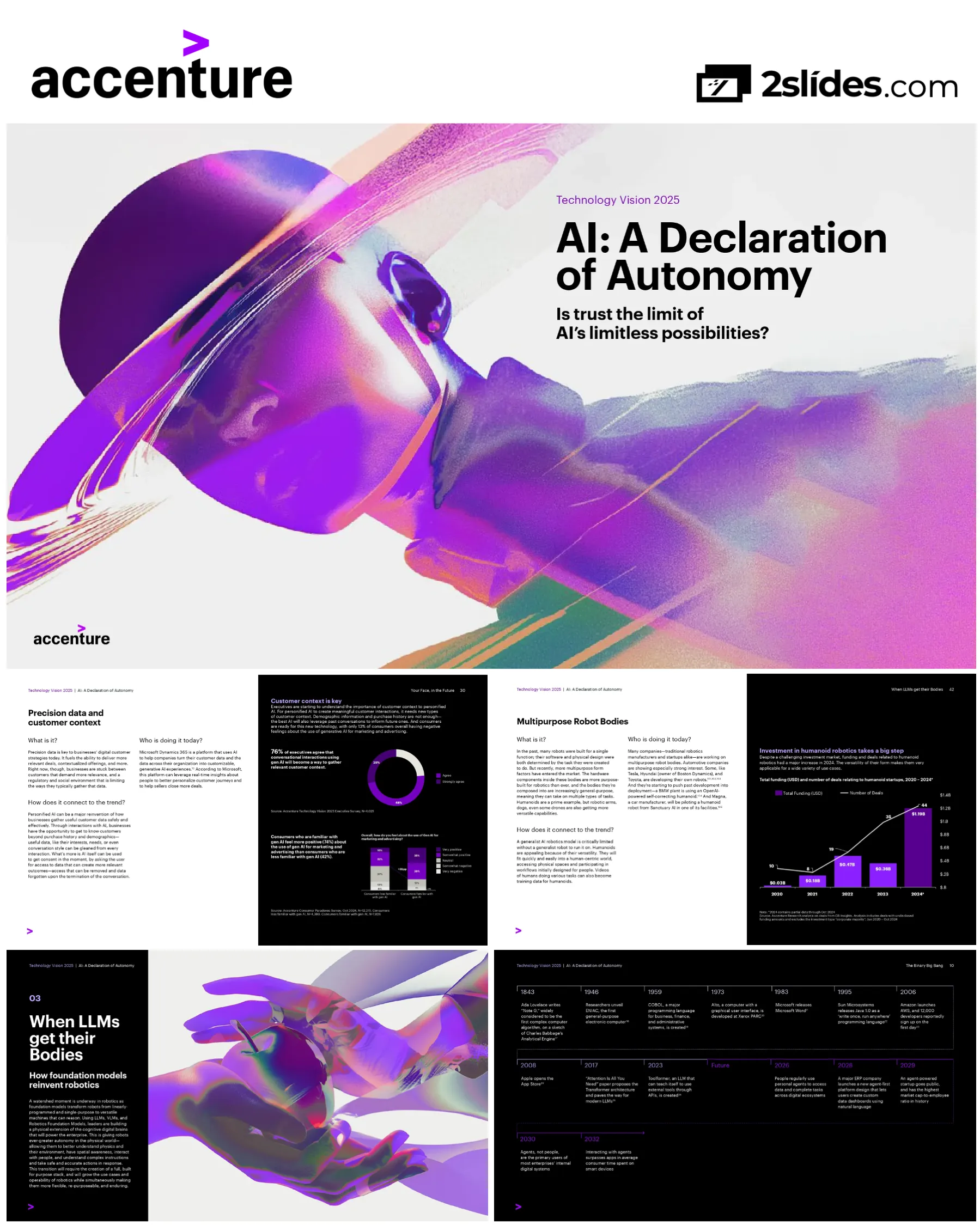
Accenture Technology Vision 2025 - AI: A Declaration of Autonomy
Schnellnavigation
Tags
Folien teilen
Accenture Technology Vision 2025 - AI: A Declaration of Autonomy
Detaillierte Ansicht jeder Folien-Seite, einschließlich Layout, wichtigem Inhalt und visuellen Elementen.
Title slide introducing Accenture's 2025 Technology Vision focused on AI autonomy and trust
Bold title design with Accenture logo, main theme statement, and visual accent element
Introduction to the 25th edition of Technology Vision, highlighting AI as the new digital and 2025 as the year of scaled AI
Single-column text layout with paragraph formatting and key points emphasized
Table of contents listing the four key trends with corresponding page numbers
Grid layout with icon-based section previews and page number indicators
Overview of AI generalization as the key trend, distinguishing from AGI and introducing cognitive digital brains
Single-column text with section headers and paragraph breaks
Exploration of AI's growing pervasiveness in daily life and business, with examples of current applications
Text-heavy single-column layout with subheadings for key concepts
Explanation of how cognitive digital brains operate at individual, business, industry, and national levels
Text layout with four key dimensions described in separate sections
Breakdown of the four interconnected layers (Knowledge, Models, Agents, Architecture) that compose cognitive digital brains
Text-based layout with bullet points for each layer
Discussion of trust as the critical enabler for AI autonomy, with analogies and business implications
Single-column text with narrative flow and key points highlighted
Three key dimensions for building trust: systems and data, AI itself, and people-driven trust
Text layout with three main sections each addressing a trust dimension
Overview of the four key trends explored in the report and their transformative impacts
Text-based layout with brief descriptions of each trend
Historical timeline of software development milestones leading to the current AI revolution
Horizontal timeline layout with years and corresponding technology milestones
Analysis of how foundation models are transforming software development and digital ecosystems
Text layout with paragraph formatting and key examples
Explanation of abundance, abstraction, and autonomy as the three pillars of the new technology paradigm
Text-based layout with each pillar addressed in separate sections
Introduction to the three key technologies driving the trend: Agentic Systems, Digital Core, Generative UI
Bullet-point list of technology categories with brief descriptions
Detailed explanation of agentic systems, their capabilities, and current implementations
Text layout with subsections for 'What is it?', 'How does it connect?', and 'Who is doing it?'
Explanation of composable digital core architecture and its role in enabling AI agent autonomy
Text layout with standard subsection format and data visualization
Overview of generative UI concepts, benefits, and current implementations by Google, Vercel, etc.
Text layout with standard subsections and survey data visualization
Analysis of how the new technology paradigm will disrupt the app model and business workflows
Single-column text with paragraph formatting and key implications highlighted
Exploration of how generative UI and agentic systems will transform customer experiences and business models
Text-based layout with examples and future scenarios
Actionable guidance for organizations at different adoption stages (early adopter, slower approach, preparing to start)
Sectioned layout with clear headings for each adoption stage
Narrative scenario showing how a pizza chain operations employee uses AI agents to develop a new business opportunity
Story-based text layout with narrative flow
Title page for the second trend focusing on AI personality and brand differentiation
Bold title design with trend name, subtitle, and visual background
Historical timeline of brand personality and customer interaction innovations
Dual timeline layout (historical and future projections) with year indicators
Analysis of the risk of generic AI experiences and the opportunity to infuse brand personality into AI systems
Text-based layout with paragraph formatting and key points emphasized
Examples of successful personified AI implementations by Instagram, SiriusXM, and others
Text layout with case examples and key insights
Vision for how personified AI will create new customer relationships and brand experiences
Text-based layout with narrative descriptions of future scenarios
Introduction to three key technologies: Personified AI, Multimodal Models, Precision Data & Context
Bullet-point list of technology categories
Detailed explanation of personified AI capabilities, implementation approaches, and examples like GPT-4o
Text layout with standard subsections and data visualization
Overview of multimodal AI capabilities (text, image, audio, video) and current implementations
Text layout with standard subsections and research data
Explanation of how precision data enables meaningful personified AI interactions while maintaining privacy
Text layout with subsections and survey data visualizations
Analysis of trust implications for personified AI, including data privacy, transparency, and explainability
Text-based layout with three key trust pillars addressed
Actionable guidance for organizations at different adoption stages for implementing personified AI
Sectioned layout with clear headings for each adoption stage
Narrative scenario showing how a personified AI mortgage broker creates a differentiated customer experience
Story-based text layout with narrative flow
Title page for the third trend focusing on AI-powered robotics and physical autonomy
Bold title design with trend name, subtitle, and visual background
Historical timeline of robotics development milestones leading to current foundation model-powered robots
Horizontal timeline layout with years and corresponding robotics innovations
Analysis of how foundation models are transforming robots from task-specific to general-purpose machines
Text-based layout with paragraph formatting and key insights
Explanation of three key robotics evolutions: contextual understanding, communication, and planning & action
Text layout with three clearly defined sections
Analysis of the rise of generalist robots, hardware evolution, and business model implications
Text-based layout with paragraph formatting and market data
Introduction to three key technologies: Foundation Models for Robotics, Robot Training/Data Collection, Multipurpose Robot Bodies
Bullet-point list of technology categories
Detailed explanation of embodied AI, its capabilities, and leading implementations by Google Research
Text layout with standard subsections and research data
Overview of robotics training data challenges, solutions like Open X-Embodiment dataset, and ongoing data collection approaches
Text layout with standard subsections and data visualizations
Explanation of general-purpose robot hardware developments, humanoid designs, and current deployments
Text layout with standard subsections and investment data
Analysis of responsible AI, business model, and sustainability implications for robotics adoption
Text-based layout with three key implication sections
Exploration of robotics-as-a-service models and sustainability considerations for AI-powered robots
Text layout with two main sections
Actionable guidance for organizations at different adoption stages for robotics implementation
Sectioned layout with clear headings for each adoption stage
Narrative scenario showing how a robotic fleet specialist uses AI-powered robots across multiple industries
Story-based text layout with narrative flow
Title page for the fourth trend focusing on human-AI collaboration and learning cycles
Bold title design with trend name, subtitle, and visual background
Historical timeline of automation and workforce technology milestones leading to current AI collaboration models
Horizontal timeline layout with key historical and future projection points
Analysis of the virtuous cycle between humans and AI, contrasting traditional automation with AI collaboration
Text-based layout with paragraph formatting and key insights
Explanation of three key advantages of human-AI collaboration: infinite skills, engagement navigation, and change leadership
Text layout with three clearly defined sections
Exploration of how human-AI collaboration empowers employees to drive organizational change and innovation
Text-based layout with paragraph formatting and case examples
Introduction to three key technologies: Accessibility of Automation, Agentic Workflows, Physical Copilots
Bullet-point list of technology categories
Detailed explanation of how generative AI is democratizing automation capabilities for all employees
Text layout with standard subsections and survey data
Overview of agentic workflow concepts, benefits, and current implementations by Kognitos, Microsoft, etc.
Text layout with standard subsections and research data
Explanation of physical AI assistants (robots, exoskeletons) and their impact on physical work environments
Text layout with standard subsections and survey data
Analysis of talent strategy implications, including skills redefinition, training needs, and innovation incentives
Text-based layout with three key implication sections
Actionable guidance for organizations at different adoption stages for implementing human-AI collaboration
Sectioned layout with clear headings for each adoption stage
Narrative scenario showing how a fashion brand uses AI tools to empower designers and drive innovation
Story-based text layout with narrative flow
List of report authors and research team members with leadership photos
Grid layout with author names, titles, and team member listings
Explanation of Accenture's 25-year Technology Vision tradition and research methodology
Text-based layout with paragraph formatting and methodology details
Visual representation of how current trends build on previous Technology Vision themes
Visual diagram layout with connecting themes
Detailed breakdown of survey participants by country, company size, and industry
Table and bullet-point layout with demographic data
First section of reference citations for research sources, case studies, and data
Numbered list layout with consistent citation formatting
Second section of reference citations continuing from previous page
Continued numbered list layout with consistent citation formatting
Third section of reference citations continuing from previous page
Continued numbered list layout with consistent citation formatting
Fourth section of reference citations continuing from previous page
Continued numbered list layout with consistent citation formatting
Company information, services overview, and Accenture Research description
Text-based layout with paragraph formatting and company details
Häufige Fragen zu dieser Folie und dem zugrunde liegenden Präsentationsinhalt.
This template is designed for C-level executives, technology leaders, digital transformation teams, and AI strategy professionals who need to understand and communicate 2025 AI trends and their business implications.
The four trends are: The Binary Big Bang (AI-powered software transformation), Your Face, in the Future (AI personality and brand differentiation), When LLMs get their Bodies (AI-powered robotics), and The New Learning Loop (human-AI collaboration).
Yes, each trend section includes 'What's Next' guidance tailored to three adoption stages: early adopters, organizations taking a slower approach, and those just preparing to start.
The insights are backed by a global survey of 4,021 executives across 21 industries, analysis of academic papers and earnings calls, and case studies of current AI implementations by leading organizations.
Trust is positioned as the foundational element of AI success, with dedicated sections on building trust across systems/data, AI itself, and people, plus specific trust preservation guidance for each trend.
Yes, the content is designed to be relevant across industries and includes guidance scalable for companies of all sizes, from less than $5 billion to $50 billion+ in revenue.
Each trend section includes current implementation examples from leading companies and a 'Portrait of the Future' narrative scenario demonstrating practical applications of the trend.
This template offers a unique focus on AI autonomy rather than just automation, provides a holistic framework including technology, people, and trust, and draws on Accenture's 25 years of technology trend expertise.

Create Your Own Slides
Turn your ideas into professional presentations in seconds with 2slides AI.
Referenzieren Sie professionelle Designs, wählen Sie Ihren Stil und generieren Sie Folien mit perfekter Textdarstellung. Angetrieben von Nano Banana—beginnen Sie jetzt mit der Erstellung Ihrer Präsentation.
Ihr KI-Agent für Folien. Sparen Sie Zeit, glänzen Sie schneller mit intelligenter Präsentationserstellung.




© 2026 2slides. Alle Rechte vorbehalten.