
IBM IBV 5 Trends for 2025: Ignite Innovation with People-Powered AI
快速导航
标签
分享幻灯片
IBM IBV 5 Trends for 2025: Ignite Innovation with People-Powered AI
每张幻灯片页面的详细视图,包括布局、关键内容和视觉元素。
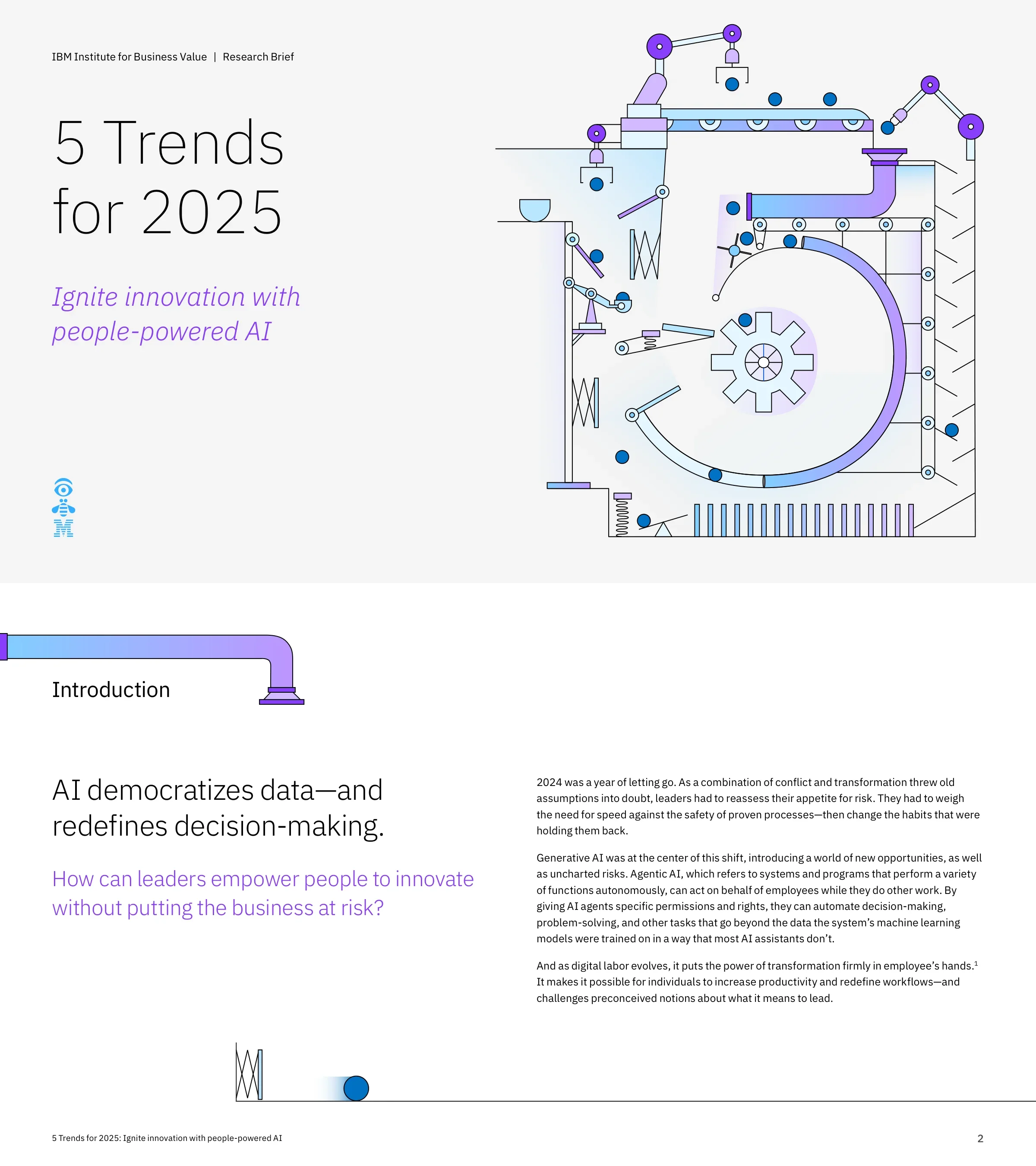
Title slide: '5 Trends for 2025: Ignite innovation with people-powered AI' by IBM Institute for Business Value, Research Brief.
Left-aligned large title text with subtitle, IBM IBV branding top-left, decorative mechanical illustration on right half
Introduction section discussing how 2024 brought conflict and transformation, the rise of agentic AI that performs autonomous functions, and how digital labor puts transformation power in employees' hands.
Two-column layout with section header banner at top, large heading left, body text right
Survey data showing organizational AI adoption stages: Experimenting (30% in 2024 to 6% in 2025), Scaling & Optimizing (44% to 46%), Innovating (24% to 44%). IBM IBV surveyed 400 global leaders across 17 industries. 63% of executives expect material financial impact from AI portfolio in 1-2 years.
Left column with narrative text, right column with year comparison chart using proportional circles
Summary of the 5 trends: (1) Agentic AI will transform business but requires reskilling, (2) Technical debt continues to increase, (3) Location is everything in the AI age, (4) AI has upended IT budgets but self-funding is imminent, (5) AI product/service innovation is #1 CEO goal yet business models lag.
Left column with narrative text, right side with numbered trend list in a bordered box
Methodology details: Part of IBM IBV's 'Five Trends' series (6th year). Based on 12 months of research, 55 surveys, 43,000+ executives, 4,000 consumers. Pulse survey of 400 global leaders across 17 industries and 6 geographies (US, UK, Germany, India, Australia, Singapore) in Oct-Nov 2024.
Three-column layout with methodology details, survey specifics, and report purpose
Trend 1 title slide: 'Agentic AI will transform your business—but first you must reskill your people.' The future of work is being rewritten with AI, but many employees are unprepared.
Large display heading left with supporting subtitle, decorative number '1' illustration on right
5% of global workforce consistently needs reskilling annually, but AI has sent this figure skyrocketing. In 2024, CEOs estimated 35% of their workforce needed reskilling (1 billion+ workers). 87% of executives expect jobs to be augmented rather than replaced by AI.
Left side with dot matrix visualization (purple and blue dots representing workforce), right column with detailed text
64% of CEOs say succeeding with AI depends more on people than technology. 47% of executives say people lack skills to scale AI. 9 in 10 executives' workflows will be digitized by 2026. 77% believe gen AI will enable autonomous decisions by 2026. 82% agree benefits from gen AI will exceed risks.
Two-column text-heavy layout with key statistics and a large blue pullout quote at bottom right
Three action items: (1) Make AI literacy a must-have and double down on agentic AI skills, (2) Unlock your team's collective genius through collaboration sandboxes, (3) Future-proof your workforce with new roles like process orchestrators and digital librarians.
Light blue background with conveyor belt numbered steps (1, 2, 3) and detailed action descriptions below each
Trend 2 title slide: 'Despite efforts to slow its growth, technical debt continues to increase.' Short-term workarounds create debt that limits long-term innovation. 55% of executives say technical debt is a major obstacle or roadblock.
Large decorative number '2' illustration on left, display heading and body text on right
Automotive industry analogy for technical debt. 77% of executives say they need to adopt gen AI quickly to keep up with competitors, but only 25% strongly agree their IT infrastructure can support scaling AI across the enterprise.
Left column with narrative text, center with large circular infographic (77%), right with contrasting statistic (25%)
Data quality and accessibility are major barriers. Only 16% of tech leaders are confident their cloud/data capabilities support gen AI. Only 21% agree their organization has data to scale AI. Hybrid by design approach yields 3X higher ROI. Two-thirds of CEOs prioritize short-term over long-term efforts.
Two-column text layout with pullout quote at bottom right in blue
Three action items: (1) Bridge the gap between vision and reality — identify missing architectural pieces for AI at scale, (2) Incentivize scalability — educate business on full cost of tech architecture for AI, (3) Architect for agility — build composable platforms with modular tools and infrastructure.
Light blue background with numbered conveyor belt steps and three-column action descriptions
Trend 3 title slide: 'In the age of AI, location is everything.' Perpetual disruption is here to stay. Leaders must see the big picture and market-level minutiae in one sweeping view.
Large heading and subtitle on left, decorative mechanical illustration with number '5' shape on right
60% of government leaders believe shocks will increase in frequency, 70% in intensity. 86% of executives say location strategy was impacted by geopolitical disruption in 2024 (expected to rise to 93% in 2026). 96% say data privacy, security, and regulations will determine operational locations in 2026. 93% expect AI to impact location strategy in 2026.
Left column with narrative text, center-right with large donut chart and world map background
Regulations will determine where companies locate operations. Hybrid cloud environments help ensure compliance while maintaining flexibility. 89% of executives agree on widening global reach while focusing on core markets. 37% will manage data strategy regionally in 2025. 57% of CEOs say EU AI Act guidelines increase their willingness to invest in AI.
Two-column text layout with blue pullout quote at bottom right
Three action items: (1) Stress-test your strategy using AI models for navigating global instability, (2) Innovate through volatility with hybrid cloud and open AI approaches, (3) Bake in regulatory preparedness with documentation and AI asset tracking.
Light blue background with numbered conveyor belt steps and three-column action descriptions
Trend 4 title slide: 'The rapid pivot to AI has upended IT budgets, but self-funding is imminent.' Gen AI has made traditional IT budgeting untenable, sending shockwaves through technology and finance teams.
Large display heading on left, decorative mechanical number '4' illustration on right
One in three organizations pulled gen AI funding from other IT budgets in 2024. Only 18% of tech execs fund AI with net-new spend. Infrastructure, cloud, and data account for 40%+ of gen AI costs. 95% say gen AI will be at least partially self-funded by 2026. 75% of leaders see gen AI as innovation investment, but 71% say it should be self-funded.
Top section with financial icons and statistics (75%, 71%), bottom with narrative text
Average gen AI investment takes 14 months for positive ROI vs 10 months for other tech. In 2024, 71% of gen AI spending went to HR, finance, customer service, sales, and marketing. Only 29% to product-related functions. Executives expect 63% more open models in AI portfolios over next 3 years. Revenue growth will be the primary way to measure AI differentiation long-term.
Two-column text layout with blue pullout quote at bottom right about fit-for-purpose AI models
Three action items: (1) Unify infrastructure, amplify impact — centralize AI efforts to measure business outcomes, (2) Invest like a shark — identify high-value projects and cut dead weight, (3) Own the open-source advantage — build a warehouse of reviewed open-source code.
Light blue background with numbered conveyor belt steps and three-column action descriptions
Trend 5 title slide: 'AI product and service innovation is the #1 CEO goal, yet business models aren't keeping up.' Gen AI supercharges innovation but organizations are too wedded to old business models.
Large mechanical illustration on left, display heading and subtitle on right
In 2024, business model innovation is cited as the top CEO challenge for next 3 years (up from 10th in 2023). Product and service innovation is the #1 CEO priority in 2024 (up from 6th in 2023). 62% of CEOs say they must rewrite their organizational playbook. 85% say AI will enable business model innovation. 9 in 10 use gen AI for product idea generation.
Left column with narrative text, right with two ranked priority lists comparing 2023 vs 2024
Customer loyalty is the single biggest differentiating factor across 13 industries. Executives expect personalization and customization to be the top customer demand disrupting product/service delivery. Ecosystem partnerships are essential — it's about being the best at what you do best and partnering for everything else.
Two-column text layout with blue pullout quote at bottom right about bespoke experiences
Three action items: (1) Shatter departmental divides — build multidisciplinary teams blending tech and business, (2) Lock onto the moving target of customer demand using gen AI for market analysis, (3) Stop trying to go it alone — forge alliances with startups, academia, and even competitors.
Light blue background with numbered conveyor belt steps and three-column action descriptions
References 1-21 including IBM research papers, Forbes articles, CEO studies, and industry reports from 2023-2025.
Multi-column reference list with numbered citations
References 22-33 plus 'The right partner for a changing world' section and IBM Institute for Business Value description. IBV produces research-backed strategic insights at the intersection of business, technology, and society.
Left columns with remaining references, right columns with IBM IBV description and partnership messaging
IBM Corporation copyright 2024. Legal disclaimers, trademark notices, and publication information. Document ID: 11630e2b96302-USEN-02.
IBM logo at top, legal text in left column
关于此幻灯片和基础演示文稿内容的常见问题。
The five trends are: (1) Agentic AI will transform business but requires workforce reskilling, (2) Technical debt continues to increase despite efforts to slow it, (3) In the age of AI, geographic location strategy is everything, (4) The rapid pivot to AI has upended IT budgets but self-funding is imminent, and (5) AI product and service innovation is the #1 CEO goal yet business models are not keeping up.
This research was conducted by the IBM Institute for Business Value (IBM IBV) in partnership with Oxford Economics. It draws from 55 surveys covering over 43,000 executives and 4,000 consumers worldwide, plus a pulse survey of 400 global leaders across 17 industries and 6 geographies conducted in October-November 2024.
According to the report, global CEOs estimated in 2024 that on average 35% of their workforce needs to be reskilled for AI, translating to more than a billion workers worldwide. Meanwhile, 87% of executives expect jobs to be augmented rather than replaced by generative AI.
The report shows a dramatic shift: organizations still experimenting with AI will drop from 30% to just 6%, those scaling and optimizing will stay steady at around 44-46%, and those innovating with AI will nearly double from 24% to 44%. This signals a major move from experimentation to action.
In 2024, one in three organizations pulled gen AI funding from other IT budgets, with only 18% using net-new spending. However, 95% of executives say gen AI will be at least partially self-funded by 2026. While 75% see gen AI as an innovation investment, 71% say it should ultimately be self-funded to justify its cost.
96% of executives say data privacy, security, and regulations will determine where they locate operations by 2026. Additionally, 93% expect AI to impact their location strategy. Organizations are moving operations to places that provide the greatest strategic advantage in terms of talent, data ecosystems, and infrastructure for scaling AI.
Yes, this IBM IBV report features clean, professional design with large data visualizations, executive statistics, and actionable insights formatted for C-suite audiences. Each trend includes a 'What to Do' section with three concrete action items, making it ideal for strategic planning sessions and board presentations.
The report recommends three key actions: (1) Bridge the gap between vision and reality by identifying missing architectural components, (2) Incentivize scalability by educating business leaders on the full cost of the tech architecture required for AI, and (3) Architect for agility by building composable platforms that decouple models, tools, infrastructure, and apps.

Create Your Own Slides
Turn your ideas into professional presentations in seconds with 2slides AI.
参考专业设计,选择您的风格,生成具有完美文本渲染的幻灯片。由 Nano Banana 提供支持——立即开始创建您的演示文稿。