
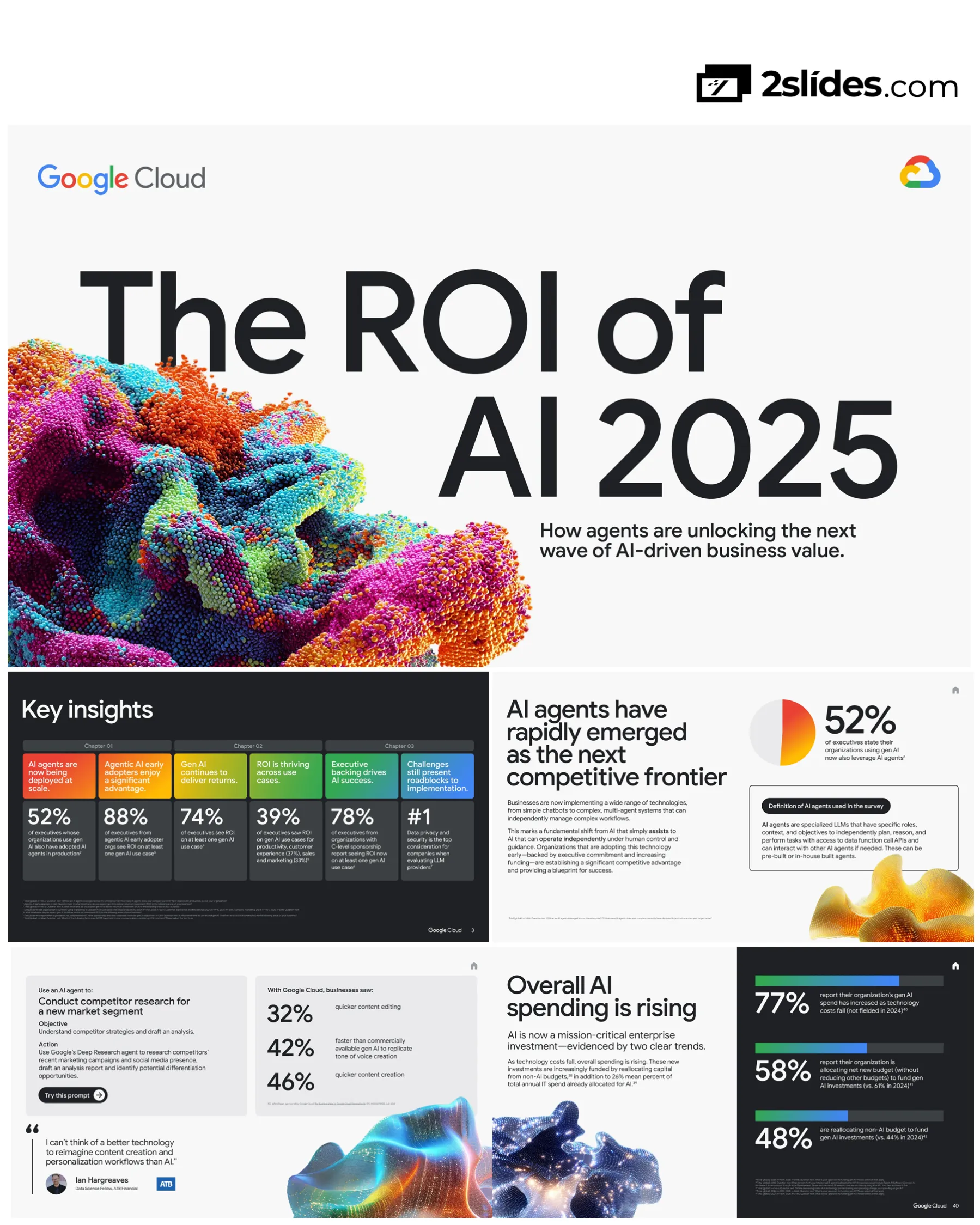
The ROI of AI 2025 - How AI Agents are Unlocking Business Value
Navegação Rápida
Tags
Compartilhar os slides
The ROI of AI 2025 - How AI Agents are Unlocking Business Value
Visualização detalhada de cada página de slide, incluindo layout, conteúdo principal e elementos visuais.
Title slide featuring colorful 3D molecular-style visualization and main subtitle: 'How agents are unlocking the next wave of AI-driven business value' with Google Cloud branding
Full-page cover design with large bold typography, vibrant abstract 3D graphics in pink, orange, cyan, and yellow colors creating depth, Google Cloud logo in top left
Overview of AI's evolution from predictive to generative to agentic era, highlighting that 88% of agentic AI early adopters now see positive ROI. Explains shift from 'if' to 'how' companies should use AI, with focus on scaling proven use cases and building sophisticated AI agents. Written by Oliver Parker, VP Global Generative AI GTM at Google Cloud.
Two-column layout with narrative text on left side, large 88% statistic with gradient bar on right side, abstract 3D graphics in background
Six major findings presented in colored cards organized by three chapters: (1) AI agents deployed at scale - 52% have agents in production, (2) Agentic AI early adopters enjoy significant advantage - 88% see ROI, (3) Gen AI continues to deliver returns - 74% see ROI on at least one use case, (4) ROI thriving across use cases - 39% see ROI on productivity, 37% on customer experience, 33% on sales/marketing, (5) Executive backing drives AI success - 78% with C-level sponsorship see ROI, (6) Challenges still present roadblocks - #1 consideration is data privacy and security
Dark background with six colorful gradient cards (red to yellow to green to blue spectrum) arranged in grid, chapter labels at top, detailed footnotes at bottom
Research methodology description: 16-minute online survey of 3,466 senior business leaders from global enterprises with $10M+ revenue and 100+ employees. Conducted by Google Cloud and National Research Group between April 18-June 3, 2025. Comprehensive benchmark of gen AI impact on business and financial performance. Unless noted, statistics only include those using gen AI in production.
Left side contains methodology text, right side features abstract 3D iridescent particle mesh visualization in purple, pink, and blue gradients
Detailed breakdown of survey respondents: 940 CEO/CIO, 1,097 CFO/CMO/CTO, 768 CISO/CDO/CSO/COO/Directors, 661 IT Directors/Heads of Innovation. Geographic distribution across 25+ markets with world map visualization. Robust industry representation across media/entertainment, retail/CPG, financial services, manufacturing, healthcare, telecom, and public sector.
Left column contains detailed respondent breakdown and organization size criteria, right side shows world map with country-by-country participant counts, industries listed at bottom
Four main report sections: (1) The agentic shift - page 07, (2) 5 proven areas where AI is delivering ROI - page 21, (3) Investment trends for an AI-ready future - page 38, (4) Your next steps - page 46
Large bold black typography on white background for 'Table of contents', colored progress bar at top transitioning through spectrum, abstract blue/purple 3D particle wave visualization at bottom, four section titles with page numbers aligned right
Chapter opening slide with large typography '01 The agentic shift' on orange gradient background transitioning from red-orange to yellow-green
Full-page gradient background (warm orange tones), minimal text with '01' chapter number and 'The agentic shift' title, page number '7' in bottom right
Explanation of how businesses are implementing AI technologies from simple chatbots to complex multi-agent systems, marking fundamental shift from AI that assists to AI that operates independently under human control. 52% of executives state their organizations using gen AI now also leverage AI agents. Includes definition box explaining that AI agents are specialized LLMs with specific roles, context, and objectives to independently plan, reason, and perform tasks.
Left side contains narrative text and 52% statistic with pie chart visualization, right side features definition box with yellow accent and 3D golden particle mesh visualization at bottom
Three-level maturity framework: Level 1 - Simple tasks (chatbots, information retrieval, image generation), Level 2 - AI agent applications (customer service AI agents, creative agents), Level 3 - Multi-agent workflows (agentic workflows, agent orchestration). Visual representation shows progression from basic to complex implementations.
Three-column layout with gradient-colored cards (orange to yellow to green), each level has rounded pill-shaped examples, simple icon visualizations at bottom showing single elements progressing to interconnected networks
Featured quote from Fiona Tan, CTO of Wayfair: 'AI agents are applicable across a wide variety of use cases, and I believe every business has workflows where agentic AI can deliver meaningful value. It accelerates existing processes, driving measurable business impact.'
Clean white background with large quotation mark, Wayfair logo, quote text in large typography, professional headshot of Fiona Tan with title underneath
Key statistic: 39% of executives say their organization has launched more than 10 AI agents. Supporting text explains that though core technologies were largely theoretical just 1-2 years ago, agentic AI is already in widespread deployment across industries and around the world. Includes quote from Velit Dundar, VP of Global eCommerce at Radisson Hotel Group about humans and machines having a truly symbiotic relationship.
Left side contains headline and statistics with gradient progress bar, right side features quote box with Radisson Hotel Group logo and executive quote, abstract 3D visualization in background
Analysis showing AI adoption accelerating at remarkable pace across organizations of every size, sector, and location. Explains that consistent emergence across diverse organizational types points to powerful trend toward widespread use. However, application varies by region based on different business imperatives - Europe prioritizes AI-enhanced tech support, JAPAC focuses on customer service, LATAM emphasizes marketing. Includes Deutsche Bank quote about AI agents supporting humans behind the scenes to improve financial performance.
Left column contains narrative text and quote box, right side would show regional breakdowns (referenced but partially visible)
Comprehensive data showing AI agent adoption rates: By Region - NorthAm 46%, LATAM 56%, Europe 47%, JAPAC 64%, MEA 59%; By Industry - Retail/CPG 51%, Financial Services 53%, Media/Entertainment 54%, Telecom 56%, Healthcare 44%, Manufacturing 56%, Public Sector 55%; By Organization Size - 100-499 employees 49%, 500-999 employees 56%, 1000+ employees 52%
Three-column layout with icon headers (globe, building, people) and detailed percentage breakdowns for each category, footnotes at bottom, clean data visualization design
Cross-industry AI agent use cases ranked by adoption: Customer service/experience 49%, Marketing 46%, Security ops/cybersecurity 46%, Tech support 45%, Product innovation/design 43%, Productivity/research 43%, Software development 40%, Finance/accounting 38%, Sales 35%, HR 31%, Personalization 29%, Legal 15%. From customer service and marketing to security operations and tech support, AI agents help people focus on work that matters by handling tedious tasks. Includes Morrisons quote about competitive advantage.
Left side contains narrative text and Morrisons quote, right side displays horizontal bar chart with orange-to-yellow gradient bars showing adoption percentages for each use case
While AI agents are being deployed broadly, every industry has its own priorities as companies invest in use cases that deliver the most significant impact. This deployment represents a fundamental operational shift across the business landscape. Includes quote from Bruno de F. Melo e Souza, Director of Engineering, Data & AI at Globo, about opportunities everywhere in media/entertainment for improving media production flow from idea to distribution.
Left side contains analysis text, center/right features quote box with Globo logo and abstract blue/green 3D particle visualization
Detailed breakdown showing top 3 AI agent priorities by industry: Retail/CPG - Customer service 47%, Marketing 44%, Security ops 41%; Financial Services - Customer service 57%, Marketing 48%, Finance/accounting & Security ops (tied) 46%; Media/Entertainment - Security ops 47%, Software dev 46%, Product innovation 46%; Telecom - Security ops 47%, Tech support 46%, Customer service 45%; Healthcare - Tech support 49%, Productivity/research 44%, Security ops 43%; Manufacturing - Customer service/Marketing (tied) 56%, Productivity/research 55%, Quality control 54%; Public Sector - Tech support 56%, Customer service/Software dev (tied) 51%, Finance/accounting 51%
Seven industry columns with icon headers, each showing top 3 use cases with percentages, color-coded from yellow to green across columns
Within broader landscape of AI agent adoption, distinct cohort of early adopters is setting themselves apart. Early adopters dedicate at least 50% of future AI budget to AI agents and already have agents deeply embedded across operations. Key statistics: 82% of early adopter organizations have deployed more than 10 AI agents (vs 39% across all organizations), 78% have been leveraging gen AI in production for over a year (vs 52% across all organizations). Their top performance isn't chance - it's result of deliberate strategy centered on deep technical capability and organizational commitment.
Left column contains definition and narrative text, right side displays two major statistics (82% and 78%) with horizontal bar comparisons showing early adopter vs overall percentages
Featured quote from Vishal Gupta, Chief Procurement Officer at Indosat: 'We see all employees at Indosat having a personal agent to amplify our capabilities and improve our overall impact.'
White background with large quotation mark, Indosat logo (pink flower design), quote text in large clean typography, professional headshot with title
Success of early adopters provides clear roadmap for organizations whether building business case or scaling existing programs. Leaders champion AI in production, sponsor deployment of multiple agents, and secure dedicated budgets for growth, translating into more consistent ROI. Key findings: 88% of agentic AI early adopters see ROI now on at least one gen AI use case (vs 74% across all organizations); Early adopter organizations have at least 50% of future AI budget allocated to agents; 39% of total annual IT spend allocated to AI (vs 26% average); Early adopters more likely to report significant value from gen AI across key areas including customer experience, business growth, security, and marketing; More likely to report ROI on all cross-industry agentic AI use cases.
Left column shows large 88% vs 74% comparison with gradient bar, right side lists five checkmarked success factors in gray boxes
Featured quote from Cristina Nitulescu, Head of Digital Transformation and IT at Bayer Consumer Health: 'You have to look at ROI as not just size of return but also speed of return. AI initiatives are sizable investments that are not commodities yet, so we have to look at where hyper-automation and scaling with AI is actually generating a return first. How fast is your investment coming back to the organization and what capabilities are you investing in now that will scale up and create more efficiencies or business transformation down the road?'
White background with Bayer logo, extended quote text in large typography, professional headshot with title, abstract yellow/orange 3D visualization on right side
Chapter opening slide with large typography '02 5 proven areas where AI is delivering ROI' on yellow-to-green gradient background
Full-page gradient background (warm yellow transitioning to green), minimal text with '02' chapter number and chapter title, page number '21' in bottom right
Overview of virtuous cycle where demonstrable ROI is accelerating adoption of gen AI for certain use cases, which in turn justifies even greater focus on those use cases. After 2024 proved gen AI works, 2025 is about building on that success with early adopters layering new AI applications on top of initial wins. Three key measures: ROI - 74% report within first year (unchanged YoY); Annual revenue increase - 53% of those reporting increased revenue estimate gains between 6-10% (vs 52% in 2024); Time to market - 51% note average 3-6 months from idea to production (vs 47% in 2024).
Left side contains narrative text explaining the virtuous cycle, right side displays three circular progress indicators with statistics and YoY comparisons
Five key benefits emerged from global data set as having greatest overall gains attributed to gen AI: (1) Productivity, (2) Customer experience, (3) Business growth, (4) Marketing, (5) Security. While executives' estimates of gen AI value-add are generally more conservative than in 2024, a higher share report improved customer experience. These areas provide template for executives to re-imagine their organization's business functions once augmented with gen AI.
Left column contains narrative explanation, right side displays five numbered boxes (01-05) in gradient colors from yellow through green, each labeled with a benefit category
Comprehensive data showing top gen AI impacts: (1) Productivity - 70% report improved productivity from gen AI (vs 71% in 2024); (2) Customer experience - 63% report improved customer experience (vs 60% in 2024); (3) Business growth - 56% report business growth (vs 63% in 2024); (4) Marketing - 55% report meaningful impact to marketing (new to 2025); (5) Security - 49% report security improvements (vs 56% in 2024). Business benefits are used to measure health of technology transformation initiatives and serve as leading indicators of financial performance.
Top section shows five benefit categories with percentage comparisons, abstract colorful 3D visualization in top right corner, data presented in clean columnar format
Quote from Francis Pugeda, Director of AI Product Development at Globe Telecom: 'With new low-code tools, our experts in marketing, finance, or operations can build their own simple AI helpers to solve their specific problems.' Accompanied by IDC White Paper data showing 727% ROI achieved over three years on average by businesses with Google Cloud.
Left side features Globe logo and quote, right side displays large 727% statistic with explanation text and IDC source citation
Detailed analysis of productivity improvements: 70% report improved productivity (vs 71% in 2024); 39% of executives reporting increased organizational productivity indicate their employee productivity has at least doubled as a result of gen AI (vs 45% in 2024); 39% saw ROI on gen AI use cases for individual productivity including emails, documents, presentations, meetings, chat (vs 34% in 2024). Among executives reporting increased productivity, higher share reported non-IT improvements year-over-year. Key areas where AI is driving ROI: IT processes/staff productivity 70%, Faster time to insight 61%, Non-IT processes/staff productivity 60%, Better accuracy 58%, Faster time to market 48%.
Left column shows three major statistics with gradient progress bars, right side displays dark background with five horizontal bar charts showing specific productivity improvement areas
Practical use case example - Objective: Get insights from data stored in Google Sheet to make better informed decisions. Action: Open side panel of Sheet containing data and click suggested prompt to analyze data, which will automatically review and analyze to provide overview and insights. Results with Google Cloud: $250k in average annual benefits per 1,000 employees; 50% more productive developers; 36% more productive end users. Includes quote from Natalie Bowman, Managing Director at Alaska Airlines about humanity and AI comfort.
Left side shows use case box with objective and action steps plus 'Try this prompt' button, right side displays three key statistics from IDC study, Alaska Airlines quote at bottom
Customer experience analysis showing accelerating year-over-year improvement confirms AI's role as primary engine for user engagement: 63% report improved customer experience (vs 60% in 2024); 51% of executives reporting improved customer experience indicate improvement of 6-10% (vs 53% in 2024); 68% of retail/CPG organizations report gen AI solutions have added value to their customer experience (vs 57% in 2024); 37% saw ROI on gen AI use cases for customer experience and field service including chat, call centers, and in-field technician support (vs 34% in 2024). Improved customer experience areas: Increased user engagement 83% (-2% YoY), Improved user satisfaction/NPS 75% (-5% YoY).
Left column shows four major statistics with gradient progress bars, right side displays dark background with two circular progress indicators showing specific customer experience improvements
Featured quote from Nick Manning, Director of Consumer Products at Golden State Warriors: 'For any business, the ultimate goal is to meet customers where they are. A significant advantage is having dependable gen AI consistently available through various channels such as email, text, and chat. Gen AI enables you to build customer experiences that effectively answer questions and complete tasks, eliminating the need for customers to wait in a queue to speak with a human.'
White background with Golden State Warriors logo, extended quote text in large typography, professional headshot with title
Practical use case example - Objective: Help customer resolve common product issue and achieve positive resolution. Action: AI agent can locate knowledge base articles, show recent support tickets, warranty information, and recommend top troubleshooting tips. Results with Google Cloud: 207% three-year ROI from using Customer Engagement Suite with Google AI; 120 seconds saved per contact in first year, increasing to 130 seconds by third year; $2M increase in additional revenue in first year, doubling to $4M by third year from better routing and information. Includes quote from Leeza Constantoulakis, Chief Nursing Officer at Drive Health.
Left side shows use case instruction box with 'Try this prompt' button, right side displays three key statistics from Forrester study, Drive Health quote at bottom
Revenue growth analysis showing it is markedly higher within organizations that leverage AI in production: 56% report business growth due to gen AI (vs 63% in 2024). Revenue growth from gen AI comparison 2024 vs 2025: Increased overall annual revenue between 1-5%: 14% in 2024, 15% in 2025; Increased overall annual revenue between 6-10%: 52% in 2024, 53% in 2025; Increased overall annual revenue of more than 10%: 34% in 2024, 31% in 2025.
Left side shows 56% headline statistic with abstract colorful 3D visualization at bottom, right side displays dark background table comparing 2024 vs 2025 revenue growth percentages across three tiers
Practical use case example - Objective: Identify slow-moving product and take action to improve sales or manage inventory. Action: AI agent can show sales data and current inventory levels, analyze and compare trends, then suggest targeted clearance promotion or adjust stock ordering levels. Results: $1.4M in additional net revenue achieved, on average, by Google Cloud customers. Features large $1.4M statistic with abstract green 3D visualization.
Large $1.4M statistic dominates left side with abstract green particle visualization, right side shows gray instruction box with objective/action format and 'Try this prompt' button
Marketing analysis showing implementing AI in marketing workflows enables more effective campaigns, drives more leads, and increases conversion: 55% report gen AI has resulted in meaningful impact on marketing, helping to create campaigns and increase leads and conversion; 33% saw ROI on gen AI use cases for sales and marketing including field sales activities, marketing operations, and content creation (unchanged YoY). Improved marketing from gen AI across industries: Retail/CPG 59%, Financial Services 56%, Media/Entertainment 59%, Telecom 49%, Healthcare 48%, Manufacturing 58%, Public Sector 51%.
Left column shows two major statistics (55% and 33%) with gradient progress bars, right side displays dark background with seven horizontal bar charts showing industry-specific marketing improvements
Practical use case example - Objective: Understand competitor strategies and draft analysis. Action: Use Google's Deep Research agent to research competitors' recent marketing campaigns and social media presence, draft analysis report and identify potential differentiation opportunities. Results with Google Cloud: 32% quicker content editing; 42% faster than commercially available gen AI to replicate tone of voice creation; 46% quicker content creation. Includes quote from Ian Hargreaves, Data Science Fellow at ATB Financial about reimagining content creation with AI.
Left side shows use case instruction box with 'Try this prompt' button, right side displays three key statistics from IDC study, abstract blue/green 3D visualization on right, ATB Financial quote at bottom
Featured quote from Zafar Chaudry, Chief Digital Officer & Chief AI and Information Officer at Seattle Children's Hospital: 'Gen AI excels at marketing-related tasks that require extracting data from a large database, such as audience building, journey orchestration, content creation, and designing targeted, personalized campaigns.'
White background with Seattle Children's logo (orange fish design), quote text in large typography, professional headshot with title, abstract teal/green 3D visualization on right side
Security analysis showing AI threat detection and response can enhance security posture, especially against emerging threats: 49% report gen AI has resulted in meaningful impact to security posture (new to 2025). Improved security posture from gen AI: Improved ability to identify threats 77% (-5% YoY), Reduction in time to resolution 61% (-10% YoY), Improved intelligence and response integration 74% (new to 2025), Reduction in number of security tickets 53% (-12% YoY).
Left column shows 49% headline statistic and four specific security improvements with gradient progress bars and YoY comparisons, each metric displayed with prominent percentage
Practical use case example - Objective: Quickly assess reported security vulnerability, coordinate fix, and communicate with stakeholders. Action: Agent gathers vulnerability reports, current security states, and pentest results. After assessing issue's severity, agent drafts report and creates support tickets to implement fix. Results with Google Cloud: $1.2M saved over three years by providing predictable cost model and enabling decommissioning of legacy on-prem security tools; 70% reduction in risk and cost of breach; 50% faster mean time to respond and 65% faster mean time to investigate for SecOps teams. Includes quote from Zafar Chaudry about security being perfect use case for gen AI.
Left side shows use case instruction box with 'Try this prompt' button, right side displays three key statistics from Forrester study, Seattle Children's quote at bottom
Chapter opening slide with large typography '03 Investment trends for an AI-ready future' on green-to-blue gradient background
Full-page gradient background (green transitioning to blue), minimal text with '03' chapter number and chapter title, page number '38' in bottom right
Businesses are revising priorities to align with AI-first future - investment is growing, and higher portion of AI budgets is being aimed at AI agent deployment. Top 5 business objectives comparing 2024 vs 2025: Increased operational efficiency (53% in 2024, 51% in 2025), Improved customer experience (52% in 2024, 50% in 2025), Increased employee productivity (52% in 2024, 49% in 2025), Greater AI agent deployment (New to 2025, 43% in 2025), Increased competitiveness/market share (50% in 2024, 41% in 2025). Includes quote from Cristina Nitulescu of Bayer about prioritizing agentic AI for the future.
Left side contains narrative text and Bayer quote, right side displays horizontal bar chart comparing 2024 (gray) vs 2025 (blue/green gradient) for five business objectives
AI is now mission-critical enterprise investment evidenced by two clear trends. As technology costs fall, overall spending is rising. These new investments are increasingly funded by reallocating capital from non-AI budgets, in addition to 26% mean percent of total annual IT spend already allocated for AI. Three key findings: 77% report their organization's gen AI spend has increased as technology costs fall (not fielded in 2024); 58% report their organization is allocating net new budget (without reducing other budgets) to fund gen AI investments (vs 61% in 2024); 48% are reallocating non-AI budget to fund gen AI investments (vs 44% in 2024).
Left side contains headline and narrative text with abstract blue particle visualization at bottom, right side displays three statistics with gradient progress bars on dark background
Strategic investment priorities ranked: 42% Align business and technology to support change management for user adoption of AI; 41% Enhance quality of data and knowledge management; 40% Upskill staff, hire talent, and develop right outsource partnerships; 37% Provide right tooling and compute resources for AI; 33% Govern and manage risk of AI; 31% Deploying AI agents; 29% Reconsider organizational structure and operating models for implications of AI; 28% Measure AI impact. Includes quote from Oliver Dörler, Chief Data and AI Officer at Commerzbank about prioritizing AI use cases with greatest ROI.
Left side displays dark background with eight horizontal investment priorities shown as gradient bars with percentages, right side features Commerzbank quote on white background
The biggest returns come when AI is aligned to clear business goals. Formalization of AI strategy is most evident in stability and strength of executive sponsorship. Similar to last year's findings, C-suite sponsorship remains crucial for successful AI adoption. Executives who report their organization has comprehensive executive alignment are consistently more likely to see tangible ROI from their AI initiatives. Includes quote from Eric Lambert, VP Legal and Employment Counsel at Trimble about defining what ROI means beyond financial returns.
Left side contains narrative text explaining importance of sponsorship, right side features Trimble quote with logo on white background
Data comparing organizations with vs without comprehensive C-suite sponsorship: 2024 - Orgs with C-suite sponsorship 78%, Orgs without 71%; 2025 - Orgs with C-suite sponsorship 78%, Orgs without 72%. Key finding: 78% of executives who report their organization has C-level sponsorship report seeing ROI now on at least one gen AI use case in 2025. Even more telling is significant increase in strong alignment between gen AI adoption and C-suite level sponsorship - which grew from 69% in 2024 to 73% in 2025. Includes quote from Anaterra Oliveira, VP of Technology at Dasa about C-level sponsorship being essential.
Left side shows comparative bar chart for 2024 and 2025 with green gradient bars, top right displays 78% statistic, bottom section features Dasa quote
For many organizations, top challenges with AI are rooted in foundational work required to support them. Overcoming complexities of systems integration and meeting high standards for data security represent most significant hurdles. Solution lies in adopting modern, integrated data strategy that prioritizes strong governance and security protocols from start. Over 1 in 3 indicate that data privacy and security is top consideration for LLM providers. Includes quote from Christoph Rabenseifner of Deutsche Bank about difficulty of deploying AI agents while covering enterprise security, compliance and other requirements.
Left side contains narrative text and 'Over 1 in 3' callout, right side features Deutsche Bank quote on white background
Key factors when considering LLM providers: #1 Data privacy and security 37%; #2 Integration with existing systems 28%; #3 Cost 27%. Includes quote from Natalie Bowman of Alaska Airlines about biggest security concern being risk of bad actors getting access to data or LLM hallucinating/changing it, leading to loss of true view of data in vicious cycle.
Left side features Alaska Airlines quote, right side displays three factors with gradient green bars showing percentages on white background
Chapter opening slide with large typography '04 Your next steps' on blue gradient background
Full-page gradient background (green transitioning to blue), minimal text with '04' chapter number and chapter title, page number '46' in bottom right
Seven-point checklist for AI agent success: (1) Find your executive champions - Cultivate C-suite sponsorship to advocate for AI initiatives, clear roadblocks, and align to results; (2) Demonstrate value to secure AI budget - Build compelling business case for why AI deserves its own investment; (3) Create your AI rulebook now, not later - As AI use grows, so do risks. Establish clear, enterprise-wide guidelines to secure data, protect IP, and ensure compliance as you scale; (4) Start with biggest wins - Not all AI projects are created equal. Focus energy on building AI agents that can automate repeatable tasks to deliver clear ROI; (5) Build trust in AI from day one - First, get your data house in order with robust data governance and enterprise security framework. Second, always keep human-in-the-loop; (6) Give your AI agents the tools to be useful - For AI agent to do work, it needs access to internal enterprise systems like CRM or Drive. Grant it secure, governed access; (7) Invest in your talent and internal AI education programs - Most successful companies don't just buy technology, they build skills.
Two-column layout with checkmarked items, each containing strategic guidance with linked keywords, abstract blue/purple 3D visualization in top right corner
Final call-to-action slide with large text 'Ready to see ROI from AI?' and two action options: 'Get in touch' and 'Share this report' with arrow icon. Abstract colorful gradient visualization (blue, green, yellow) in background on right side.
Dark background with large white typography on left side, abstract colorful gradient 3D visualization on right side, two call-to-action links at bottom left, Google Cloud logo in top left
Perguntas comuns sobre este slide e o conteúdo da apresentação subjacente.
Agentic AI represents the evolution beyond generative AI. While generative AI creates content based on prompts, agentic AI involves specialized LLMs that have specific roles, context, and objectives to independently plan, reason, and perform tasks with access to data, function call APIs, and can interact with other AI agents. The report defines three levels of AI agent maturity: Level 1 (Simple tasks like chatbots), Level 2 (AI agent applications like customer service agents), and Level 3 (Multi-agent workflows with agent orchestration). This marks a shift from AI that simply assists to AI that can operate independently under human control and guidance.
According to the 2025 research, 88% of agentic AI early adopters (organizations dedicating at least 50% of their future AI budget to agents) now see positive ROI on gen AI investments, compared to 74% across all organizations. Specific results include: 70% report improved productivity, 63% see better customer experience, 56% experience business growth, and 53% of those with increased revenue report gains between 6-10%. IDC's research shows Google Cloud customers achieved 727% ROI over three years on average. The time to ROI is also improving, with 51% noting average time from idea to production is 3-6 months.
AI agent adoption has reached mainstream status remarkably quickly. The research shows that 52% of executives whose organizations use gen AI have already deployed AI agents in production, with 39% reporting their organization has launched more than 10 AI agents. Among agentic AI early adopters, 82% have deployed more than 10 agents. Adoption varies by region (JAPAC leads at 64%, followed by MEA at 59%, LATAM at 56%), by industry (Manufacturing 56%, Telecom 56%, Public Sector 55%), and is strong across all organization sizes (56% for 500-999 employee companies).
The research identifies five proven areas where AI is delivering measurable ROI: (1) Productivity - 70% report improvements, with AI agents helping with emails, documents, presentations, and research; (2) Customer Experience - 63% see improvements through AI-powered chat, call centers, and field service support; (3) Business Growth - 56% report revenue increases, with 53% seeing 6-10% gains; (4) Marketing - 55% report meaningful impact on campaign creation, lead generation, and content development; (5) Security - 49% see improvements in threat detection, response time (61% faster), and incident reduction. Cross-industry use cases include customer service (49%), marketing (46%), security ops (46%), and tech support (45%).
The report shows that successful organizations are making substantial AI investments. The average organization allocates 26% of total annual IT spend to AI, while agentic AI early adopters dedicate 39% of IT spend to AI initiatives. Importantly, 77% of organizations report their gen AI spending has increased even as technology costs fall. In terms of funding approach, 58% are allocating net new budget (without reducing other budgets), while 48% are reallocating non-AI budgets to fund gen AI investments. Early adopters ensure at least 50% of their future AI budget is specifically allocated to AI agents, demonstrating the strategic priority of agentic systems.
C-suite sponsorship is crucial for AI ROI success. The data shows that 78% of executives from organizations with comprehensive C-level sponsorship report seeing ROI now on at least one gen AI use case, compared to 72% for organizations without such sponsorship. Strong alignment between gen AI adoption and C-suite level sponsorship has grown from 69% in 2024 to 73% in 2025. The top investment priority identified is to 'align business and technology to support change management for user adoption of AI' (42%), emphasizing that executive champions are needed to advocate for AI initiatives, clear roadblocks, secure dedicated budgets, and align efforts to measurable business results.
The research identifies several key challenges: (1) Data privacy and security - the #1 consideration when evaluating LLM providers (37% rank it in top 3 factors); (2) Integration with existing systems - 28% cite this as a top concern; (3) Cost - 27% identify this as a major factor. Other significant challenges include enhancing data quality and knowledge management (41% priority), upskilling staff and hiring talent (40%), providing right tooling and compute resources (37%), and governing/managing AI risk (33%). The solution lies in adopting a modern, integrated data strategy that prioritizes strong governance and security protocols from the start, with always keeping a human-in-the-loop for oversight.
Based on the research, follow this blueprint: (1) Find your executive champions - cultivate C-suite sponsorship; (2) Start with the biggest wins - focus on AI agents that can automate repeatable tasks with clear ROI potential; (3) Build trust from day one - get your data house in order with robust governance and enterprise security, always keeping humans in the loop; (4) Give agents the tools to be useful - grant them secure, governed access to internal systems like CRM or Drive; (5) Create your AI rulebook now - establish clear enterprise-wide guidelines for data security, IP protection, and compliance; (6) Demonstrate value to secure budget - build a compelling business case showing how early adopters achieve 88% ROI rates; (7) Invest in talent - the most successful companies build skills, not just buy technology. The average time from idea to production is 3-6 months for successful organizations.

Create Your Own Slides
Turn your ideas into professional presentations in seconds with 2slides AI.
Referencie designs profissionais, escolha seu estilo e gere slides com renderização de texto perfeita. Alimentado por Nano Banana—comece a criar sua apresentação agora.
Seu Agente IA para slides. Economize tempo, brilhe mais rápido com criação inteligente de apresentações.




© 2026 2slides. Todos os direitos reservados.