
Qualcomm's third quarter fiscal 2026 earnings presentation (July 29, 2026) — a 32-slide deck covering revenues of $9.9 billion, GAAP EPS of $1.87 and non-GAAP EPS of $2.21, QCT and QTL segment results, the memory-cost and Apple modem-share headwinds shaping fourth quarter guidance, an Investor Day recap that raises the FY29 non-handset revenue target from $22 billion to $40 billion with a >$18 non-GAAP EPS target, a data center roadmap built on the new Qualcomm Dragonfly portfolio against a $1 trillion-plus 2029 TAM, nine key announcement slides covering Meta, Hugging Face, Samsung, Stellantis, BMW and the Modular acquisition, and six pages of GAAP-to-non-GAAP reconciliations.
त्वरित नेविगेशन
टैग
स्लाइड साझा करें
Qualcomm's third quarter fiscal 2026 earnings presentation (July 29, 2026) — a 32-slide deck covering revenues of $9.9 billion, GAAP EPS of $1.87 and non-GAAP EPS of $2.21, QCT and QTL segment results, the memory-cost and Apple modem-share headwinds shaping fourth quarter guidance, an Investor Day recap that raises the FY29 non-handset revenue target from $22 billion to $40 billion with a >$18 non-GAAP EPS target, a data center roadmap built on the new Qualcomm Dragonfly portfolio against a $1 trillion-plus 2029 TAM, nine key announcement slides covering Meta, Hugging Face, Samsung, Stellantis, BMW and the Modular acquisition, and six pages of GAAP-to-non-GAAP reconciliations.
प्रत्येक स्लाइड पृष्ठ का विस्तृत दृश्य, लेआउट, मुख्य सामग्री और दृश्य तत्वों सहित।
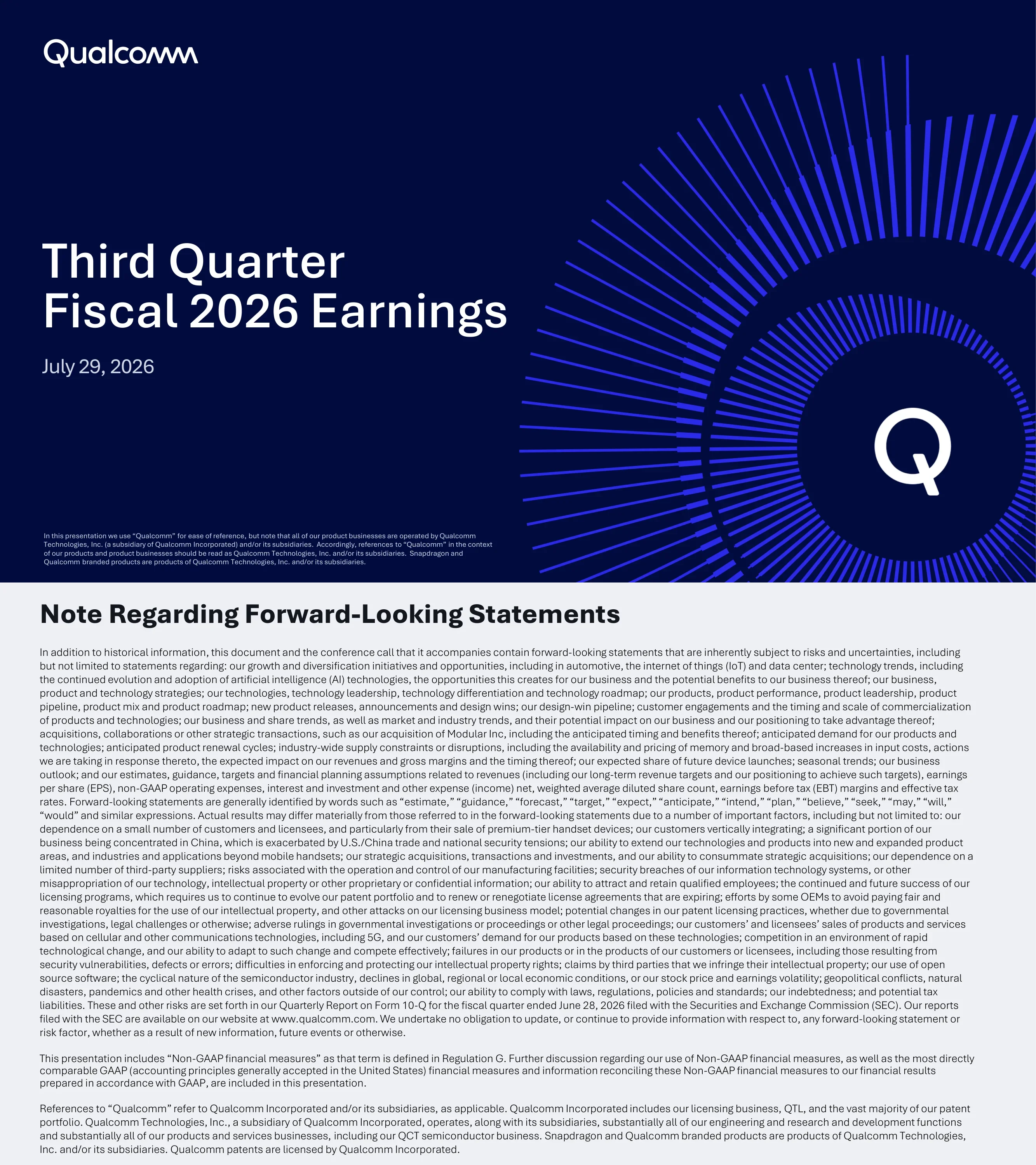
Cover slide for Qualcomm's third quarter fiscal 2026 earnings presentation, dated July 29, 2026, with a footnote explaining that references to 'Qualcomm' in a product context mean Qualcomm Technologies, Inc.
Dark navy field. Qualcomm wordmark at the top left, a two-line white title at left-centre above the date, and a large radial burst of blue lines forming a circle around a white 'Q' filling the right half. Legal footnote in small type at the bottom left.
Safe-harbour disclosure listing the forward-looking topics — growth in automotive, IoT and data center, AI adoption, product roadmap, the Modular acquisition, industry-wide supply constraints and memory pricing, guidance and long-term revenue targets — followed by the risk factors, a note on non-GAAP measures, and the definitions distinguishing Qualcomm Incorporated, QTL and Qualcomm Technologies.
Light grey slide, bold black heading, then three blocks of small justified body text filling the full width. No graphics.
Section divider introducing the quarter's results.
Dark navy field with the section title in white at left-centre and the radial burst and Q monogram in the lower right — the cover construction with the title swapped.
Headline results: revenues $9.9 billion, GAAP EPS $1.87, non-GAAP EPS $2.21. QCT delivered $8.5 billion of revenue at the high end of the guidance range, with $3.4 billion of combined Automotive and IoT revenue up 28% year over year, EBT of $2.2 billion at a 26% margin, and a note that Automotive has now posted 23 consecutive quarters of double-digit year-over-year revenue growth. QTL revenues of $1.3 billion came in above the midpoint of guidance at a 69% EBT margin. Other items: $2.3 billion returned to stockholders including $1.4 billion of share repurchases and $1.0 billion of dividends, and the completed acquisition of Modular Inc, strengthening the software foundation for generative and agentic AI.
Upper third is a white band holding three oversized headline figures with labels above. Below, a dark navy field carries three outlined cards — QCT, QTL and Other — each with a small-caps header bar and figures set large inside.
Non-GAAP results against the prior year: revenues $9,947 million versus $10,365 million (down 4%), EBT $2,693 million versus $3,544 million (down 24%), EPS $2.21 versus $2.77 (down 20%). QCT revenues $8,504 million versus $8,993 million (down 5%), of which handsets $5,086 million (down 20%), automotive $1,588 million (up 61%) and IoT $1,830 million (up 9%); QCT EBT $2,192 million versus $2,671 million (down 18%) at a 26% margin against 30%, down 4 points. QTL revenues $1,278 million versus $1,318 million (down 3%), EBT $881 million versus $942 million (down 6%), margin 69% against 71%.
Dark navy slide with a three-column table — Q3FY26, Q3FY25 and YoY delta — the current-quarter column highlighted in a brighter blue block. Section labels Non-GAAP, QCT and QTL break the rows into groups; percentage rows are set in italic.
As of July 29, 2026. An italic preamble states that the semiconductor industry is experiencing a broad-based increase in input costs across wafer fabrication, assembly, test, advanced packaging and memory, and that Qualcomm is taking pricing actions expected to benefit gross margins over time. The table gives Q3FY26 guidance, Q3FY26 results and Q4FY26 guidance: revenues $9.2–10.0B / $9.9B / $9.7–10.5B; non-GAAP diluted EPS $2.10–2.30 / $2.21 / $2.05–2.25; non-GAAP operating expenses ~$2.60B / $2.59B / ~$2.70B; GAAP interest and investment and other expense (income) net $70M / $(836)M / $90M; non-GAAP effective tax rate 12.5% throughout; weighted average diluted share count ~1.06B / 1.07B / ~1.08B. Segment lines: QCT revenues $7.9–8.5B / $8.5B / $8.4–9.0B and EBT margin 25–27% / 26% / 23–25%; QTL revenues $1.15–1.35B / $1.3B / $1.2–1.4B and EBT margin 67–71% / 69% / 68–72%. Annual guidance: non-GAAP effective tax rate 13.0%.
Dark navy table with three columns, the Q4 guidance column outlined in bright blue to mark it as the new information. Row bands alternate between two navy tones; three sub-headings split quarterly, segment and annual guidance. Four numbered footnotes run across the bottom.
Three numbered factors: QCT handset revenues from China OEMs reached a bottom in the third fiscal quarter and will return to double-digit sequential growth in the fourth; the semiconductor industry is seeing a broad-based increase in input costs and Qualcomm is taking pricing actions expected to benefit gross margins over time; and as a result of supply constraints, Qualcomm now expects an acceleration in the step down of Apple product revenues starting in the fourth fiscal quarter, as its modem share for the upcoming iPhone launch is expected to be materially lower than the prior estimate of 20%.
Dark navy slide, bold white title, and a single outlined panel headed 'SUMMARY' holding three numbered paragraphs in large readable type, with a closing line beneath.
Historical trend: QCT Android handset revenues grew from roughly $11 billion in FY20 to about $20 billion in FY25, a 12% CAGR. FY26 memory industry impact, relative to the FY25 baseline: a roughly 20% revenue decline in FY26 equals a $1.50-plus EPS impact. A closing line explains that unprecedented increases in memory pricing and supply constraints have created significant cyclical headwinds for the global smartphone industry.
Two charts on a dark navy field separated by a vertical rule — a two-bar historical trend with a CAGR arrow at the left, and a two-bar FY25-versus-FY26e comparison at the right where the shortfall is drawn as a hatched block with a bracketed annotation. Bold summary sentence across the bottom.
Described as a significant inflection point in the execution of the growth strategy: non-handset revenues of roughly $10 billion in FY25 growing 24% to about $13 billion in FY26e, then accelerating to 60%-plus growth in FY27e. Two callouts state that year-over-year growth in non-handset revenues accelerates from 24% in FY26 to 60%-plus in FY27, and that the year-over-year growth in non-handset revenue in FY27 is expected to replace total Apple product revenues in FY26. A note adds that non-handset revenues include data center revenues.
Dark navy slide with three bars — two solid, the FY27e bar drawn as a dashed outline to mark it as a target — joined by a solid and then a dashed growth arrow. Two text blocks occupy the right third.
Section divider introducing the long-range targets from the 2026 Investor Day.
The same dark navy divider construction with the radial burst and Q monogram at the lower right.
The 2024 Investor Day targets — Automotive $8B, IoT $14B, Data Center not yet a line, total non-handsets $22B — set beside the 2026 Investor Day update: Automotive $10B, IoT $14B-plus, Data Center $15B-plus, total non-handsets $40B. Callouts give a roughly 2x increase versus the prior FY29 target and a roughly 40% four-year CAGR from FY25 to FY29.
Two stacked card groups side by side on a light ground, the old targets in dark navy header and the new ones in bright blue, joined by an arrow; the total rows are reversed out as solid bars. Two callouts at the right.
Revenue targets: non-handsets $40B, comprising Automotive $10B, IoT $14B-plus and Data Center $15B-plus; Android handsets growing at roughly 5% on an FY26–29 CAGR; licensing scaling with 4G/5G units.
Light grey slide with a bright blue banner reading 'REVENUE TARGETS' above a five-row list; row labels at the left in dark type, figures at the right in bright blue, with the three non-handset components indented beneath their total.
Non-handsets are expected to represent approximately two-thirds of QCT revenue in FY29. Three donut charts — FY25, FY27 target and FY29 target — show the handset share shrinking as Automotive and IoT grow and Data Center appears and expands. A note states that QCT revenue is inclusive of Data Center revenue.
Light grey slide with three equally sized donut charts in a row, each labelled with its fiscal year in the centre, segments labelled along the ring with small product icons.
A roadmap of four product lines with their ramp timing and 2029 TAM: Connectivity, start of revenue ramp in FY26, $65B TAM; Custom silicon, Q1 FY27, $115B; AI accelerator, 2H FY27, $680B; CPU, 2H FY28, $200B — adding to a $1 trillion-plus 2029 TAM. The Qualcomm Dragonfly brand and a rack render appear at the right.
Light grey slide with a horizontal timeline across the middle, four icon-marked milestones above it and their TAM figures below, terminating in a dark circle holding the $1T+ total. The right quarter is a photographic render of a Dragonfly rack.
Data center revenues of $0.3 billion in FY26e growing to $5 billion in FY27 and $15 billion-plus in FY29, described as an opportunity of more than a 5% share of the $1 trillion-plus TAM in five to seven years. FY27 metrics: custom silicon with two hyperscaler customers of more than $1 billion revenue each, accretive to QCT operating margin; AI accelerator and CPU investment ahead of the revenue ramp. A banner reads 'Multiple customers | Multiple products | Multiple generations'.
Three ascending bars at the left in grey, navy and bright blue, a share-of-TAM callout in the middle, and a boxed 'FY27 METRICS' block at the right. A full-width grey banner carries the three-part claim near the bottom.
Four claims: a diversified revenue base across Handsets, Data Center, Automotive and IoT; the FY29 non-handset revenue target increased from $22B to $40B; confidence in scaling non-GAAP EPS to more than $18 in FY29; and a $100 billion-plus annual revenue opportunity in five to seven years.
Dark navy slide with the title at the upper left and a collage of product photography — a Dragonfly rack, a car, a phone, a robot and smart glasses — filling the centre-left in a staggered grid. Four hairline-separated claims run down the right third.
Section divider introducing the announcement slides.
The dark navy divider construction for the fourth time, radial burst at the lower right.
Qualcomm Technologies introduced new data center solutions including the Qualcomm Dragonfly C1000 CPU, Qualcomm High Bandwidth Compute (HBC), the Dragonfly AI300 inference accelerator and connectivity products, together with custom silicon. The AI300 joins the AI250 in a multi-generation HBC-based accelerator roadmap on an annual cadence, and new HBC technology is described as breaking the memory wall with lower energy per token. A closing line states the four-product-line portfolio ramps in stages to realise the FY29 goal of $15B data center revenues.
A white header band carries a category label, the announcement headline and a 'link'. Below, the left half is a navy panel headed 'HIGHLIGHTS' with diamond bullets; the right half names the four product lines with icons beside an isometric render of server racks.
Qualcomm and Meta announced a collaboration on a multi-generation CPU roadmap supporting Meta's growing compute footprint. The first-generation Dragonfly C1000 CPU will be in production starting in the second half of 2028 and targets the 2029 TAM of $200 billion across agentic CPU, general-purpose CPU and AI head node categories. Specifications given: greater than 5GHz clock speed for custom-designed Qualcomm Oryon server cores, and 250-plus cores in a chiplet design.
The announcement layout repeated — white header band, navy highlights panel at the left, and a two-logo lock-up above a photographic render of the chip package at the right, with two specification callouts beneath.
Qualcomm announced completion of its acquisition of Modular Inc. Modular's AI-native software platform complements Qualcomm Technologies' solutions to accelerate generative and agentic AI from edge to cloud, and the combination creates an AI compute platform spanning data center, edge infrastructure, and personal and industrial AI. Modular's open ecosystem mission continues, with Mojo, MAX and Modular Cloud continuing as products and brands.
Same announcement layout; the right half is a dark gradient panel holding the two wordmarks separated by a circled 'x'.
Qualcomm Technologies announced the expansion of its strategic relationship with Hugging Face to advance open, developer-driven AI from devices to cloud infrastructure, bringing Hugging Face internal and developer workloads onto Qualcomm Dragonfly data center solutions. Hugging Face enables agentic AI model onboarding across the compute continuum, and the Hugging Face Agent drives hybrid orchestration between devices and data center. The closing line notes a frictionless onboarding process for 16 million developers.
Same layout; the right half is a dark navy field with a faint network graph behind the two logos.
Snapdragon 8 Elite Gen 5 for Galaxy delivers performance and power efficiency for Galaxy AI experiences; the Snapdragon Wear Elite platform marks Samsung's first Snapdragon-powered smartwatch platform, purpose-built for Personal AI with advanced sensor fusion; and Snapdragon AR1 Gen 1 powers Samsung and Google's new intelligent eyewear. The closing line notes that Snapdragon now powers devices across Samsung's broader Galaxy ecosystem for the first time, spanning smartphones, watches and intelligent eyewear. Devices pictured include Galaxy Z Fold8 Ultra, Z Fold8, Z Flip8, Watch9, Watch Ultra2 and Gentle Monster and Warby Parker eyewear.
Same layout; the right half is a blue gradient panel with three 'Powered by' chip badges down the left and their corresponding device photographs to the right, arranged in three rows.
Snapdragon Scalable Turnkey-AI Ready Toolkit (START) hardware modules are ready-made solutions combining compute, connectivity and AI in a compact wearable footprint; START combines these with an AI-agnostic full software stack and a network of manufacturing partners; and global eyewear company Inspecs is the first to work with Qualcomm Technologies to bring smart glasses to market across multiple brands. Market context: 600 million-plus global eyewear units shipped annually with smart glasses at roughly 1% of shipments. START ASPs are given as $40 audio only, $100-plus multi-modal and $200-plus premium display, with the closing line that for as low as $40 any glasses can become an agent-ready personal AI device.
Same layout; the right half is a light gradient panel with the Snapdragon START wordmark, two market-context figures, and three pairs of eyewear photographed beside their ASP tiers connected by a bracket.
Qualcomm Technologies and Stellantis announced a collaboration to use Snapdragon Digital Chassis solutions for unified compute across the entire vehicle, including cockpit, connectivity and ADAS. The expanded multi-year award includes the Snapdragon Ride Pilot ADAS stack and systems-on-chips for next-generation Stellantis vehicles, enabling a globally validated, scalable solution for L2-plus automated driving.
Same layout; the right half shows a translucent vehicle render above four Snapdragon product marks — Auto Connectivity, Cockpit, Ride and Car-to-Cloud — in a two-by-two grid.
BMW Group selected Qualcomm Technologies as its leading compute silicon provider for the digital cockpit and next-generation ADAS/AD systems, with model programs starting next decade. The agreement spans the Snapdragon Digital Chassis portfolio including Snapdragon Cockpit and Snapdragon Ride, and builds on a co-development track record including the November 2025 commercial launch of Snapdragon Ride Pilot in the BMW iX3 and the Neue Klasse vehicle line.
Same layout; the right half is plain dark navy holding only the two logos separated by a vertical rule — the sparsest of the announcement pages.
A linked index of fifteen announcements from the quarter, including the NASCAR San Diego circuit partnership, two new Snapdragon mobile platforms, the Stellantis collaboration, Snapdragon C for entry-tier laptops, Trackhouse Racing PROJECT91, an SDG&E and UC San Diego edge AI wildfire collaboration, Snapdragon START, Snapdragon Reality Elite for spatial computing, the Dragonfly data center roadmap, the Meta CPU agreement, the Hugging Face expansion, the diversification strategy release, the Samsung Galaxy collaboration, the Modular acquisition and the BMW lead compute silicon award.
Dark navy slide with the section title inside a large radial burst circle at the left and a white rounded card at the right holding fifteen bulleted lines, each ending in a 'Link'.
Section divider introducing the non-GAAP reconciliation appendix.
The dark navy divider construction for the fifth and final time.
Explains that non-GAAP measures supplement rather than replace GAAP; that they are used to evaluate QCT and QTL performance and in executive incentive compensation; and that non-GAAP information excludes the QSI segment, share-based compensation, acquisition-related items, certain tax items and other items. Sub-bullets cover why QSI is excluded, the treatment of share-based compensation, acquisition-related intangible amortisation, restructuring and impairments, and the fixed estimated non-GAAP tax rate applied beginning in the first quarter of fiscal 2026.
Light grey slide, bold heading, then four paragraph blocks with nested bullets running to the foot of the page. No graphics.
Third quarter fiscal 2026: GAAP revenues $9,947 million, EBT $2,462 million, net income $2,002 million, diluted EPS $1.87 on 1,069 million shares; less QSI $768 million, less share-based compensation $(827) million and less other items $(172) million give non-GAAP EBT $2,693 million, net income $2,356 million and EPS $2.21. Third quarter fiscal 2025: GAAP revenues $10,365 million, EBT $2,952 million, net income $2,666 million, EPS $2.43 on 1,099 million shares, reconciling to non-GAAP EBT $3,544 million, net income $3,040 million and EPS $2.77. Footnotes itemise $101 million of acquisition-related charges, $70 million of restructuring charges and $1 million of interest expense related to the 2019 European Commission fine.
Light grey slide with two stacked five-column tables, one per fiscal year, each running GAAP results through three deduction columns to non-GAAP results, with alternating row shading and underlined column headers.
Q3FY26 guidance beside Q4FY26 guidance: revenues $9.2–10.0B versus $9.7–10.5B; GAAP diluted EPS $1.26–1.46 versus $1.22–1.42; less diluted EPS attributable to QSI nil in both; less share-based compensation $(0.68) versus $(0.72); less other items $(0.16) versus $(0.11); giving non-GAAP diluted EPS of $2.10–2.30 versus $2.05–2.25. Footnotes date the prior guidance to April 29, 2026 and the new guidance to July 29, 2026, and note the estimated impact of the broad-based input cost increase.
Light grey slide with a compact two-column table occupying the upper third, the deduction lines indented under GAAP EPS, and three numbered footnotes filling the lower half.
Operating expenses: GAAP combined R&D and SG&A of approximately $3,450 million guided, $3,583 million actual and approximately $3,600 million guided for Q4; less QSI $3 million, less share-based compensation $801 million and less other items $186 million give non-GAAP operating expenses of approximately $2,600 million guided, $2,593 million actual and approximately $2,700 million guided. Effective tax rates: estimated Q3FY26 17% GAAP reconciling to 12.5% non-GAAP; actual Q3FY26 18.5% to 12.5%; estimated Q4FY26 14% to 12.5%; previous estimated FY26 annual (40)% to 13%; estimated FY26 annual (40.5)% to 13%. Footnotes note $40 million of acquisition-related charges, $146 million of deferred compensation revaluation losses, and a $5.7 billion income tax benefit from a valuation allowance release in the second quarter of fiscal 2026.
Two tables stacked on a light grey slide, each with underlined column headers and alternating row shading; six numbered footnotes and an 'N/P - Not provided' key run across the bottom.
The FY29 EPS target reconciled: GAAP greater than $14.50, with QSI, share-based compensation and other items not provided individually, giving non-GAAP greater than $18.00. A footnote dates the guidance to July 29, 2026 and notes that substantially all of the excluded amounts relate to share-based compensation.
Light grey slide with a single five-row table occupying the upper third — the shortest table in the deck — and most of the page left empty below it.
इस स्लाइड और अंतर्निहित प्रस्तुति सामग्री के बारे में सामान्य प्रश्न।
The full 32-slide Qualcomm Q3 FY26 earnings presentation as both PDF and editable PowerPoint, plus a page-by-page preview. The PPTX keeps tables and charts as editable objects so the layouts can be reused with your own figures.
Yes. The PDF is the file Qualcomm published on its investor relations site for the third quarter of fiscal 2026, presented July 29, 2026. The PowerPoint was converted from that PDF for editing convenience — check any layout you plan to reuse, since conversion is not always pixel-perfect.
Revenues of $9.9 billion, GAAP EPS of $1.87 and non-GAAP EPS of $2.21. On a non-GAAP basis revenue fell 4% year over year and EPS fell 20%. QCT revenue was $8.5 billion at a 26% EBT margin, with automotive up 61% and IoT up 9% but handsets down 20%; QTL revenue was $1.3 billion at a 69% EBT margin.
Slide 7 gives three reasons and does not bury them. China OEM handset revenues bottomed in the quarter; the semiconductor industry is seeing broad-based input cost increases, especially memory; and Qualcomm now expects an accelerated step down in Apple product revenues from the fourth quarter, because its modem share for the upcoming iPhone launch will be materially lower than its prior 20% estimate. Slide 8 quantifies the memory effect at more than $1.50 of annual EPS.
The FY29 non-handset revenue target went from $22 billion to $40 billion — roughly 2x — with Automotive raised to $10 billion, IoT to $14 billion-plus and a new Data Center line at $15 billion-plus. Qualcomm also set an FY29 non-GAAP EPS target above $18.00 and describes a $100 billion-plus annual revenue opportunity in five to seven years. Slide 11 shows the old targets beside the new ones.
Four product lines ramping in stages under the Qualcomm Dragonfly brand: connectivity from FY26, custom silicon from Q1 FY27, AI accelerator from 2H FY27 and CPU from 2H FY28, against 2029 TAMs of $65B, $115B, $680B and $200B respectively. Revenue is modelled at $0.3B in FY26e, $5B in FY27 and $15B-plus in FY29, with Meta named as a multi-generation CPU partner.
It is the best model here for a company that needs to report a quarter and update a strategy at once. The structure divides cleanly: results and guidance, then the factors behind them, then long-range targets with the old numbers left visible, then one slide per announcement, then reconciliations. Each section has its own divider so the deck can be cut down to any one part.
A dark navy ground with one accent blue, and a strict alternation: navy for the story, light grey for the tables. The radial burst and Q monogram appear only on dividers, so section changes register instantly. Announcement pages all share one frame — white header band with a link, highlights panel left, imagery right — so nine partnerships read as one series rather than nine different slides.
Original PDF published by Qualcomm alongside the Q3 FY26 earnings release on July 29, 2026.

Create Your Own Slides
Turn your ideas into professional presentations in seconds with 2slides AI.
पेशेवर डिज़ाइन का संदर्भ लें, अपनी शैली चुनें, और सही टेक्स्ट रेंडरिंग के साथ स्लाइड्स जेनरेट करें। Nano Banana द्वारा संचालित—अभी अपना प्रेजेंटेशन बनाना शुरू करें।
Your AI Agent for slides. Save time, shine faster with intelligent presentation creation.




© 2026 2slides. All rights reserved.