
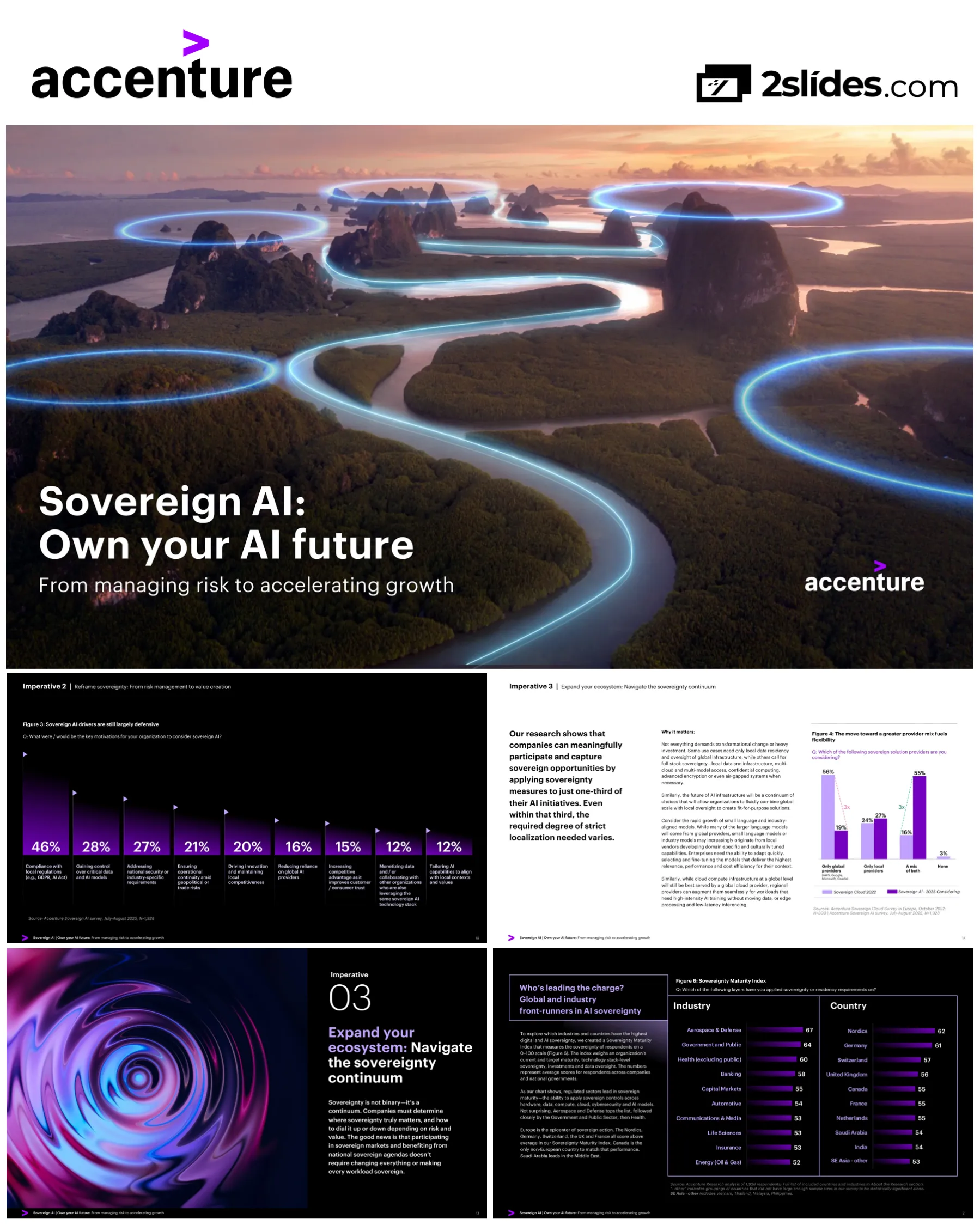
Sovereign AI: Own your AI future - From managing risk to accelerating growth
Navigation rapide
Étiquettes
Partager les diapositives
Sovereign AI: Own your AI future - From managing risk to accelerating growth
Vue détaillée de chaque page de diapositive, incluant la mise en page, le contenu clé et les éléments visuels.
Title slide featuring aerial photograph of winding river with glowing blue light paths overlaid on landscape, symbolizing AI pathways and sovereignty. Subtitle: 'From managing risk to accelerating growth' with Accenture branding
Full-bleed background image with large white typography overlay, Accenture logo in bottom right corner
Introduction of six global authors and Sovereign AI leaders from Accenture: David Wood (Global Technology Consulting Lead), Bryan Rich (Global AI Lead - Health, Public Services and Defense), Surya Mukherjee (Global Research Lead), Mauro Macchi (CEO - EMEA), Mauro Capo (Digital Sovereignty Lead - EMEA), Kunal Shah (Sovereign AI Lead - Asia Pacific)
Three-column layout organizing authors by region (Global, EMEA, Asia Pacific) with professional headshots, names, and titles
Opening statement establishing AI as foundation for national competitiveness and business survival. Highlights concentration risk: 70% of leading AI models from US, 25% from China. Introduces Sovereign AI as path to both risk mitigation and growth opportunity. Key insight: only one-third of AI workloads need to be sovereign
Text-only slide with clear heading and body copy, minimal design
Defines Sovereign AI as a country's ability to independently develop and deploy AI using own infrastructure, data, models and talent. Emphasizes it's about interoperability on one's own terms, not isolationism. Features split-screen layout with cityscape at dusk/night showing urban infrastructure
Two-column layout with text on left, large aspirational cityscape photograph on right spanning half the page
Presents survey finding that 61% of leaders more likely to seek sovereign solutions due to geopolitical risks. Includes bar chart showing attitude changes. References market opportunity estimates: $1.5 trillion potential (Oppenheimer), $120B in Europe. Gartner projection: by 2027, 35% of countries locked into region-specific AI platforms
Left side text content with embedded horizontal bar chart showing distribution from 'significantly less likely' to 'significantly more likely' to adopt sovereign tech
Discusses global sovereign AI initiatives: Switzerland's compliant cloud, EU AI Continent Action Plan, India's Sovereign AI plan, Saudi Arabia's HUMAIN initiative. Notes 73% see governments as key catalyst. Introduces four imperatives that separate leaders: CEO-led priority, value creation reframe, hybrid ecosystems, flexible architecture
Split layout with text content on left describing global initiatives, numbered list of four imperatives on right, blurred people imagery at top
Introduction to first imperative: Make sovereign AI leadership's new power play. References NVIDIA CEO Jensen Huang's Denmark AI supercomputer launch with Denmark's king as symbolic moment showing sovereignty is now CEO and board-level concern
Large dramatic photograph of businessman looking up at skyscraper, text overlay on right side with large '01' numeral
Explains three decisive actions for CEO ownership: 1) Pick suppliers based on geopolitics and resilience, 2) Coordinate across business units, 3) Engage policy and industry leaders. Highlights that only 15% of organizations have made AI sovereignty CEO/board-level concern (pie chart). Notes different stakes by industry regulation level
Two-column layout with 'Why it matters' and 'Take action' sections, embedded pie chart showing responsibility distribution across Chief Data Officer (37%), Chief Compliance Officer (29%), IT Team (19%), CEO/Board (15%)
Introduction to second imperative: Reframe sovereignty from risk management to value creation. Opening statement that most organizations approach sovereign AI defensively (compliance 46%, data control 28%, cybersecurity 27%) with fewer than 13% citing monetization or cultural alignment
Split layout with text on left, large cityscape photograph at sunset/sunrise on right showing highway and waterfront
Bar chart showing key motivations for sovereign AI adoption: Compliance with regulations (46%), Control over critical data (28%), Security requirements (27%), Operational continuity (21%), Innovation (20%), Reducing reliance on global providers (16%), Competitive advantage (15%), Data monetization (12%), Cultural alignment (12%)
Full-page horizontal bar chart with nine categories arranged vertically, purple gradient bars with percentage labels
Discusses trust as foundation for collaboration and data sharing. Examples include OpenBind Consortium (UK Government £8M investment for AI drug discovery dataset 20x larger than before), telecom operators (Indosat Indonesia), software platforms (Oracle EU Sovereign Cloud, Microsoft partnerships), healthcare (Sovereign AI Factory Frankfurt)
Text-only content layout with 'Why it matters' narrative explaining value creation through sovereign ecosystems and specific industry examples
Discusses STACKIT (Schwarz Group cloud provider) example - evolved from internal sovereign cloud to external provider. Emphasizes government role in funding infrastructure, subsidizing providers, opening public datasets, partnering with academia. Highlights that sovereignty shapes access to markets, customer trust, and revenue performance
Split-page layout with panoramic landscape photograph at top showing winding road through coastal wetlands at sunset, text content below in two columns
Introduction to third imperative: Expand your ecosystem - Navigate the sovereignty continuum. Opening statement that sovereignty is not binary but a continuum, companies must determine where sovereignty matters and dial it up or down based on risk and value. Participation doesn't require making every workload sovereign
Text on left with large abstract swirling visual on right showing circular gradient patterns in blue and purple
Explains that only one-third of AI initiatives need sovereignty measures, and even within that the degree varies. Shows evolution from 2022 Sovereign Cloud to 2025 Sovereign AI: 'Only global providers' dropped from 56% to 27% (3x decrease), 'Mix of both' increased from 24% to 55% (3x increase), 'Only local providers' slightly decreased from 19% to 16%
Two-column layout with bar charts comparing 2022 vs 2025 provider preferences, text explanation on left side
Describes four types of AI solution providers: 1) Global cloud providers (AWS, Microsoft, Google) offering scale and innovation, 2) Frontliners (national champions like telcos), 3) Neoclouds (AI-native providers like Nebius, CoreWeave), 4) Federated consortia (government-industry alliances). Discusses AI Gigafactory concept with 16 EU Member States interested across 60 sites
Two-column text layout with 'Take action' header, detailed descriptions of four provider types
Features Nebius AI cloud platform description and partnership with Accenture. Lists four regional partnerships: Cassava Technologies (Africa), Telus (Canada - first sovereign AI factory), Telia Cygate (Sweden), Indosat Ooredoo Hutchison (Indonesia). Each includes brief description of sovereign AI infrastructure initiatives
Table/box layout with Nebius description in left column, four regional examples in right column stacked vertically with borders
Introduction to fourth imperative: Redefine architecture - Sovereignty for intelligence, not just infrastructure. Opening statement emphasizing need to assess digital foundations including hardware, data, cloud readiness, compute needs, cybersecurity, and AI model selection for each critical use case
Text on left side with dramatic coastal landscape photograph on right showing rocky coastline with glowing light trails at dusk
Explains that sovereignty now extends beyond infrastructure to intelligence itself - models, agents, platforms. Discusses multi-cloud, multi-model, multi-agent architectures. Three-step approach: 1) Conduct sovereignty audit per use case, 2) Benchmark current infrastructure and dependencies, 3) Establish dynamic controls and governance. Notes agentic AI requires new design for error handling, compliance, and accountability
Split layout with city street scene photograph on left showing person from behind, two-column text on right with 'Why it matters' and 'Take action' sections
Bar chart showing sovereignty application by layer: Data (60%), Infrastructure/Cloud (46%), Security & Governance (35%), Applications (32%), AI Models (22%), None (21%). Highlights major blind spot: only 22% extend sovereignty to AI models. Emphasizes need for real-time auditing, dynamic control, and predictive rather than reactive compliance
Horizontal bar chart with six categories, accompanying text explaining the blind spot in AI model sovereignty
Concluding statement that Sovereign AI marks next phase of globalization where nations/firms share technology but retain agency. As ecosystems mature, new markets emerge. Organizations acting now on four imperatives will shape the technological era. Final message: 'The future belongs to those who build it sovereign'
Full-page gradient background (purple to blue) with text content centered in three columns describing conclusion, future outlook, and call to action
Presents Sovereignty Maturity Index (0-100 scale) showing industry and country rankings. Industry leaders: Aerospace & Defense (67), Government/Public (64), Health (60), Banking (58). Country leaders: Nordics (62), Germany (61), Switzerland (57), UK (56), Canada (55), France (55). Explains index measures current/target maturity, tech stack sovereignty, investments, data oversight
Two-column bar chart layout showing industry scores on left, country scores on right, with explanatory text above
Methodology description: Survey of 1,928 organizations across 28 countries and 18 industries (Jul-Aug 2025). Respondents: CIOs, CTOs, Chief Data/AI/Risk Officers from organizations where sovereignty is highly/critically important. Lists all 28 countries and 18 industries included. Explains Sovereignty Index components: current/target levels (0.5 weight), stack coverage (0.3), investment (0.1), data control (0.1)
Text-only layout with clear sections describing survey methodology, scope, and index calculation
12 numbered references to external sources including AI Index 2025, Investopedia, Gartner reports, government websites, news releases from Oracle, Microsoft, Accenture. Acknowledgements section thanking Research Team (6 people), M+C Team (10 people), and special thanks to 4 additional contributors
Two-section layout with numbered references list on left, acknowledgements section on right organized by team
Two-column layout describing Accenture as global professional services company with 779,000 people, focus on reinvention and AI enablement. Accenture Research described as thought leadership unit with 300 researchers in 20 countries. Includes standard disclaimer about document being for information purposes only. Copyright notice and accenture.com references
Two-column text layout with company descriptions, footer with disclaimer text at bottom
Questions courantes sur cette diapositive et le contenu de présentation sous-jacent.
Sovereign AI refers to a country's or organization's ability to independently develop and deploy AI using its own infrastructure, data, models, and talent. It matters because 70% of leading AI models originate in the US and 25% in China, creating concentration risk. Sovereign AI enables organizations to foster innovation, drive economic growth, and advance strategic goals while retaining control over the entire AI lifecycle. It's about interoperability on your own terms, not isolationism - you can participate in both global and local AI ecosystems while maintaining appropriate oversight.
No. Research shows that organizations can meaningfully participate in sovereign opportunities by applying sovereignty measures to just one-third of their AI initiatives. Sovereignty is a continuum, not binary - you determine where sovereignty truly matters based on risk and value. Some use cases need only local data residency with global infrastructure oversight, while others require full-stack sovereignty with air-gapped systems. The key is working with a mix of global and local providers to maximize innovation while managing risk appropriately.
The four imperatives are: 1) Make sovereignty a CEO-led priority to align AI strategy with enterprise resilience and geopolitical realities (currently only 15% have this), 2) Reframe sovereignty as a source of value creation, not just risk mitigation or compliance, 3) Build hybrid ecosystems that combine local trust with global innovation and scale using global clouds, frontliners, neoclouds, and federated consortia, 4) Architect AI ensuring flexibility across infrastructure, data, and models - extending sovereignty beyond just infrastructure to intelligence itself (models and agents).
There are four types to consider: 1) Global cloud providers (AWS, Microsoft, Google) offering unmatched scale and innovation with sovereign capabilities, 2) Frontliners - country-endorsed national champions (often telcos or high-tech companies) with local brand recognition meeting public sector trust requirements, 3) Neoclouds - AI-native providers like Nebius, CoreWeave, and Lambda built for high-performance AI workloads with modern architectures, 4) Federated consortia - government-industry alliances co-developing shared sovereign infrastructure. The most resilient strategies combine all four as needed.
According to the Sovereignty Maturity Index (0-100 scale), regulated sectors lead: Aerospace & Defense (67), Government and Public Sector (64), Health (60), and Banking (58) score highest. Geographically, Europe dominates: the Nordics (62), Germany (61), Switzerland (57), UK (56), France (55), with Canada (55) as the only non-European country matching that performance. Saudi Arabia leads in the Middle East (54). These scores measure current/target maturity, technology stack-level sovereignty, investments, and data oversight.
Sovereign AI extends beyond traditional sovereign cloud concepts. While sovereign cloud focuses on data residency and infrastructure location, sovereign AI encompasses the intelligence itself - how AI models, agents, and platforms communicate, learn, and make decisions within defined boundaries. It addresses multi-cloud, multi-model, and multi-agent architectures where a single workload might draw from multiple providers with varying sovereignty levels. Research shows 60% apply sovereignty to data and 46% to infrastructure, but only 22% extend it to AI models - revealing a major blind spot in current approaches.
61% of organizations are now more likely to seek sovereign technology solutions as geopolitical risks rise. Key drivers include: compliance with local regulations like GDPR and EU AI Act (46%), gaining control over critical data and AI models (28%), addressing national security requirements (27%), and ensuring operational continuity amid geopolitical tensions (21%). Analysts estimate the sovereign AI infrastructure opportunity at $1.5 trillion, including $120 billion in Europe. Gartner projects that by 2027, 35% of countries will be locked into region-specific AI platforms using proprietary contextual data.
Start by conducting a sovereignty audit for each use case, considering country risk, industry regulation, and business criticality. Then benchmark your current infrastructure, data residency, and provider dependencies to identify gaps. Establish dynamic controls and governance across your entire AI stack - from hardware and data to models and applications. Make this a CEO and board-level priority (currently only 15% of organizations do this). Focus on the one-third of workloads that truly need sovereignty measures, and build a hybrid ecosystem combining global innovation with local trust. Remember: sovereignty should enable value creation, not just risk mitigation.

Create Your Own Slides
Turn your ideas into professional presentations in seconds with 2slides AI.
Référencez des conceptions professionnelles, choisissez votre style et générez des diapositives avec un rendu de texte parfait. Alimenté par Nano Banana—commencez à créer votre présentation maintenant.
Votre Agent IA pour les diapositives. Gagnez du temps, brillez plus vite avec la création intelligente de présentations.




© 2026 2slides. Tous droits réservés.