
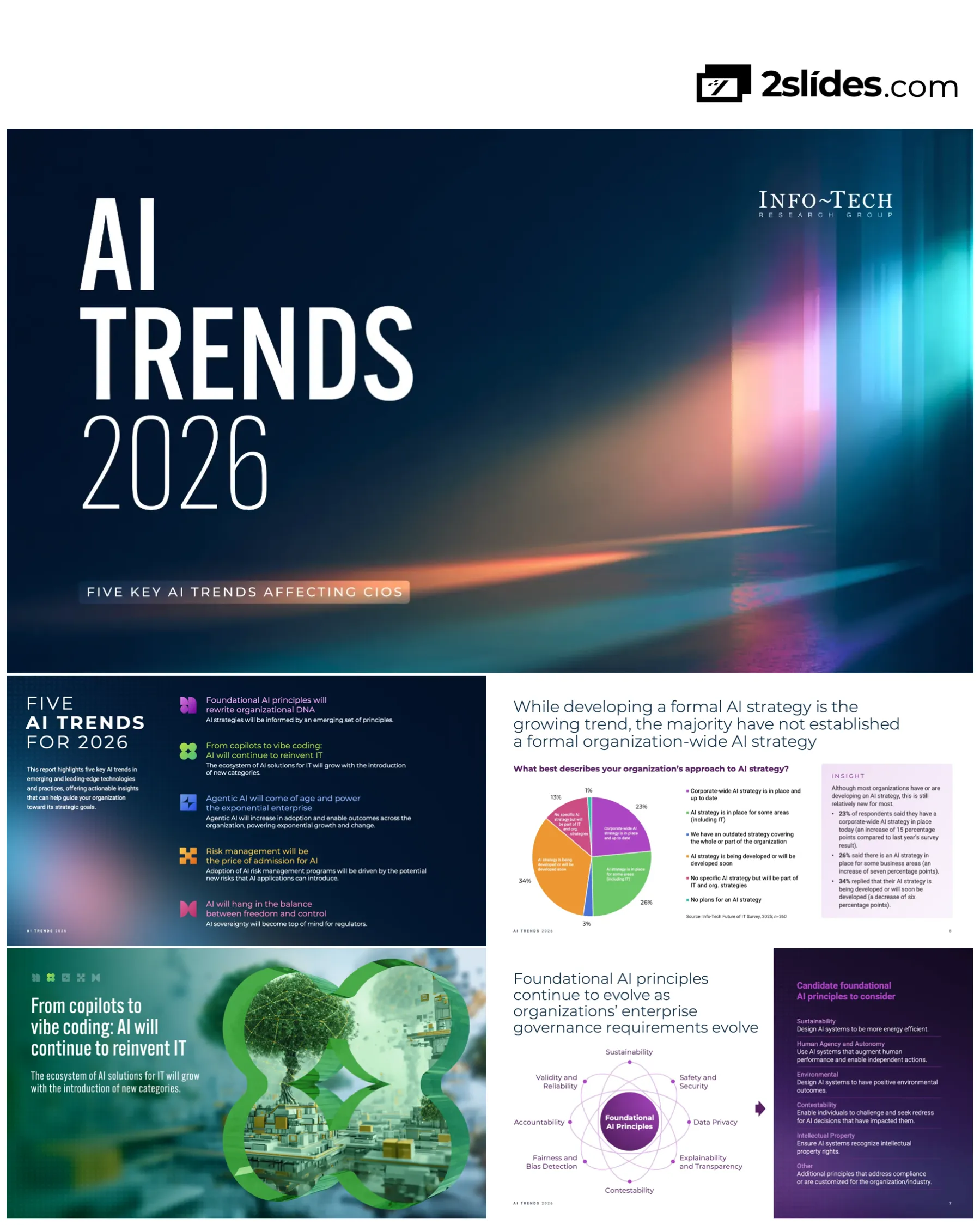
AI Trends 2026 - Five Key AI Trends Affecting CIOs
التنقل السريع
العلامات
مشاركة الشرائح
AI Trends 2026 - Five Key AI Trends Affecting CIOs
عرض تفصيلي لكل صفحة شريحة، بما في ذلك التخطيط والمحتوى الرئيسي والعناصر المرئية.
Title slide featuring 'AI TRENDS 2026' with subtitle 'FIVE KEY AI TRENDS AFFECTING CIOs' and Info-Tech Research Group branding against a gradient background with light effects
Large bold typography for title, centered layout with Info-Tech logo in top right, modern gradient color scheme from dark blue to teal/pink
Executive summary listing the five key trends: 1) Foundational AI principles will rewrite organizational DNA, 2) From copilots to vibe coding: AI will continue to reinvent IT, 3) Agentic AI will come of age and power the exponential enterprise, 4) Risk management will be the price of admission for AI, 5) AI will hang in the balance between freedom and control
Dark gradient background with icon-based list format, each trend has colored icon (purple, green, blue, orange, pink) with title and description
Overview of survey basis with 700+ IT leader responses from May-June 2025, primarily North American but global representation, director-level+ positions, covering 12+ industries including government, financial services, education, manufacturing, professional services, healthcare, and others
Left side text content with right side laptop mockup showing survey interface, white background with dark text
Section divider introducing first trend with purple-themed visual showing abstract 3D AI letters with cityscape integration, tagline reads 'AI strategies will be informed by an emerging set of principles'
Full-bleed artistic visual with trend icons in top left, large text overlay on left side, abstract 3D rendering on right
Framework showing AI strategy is driven by organizational strategy and value drivers, with four key components: AI Vision (forward-looking commitment), Business Value Drivers (value recognition methods), Strategic AI Principles (business-AI alignment), and Foundational AI Principles (risk mitigation)
Center diagram with AI Strategy hub connected to four surrounding elements, white background with illustrated icons for each component
Explanation that foundational AI principles address AI risks and align with organizational guiding principles, core to AI governance and used to identify risk categories. Diagram shows eight principles arranged in atom-like structure: Sustainability, Safety and Security, Data Privacy, Explainability and Transparency, Contestability, Validity and Reliability, Accountability, Fairness and Bias Detection
Text on left, circular atom-style diagram on right showing interconnected principles
Explains that foundational AI principles continue to evolve with enterprise governance requirements. Lists candidate principles to consider: Sustainability (energy efficient), Human Agency and Autonomy, Environmental (positive outcomes), Contestability (challenge AI decisions), Intellectual Property, and Other customized principles
Left side shows same atomic diagram from previous page, right side lists additional candidate principles in purple box
Survey data showing that while developing formal AI strategy is growing trend, majority have not established formal organization-wide strategy: 23% have corporate-wide strategy, 26% have strategy for some areas, 34% developing soon, 13% will integrate with IT/org strategies, 3% have outdated strategy, 1% no plans
Left side pie chart, right side insight box with lavender background explaining the findings
Over half of respondents understand need for foundational AI principles to address AI risks: 31% have established and integrated principles, 24% currently implementing with expansion plans, 35% assessing and in early stages, 6% aware but no plans, 4% not aware, 0% see no need (zero respondents view as impairment to innovation)
Pie chart on left, insight box on right with light purple background
Majority of organizations feel prepared to put AI principles into practice: 70% feel prepared (3) to fully prepared (5) on 5-point scale, with distribution showing strong skew toward higher preparedness levels
Horizontal bar chart showing 5-point scale distribution, insight box on right
Balanced view of AI strategy impacts. Opportunities: Accelerated deployments, improved customer experience, talent attraction/retention, innovation and growth, increased productivity. Risks: Possible job displacement, overreliance on AI, deepfakes for fraud, misalignment with principles, privacy breaches
Two-column layout with Opportunities and Risks sections, dark background with abstract visual element on right side
Situational analysis of DeepSeek release on January 20, 2025, including R1 models for complex reasoning and V3 chatbot. Highlights: first open-source model matching OpenAI o1 performance, open-source with commercial availability, new reinforcement learning techniques, cost only $6M and 2 months vs OpenAI's $6.6B investment, 27x lower costs than OpenAI
Two-column layout with DeepSeek logo, situational analysis left, model highlights right
Organizations banning DeepSeek (US agencies, Australia, India, Italy, South Korea, Taiwan) due to breaches of foundational AI principles: Safety/Security (national security risk) and Data Privacy (GDPR violations). Recommendation: require AI technologies to align with foundational principles before adoption
Left column actions and trend analysis, right shows foundational principles diagram
Recommendations to establish foundational AI principles as core component of AI strategy and governance: leverage principles as AI risk categories, use for risk management program, evolve principles as strategy changes, expand focus to value creation, consider additional principles like sustainability and contestability
Left side bullet point action items, right side abstract architectural image with light streaks
Section divider for second trend: 'From copilots to vibe coding: AI will continue to reinvent IT' with green theme and abstract four-leaf clover design incorporating technology imagery (circuit boards, nature, buildings)
Full-bleed visual with trend icons top left, text overlay left side, abstract 3D clover on right
Comprehensive view of AI technology stack showing five layers: Applications (Amazon Q, Copilot, Workday, Writer, ServiceNow, Glean, SAP, etc.), Data and AI Tools (Bedrock, SageMaker, Azure ML, Vertex AI, LangChain, Hugging Face, PyTorch, Kafka, DataRobot, Domino), Foundational Models (OpenAI, Anthropic, Mistral, Stability.ai, Runway, Bloom, Gemma, LLaMA, DeepSeek), Data Platform (AWS, Azure, Google Cloud, Salesforce, Snowflake, Redis, Databricks, Elastic, Pinecone, Stardog, Milvus, Chroma), Infrastructure (AWS, Azure, Google Cloud, Nvidia, AMD, Intel, Qualcomm)
Five-row table showing technology stack with company logos across each layer
Diagram showing evolution from Prompt Engineering/Inferencing (simplest) through RAG (with knowledge base), Fine-Tuning (task-specific data), to Full Training (most complex). Shows progression in accuracy and complexity, with data scientist skills required increasing for more complex approaches
2x2 grid showing four approaches with icons and descriptions, accuracy on Y-axis, complexity on X-axis
Comparison of two approaches - Best-of-Breed AI Tools (best for specific tasks, lower costs, flexibility) vs AI Development Platform (solution-oriented, easier management, reduced integration complexity). Shows trade-offs including vendor lock-in, integration challenges, and cost considerations
Two-column comparison with pros/cons for each approach, balanced scale graphic at bottom
IT department leads in AI adoption with 70% already acquired, followed by Creative (50%), Marketing and Sales (46%), R&D (45%), Operations (44%), HR, and Finance/Administration. Shows planned adoption through 2026 and beyond
Stacked horizontal bar chart showing adoption status across business functions, insight box on right
Most popular AI applications for IT: IT Security (54%), IT Service Management (44%), Business Intelligence and Analytics (41%), IT Asset Management (37%), Service Desk (35%), Code Generation and Quality (32%), Data Management (31%), Software Testing (24%), Source Code and Build Management (23%), Infrastructure (19%), Synthetic Data Generation (18%)
Horizontal bar chart with insight box on right
While many prefer to buy off-shelf, most will need to customize: 41% buy commercially available, 13% build by fine-tuning, 46% both buy and build. Insight notes vendor ecosystem continues to grow and many willing to fine-tune
Pie chart on left with three segments, insight box on right
Opportunities: Improved time to market, lower initial costs, lower maintenance, improved scalability. Risks: Overreliance on vendor, integration challenges, limited customization, limited control for new features
Two-column layout with dark/green background, abstract dashboard visual on right
Introduces vibe coding as new AI tool category announced February 2025, enabling software development without technical background. Shows comparison table of Traditional Coding vs AI-Assisted Coding vs Vibe Coding, highlighting differences in definition, primary goal, and human role. Notes Replit incident where AI deleted production database
Two-column layout with definition table and incident description
Recommendations: leverage existing software selection frameworks including foundational AI principles alignment, plan exit strategy for vendors to prevent lock-in, identify data migration paths, include business continuity plan
Left side action items, right side abstract architectural image with light streaks
Section divider for third trend: 'Agentic AI will come of age and power the exponential enterprise' with blue theme showing abstract 3D composition of business/technology imagery including handshakes and circuit boards
Full-bleed visual with trend icons top left, text overlay left side, 3D composite imagery right
Table comparing five automation approaches: Business Process Management (expense reporting, structured data), RPA (invoice processing, structured/semi-structured), Intelligent Automation (fraud detection, adds AI capabilities), Generative AI (virtual assistant, generates new content), Agentic AI (autonomous research and reporting, reasons and executes programs). Shows progression in automation capabilities, technology, and data handling
Comprehensive comparison table with five columns and six rows covering use cases, capabilities, technology, and data
Shows four key architectural components in circular flow around central LLM: Sense (collect sensory data, preprocess, monitor dependencies), Reason (assess/plan tasks, reflect on options, plan orchestration, validate AI principles), Act (orchestrate actions, manage persistence, synthesize results, verify), Adapt (measure impacts, optimize workflows, update knowledge base and policies). Protocols include Model Context Protocol and Agent2Agent
Circular flow diagram with central brain icon, four components with connecting arrows
Shows three common design patterns: Planning (decomposes goals into subtasks with evaluation feedback loop), Multi-agent orchestration (orchestrator assigns tasks, synthesizer consolidates results), Tool usage and Reflection (leverages external tools, performs self-evaluation). Includes flow diagrams showing IN/OUT and feedback loops
Three pattern sections with flow diagrams showing process flows and decision points
Primary drivers for agentic AI: Improve operational efficiency (70%), Improve user experience (61%), Support growth initiatives (48%), Enable innovation (40%), Improve risk management (25%), Not pursuing AI agents (5%). Insight notes operational efficiency remains top driver
Horizontal bar chart with insight box on right
Leading tools for agentic AI development: Microsoft Copilot Studio (60%), Google Vertex AI Agent Builder (37%), Microsoft AutoGen (28%), Amazon tools (24%), Salesforce Agentforce, Botpress, CrewAI, LangChain, Eliza, LangGraph, Fine, and other commercial/open-source platforms. Insight notes expectation for new tools like OpenAI to see growth
Horizontal bar chart with insight box on right
Two charts showing: 1) Confidence in understanding AI agents with majority at levels 4-5, 2) Investment plans showing 50%+ currently using and plan to increase, 20% plan to adopt by end of 2026, smaller percentages for later adoption or no plans. Insight notes organizations investing and developing skills with expectation of significant growth
Two horizontal bar charts side by side with insight box at bottom
Opportunities: Autonomous operations, adaptive systems, hyperpersonalized experiences, improved time to market, exponential growth. Risks: Possible job displacements, privacy concerns with data sharing, excessive resource consumption, agents not aligned with foundational AI principles, greater complexity
Two-column layout with dark blue background, abstract dashboard visual on right
Situational analysis from Walmart CTO Hari Vasudev describing surgical approach to agentic AI focused on specific use cases. Notes two key components: customers training their agents with preferences, and retailers enabling personal shopping agents to communicate with internal agents. Discusses Walmart's extensive resources and data commitment
Two-column layout with situational analysis and action sections
Recommendations to prepare for exponential organization: understand application characteristics best suited for agentic AI (avoid for fixed/repetitive tasks, deterministic outcomes, low latency needs, cost-constrained environments), implement human oversight with review/approval for high-risk operations, review performance with feedback systems
Left side action items, right side abstract architectural image
Section divider for fourth trend: 'Risk management will be the price of admission for AI' with orange theme showing abstract 3D geometric structure with network connections
Full-bleed visual with trend icons top left, text overlay left side, 3D geometric structure right
Comparison table of five frameworks: NIST AI RMF (nonregulatory, focus on trustworthiness), ISO/IEC 23894:2023 (international standard, ethics and human rights focus), ISO 31000 (enterprise risk adaptable to AI), COSO ERM (enterprise risk adaptable to AI), Info-Tech AI RMF (specifically designed for AI, focus on foundational principles). Compares focus, regulatory nature, AI principles, risk categories, adaptability, and implementation approach
Comprehensive comparison table with six rows and five framework columns
Shows four key functions: Risk Governance (legal/regulatory requirements, foundational AI principles, risk tolerance, transparency, monitoring, inventory, decommissioning), Risk Identification (establish context, AI system categorization, value/benefits, risks, impact categorization), Risk Measurement (AI risk metrics, foundational principles alignment assessments, system risk monitoring, measurements assessment), Risk Response (prioritized response, system risk strategies, third-party risks/benefits, treatment and communication plans). Includes sample artifacts for each function
Four-box horizontal layout with detailed bullet points and sample artifacts below each
Four drone examples showing how same technology has different risk levels based on context: Minimal Risk (manual leisure drone, no data collection), Limited Risk (package delivery with human override, delivery confirmation interaction), High Risk (medical supply delivery in critical infrastructure where failure has severe consequences), Unacceptable Risk (mass surveillance with facial recognition for law enforcement without cause - prohibited)
Four-quadrant layout with drone images and risk descriptions
Leadership for AI governance: AI center of excellence or committee (31%), CIO (23%), Shared by two or more positions below executive level (13%), Shared by two or more executives (10%), CEO (10%), Risk and compliance officer/executive (2%), Other C-suite executives (5%), No one (6%). Insight notes AI governance is shared responsibility with AI center of excellence or CIO most often leading
Pie chart on left, insight box on right
Overwhelming majority see risk management as important: 62% very important, 32% somewhat important, 6% marginally important, 0% not important. Insight notes risk management is integral program recognized by nearly all respondents
Pie chart with insight box
Enterprise risk management is preferred approach: 33% fully integrated enterprise risk management, 28% integrated and centralized, 26% domain specific, 13% ad hoc or reactive. Insight notes 61% prefer enterprise approach vs siloed/ad hoc
Pie chart with insight box
Opportunities: Deliver safeguards for AI systems, enforce foundational AI principles, ensure accuracy and validity, comply with regulations, maximize value from AI. Risks: Lack of expertise in governance and risk management, lack of executive support, lack of enterprise-wide education program, lack of effective risk identification, lack of effective monitoring and measuring
Two-column layout with dark brown background, abstract dashboard visual on right
Situational analysis noting different government approaches (US/UK innovation-driven vs EU comprehensive legislation) and challenges with current risk programs not anticipating AI. Discusses EU AI Act risk classifications (unacceptable, high-risk regulated, limited-risk transparency, minimal-risk unregulated). Notes US Executive Order mandating federal agencies implement minimum risk management practices by April 2026
Two-column layout with situational analysis, action, and trend sections, includes Info-Tech framework diagram
Recommendations to adopt risk-based management culture: cultivate culture of risk management by educating workforce on AI risk/benefits and establishing foundational AI principles as risk categories, implement AI risk management framework with regular assessments, operationalize responsible AI principles (consider automation tools), ensure program is adaptive to address agentic AI applications
Left side action items, right side abstract architectural image
Section divider for fifth trend: 'AI will hang in the balance between freedom and control' with pink/magenta theme showing abstract 3D geometric structure with spherical element, tagline reads 'AI sovereignty will become top of mind for regulators'
Full-bleed visual with trend icons top left, text overlay left side, 3D geometric art right
Comprehensive comparison table of AI regulations across six regions: European Union (Risk/Rights-Based, EU AI Act), United States (Market-Driven, Executive Orders), United Kingdom (Context/Market-Driven, Online Safety Act), China (State-Driven, Generative AI Regulation), Canada (Risk/Rights-Based, AI and Data Act proposed), Australia (Risk/Rights-Based, AI Ethics Principles). Includes regulatory approach, AI regulations/initiatives, and enforcement details for each
Large comparison table with country flags, three-row structure covering characteristics, regulations, and enforcement
Detailed comparison of contrasting approaches: US focuses on innovation and deregulation with voluntary policies and minimal penalties, America's AI Action Plan, and 'Unbiased AI Principles' (truth-seeking, ideological neutrality). EU focuses on safety and innovation with AI regulations and financial penalties, EU AI Continent Action Plan (AI Factories, Data Union Strategy, AI Skills Academy), and seven foundational principles including diversity/fairness. Shows risk classification systems for both
Two-column detailed comparison table covering key drivers, frameworks, principles, action plans, and risk management
Circular diagram showing adaptive AI governance components: AI Guiding Principles (center atom icon), Organizational Structure (people icon), Risk & Compliance (scale icon), Policies/Processes/Standards (checklist icon), Assurance (shield icon), Accountability (handshake icon), Adaptability & Resilience (brain icon). Lists benefits: minimizes risk, ensures compliance, provides attributability, enables dynamic policy management, provides real-time assurance, enables real-time mitigation, fosters continuous improvement, aligns with NIST AI RMF 1.0 and EU AI Act
Left side circular governance diagram, right side benefits list
Many organizations pursuing sovereign AI: 40% exclusively using sovereign AI, 21% using both sovereign and non-sovereign, 14% actively assessing sovereign AI models, 13% no immediate plans, 3% no sovereign options available, 9% not a consideration. Insight notes national security, autonomy, data control, and economic growth as drivers
Pie chart with insight box
Most organizations confident vendors will build safeguards: 72% feel confident (3) to very confident (5) that AI vendors will self-regulate and implement necessary safeguards. Distribution shows strong skew toward higher confidence levels (4 being most common response)
Horizontal bar chart with 5-point scale and insight box
Strong support for introducing AI regulations: 33% strongly support, 45% moderately support (78% total support), 11% neutral, 6% moderately against, 5% strongly against (11% total against). Insight emphasizes most respondents support government regulation
Pie chart with insight box
Opportunities: Geographies like US/UK may attract more capital due to lack of regulations, AI regulations can be tailored to reflect national/economic priorities, promote independence from Big Tech AI oligopoly. Risks: Unique regulations may be barrier to entry, lack of consumer trust if no AI regulations, innovation may stagnate if overregulated
Two-column layout with dark purple background, abstract dashboard visual on right
Situational analysis of countries pursuing sovereign AI strategies driven by national security, technology independence from Big Tech, national identity/culture/language preservation, and economic drivers. Shows triangle diagram with three vertices: LLM Sovereignty (strategic autonomy, national security, IP, language support), Data Sovereignty (national security, data privacy, legislation, performance), Infrastructure Sovereignty (national security/resilience, drive local economy, control, performance), with Foundational AI Principles at center
Left side situational analysis, right side triangle diagram with three sovereignty components
Lists announced AI sovereignty initiatives globally including America's AI Action Plan, Canadian Sovereign AI Compute Strategy, EU AI Continent Action Plan, UK AI Opportunities Action Plan, strategies from Germany, France, Spain, Sweden, China, India, South Korea, UAE, and Brazil. Notes US Executive Order 14320 promoting export of American AI Technology Stack as global standard. Explains trends of disjointed AI regulation development and drivers for local AI model development (national initiatives, commoditization, geopolitical forces)
Two-column layout with actions and trend analysis sections
Recommendations for navigating disjointed AI regulation: understand new risks associated with AI applications regardless of government perspective (introduce AI risk management program, implement risk classification system), assess feasibility of developing or leveraging sovereign AI models (ensure candidate foundation model meets accuracy requirements, improve relevance by fine-tuning for local language and culture)
Left side action items, right side abstract architectural image
Executive summary of five trends with action items: AI Strategy (establish foundational principles), AI Vendor Applications (solution-centric approach aligned with principles), Agentic AI (select business-driven use cases with human oversight), AI Risk Management (cultivate risk culture with management program), AI Regulations (develop adaptive governance framework, ensure competitive sovereign models)
Five-section summary with abstract futuristic imagery on right showing figure walking through technology landscape
Lists external contributors (Andreu Gomez - UN Vienna CDO, Sunil Gupta - CTBTO CITO, Said Ahmed - UN Technology Development Risk, Rick Pastore - SustainableIT.org, Tom Godden and Paul Weiss - AWS) and internal contributors (Jack Hakimian - SVP Research, Rob Garmaise - VP AI Research, Mark Tauschek - VP Research Fellowships, Brian Jackson - Principal Research Director, Naveli Thomas - AVP Content Marketing, Manoj Atwal - Senior Member Services Director)
Two-column layout listing external and internal contributors with titles, abstract technology background on right
First page of bibliography listing sources including AI Act (European Commission), AI Policy and Regulations of Brazil (NewMind AI), NIST AI Risk Management Framework, America's AI Action Plan (The White House), various international AI strategies and technical reports on DeepSeek models
Single-column bibliography with standard citation format, abstract background imagery
Continuation of bibliography including M-25-21 Memorandum (OMB), Make France an AI Powerhouse, Walmart AI strategy articles, DeepSeek pricing documentation, international AI strategies from Sweden, South Korea, UAE, UK AI Action Plan, and vibe coding incident reports
Single-column bibliography continuing from previous page
Promotes three Info-Tech resources: AI Marketplace (unlock AI potential with tailored support), Build Your AI Strategy Roadmap (maximize value while managing risks), Build Your AI Risk Management Roadmap (transform ad hoc processes into formalized ongoing program). Each includes brief description and visual representation
Three sections with thumbnail images and descriptions for each resource
أسئلة شائعة حول هذه الشريحة ومحتوى العرض التقديمي الأساسي.
The five key trends are: 1) Foundational AI principles will rewrite organizational DNA - AI strategies will be informed by emerging principles like safety, privacy, and fairness; 2) From copilots to vibe coding: AI will continue to reinvent IT - The ecosystem of AI solutions for IT will grow with new categories; 3) Agentic AI will come of age and power the exponential enterprise - Agentic AI will enable autonomous operations and exponential growth; 4) Risk management will be the price of admission for AI - Organizations must adopt AI risk management programs; 5) AI will hang in the balance between freedom and control - AI sovereignty will become critical for regulators globally.
The Info-Tech AI Risk Management Framework is specifically designed for AI systems and consists of four key functions: Risk Governance (establishing legal requirements, foundational principles, risk tolerance, and AI inventory), Risk Identification (establishing context, categorizing AI systems, and identifying risks), Risk Measurement (defining AI risk metrics, conducting alignment assessments, and monitoring systems), and Risk Response (prioritizing responses, developing risk strategies, and implementing treatment plans). It's based on NIST AI RMF 1.0 and focuses on foundational AI principles as the core risk categories.
Organizations should establish eight core foundational AI principles: Safety and Security (protecting systems and people), Data Privacy (protecting personal information), Explainability and Transparency (making AI decisions understandable), Validity and Reliability (ensuring accuracy), Fairness and Bias Detection (preventing discrimination), Accountability (assigning responsibility), Contestability (allowing challenges to AI decisions), and Sustainability (minimizing environmental impact). Additional emerging principles include Human Agency and Autonomy, Environmental considerations, and Intellectual Property protection.
The US and EU take contrasting approaches to AI regulation. The US follows a market-driven, innovation-focused approach with voluntary policies through executive orders and no federal legislation, emphasizing minimal regulation to promote American AI leadership. The EU takes a risk- and rights-based approach with comprehensive regulation through the EU AI Act, GDPR, and other legislation, imposing financial penalties for noncompliance. The US focuses on 'Unbiased AI Principles' (truth-seeking and ideological neutrality), while the EU emphasizes seven foundational principles including human agency, transparency, diversity, fairness, and societal wellbeing. Both implement risk classification systems, but the EU's is more prescriptive with four categories: unacceptable (prohibited), high-risk (regulated), limited-risk (transparency obligations), and minimal-risk (unregulated).
Agentic AI represents autonomous software that can reason, decompose goals into subtasks, and execute external programs without human intervention. It's the most advanced evolution beyond RPA, intelligent automation, and generative AI. Organizations should use agentic AI for complex, dynamic tasks requiring adaptation and decision-making, such as autonomous research, customer service orchestration, and multi-step workflow automation. However, organizations should AVOID agentic AI for: fixed and repetitive tasks, situations requiring deterministic outcomes, low-latency requirements, or cost-constrained environments. Best practices include implementing human oversight for high-risk operations, establishing clear review and approval processes, and using feedback systems to continuously improve agent performance.
Sovereign AI refers to AI models and infrastructure developed and operated within a specific country or region. According to the survey, 40% of organizations exclusively use sovereign AI models, and 21% use both sovereign and non-sovereign models. Organizations pursue sovereign AI for several key reasons: National Security (protecting sensitive data and operations), Technology Independence (reducing dependence on Big Tech vendors from other countries), National Identity (preserving local culture and language), Economic Growth (driving local AI industry and jobs), and Data Control (ensuring data sovereignty and compliance with local regulations). Countries like the US, Canada, EU nations, China, India, South Korea, UAE, and Brazil have all announced sovereign AI initiatives and strategies.
According to the survey, 41% of organizations prefer to buy commercially available off-the-shelf solutions, 13% build by fine-tuning existing models, and 46% do both. When choosing, consider: For Vendor Solutions - faster time to market, lower initial costs, less maintenance, better scalability, but risk vendor lock-in, integration challenges, limited customization, and less control over features. For Custom Building - best tool for specific tasks, lower long-term licensing costs, greater flexibility, but requires multiple tools, higher integration costs, and more vendor management complexity. Best practice is to adopt a solution-centric approach that focuses on business value, ensures alignment with foundational AI principles, and always plans an exit strategy to prevent vendor lock-in.
CIOs should focus on five critical action areas: 1) AI Strategy - Establish foundational AI principles that address risks and reflect organizational strategic principles; 2) AI Vendor Applications - Adopt a solution-centric approach using existing software selection frameworks that include foundational AI principles alignment; 3) Agentic AI - Select business-driven use cases, understand characteristics best suited for agentic AI, and include human oversight for high-impact operations; 4) AI Risk Management - Cultivate a culture of risk management by educating workforce and implementing a formal AI risk management program aligned with business processes; 5) AI Regulations - Develop an adaptive AI governance framework to provide safeguards and self-regulate regardless of legislative environment, and ensure sovereign AI models are competitive with Big Tech vendor models.

Create Your Own Slides
Turn your ideas into professional presentations in seconds with 2slides AI.
راجع التصاميم الاحترافية، اختر أسلوبك، وأنشئ شرائح بعرض نصي مثالي. مدعوم بـ Nano Banana—ابدأ في إنشاء عرضك التقديمي الآن.
وكيل الذكاء الاصطناعي الخاص بك للشرائح. وفر الوقت، أشرق بشكل أسرع مع إنشاء عروض تقديمية ذكية.




© 2026 2slides. جميع الحقوق محفوظة.