
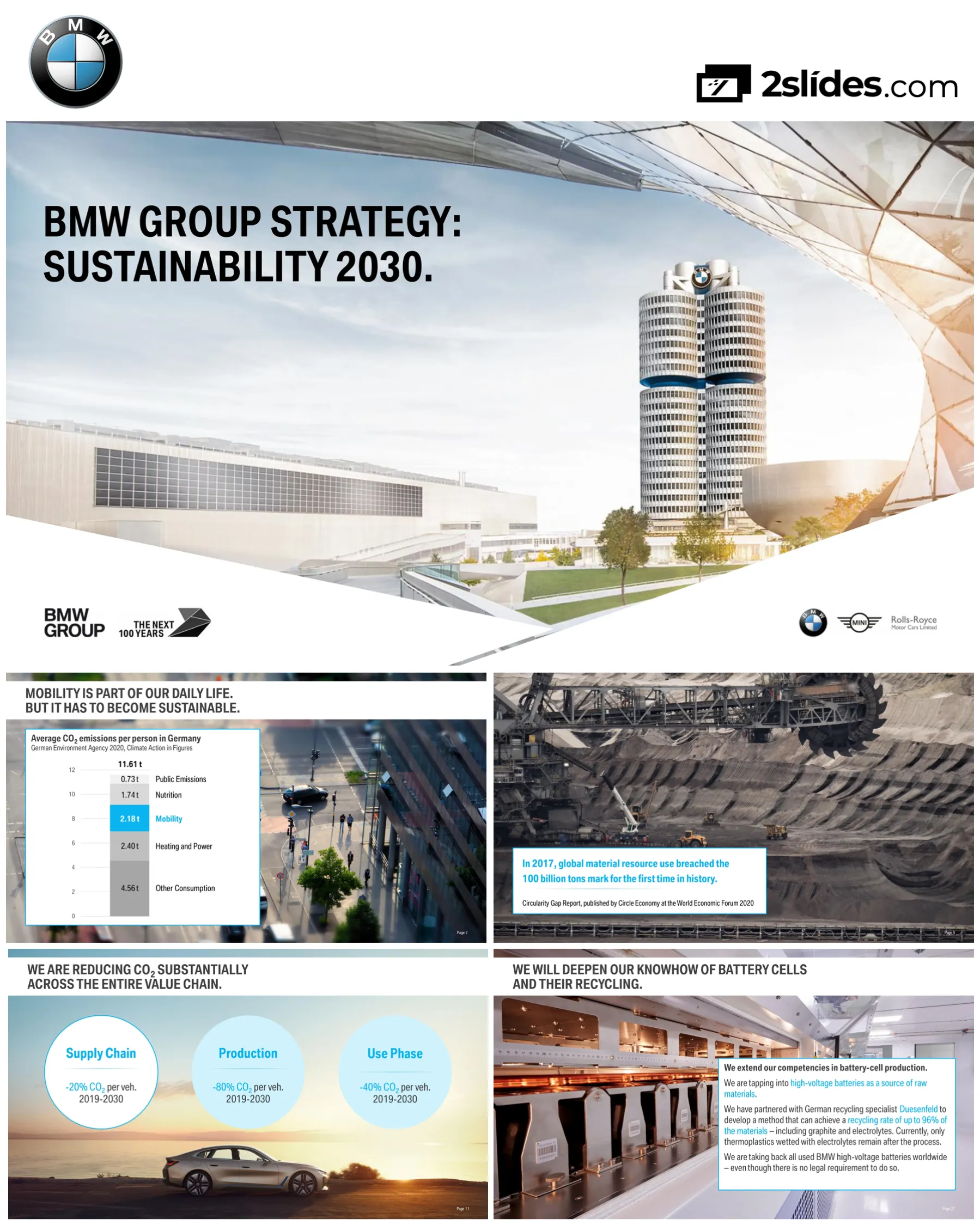
BMW Group Sustainability Strategy 2030 - Comprehensive Climate Action and Circular Economy Framework
빠른 탐색
태그
슬라이드 공유
BMW Group Sustainability Strategy 2030 - Comprehensive Climate Action and Circular Economy Framework
레이아웃, 주요 콘텐츠 및 시각적 요소를 포함한 각 슬라이드 페이지의 상세 보기.
Title slide featuring BMW headquarters building and iconic tower with 'THE NEXT 100 YEARS' branding, introducing the comprehensive sustainability strategy through 2030
Full-bleed architectural photograph with large white typography overlay, BMW Group logo and brand partners (BMW, MINI, Rolls-Royce) in bottom corners
Data visualization showing average CO2 emissions per person in Germany totaling 11.61 tons, with mobility accounting for 2.18 tons (highlighted in blue), emphasizing that mobility must become sustainable
Split layout with horizontal bar chart on left and urban street photography on right, headline across top
Statement of commitment positioning sustainability as central to BMW Group's strategic direction, emphasizing that excellent products and sustainability are inseparable, with impacts beyond the company
Text-focused slide with four key statement blocks overlaying BMW headquarters architecture background
Powerful positioning statement: 'We don't do sustainability at BMW. We make BMW sustainable.' - emphasizing transformation of core business rather than sustainability as add-on
Minimal text layout with two contrasting statements and large architectural background
Context slide showing that global material resource use breached 100 billion tons for first time in 2017, establishing urgency for circular economy approaches
Impactful industrial photography with text overlay callout box in bottom left
Introduction of BMW's commitment to Science-Based Targets initiative, transparent methodology using comprehensive emission values normalized to CO2 equivalents, and commitment to improved reporting maturity
Split screen with text box on left and Earth from space imagery on right, dark background for emphasis
Historical performance showing BMW achieved 17% CO2 reduction (2006-2008) through Efficient Dynamics and is on track for 20% reduction (2019-2020) to meet EU targets, demonstrating credibility
Line graph visualization on left with real-world electric vehicle charging scene on right
Lifecycle comparison showing average BMW vehicle (~52t CO2), 2030 average (~33t), and BMW i4 electric vehicle with different scenarios (base 29t, with green power measures 13t)
Horizontal bar chart overlay on lifestyle photography showing family with vehicle
Introduction of dual strategy: (1) Reducing CO2 footprint significantly through substantial measures, (2) Conserving resources by enabling Circular Economy
Two numbered sections with headers against BMW headquarters architecture background
Commitment to reduce CO2 footprint per vehicle to less than 66% of 2019 baseline (~52t to <34t) by 2030, emphasizing true and substantial reduction in overseen timeframe with personal responsibility
Diagonal graphical representation showing reduction trajectory with Paris Agreement logo
Overview of ambitious targets across three areas: Supply Chain (-20%), Production (-80%), Use Phase (-40%), all compared to 2019 baseline through 2030
Three circular graphics arranged horizontally over BMW concept vehicle on coastal road
Explains that without measures, electrification would increase supply chain CO2 from ~10t to ~14t per vehicle; BMW will reverse this trend to ~8t (-20%), avoiding +40% increase
Circular callout on left with bar chart on right, industrial production facility background
Multi-tier supplier network visualization showing BMW's approach: carbon footprint as contract award criteria, promoting green power with suppliers, aiming to be benchmark for sustainable supply chains
Tiered pyramid diagram showing OEM to Tier n suppliers with text callout box
Details that battery cells account for up to 40% of EV CO2 emissions, with 1/3 from cell manufacturing power; BMW secured 100% green power from suppliers, saving 10 million tons CO2 by 2030; Northvolt partnership worth €2 billion from 2024
Close-up battery cell photography with text overlay callout box
Repeated visualization of three-pillar approach (Supply Chain -20%, Production -80%, Use Phase -40%) for emphasis and transition to production section
Identical to page 11 - three circles over BMW i4 concept vehicle
Production commitments: already industry benchmark in resource efficiency, 100% renewable external electricity from 2020, CO2-neutral production from 2021, 80% substantial reduction by 2030
Text callout box on right with production facility and vehicle photography
Detailed measures: renewable energy at all locations, alternative heat generation (H2, biogas, biomass, geothermal), pilot plant for H2-based heat, waste heat reuse, Data Analytics for power optimization and scrap reduction
Split layout with targets on left and detailed text on right, production equipment background
Third repetition of value chain visualization, now highlighting Use Phase (-40%) as focus area for next section
Three circles with Use Phase emphasized, BMW i4 concept vehicle background
Extensive electrification strategy: 7 million electrified vehicles by 2030 (2/3 fully electric), core models electrified (7 Series, 5 Series, X1), eDrive Zones and smart charging for real emission-free kilometers, continued Efficient Dynamics for combustion engines
Interior cabin view with driver and detailed text callout
In-house competency expansion: 500,000 units annually of 5th generation electric drivetrains from Dingolfing from 2022, increased plug-in hybrid electric range for emissions-free daily driving
Production line photography with electric drivetrain components and text overlay
California pilot with PG&E and 400 BMW customers showed: 1,200 kWh additional renewable energy per vehicle yearly (equivalent to 6,000 emission-free km), 32% lower greenhouse gas emissions, 83% shifted charging away from grid congestion hours
Circular diagram showing solar power and time of day with detailed results text
Technology-neutral approach includes hydrogen fuel cells for climate-neutrality by 2050, aligned with national hydrogen strategies, BMW i Hydrogen NEXT small series planned from 2022
Technical cutaway visualization of hydrogen fuel cell system with explanatory text
Transition slide returning to two-pillar framework, now highlighting Pillar 2: Conserving resources through Circular Economy as next focus area
Two numbered sections with Pillar 2 emphasized in blue outline box
Two fundamental questions posed: How do we use finite resources as efficiently as possible? How do we gain transparency of our resources? Shown with cobalt ore imagery
Dramatic close-up photography of cobalt ore with text overlay questions
Recycling and Dismantling Center advances recycling processes; plan to significantly increase secondary materials by 2030; current use: ~25% secondary steel, up to 50% secondary aluminum in parts, up to 20% secondary thermoplastics; CO2 reduction factors: 4-6x for aluminum, 2-5x for steel and thermoplastics
Recycling process imagery with detailed statistics text overlay
Comprehensive circular diagram showing: certified cobalt/lithium from Australia/Morocco, 100% renewable power for cell production, CO2-neutral EV production, renewable-powered usage, global battery take-back, second use in storage farms, recycling with secondary material return
Circular flow diagram with seven stages around infinity symbol centerpiece
Partnership with Duesenfeld achieves up to 96% recycling rate including graphite and electrolytes (only electrolyte-wetted thermoplastics remain); BMW takes back all high-voltage batteries worldwide despite no legal requirement
High-tech battery recycling facility with organized battery modules and text overlay
Creates transparency in end-of-life vehicle recycling; ~3,000 collection points worldwide; ensures transparent electric vehicle recycling; addresses discrepancy (Germany 2018: 3.4M new vs 565K end-of-life registrations); creates high-quality secondary material through transparency
Industrial recycling facility with vehicle being processed and statistical callout
Paris Climate Agreement commitment aligned with well-below-two-degrees target; annual integrated reporting against science-based targets; Board of Management and executive compensation tied to sustainability targets
Text-focused message slide with BMW headquarters architecture background
이 슬라이드 및 기본 프레젠테이션 콘텐츠에 대한 일반적인 질문.
BMW Group aims to reduce its total CO2 footprint per vehicle to less than 66% of 2019 levels by 2030 (from approximately 52 tons to under 34 tons). This breaks down into three areas: Supply Chain (-20% per vehicle), Production (-80% per vehicle), and Use Phase (-40% per vehicle), all compared to 2019 baselines. These targets are science-based and aligned with the Paris Climate Agreement's well-below-two-degrees goal.
BMW has secured agreements with all battery cell suppliers to use 100% green power for manufacturing, which will save 10 million tons of CO2 by 2030. Up to 40% of an electric vehicle's CO2 emissions come from battery cell production, with one-third from the cell manufacturer's power consumption. BMW also sources cobalt and lithium from certified mines in Australia and Morocco, and has partnered with Northvolt as a third strategic battery supplier with a €2 billion long-term order starting in 2024.
By 2030, BMW plans to have delivered more than 7 million electrified vehicles, with two-thirds of them being fully electric. This electrification will extend to core models including the 7 Series, 5 Series, and X1. From 2022, BMW will produce 500,000 units annually of their fifth-generation electric drivetrains at Dingolfing. The company is also increasing the electric driving range of plug-in hybrids to enable emission-free daily driving and developing hydrogen fuel cells with the BMW i Hydrogen NEXT small series planned from 2022.
BMW will source 100% of external electricity from renewable sources starting in 2020 and make all locations CO2-neutral from 2021 through full offsetting. The 80% substantial reduction target by 2030 means reducing emissions through actual measures rather than offsets, including: renewable energy at all facilities, alternative heat generation (hydrogen, biogas, biomass, geothermal energy), pilot plants for H2-based heat generation, increased waste heat reuse, thermal cycle optimization, and Data Analytics to reduce machine power consumption and minimize scrap. BMW is already the industry benchmark for low resource consumption in production.
BMW operates a Recycling and Dismantling Center to advance recycling processes and plans to significantly increase secondary material usage by 2030 (currently ~25% secondary steel, up to 50% secondary aluminum in parts, up to 20% secondary thermoplastics). For batteries, BMW has partnered with Duesenfeld to achieve up to 96% recycling rates including graphite and electrolytes. The company takes back all high-voltage batteries worldwide (despite no legal requirement) for second use in battery storage farms before final recycling. BMW also maintains ~3,000 collection points worldwide for end-of-life vehicle recycling.
The Smart Charging pilot with energy provider PG&E and 400 BMW customers in Northern California achieved significant results over three years: an additional 1,200 kWh of renewable energy charged per vehicle annually (equivalent to 6,000 emission-free kilometers), 32% lower greenhouse gas emissions compared to unmanaged vehicles, and 83% of participants fully shifted charging loads away from high grid congestion hours. BMW continues to advance sector coupling and vehicle-to-grid communication based on these results.
BMW currently uses approximately 25% secondary steel, up to 50% secondary aluminum in specific parts, and up to 20% secondary thermoplastics. Secondary materials dramatically reduce CO2 emissions compared to primary materials: aluminum by a factor of 4-6, steel by a factor of 2-5, and thermoplastics by a factor of 2-5, depending on the specific alloy or material. The company plans to significantly increase these percentages by 2030 and is exploring far-reaching scenarios for secondary material usage.
BMW demonstrates accountability through several mechanisms: commitment to the Science-Based Targets initiative for validated target-setting, annual integrated reporting measuring progress against science-based targets, direct linkage of Board of Management and executive management compensation to sustainability performance, transparent methodology using comprehensive emission values normalized to CO2 equivalents, and fundamental refinement of sustainability indicator calculations to improve reporting maturity. The company publicly commits to showing what is technically possible and economically viable in their own area of responsibility.

Create Your Own Slides
Turn your ideas into professional presentations in seconds with 2slides AI.
전문 디자인을 참조하고, 스타일을 선택하며, 완벽한 텍스트 렌더링으로 슬라이드를 생성하세요. Nano Banana로 구동—지금 프레젠테이션 만들기를 시작하세요.