
Bagian dari Contoh presentasi konsultan
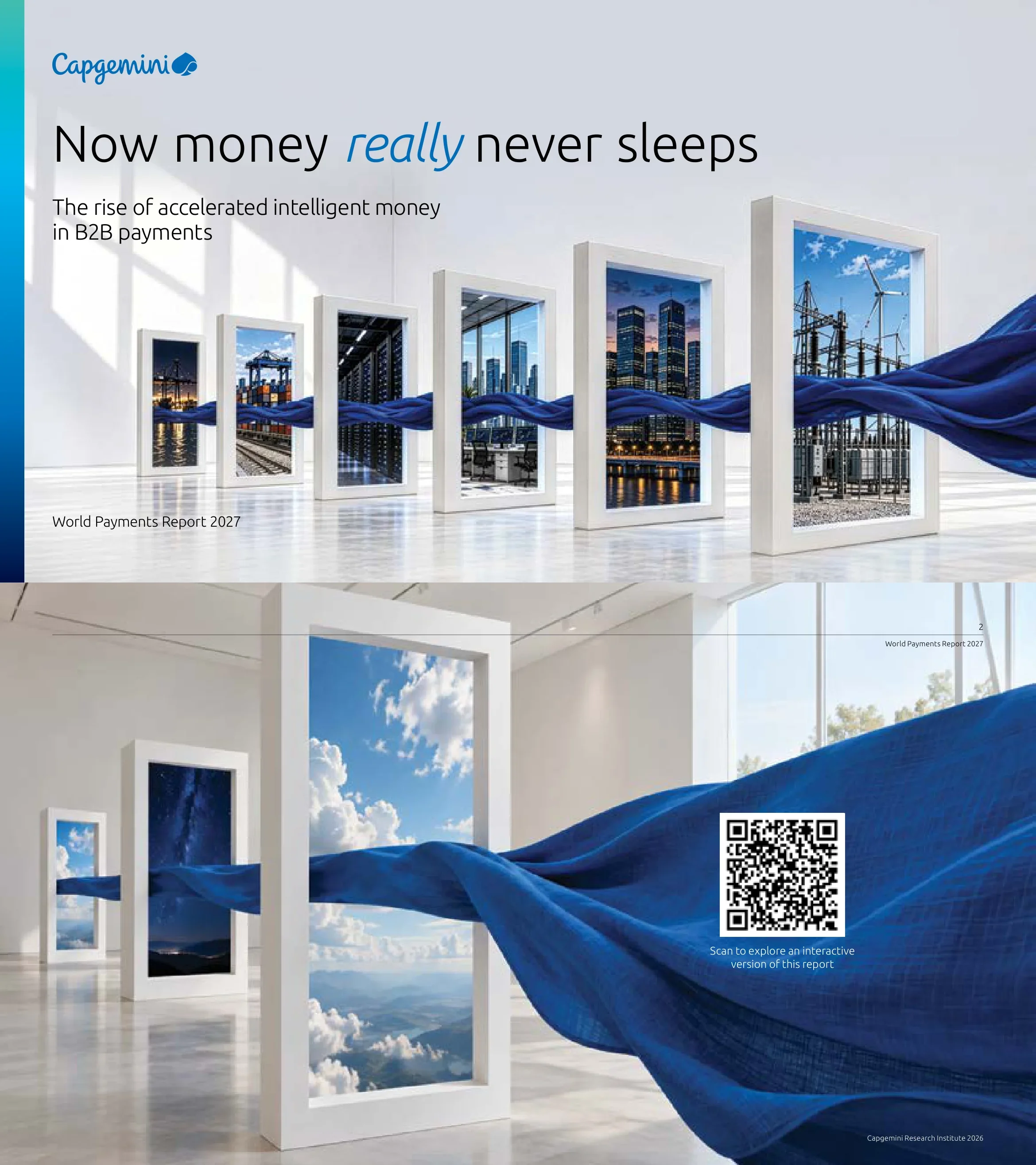
Capgemini World Payments Report 2027 (Capgemini Research Institute for Financial Services, published 2026): 'Now money really never sleeps - The rise of accelerated intelligent money in B2B payments', a 68-page consulting research report on how stablecoins, tokenized deposits and CBDCs are reshaping B2B payments and what role banks should play.
Menggunakan sampul presentasi ini sebagai referensi gaya untuk slide yang dibuat dari konten Anda sendiri. Atau pilih halaman mana pun di bawah untuk memakai tata letaknya sebagai referensi.
Navigasi Cepat
Tag
Bagikan slide
Capgemini World Payments Report 2027 (Capgemini Research Institute for Financial Services, published 2026): 'Now money really never sleeps - The rise of accelerated intelligent money in B2B payments', a 68-page consulting research report on how stablecoins, tokenized deposits and CBDCs are reshaping B2B payments and what role banks should play.
Tampilan detail setiap halaman slide, termasuk tata letak, konten utama dan elemen visual.
Cover of the Capgemini World Payments Report 2027, subtitled 'The rise of accelerated intelligent money in B2B payments'.
Full-bleed photographic cover with large headline top-left and report name bottom-left
Image page with a QR code inviting readers to scan for an interactive version of the report.
Full-bleed photo with QR code overlay on the right
Contents listing Foreword (4), Executive Steering Committee (6), Executive summary (8), Introduction (12), A new form of money (18), A new source of value (30), A new role for banks (44), Conclusion (56), Partner with Capgemini (57), Ask the experts (58), Key contacts (60), Acknowledgments (62) and Methodology (64).
Vertical title band on the left, dark navy grid of page numbers and section names
Introduces accelerated intelligent money (stablecoins, tokenized deposits, CBDCs), notes only 21% of banks are scaling an instrument, and highlights USD 4 trillion held in nostro and vostro accounts for cross-border settlement.
Rotated section label left, two text columns, big-number callout bottom-right
Kartik Ramakrishnan, CEO Financial Services at Capgemini, frames the strategic choice banks face: distribute, differentiate, or build infrastructure.
Text column with headshot and signature block, photo panel on the right
Nine bank executives guiding the report, from J.P. Morgan Payments, Barclays, Deutsche Bank, Standard Chartered, NatWest, BNP Paribas, Societe Generale, Citi and HSBC.
3x3 grid of headshots with names, titles, firms and country flags
Six committee members from Google Cloud, Fiserv, Nyca, Anchorage Digital Bank, Worldline and Network International.
2x3 grid of headshots under a blue header bar
60% of banks prioritized B2B payment innovation but only 32% of corporates are satisfied with their primary bank, and about 60% of corporates would source stablecoin services from non-banks.
Rotated section label, text column, big-stat callout on the right
Only 21% of banks are scaling an instrument; about USD 230 billion (~10% of payments revenue) is under pressure, and leaders are 2.7 times more likely to have identified new revenue streams.
Two-column bulleted text with bold lead-ins
Describes reactive, offensive and transformative postures: no leaders plan to be reactive vs 40% of mainstream banks, 67% of leaders vs 43% choose offensive, and 33% vs 17% choose transformative.
Two-column text with numbered list and capability bullets
Full-page photograph of blue fabric wrapped around white pillars, with no text beyond the running header.
Full-bleed image
Section opener for the introduction chapter.
Full-bleed fabric photo with large white title and gradient bar
Figure 1 shows global non-cash transactions rising from 438.8bn (2015) to 1,964.2bn (2025E), 2,250.5bn (2026F) and 4,002.5bn (2030F), with 15.3% global CAGR 2025-30 and APAC at 2,287.8bn by 2030.
Action title and body text left, stacked bar chart with regional growth/CAGR table right
Lists digital platforms, embedded enterprise technology and infrastructure modernization as drivers, and names APAC (UPI, PayNow, PromptPay) as the fastest-growing region.
Large photo left, bulleted text column right
Figure 2 shows cards falling from 65% (2020) to 50% (2025E) and 44% (2030F) of volume while instant payments plus e-money rise from 13% to 26% to 32%, and accelerated intelligent money reaches 4% by 2030.
Text column left, 100% stacked bar chart with legend right
Big-stat page: 4% of global payments volume via new instruments by 2030, 60% of banks prioritized B2B innovation, and only 32% of corporates are satisfied, with a Barclays quote on modest near-term share.
Quote sidebar left, text center, stacked stat callouts right
An ABN AMRO quote says adoption, not technical feasibility, is the barrier, and the page sets up the report's focus on next-generation B2B payment instruments.
Text column left, large image right
Chapter 1 opener.
Full-bleed photo with large numeral and title over gradient bar
Traces paper, electronic and digital payment eras and defines accelerated intelligent money as merging value transfer, settlement logic and business rules into one execution layer.
Two text columns with a pull-quote sidebar
Figure 3 compares instant payments, tokenized deposits, stablecoins and CBDCs on issuer, backing, ease of access, yield for end users and autonomous execution readiness.
Text left, comparison table with traffic-light dots right
Names the three adoption forces and presents a case study: a European transaction bank built a Hyperledger Fabric DLT payment platform with Capgemini in a 12-sprint agile delivery.
White text column left, teal case-study panel right (challenge/solution/results)
Covers the ~USD 50 billion Terra-Luna collapse, USDT and USDC at ~85% of stablecoin market cap, MiCA, Singapore MAS, the GENIUS Act (July 2025), Hong Kong's Stablecoins Ordinance and UK plans.
Quote sidebar left, two text columns
Notes that a lack of global harmonization complicates single operating models and that regulation creates conditions but not urgency.
Text column left, image right
A typical large corporate operates in 14 markets with 11 banks and 34% cross-border volume; 74% call cross-border payments slow and costly, and the full payment journey takes about 3.5 days.
Quote sidebar left, two text columns, big-stat callout
64% report complex ERP/treasury integration, 57% lack live payment status, 55% face instant-payment value limits, and 46% route corridors through unconnected banks.
Quote sidebar left, bullet text center, photo right
Cites Circle USDC's USD 21.5 trillion Q1 2026 volume (263% QoQ), Mastercard-BVNK, ECB Project Pontes, Swift's ledger with 17 banks, and Kinexys at ~USD 5 billion daily.
Three text columns with bold-labeled examples
Figure 4 ranks adoption priority (tokenized deposits 1, stablecoins 2, wholesale CBDC 3; instant rails continue expanding) and rates each on cost, revenue, risk and demand drivers.
Text left, priority matrix with colored dots right
Explains why stablecoins rank second and wholesale CBDCs third, and argues Tier-1 banks must orchestrate multiple instruments in parallel.
Two quote sidebars flanking a central text column
USD 4 trillion is trapped in nostro/vostro accounts, intraday liquidity averages ~USD 630bn on Fedwire and ~USD 443bn on TARGET2, 13% of cross-border transactions need exception handling, and 36% of B2B volume flows through non-banks.
Three text columns with a big-stat callout
Chapter 2 opener.
Full-bleed photo with large numeral and title over gradient bar
Figure 5 splits banks into 21% leaders actively scaling and 79% mainstream, with three leader priorities: capitalizing on corporate demand, building new revenue engines and scaling for continuous execution.
Text with big stat left, capsule diagram with three arrow labels right
Leaders understand that corporates value settlement certainty, real-time visibility and control, with a quote from the CEO of Qivalis.
Large office photo left, text column right
Figure 6 plots use cases by corporate friction and willingness to pay, highlighting reinsurance multi-party settlement, 24/7 cross-border B2B payments with atomic settlement, and real-time cash visibility as priorities (n=1,110).
Text left, 3x3 priority grid with sector-coded dots right
25% of insurers use non-banks for multi-party reinsurance settlement and 25% of corporates use non-banks for always-on cross-border flows, with examples from Aon, HSBC, BNP Paribas and Siemens.
Quote sidebar left, two text columns
Case study: an APAC bank and Capgemini built a DLT token-based intra-bank settlement proof of concept using ISO 20022, which validated instant and 24/7 settlement.
Teal two-column case study with photo right
42% of corporates use non-banks for real-time cash visibility; 70% of bank executives expect instant payments and intelligent money to converge, and 55% expect digital wallets to become the primary interface.
Quote sidebar left, two text columns with subsection heading
Rails carrying 71% of B2B volume face pressure, and about USD 230 billion (~10% of revenue) is at risk; leaders expect to offset declines in 15 months vs 25 for mainstream banks (1.7x faster).
Quote sidebar left, text with big-number callout center, photo right
Figure 7: leaders vs mainstream adoption of bundled services (66% vs 46%), subscription (54% vs 30%), outcome-based pricing (41% vs 12%), tiered volume pricing (59% vs 67%) and fixed fees (51% vs 60%); leaders are 3.1x more likely to find new revenue streams.
Text left, diverging horizontal bar chart right
71% of corporates prefer banks over fintechs for tokenized payments at equal cost and quality, and compliance must shift from post-transaction detection to pre-transaction prevention.
Big stat left, text center, quote sidebar right
Leaders outpace peers 1.5x in cross-network monitoring and 1.2x in AI surveillance and embedded AML/KYC; a WNS case cut verification times ~15 days, lifted CSAT 1,200 bps, cut cost-to-resolve 30% and ramped 600+ staff.
Numbered list left, teal case-study panel right
Figure 8 compares leaders vs mainstream readiness: digital asset talent 56% vs 17% (3.3x), smart contract governance 52% vs 21% (2.5x), 24/7 process redesign 64% vs 33% (1.9x), and tokenization 56% vs 23% (2.4x).
Text with big stat left, two-panel capability comparison right
Leaders show 3.3x higher readiness in digital-asset talent; quotes from Standard Chartered and Mastercard stress multidisciplinary talent and organizational readiness.
Quote sidebar left, stat and text center, photo right
Full-page photo of people draping blue fabric across a columned atrium, with no body text.
Full-bleed image
Chapter 3 opener.
Full-bleed photo with large numeral and title over gradient bar
Details reactive (e.g. partnering with Circle), offensive (Standard Chartered HK-Singapore tokenized deposits) and transformative (JPMorgan, Citi, Wells Fargo, BofA tokenized deposit network; 21-bank stablecoin consortium) postures and their trade-offs.
Three text columns with numbered list
Big-stat page with a quote from the CEO of Quant urging smaller banks to join consortia, arguing the right posture depends on capabilities and risk appetite.
Stat and text left, large lobby photo right
Figure 9 shows a stack of foundational capabilities, move value, program value and connect value, with reactive, offensive and transformative involvement levels.
Text left, house-shaped framework diagram with involvement dots right
Figure 10 lists must-have capabilities: agile operating model, trust and resilience, interoperable infrastructure, open orchestration, and an always-on AI decisioning engine.
Text left, three-column capability diagram right
Explains organizational and technology foundations and the AI decisioning layer, concluding that foundational capability building is a no-regret investment in a hybrid market.
Quote sidebar left, two text columns
Case study: a global financial messaging provider and Capgemini built a tokenized deposit interoperability prototype (Paladin, then Validium) in six months, with ~30 global banks defining MVP requirements.
Photo left, teal two-column case study right
Defines move-value capabilities (liquidity coordination across corridors) and program-value capabilities (AI-native decisioning and rules), with quotes from Stripe and HSBC.
Two text columns with quote sidebar right
Describes conditional payment execution tied to ERP and treasury systems, and introduces connect-value capabilities for ecosystem-wide coordination.
Aerial photo left, two text columns right
Explains the three connect-value capabilities, cites the CBMT sandbox (Commerzbank, DZ Bank, BNP Paribas, BASF, Siemens and others), and quotes Partior and J.P. Morgan's Kinexys.
Two text columns with quote sidebar right
Case study: Capgemini and Kaleido extended a messaging provider's CBDC connector across Corda, Hyperledger Fabric and Besu, demonstrating atomic settlement, FX and trade finance use cases.
Photo left, teal two-column case study right
Maps postures to future roles: reactive = gateway institution, offensive = orchestrator, transformative = ecosystem owner.
Two text columns with tall atrium photo right
Summarizes that leaders are winning treasury and cross-border mandates, shaping standards and unlocking new revenue, and that standing still is no longer an option.
Dark navy two-column text with photo right
Describes Capgemini offerings in Connected Accelerated Intelligent Money, Connected Payments, and Financial Crime and Compliance.
Solid blue page with three text columns
Profiles six Capgemini payments leaders including Gareth Wilson, Jeroen Holscher, Florian Forst, Ravi Vikram, Michel Vaja and Michael Levens.
2x3 grid of headshots with bios and emails
Profiles Sriram Kannan, Luca Russignan and Vivek Singh of Capgemini and the Capgemini Research Institute for Financial Services.
Three-column headshot and bio row
Regional Capgemini contacts for Global, Americas, Asia, France, Australia, Belgium/Netherlands, Japan and Italy.
Three-column contact directory by region
Contacts for Latin America, Austria/Germany, Spain, Middle East, Nordics, Switzerland and the UK.
Three-column contact directory by region
Thanks participating banks, other financial services firms, technology firms, survey partner INJ Partners, and the Capgemini research, sponsorship, payments network and marketing teams.
Three-column text with bold category labels
Introduces the report team: project manager Bipin Jose, deputy Badhri Narayanan Ravikumar, and analysts Vartika Kansal and Aravindh M A Shanmugam.
Dark navy panel with headshots left, meeting photo right
Describes the 2026 Global Corporate Survey (1,110 corporates with over USD 1bn revenue across insurance, manufacturing and logistics) and the Banking Executive Survey (300 executives, 50+ interviews) across nine markets, May-June 2026.
Three text columns
Full-page aerial photo of three people crossing blue fabric bands, with no body text.
Full-bleed image
Lists 21 sources including the Federal Reserve, WEF, Swift, BIS, Circle, Mastercard, J.P. Morgan, Aon, HSBC, BNY, Standard Chartered and CBMT.
Single numbered list
About Capgemini (410,000+ people in 50+ countries, 2025 revenue of EUR 22.5 billion), the Research Institute's Financial Services World Reports series, and a disclaimer.
Three columns with logos
A QR code and link to the World Payments Report page, the payments@capgemini.com contact and a press contact.
Photo left, contact panel right
Pertanyaan umum tentang slide ini dan konten presentasi yang mendasarinya.
It examines 'accelerated intelligent money' (stablecoins, tokenized deposits and CBDCs) in B2B payments. It is organized in three chapters: a new form of money, a new source of value, and a new role for banks. It also includes an executive summary, four Capgemini case studies, the methodology and endnotes, across 68 landscape pages.
Only 21% of banks are actively scaling at least one intelligent money instrument. 60% of banks prioritized B2B innovation, yet only 32% of corporates are satisfied with their primary bank, and about 60% would source stablecoin services from non-banks. About USD 230 billion (~10% of payments revenue) is exposed to disruption, USD 4 trillion sits in nostro/vostro accounts, and new instruments could carry ~4% of global payments volume by 2030.
It is published by the Capgemini Research Institute for Financial Services, Capgemini's in-house think tank, as part of its annual Financial Services World Reports series. The 2027 edition was released in 2026. It is based on a 1,110-company corporate survey and a 300-executive banking survey run in May-June 2026 across nine markets.
Almost every content page has an action title that states the takeaway. Numbered figures carry clear sources and sample sizes (n=300, n=1,110), and single statistics such as 21%, 3.5 days or USD 230 billion are shown as big-number callouts. It also uses dot-rated comparison matrices, a 2x2-style priority grid and a 'house' capability framework. Chapter dividers and the recurring blue-fabric photography keep the long document visually consistent.
Reactive banks distribute third-party capabilities and act as gateways. Offensive banks invest selectively in corridors and use cases and act as orchestrators. Transformative banks build shared infrastructure and standards and become ecosystem owners. None of the leaders plan to be reactive, compared with 40% of mainstream banks.
Use action titles, one key message per page, big-stat callouts and sourced charts. 2Slides can turn a document, report or outline into a presentation, so you can upload your research notes or a PDF and generate slides in a consulting-report style, then refine the titles and charts.
The original PDF is available from Capgemini at https://www.capgemini.com/wp-content/uploads/2026/04/WPR_2027.pdf. The report's back cover also points to the World Payments Report page in Capgemini's research library.
Original full report published by Capgemini Research Institute in 2026.

Create Your Own Slides
Turn your ideas into professional presentations in seconds with 2slides AI.
Referensikan desain profesional, pilih gaya Anda, dan hasilkan slide dengan rendering teks sempurna. Didukung oleh Nano Banana—mulai buat presentasi Anda sekarang.
Agen AI Anda untuk slide. Hemat waktu, bersinar lebih cepat dengan pembuatan presentasi yang cerdas.


© 2026 2slides. Hak cipta dilindungi.