
Gilead Sciences' Q2 2026 financial results presentation (August 4, 2026) — a 36-slide deck covering total product sales of $7.6 billion with base business up 10% year over year, HIV sales of $5.7 billion up 12%, quarterly HIV PrEP sales exceeding $1 billion for the first time, Livdelzi and Trodelvy launch momentum, a non-GAAP quarter pushed to a $(6.75) loss per share by $11.2 billion of acquired IPR&D from the Arcellx, Tubulis and Ouro Medicines deals against an illustrative $2.27 excluding them, updated FY2026 guidance, and a twelve-page appendix of pipeline charts across viral disease, cell therapy, oncology and inflammatory disease plus an adjusted debt and EBITDA reconciliation.
Navigation rapide
Étiquettes
Partager les diapositives
Gilead Sciences' Q2 2026 financial results presentation (August 4, 2026) — a 36-slide deck covering total product sales of $7.6 billion with base business up 10% year over year, HIV sales of $5.7 billion up 12%, quarterly HIV PrEP sales exceeding $1 billion for the first time, Livdelzi and Trodelvy launch momentum, a non-GAAP quarter pushed to a $(6.75) loss per share by $11.2 billion of acquired IPR&D from the Arcellx, Tubulis and Ouro Medicines deals against an illustrative $2.27 excluding them, updated FY2026 guidance, and a twelve-page appendix of pipeline charts across viral disease, cell therapy, oncology and inflammatory disease plus an adjusted debt and EBITDA reconciliation.
Vue détaillée de chaque page de diapositive, incluant la mise en page, le contenu clé et les éléments visuels.
Cover slide for Gilead's second quarter 2026 financial results, dated August 4, 2026.
White ground with the Gilead logo and 'Creating Possible' tagline at the top left, the title in navy at left-centre above the date, and a staggered grid of rounded capsule shapes in teal and navy filling the right half like brickwork.
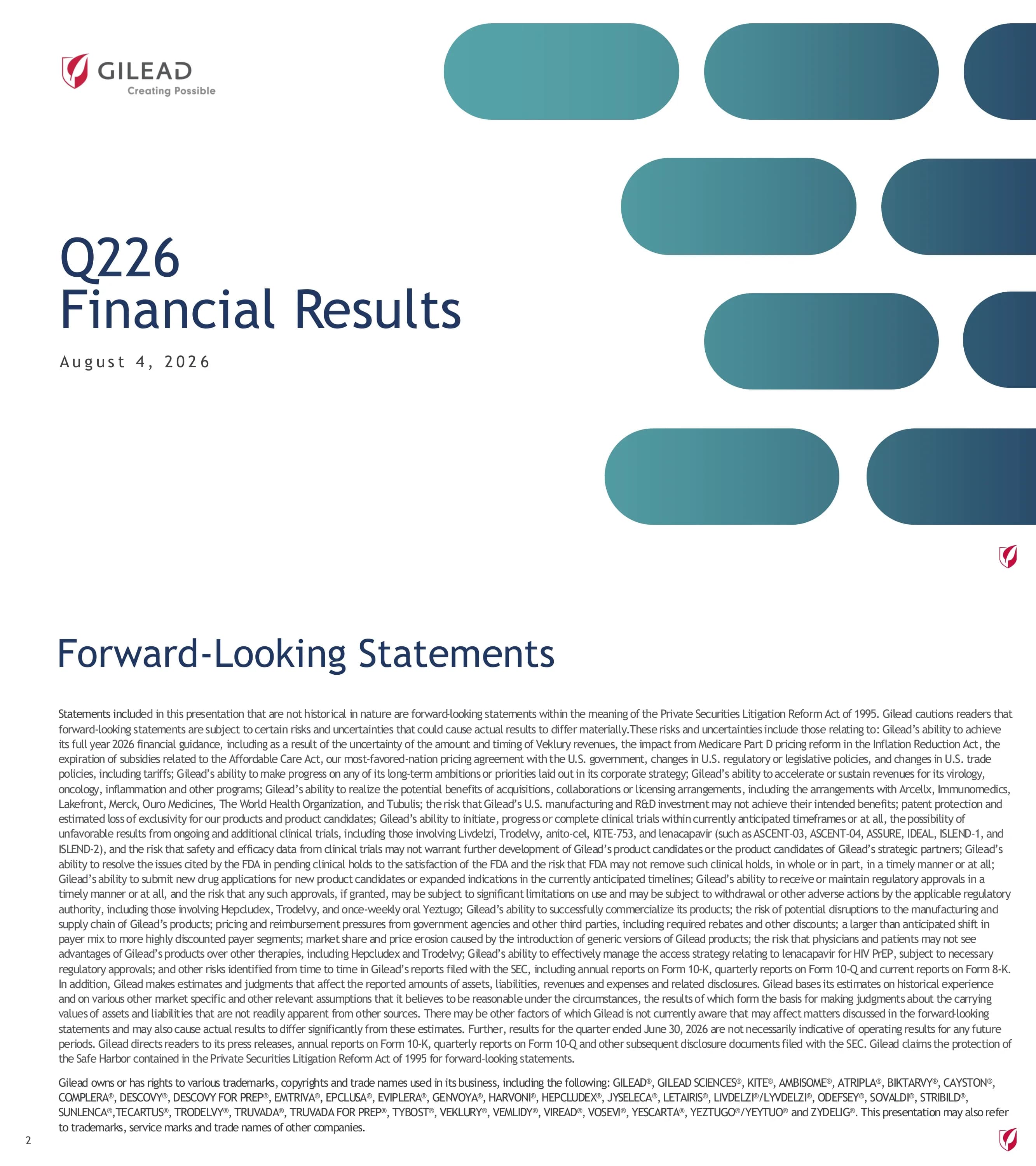
Safe-harbour disclosure covering full-year 2026 financial guidance, the uncertainty of Veklury revenues, Medicare Part D pricing reform, the most-favoured-nation pricing agreement, tariffs, the arrangements with Arcellx, Immunomedics, Lakefront, Merck, Ouro Medicines, the World Health Organization and Tubulis, clinical trial risks for Livdelzi, Trodelvy, anito-cel, KITE-753 and lenacapavir, pending FDA clinical holds, commercialisation and pricing pressures, and generic erosion. A second paragraph lists Gilead's trademarks.
White slide with a large navy heading and two dense justified paragraphs filling the page in small type. No graphics.
Five sections with page ranges: Key Takeaways 4–5, Commercial Results 6–14, Pipeline Updates 15–20, Financial Results 21–27, Appendix 29–36.
Section names in bold navy down the left, each connected by a thin grey leader line to a teal-to-navy gradient capsule holding its page range.
Section divider for the key takeaways, presented by Daniel O'Day, Chairman and Chief Executive Officer.
White slide with the Gilead logo top left, the section title and the presenter's name and title at left-centre, and a portrait photograph masked into a large capsule shape with a teal-to-navy outline filling the right half.
Three numbered blocks. Business Performance: total Q226 base business up 10% year over year, the strongest Q2 growth since 2023, driven by HIV, Trodelvy and Livdelzi; HIV up 12% with PrEP above $1 billion, up 101%; Trodelvy up 26%; liver up 10% with Livdelzi up 115%; FY26 base business expected to grow 6–7% and HIV 9–10%. Clinical Updates: positive Phase 3 ISL/LEN updates at AIDS 2026, a potential first weekly oral treatment for virally suppressed people with HIV launching 2027; a Phase 3 trial of LEN plus teropavimab plus zinlirvimab planned as a potential twice-yearly treatment; encouraging GS-8824 Phase 1 data in platinum-resistant ovarian cancer at ASCO 2026; positive Phase 3 IDEAL topline for Livdelzi in second-line PBC. Commercial Launches: two launches in Q226 with two more expected in 2H26; Trodelvy launched in first-line PD-L1-positive and PD-L1-negative metastatic triple-negative breast cancer in the U.S.; Hepcludex launched for chronic hepatitis delta, the first and only FDA-approved HDV treatment; BIC/LEN launch expected in August and anito-cel in December.
Three rounded outlined panels stacked down the slide, each with a numbered navy circle and a bold two-line label at the left and four bullets at the right. A dense abbreviations footnote runs across the bottom.
Section divider for the commercial section, presented by Johanna Mercier, Chief Commercial and Corporate Affairs Officer.
The divider template repeated with a different portrait and title.
Product sales by franchise: HIV $5.7 billion up 12%, Veklury $23 million down 81%, Trodelvy $457 million up 26%, cell therapy $417 million down 14%, liver disease $877 million up 10%, other $161 million down 20%. Headline figures: total product sales excluding Veklury $7.6 billion, up 10% year over year and 12% sequentially; total product sales $7.6 billion, up 8% and 10%; HIV product sales $5.7 billion up 12% and 13%; liver product sales $877 million up 10% and 14%; oncology product sales $873 million up 3% and 8%.
A large pie chart at the centre-left with a six-item legend down the far left, each entry carrying its dollar figure and growth rate. Five headline figures run down the right in oversized grey numerals with navy captions, split by a dotted rule.
HIV product sales across five quarters, split U.S. / Europe / Rest of World: Q225 $5,088 million ($4,096 / $624 / $368), Q325 $5,277M, Q425 $5,801M ($4,845 / $624 / $332), Q126 $5,030M ($4,004 / $607 / $419) and Q226 $5,693M ($4,659 / $640 / $393). Q226 sales $5.7 billion, up 12% year over year, driven by higher average realised price and higher demand; sequential growth driven by inventory build and price. 2026 HIV growth expectations were increased to 9–10% year over year from 8% previously.
A five-bar stacked chart in three blues at the left with every band labelled and totals above; two oversized figures and three bullets at the right.
Biktarvy: Q226 sales $3.8 billion, up 7% year over year and 12% sequentially; the number one regimen for naïve patients and switches across most major markets; more than 52% U.S. treatment market share and still increasing. BIC/LEN daily oral: PDUFA date August 27, 2026; 5–6% of people with HIV are on complex regimens and up to 20% switch HIV therapies annually; combines bictegravir, the most prescribed integrase inhibitor, with lenacapavir, described as a breakthrough capsid inhibitor; potential U.S. launch in virally suppressed people with HIV.
Two large rounded panels side by side, each with a product lock-up in a white capsule overlapping the top edge, a headline sales or regulatory line, and two white metric cards at the left facing bullets at the right.
PrEP sales up 101% year over year against roughly 14% U.S. PrEP market growth. Yeztugo (lenacapavir injection): Q226 sales $232 million, up 40% sequentially; leader in switch across all PrEP options, oral and long-acting injectable, and now leading long-acting injectable in the naïve segment. Descovy for PrEP: Q226 sales $801 million, up 60% year over year and 23% sequentially, driven by higher average realised price and demand. A footnote states Descovy for PrEP sales are internal estimates and that Truvada for PrEP is excluded.
Two oversized percentages at the top joined by a circled plus sign, then two grey panels side by side, each with a product logo in an overlapping white capsule, a sales headline in the product's brand colour, and two bullets.
Liver product sales across five quarters split PBC / HCV / HBV / HDV: Q225 $795 million ($78 / $400 / $270 / $47), Q325 $819M ($105 / $366 / $299 / $49), Q425 $844M ($150 / $342 / $305 / $48), Q126 $767M ($133 / $323 / $256 / $55) and Q226 $877M ($167 / $354 / $306 / $50). Livdelzi Q226 sales $167 million with more than 50% second-line PBC U.S. market share, up 115% year over year and 26% sequentially. Total liver up 10% year over year on higher demand across PBC, HBV and HDV offset by lower HCV starts, and up 14% sequentially on demand and inventory build partly offset by lower average realised price.
Four-band stacked bars at the left with every value labelled, the Livdelzi product logo at the upper right above two oversized figures, then three bullets split by a hairline rule.
Trodelvy product sales across five quarters split U.S. / Europe / Rest of World: Q225 $364 million ($224 / $96 / $44), Q325 $357M, Q425 $384M ($251 / $88 / $45), Q126 $402M ($253 / $95 / $54) and Q226 $457M ($307 / $92 / $57). Up 26% year over year and 13% sequentially, primarily on increased demand across metastatic breast cancer indications in all regions; number one second-line metastatic triple-negative breast cancer share in the U.S. and EU; approved in first-line mTNBC across PD-L1 status in the U.S. in June 2026.
The HIV chart layout reused — three-region stacked bars at the left, product logo and two oversized figures at the right above two bullets.
Cell therapy product sales across five quarters split Yescarta / Tecartus: Q225 $485 million ($393 / $92), Q325 $432M ($349 / $83), Q425 $458M ($368 / $90), Q126 $407M ($332 / $75) and Q226 $417M ($346 / $70). Down 14% year over year reflecting continued competitive headwinds across regions and up 2% sequentially on increased U.S. and Rest of World demand for Yescarta partly offset by Tecartus. More than 36,000 patients treated to date and more than 600 authorised treatment centres globally. Anito-cel PDUFA December 23, 2026, with launch preparations well under way.
Two-band stacked bars at the left, two product lock-ups across the top right, one oversized sales figure, two further oversized metrics side by side, and two bullets.
A launch timeline in six columns: Approved — Livdelzi for second-line PBC and Yeztugo for twice-yearly injectable HIV PrEP; Newly Approved — Hepcludex for HDV and Trodelvy for first-line PD-L1-positive and PD-L1-negative mTNBC; August 2026 — BIC/LEN, daily oral for virally suppressed people with HIV; December 2026 — anito-cel for fourth-line-plus relapsed/refractory multiple myeloma; February 2027 — Yeztugo weekly oral HIV PrEP; 2027 — ISL/LEN weekly oral for virally suppressed people with HIV.
Six coloured header capsules across the top — green for approved, blue for near-term, grey for later — with product cards hanging beneath on short stems, and a horizontal arrow band across the bottom carrying green ticks and open circles to mark status.
Section divider for the pipeline section, presented by Dietmar Berger, MD, PhD, Chief Medical Officer.
The divider template repeated a third time.
A dosing-frequency timeline across 2026, 2027 and 2028-plus. Treatment: daily oral bictegravir plus lenacapavir, U.S. launch August 2026 and EC decision 2027; weekly oral islatravir plus lenacapavir, primary endpoints met June 2026 and launch 2027; weekly oral lenacapavir plus GS-3242 and lenacapavir plus GS-1720, Phase 2 first patient in 2H 2026 and early 2027 with launch 2030; monthly oral GS-3107 plus INSTI, Phase 1 update 2H 2026 with launch 2031–2033; twice-yearly injectable lenacapavir plus teropavimab plus zinlirvimab, Phase 3 FPI 2H 2026 with launch 2030; twice-yearly injectable lenacapavir plus GS-3242, Phase 2 FPI June 2026 with launch 2031–2033. PrEP: weekly oral lenacapavir, U.S. launch February 2027; once-yearly injectable lenacapavir, Phase 3 PURPOSE 365 update 2027 with launch 2028.
A banded table with dosing frequency labels down the left, coloured regimen capsules in the second column and milestone capsules positioned along a 2026–2028+ timeline. Gold star markers flag new disclosures.
Hepcludex — the first and only FDA and EC approved treatment for chronic HDV infection, with EC conditional approval in July 2020, full EU marketing authorisation in July 2023 and FDA accelerated approval in May 2026. Livdelzi (seladelpar) — the leading FDA and EC approved treatment for second-line PBC in inadequate responders to UDCA, with accelerated approvals supported by the Phase 3 RESPONSE trial in patients with ALP above 1.67x ULN, and positive Phase 3 IDEAL results announced in patients with ALP 1–1.67x ULN with detailed data to come at a future medical congress.
Two horizontal bands separated by a hairline rule, each with a product logo at the left and a green headline over two bullets at the right.
Trodelvy — FDA approval in first-line mTNBC achieved; Phase 3 ASCENT-GYN update expected 2H 2026. Its programmes span 2L-plus mTNBC and 1L mTNBC (approved), high-risk early TNBC, pre-treated HR+/HER2- mBC, 2L-plus advanced or recurrent endometrial cancer and 2L extensive-stage small cell lung cancer. GS-8824, previously TUB-040 — Phase 1/2 NAPISTAR-1-01 ASCO update in 2L-plus platinum-resistant ovarian cancer completed, Phase 1 NAPISTAR-1-02 initiated in 2L–3L platinum-susceptible ovarian cancer, registrational trial initiation expected in 2027, and a note that it remains under evaluation for lung cancer.
Two stacked sections, each with a product name and status markers at the left and horizontal arrow bars at the right positioned under Phase 1 / Phase 2 / Phase 3 / Approved column headers — green for Trodelvy, blue for GS-8824.
Upcoming anito-cel launch — a roughly $3.5 billion CAR T addressable market in fourth-line-plus relapsed/refractory multiple myeloma; best-in-disease potential from observed deep and durable efficacy, a differentiated safety profile and rapid reliable manufacturing; a 4L R/R multiple myeloma FDA decision expected by 23 December 2026; enrollment completed in Phase 3 iMMagine-3 with filing in 2–4L R/R MM as early as 2027. In vivo platform in development — Arcellx's small D-Domain binder bypasses payload challenges to target multiple antigens; a plug-and-play modular Interius platform optimises CARs and vector targets by disease; a Pregene collaboration enables speed to clinic with initial investigator-sponsored studies exploring the platform in 2H26; designed for scalability and broad expansion across oncology and autoimmune diseases.
Two grey panels side by side, each headed by a coloured rounded banner — dark navy at the left, mid blue at the right — with bold sub-headings and bullets beneath.
1H26: ISL/LEN ISLEND-1 and ISLEND-2 Phase 3 updates in weekly oral HIV treatment, both completed; Hepcludex MYR301 FDA decision in HDV, completed. 2H26: BIC/LEN ARTISTRY-1 and -2 FDA decision in daily oral HIV treatment, on track; Trodelvy ASCENT-03 and ASCENT-04 FDA decisions in first-line mTNBC, both completed; ASCENT-GYN Phase 3 update in 2L-plus advanced endometrial cancer, on track; EVOKE-03 Phase 3 update in first-line mNSCLC, marked completed with a footnote that the study did not meet its primary endpoint and was discontinued, with data to be shared at a scientific conference; anito-cel iMMagine-1 FDA decision in 4L-plus R/R multiple myeloma, on track; Livdelzi IDEAL Phase 3 update in second-line PBC, completed.
Two tables, one per half-year, each with Program, Trial, Indication, Update and Status columns, a legend at the top right distinguishing completed, completed-with-footnote and on-track markers.
Section divider for the financial section, presented by Andrew Dickinson, Chief Financial Officer.
The divider template repeated a fourth time.
Total product sales of $7,054 million in Q225 — $6,934 million base business plus $121 million Veklury — rising to $7,627 million in Q226, comprising $7,604 million base business and $23 million Veklury. Base business sales up 10% year over year and 12% sequentially, the year-over-year growth driven by HIV products, Trodelvy and Livdelzi partly offset by lower cell therapy and HCV; total product sales up 8% and 10%, reflecting lower Veklury sales on fewer COVID-19 related hospitalisations. Veklury fell 81%.
Two tall navy bars at the left with the Veklury sliver shown as a small pale block at the base, growth labels floating between them, and two bold headlines with bullets at the right.
Q225 versus Q226: COGS $922 million versus $999 million, up 8%; product gross margin 87% in both, flat; R&D $1,450 million versus $1,429 million, down 1%; acquired IPR&D $61 million versus $11,183 million, not meaningful; SG&A $1,358 million versus $1,521 million, up 12%; non-GAAP operating expenses $2,869 million versus $14,133 million; non-GAAP operating income $3,290 million versus $(7,329) million; operating margin 46% versus (94)%; effective tax rate 19% versus (11)%; non-GAAP net income $2,521 million versus $(8,391) million; non-GAAP diluted EPS $2.01 versus $(6.75); diluted shares 1,255 million versus 1,243 million. Commentary attributes flat R&D to lower oncology clinical study activity offset by newly acquired entities, the acquired IPR&D to investments in Arcellx, Tubulis and Ouro Medicines net of the Lakefront collaboration, and the 12% SG&A rise to promotional activity for Yeztugo.
A three-column table at the left with subtotal and total rows reversed out in two shades of blue, and two commentary headings with bullets at the right, separated by a dotted vertical rule.
A bridge from Q225 non-GAAP diluted EPS of $2.01 to a Q226 illustrative non-GAAP EPS of $2.27, up 13% year over year, then the roughly $9.02 per-share impact of Q2 acquisitions and other revenues bringing the reported Q226 non-GAAP diluted EPS to $(6.75). Commentary notes the illustrative figure excludes acquired IPR&D and financing costs relating to Arcellx, Tubulis and Ouro Medicines net of the Lakefront collaboration, plus non-recurring non-cash other revenues, and that the year-over-year growth was driven by higher product sales partly offset by higher SG&A and tax.
A four-element waterfall — two navy bars above the axis, a grey bar for the acquisition effect broken by a jagged axis-break symbol, and a navy bar below the axis for the reported figure — with two bullets at the right.
Three guidance dates side by side — 10 February 2026, 7 May 2026 and 4 August 2026. Total product sales $29.6–30.0B, $30.0–30.4B and $30.1–30.4B; product sales excluding Veklury $29.0–29.4B, $29.4–29.8B and $29.8–30.1B; Veklury sales approximately $600M, no change and approximately $300M. Non-GAAP: product gross margin approximately 87.0% with no change since; R&D expense low-single-digit then mid-single-digit growth then no change; acquired IPR&D approximately $0.3B, $11.8B and $11.5B; SG&A mid-single-digit growth then no change; operating income $13.8–14.3B, $2.4–2.9B and $2.9–3.3B; effective tax rate approximately 20%, 190–140% and 140–115%; diluted EPS $8.45–8.85, $(1.05)–$(0.65) and $(0.65)–$(0.30); GAAP diluted EPS $6.75–7.15, $(3.25)–$(2.85) and $(3.75)–$(3.40). Commentary: base business guidance raised by $350 million at midpoint versus May and $750 million versus February; HIV expected to grow 9–10% including roughly $1 billion of FY26 Yeztugo sales; cell therapy expected to decline mid-teens percent; acquired IPR&D lowered by roughly $300 million on a revised accounting treatment of potential future Tubulis milestones; non-GAAP diluted EPS guidance raised by roughly $0.38 at midpoint.
A three-column table with dated navy headers, a reversed-out 'Non-GAAP' band splitting the GAAP and non-GAAP halves, and alternating row shading; two commentary headings with bullets at the right.
A bridge from May guidance of $(1.05)–$(0.65), adding back roughly $9.50 of Q2 acquisition effect to reach illustrative May guidance of $8.45–8.85; then higher base business sales of roughly $0.20–0.25 and lower Veklury sales of roughly $(0.20) give illustrative August guidance of $8.50–8.85; removing roughly $9.15 of Q2 acquisitions and other revenues gives August guidance of $(0.65)–$(0.30). Commentary notes the bottom end was raised $0.05 on higher base business sales, partly offset by lower Veklury, compared with illustrative May guidance.
A six-element waterfall across the slide with navy bars for guidance points, grey bars for the acquisition effects and small tinted boxes for the two small adjustments, all with axis-break symbols, and one bullet at the right.
Approximately $1 billion of dividends paid in Q226 and $355 million of shares repurchased — 2.7 million shares at an average price of $131.83. Capital allocation priorities: continue to invest in the business and R&D pipeline while managing expenses; continue ordinary course partnerships and business development transactions; grow the dividend; and repurchase shares to offset dilution and opportunistically reduce share count.
Two oversized figures with captions down the left third, separated from the right by a dotted vertical rule; four priorities at the right, each introduced by a small gradient arrow glyph.
Question and answer slide listing five executives: Daniel O'Day, Chairman and Chief Executive Officer; Johanna Mercier, Chief Commercial and Corporate Affairs Officer; Dietmar Berger, MD, PhD, Chief Medical Officer; Andrew Dickinson, Chief Financial Officer; and Cindy Perettie, EVP and Head of Kite.
'Q&A' set large at the left, with five circular portraits arranged three above and two below at the right, each captioned with a name in bold and a title beneath.
53 clinical programs and 4 clinical opt-in assets, laid out across Phase 1, Phase 2 and Phase 3/Filed/Approved for three therapeutic areas. Oncology named assets include SG in 1L mTNBC PD-L1-negative and PD-L1-positive, SG plus pembrolizumab in adjuvant TNBC, SG in 2L mEC and SCLC, anito-cel in 4L R/R MM and 2–4L R/R MM, axi-cel in 1L HR LBCL and 2L-plus HR FL, and KITE-753 in 2L DLBCL. Viral disease includes Hepcludex for HDV, BIC/LEN combo for HIV oral, ISL/LEN combo for HIV long-acting oral, and LEN for HIV PrEP long-acting injectable and long-acting oral. Inflammatory disease programs are shown unnamed in Phase 1 and 2.
A grid of coloured blocks — navy for oncology, green for viral disease, crimson for inflammatory disease — arranged under a dark phase header bar, with named assets only in the later phases. A legend marks Kite programs and optionable partner programs.
HIV prevention: Yeztugo (lenacapavir) for HIV PrEP long-acting oral, sNDA submitted; lenacapavir PURPOSE 365 for HIV PrEP long-acting injectable in Phase 3. HIV treatment: bictegravir/lenacapavir oral combination ARTISTRY-1 and -2, NDA submitted; islatravir/lenacapavir ISLEND-1 and -2 in Phase 3; HIV INSTI/capsid inhibitor GS-1720/GS-4182 WONDERS-1 with a clinical hold, updated to note the GS-1720 hold was lifted; HIV capsid inhibitor GS-3107 in Phase 1; HIV INSTI GS-3242 plus lenacapavir, new listing with Phase 2 planned 2H26; lenacapavir plus teropavimab plus zinlirvimab with breakthrough therapy designation; HIV INSTI GS-3242 plus lenacapavir long-acting injectable, new listing with Phase 2 FPI; HIV INSTI GS-1219, development paused. HIV cure: teropavimab plus zinlirvimab, vesatolimod and an HIV bispecific T-cell engager GS-8588.
A table with Clinical Program, Indication, phase columns and a Q2'26 Updates column, with green arrow bars sized to phase, grey section bands, and a four-symbol legend at the top right for new listings, updates, breakthrough and PRIME designations.
HDV: Hepcludex MYR301, BLA and MAA approved with FDA approval granted in the quarter, carrying update, PRIME and breakthrough markers; HDV pre-S1 nAb GS-4321 in Phase 1. HBV cure: HBV therapeutic vaccine GS-2829 plus GS-6779 in Phase 1. HSV: HSV HPI GS-1179 in Phase 1. Infectious disease: CoV Mpro inhibitor GS-1701 for neglected and emerging viruses and pandemic preparation. Opt-ins: Assembly Biosciences, one clinical stage program in HDV.
The same pipeline table format, shorter, with most of the lower half of the slide left empty.
Lymphoma: axicabtagene ciloleucel ZUMA-22 in 2L-plus high-risk follicular lymphoma and ZUMA-23 in 1L high-risk LBCL; CD19/CD20 bicistronic KITE-753 PALISADES-2 in 2L DLBCL, a new listing with RMAT designation and Phase 3 first patient in; PALISADES-1 in 3L-plus R/R DLBCL with RMAT designation; brexucabtagene autoleucel ZUMA-4 in pediatric ALL/NHL. Multiple myeloma: anitocabtagene autoleucel iMMagine-1 in 4L-plus R/R MM, BLA filed, and iMMagine-3 in 2–4L R/R MM. Autoimmune diseases: CD19/CD20 bicistronic KITE-363 in rheumatology and neurology, and anitocabtagene autoleucel in generalised myasthenia gravis.
The same pipeline table in blue for lymphoma and myeloma and pink for autoimmune, with a five-symbol legend that adds RMAT designation.
Breast: sacituzumab govitecan-hziy ASCENT-03 in 1L mTNBC PD-L1-negative, sBLA and MAA approved with FDA approval granted; ASCENT-04 with pembrolizumab in 1L mTNBC PD-L1-positive, sBLA approved and MAA submitted with FDA approval granted; ASCENT-05 with pembrolizumab in high-risk adjuvant TNBC in Phase 3. Lung and thoracic: sacituzumab govitecan-hziy EVOKE-SCLC-04 in 2L extensive-stage small cell lung cancer with breakthrough therapy designation. Gastric intestinal: denikitug in metastatic colorectal cancer, a new listing with Phase 2 first patient in. Gynecology: sacituzumab govitecan-hziy ASCENT-GYN-01 in 2L-plus metastatic endometrial cancer; NaPi2b ADC GS-8824 NAPISTAR-1-01 in 2L-plus platinum-resistant ovarian cancer and NAPISTAR-1-02 in 2L-plus platinum-susceptible ovarian cancer, both new listings acquired from Tubulis. A note lists removed programs including EVOKE-03 and TROPHY U-01.
The same pipeline table in slate blue, with four indication sections and an unusually long footnote listing removed programs and abbreviations.
Advanced cancers: efarindodekin alfa, updated from Phase 1 to Phase 2; 5T4 ADC GS-8823, a new listing acquired from Tubulis; anti-IL-18BP GS-0321; denikitug; GS-2121; GS-2426, a new listing with Phase 1 first patient in; GS-5319; and PARP1 inhibitor GS-0201. Opt-ins: Arcus with two clinical stage programs and MacroGenics with one, both in advanced cancers.
The same table with all eight programs sharing a single indication, so the Indication column repeats identically down the page — the flattest of the pipeline pages.
Lupus: edecesertib COSMIC in Phase 2. Inflammatory bowel disease: tilpisertib fosmecarbil PALEKONA and emvistegrast SWIFT in Phase 2, FXR agonist GS-8670 in Phase 1. Inflammatory diseases: gamgertamig, a new listing acquired from Ouro Medicines, in Phase 2; CD200R agonist GS-5305, IRAK4 degrader GS-6791 and PD1 agonist GS-0151 in Phase 1. Metabolic disease: GLP-1R agonist GS-4571 in Phase 1.
The same pipeline table in crimson with four indication sections, most bars stopping in Phase 1 or 2.
As of five dates from June 30, 2025 to June 30, 2026: total debt net $24.95B, $24.94B, $24.94B, $22.17B and $26.25B; debt discounts, premiums and issuance costs $0.18B, $0.18B, $0.17B, $0.17B and $0.18B; liability related to sale of future royalties $(1.13)B, $(1.12)B, $(1.11)B, $(1.09)B and $(1.08)B; total adjusted debt $24.00B, $24.00B, $24.00B, $21.25B and $25.35B. Twelve months ended the same dates: net income attributable to Gilead $6.31B, $8.11B, $8.51B, $9.22B and $(3.24)B; adding interest expense and other income/expense, tax, depreciation, amortisation, initial costs of externally developed IPR&D projects — which jump to $11.72B in the latest period — and impairments gives adjusted EBITDA of $13.08B, $13.88B, $14.18B, $14.37B and $14.14B; the adjusted debt to adjusted EBITDA ratio runs approximately 1.83x, 1.73x, 1.69x, 1.48x and 1.79x.
Two stacked tables across five dated columns, the most recent column shaded, with the ratio row reversed out in navy at the foot and four numbered footnotes beneath.
Questions courantes sur cette diapositive et le contenu de présentation sous-jacent.
The full 36-slide Gilead Q2 2026 financial results deck as both PDF and editable PowerPoint, plus a page-by-page preview. The PPTX keeps charts and pipeline tables as editable objects so the structures can be reused.
Yes. The PDF is the file Gilead published on its investor relations site alongside the Q2 2026 results on August 4, 2026. The PowerPoint was converted from that PDF for editing convenience — check any layout you plan to reuse, since conversion is not always pixel-perfect.
Acquired in-process R&D. Gilead booked $11,183 million of acquired IPR&D in the quarter from its investments in Arcellx, Tubulis and Ouro Medicines, net of the Lakefront collaboration, against $61 million a year earlier. That turned non-GAAP operating income from $3,290 million to $(7,329) million and diluted EPS from $2.01 to $(6.75). Slide 24 bridges to an illustrative $2.27 excluding it — up 13% year over year.
Base business sales — total product sales excluding Veklury — grew 10% year over year to $7.6 billion, the strongest Q2 growth since 2023. HIV was $5.7 billion, up 12%, with quarterly PrEP sales above $1 billion for the first time and up 101%. Trodelvy grew 26% and Livdelzi 115%. Cell therapy fell 14% and Veklury fell 81%.
Slide 25 shows February, May and August guidance side by side. Base business sales guidance was raised $350 million at midpoint versus May and $750 million versus February; acquired IPR&D was lowered by roughly $300 million on a revised accounting treatment of potential Tubulis milestones; and non-GAAP diluted EPS guidance was raised roughly $0.38 at midpoint to $(0.65)–$(0.30), with GAAP diluted EPS at $(3.75)–$(3.40).
53 clinical programs and 4 opt-in assets. Near-term: BIC/LEN with a PDUFA of August 27, 2026; anito-cel with a PDUFA of December 23, 2026; Yeztugo weekly oral PrEP targeted for February 2027; ISL/LEN weekly oral treatment in 2027. Six appendix pages give the full pipeline by therapeutic area with phase, designation and quarterly update for each program.
It is the strongest pharmaceutical template here. Three things are worth copying: each section opens with a portrait of the executive presenting it; every product franchise uses the same five-quarter stacked bar so they can be compared directly; and the pipeline pages share one legend and one column structure across six pages covering four therapeutic areas.
A rounded capsule is the deck's single motif — it holds the cover pattern, the contents page numbers, the executive portraits, the product logos and the pipeline phase bars. Navy and teal do almost all the work, with each therapeutic area assigned its own colour in the appendix so a reader flipping through the pipeline always knows which area they are in.
Original PDF published by Gilead alongside the Q2 2026 results on August 4, 2026.

Create Your Own Slides
Turn your ideas into professional presentations in seconds with 2slides AI.
Référencez des conceptions professionnelles, choisissez votre style et générez des diapositives avec un rendu de texte parfait. Alimenté par Nano Banana—commencez à créer votre présentation maintenant.
Your AI Agent for slides. Save time, shine faster with intelligent presentation creation.




© 2026 2slides. All rights reserved.